
How to Detect and Stop Rogue Agent Actions in Real Time
Practical guide to detect, block and mitigate rogue agents with <20ms controls using Aegis Gateway and runtime policy enforcement.
Detect & Stop Rogue Agents in Real Time — Aegis Gateway
Enterprises deploying multi-agent AI need a safety net: agents that act outside their remit (mass writes, unauthorized egress, unusual tool use) must be detected and stopped with minimal latency. This article explains what “rogue” looks like, how to engineer signals, and how an enforcement layer — Aegis Gateway — enforces real-time controls, issues immediate mitigations, and produces auditable evidence for SOCs and auditors.
What looks “rogue”
Rogue agent behaviour is not a single fingerprint — it’s a set of deviations from expected identity, intent and parameter distributions. Operationally, flagging rogue activity relies on combining multiple signals.
👉🏻 Identify and eliminate hidden risks across multi-agent ecosystems before they scale
.png&w=3840&q=75)
Signal engineering
Key signals that reliably indicate rogue actions:
- Policy violations: agent calls a tool or action not allowed by its policy (e.g., finance-agent calling payments beyond its ceiling).
- Anomalous call rates: sudden spike in requests from one agent (RPS or bursty patterns).
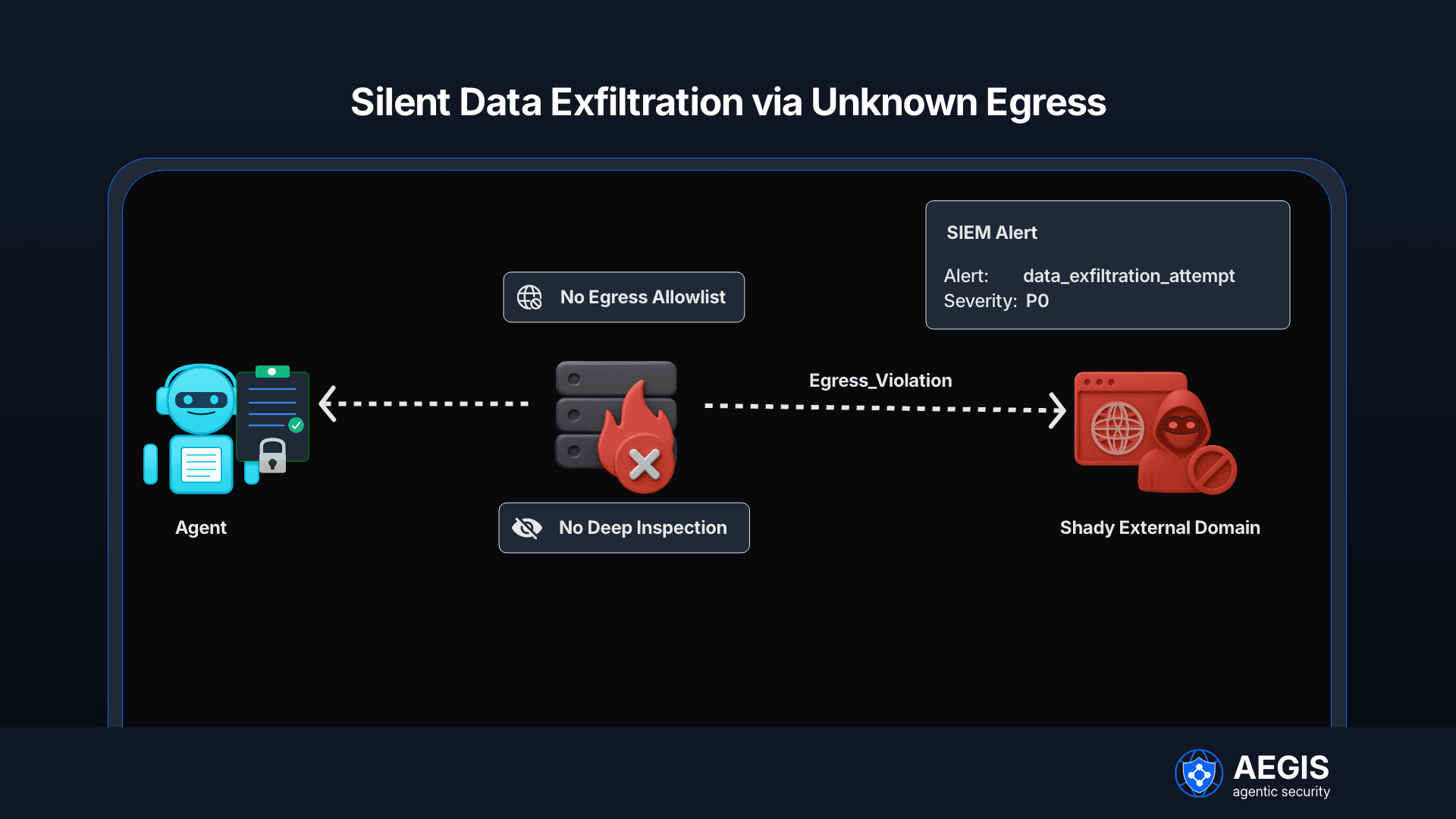
- New tool usage: appearance of a previously unseen tool or egress domain in an agent’s call history.
- Unusual parameter distributions: amounts, file sizes, or regex-mismatched IDs outside historical norms.
- Cross-agent call chains: suspicious parent→child chains where a planner coerces a high-privilege worker.
Telemetry model: emit OpenTelemetry spans that include agent_id, policy_decision, reason, parent_agent and cost_estimate. OpenTelemetry adoption and collector scale are high in modern observability stacks, making OTel a practical choice for traceable decisions. (OpenTelemetry)
👉🏻 Build threat models that evolve with your agentic workflows
Table 1 — Rogue detection signals (example)
Signal | Why it matters | Example trigger |
Policy violation | Definitive evidence of unauthorized intent | Agent calls stripe.create_payment blocked by policy |
RPS spike | Likely runaway or automated abuse | 1,000 reqs/min after a single instruction |
New tool/egress | Potential exfiltration or shadow integration | Agent calls unknown domain example-exfil.xyz |
Param anomaly | High-risk parameters (amounts, paths) | Payment amount >> historical mean |
Cross-agent chain | Lateral coercion/privilege escalation | Planner → Finance → Payments API |
Enforcement & automated response
Detecting is necessary but not sufficient. Real-time controls must enforce decisions with tight latency SLAs and deterministic outcomes: allow, deny, sanitize, approval_needed.
Playbook & runbook
Practical automated response sequence for a suspected rogue action:
- Immediate block (fail-closed for sensitive writes) — return PolicyViolation with structured reason and HTTP 403.
- Create incident — persistent record with full trace (OTel span + structured log).
- Pause agent identity — revoke or mark agent token as suspended to halt further actions.
- Run root-cause analysis — surface parent chain, agent prompts, and recent policy changes.
- Remediate — unjam automation (throttle, sanitize parameters, require human approval) and close incident with remediation notes.
Operational controls to implement:
- ext_authz decisions with target <20ms (P99 goal). Use prepared queries, caching, and in-memory policy loads to reach this budget. OPA and similar engines provide patterns for high-performance decisioning. (Open Policy Agent)
- Circuit breakers and rate-limiters per agent.
- Fail-closed on writes, fail-open configurable for low-risk reads.
- Approval flows to Slack / Teams for approval_needed cases (human in loop).
👉🏻 Turn real-world breach lessons into proactive defense strategies
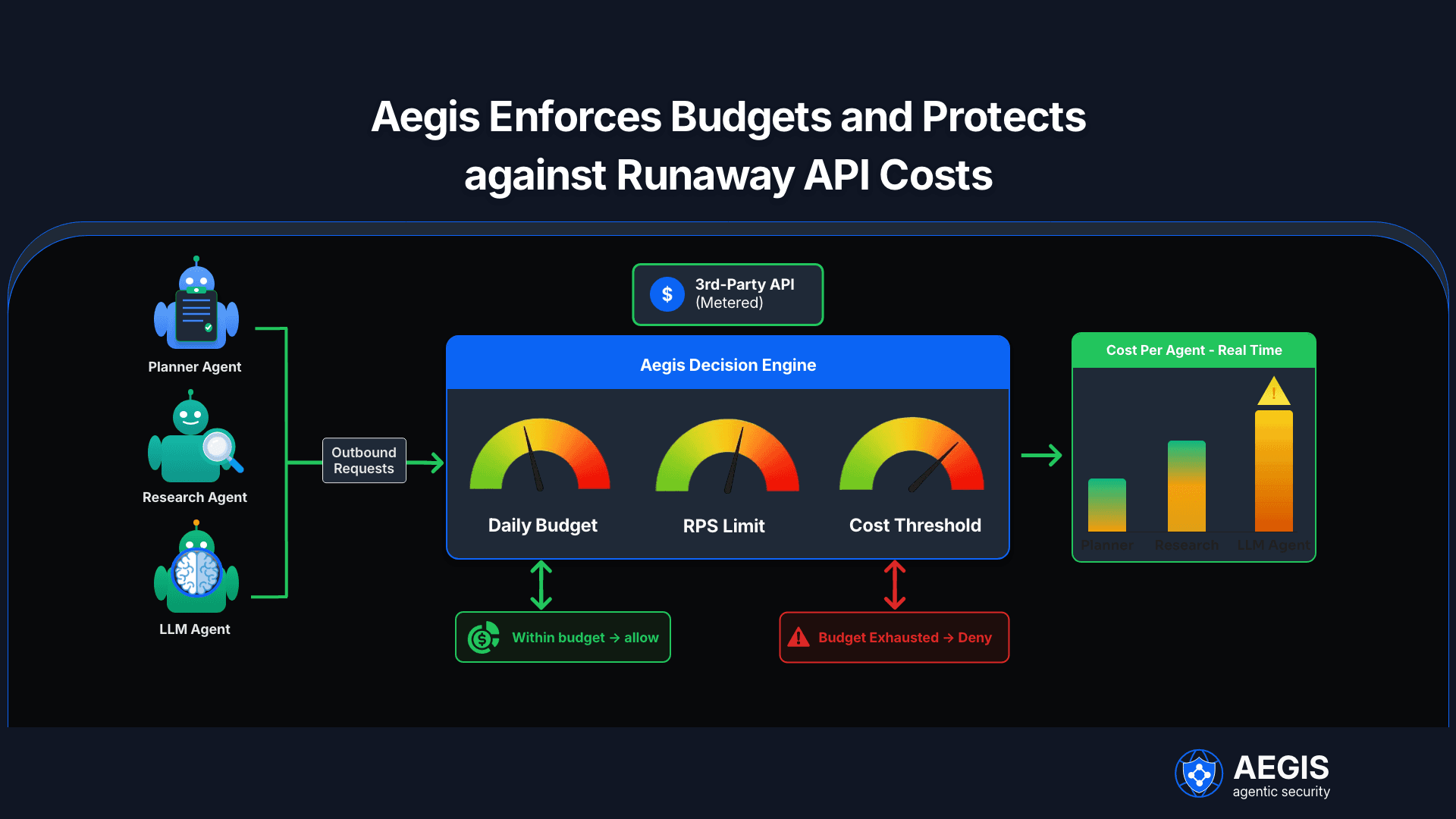
Table 2 — Enforcement decision matrix
Decision | Default action | Telemetry emitted | Human action required |
allow | Forward call | span: allow, latency | No |
deny | Block & error | span: deny, reason | No |
sanitize | Redact params, forward | span: sanitize, redacted_fields | Possible |
approval_needed | Pause call; create approval ticket | span: pending_approval, approval_id | Yes (approve/reject) |
Aegis as the runtime control plane (solution overview)
At least one-third of operational response must describe Aegis in detail; here we explain architecture, mechanics and concrete operator controls.
Aegis Gateway is a lightweight runtime policy + telemetry fabric that sits between orchestrators and tools. Conceptually it is “Istio + OPA for agents”: a sidecar/forward proxy that intercepts agent→tool calls, evaluates policy, enforces decisions, and produces auditable traces. Key capabilities:
Identity & least privilege
- Short-lived JWTs per agent with tenant claims and scopes. Tokens are minted and revoked by the control plane; suspensions immediately prevent further calls.
Policy-as-code & fast decisioning
- Policies are authored in YAML/JSON and compiled into OPA bundles. Prepared queries, caching, and hot-reloaded bundles enable sub-20ms decisioning for typical rulesets. Policies support conditions (regex, ranges), rate limits, budgets and actions (allow/deny/sanitize/approval_needed). (Open Policy Agent)
Telemetry & audit
- Each decision emits an OpenTelemetry span containing agent_id, tool, policy_version, decision_reason and trace_id. Spans and structured JSON logs are exported to SIEM or observability backends for SOC workflows. OpenTelemetry collector usage at scale makes this integration operationally practical. (OpenTelemetry)
Automated response modes
- Immediate block and throttle flows for high-risk activity.
- Sanitize actions that redact PII or dangerous parameters prior to execution.
- Approval workflows integrated with Slack/MS Teams for human gating when policy returns approval_needed. On approval an override token enables a one-time retry.
Operational UX
- Developer SDKs (Python/Node), CLI for policy dry-run and rollout, and shadow mode for tuning. Shadow mode collects would-block metrics before enforcement — critical to prevent accidental outages.
Deployment & resilience
- Sidecar pattern (Envoy ext_authz) or centralized proxy depending on topology. Fail-closed for writes, configurable fail modes, and circuit breakers for degraded networks. The control plane stores policy versions with signatures for audit.
Use cases (brief)
- Prevent automated coercion of finance agents into high-value transfers (enforce max_amount or require approval).
- DLP for EHR exports: deterministic regex redaction and deny if destination is off-tenant.
- Per-agent budgets and rate limits to prevent runaway costs.
.png&w=3840&q=75)
Implementation details (practical guidance)
- Policy design: Start with a minimal deny-by-default policy for high-risk actions and use shadow mode to collect would-deny events for 7 days before enforcement.
- Signal pipelines: Enrich traces with parent_agent and policy_version; use a dedicated SIEM index for agent-decision events.
- Latency tuning: Use prepared OPA queries, in-memory data, and WASM where necessary; benchmark at expected P99 RPS. OPA docs and Envoy integration guides are practical references for tuning. (Open Policy Agent)
- Approval scaling: Apply thresholds and rate limits to reduce noisy approvals; batch low-risk approvals or automate via playbooks if context meets strict criteria.
Placeholder image — Flowchart (Image 1): "A flowchart illustrating the 4-step Aegis agentic response: intercept → evaluate → enforce (block/sanitize/approve) → audit + remediate." (insert here)
Operational examples & measurable outcomes
Example: an agent starts mass-creating ticket objects. Aegis detects an anomalous RPS spike and policy violation for write limits, throttles the agent, blocks write calls, emits SIEM events, posts an incident to the SOC channel, and pauses the agent identity. This workflow produces a signed trace showing policy version and decisions for compliance.
Relevant industry context: enterprise adoption of agentic AI is growing rapidly — several surveys show substantial experimentation and scaling in 2024–2025, underscoring the need for runtime controls as production usage rises. Analysts predict rapid market growth but caution that many agentic projects will be re-evaluated without strong governance. (McKinsey & Company)
Frequently Asked Questions
Q: What latency should I expect for policy decisions?
A: Target P99 under 20ms with prepared queries and caching; expect <5–10ms in optimized setups for common policy paths. (Open Policy Agent)
Q: How do I avoid breaking production when enabling enforcement?
A: Use shadow mode to collect would-deny events, tune policies for 7–14 days, then flip to enforce. Keep a rollback path and policy dry-run validation.
Q: How does Aegis prevent data exfiltration?
A: Egress allowlists, deterministic DLP (regex redaction), and per-agent domain whitelists block unknown destinations and redact sensitive fields.
Q: How are approvals handled at scale?
A: Policies set thresholds; Aegis routes high-risk approvals to Slack/MS Teams with an approval_id. Approved overrides mint a one-time token for a retry.
Q: Can Aegis produce tamper-proof audit trails for regulators?
A: Yes — spans include policy_version, agent_id and signed manifests; policy bundle versioning and audit logs provide an evidence chain.
Q: Which observability standards does Aegis use?
A: OpenTelemetry for traces/metrics and structured JSON logs for SIEM ingestion. See OpenTelemetry resources for collector best practices. (OpenTelemetry)
Closing (practical next steps)
- Start with inventory: list agents, tools, and high-risk actions.
- Write minimal policies for the highest-risk tools (payments, EHR, infra).
- Deploy Aegis in shadow mode, collect would-deny metrics and tune.
- Flip to enforce with circuit breakers and SLA alarms.