
Leading with Vision: How Executives Champion Agentic AI
Discover how executives drive innovation with agentic AI while ensuring governance, compliance, and ROI through Aegis Gateway.
Leading with Vision: How Executives Champion Agentic AI
In 2025, enterprise leadership faces a paradox: how to lead the charge into agentic AI innovation without exposing the business to regulatory, operational, or reputational risk. The latest research by Architecture & Governance Magazine shows that over 50% of technology executives cite security and compliance as their top barriers to adopting multi-agent workflows. Yet those same executives recognize that the next competitive frontier lies in scalable automation through autonomous agents.
Enterprises that successfully deploy agentic AI aren’t those that build the biggest labs—they’re the ones whose executives lead with vision, structure, and governance. This article explores how C-suite leaders can create safe, measurable, and compliant agentic AI programs—and how Aegissecurity Aegis Gateway provides the enforcement and observability layer to make that possible.
The Executive Dilemma: Balancing Risk and Innovation
Regulatory and Financial Exposure
Executives are under pressure from boards and regulators to ensure that AI programs are auditable, policy-compliant, and financially controlled. In 2024 alone, global AI compliance penalties rose by 37%, primarily driven by unauthorized data access and uncontrolled automation. Agentic systems amplify this exposure by making real-time decisions that can trigger payments, data transfers, or infrastructure changes.
Risk Type | Executive Concern | Example Incident |
Regulatory Non-Compliance | Unaudited agent data access | Healthcare agent exporting PHI to third-party APIs |
Financial Loss | Rogue payment automation | Planner agent coercing Finance agent to exceed limits |
Brand/Reputation | Inconsistent AI behavior | Support bot posting unfiltered messages with PII |
Without centralized policy control, each autonomous agent becomes a potential liability. Governance must evolve from static IAM controls to runtime policy enforcement—a domain where Aegis provides measurable guardrails.
👉🏻 Strengthen accountability with governance committees built for agentic systems
The Upside of Executive Sponsorship
Executives who lead structured AI programs achieve earlier returns and higher team alignment. McKinsey’s 2025 State of AI survey found that organizations with active executive sponsorship of AI governance achieved 2.3× faster time-to-value and 40% fewer incidents in production systems. The formula for success combines sponsorship, governance, and milestone-based funding.
.png&w=3840&q=75)
From Center of Excellence to Cross-Functional Pods
The Old Model: Hoping for Alignment
In the early AI wave, executives often funded a centralized “Center of Excellence” (CoE) and expected innovation to trickle outward. This model led to isolated prototypes, inconsistent policy adherence, and disconnected ROI metrics. Governance lagged behind experimentation.
The New Model: Sponsorship with Guardrails
Modern leadership ties agentic AI projects directly to business outcomes—and funds them through cross-functional pods where security, compliance, and DevOps collaborate from day one. Instead of unchecked experimentation, these pods operate under defined policy milestones and shadow-mode safety nets.
Governance, Policy, and the New Compliance Stack
Executive Governance Requirements
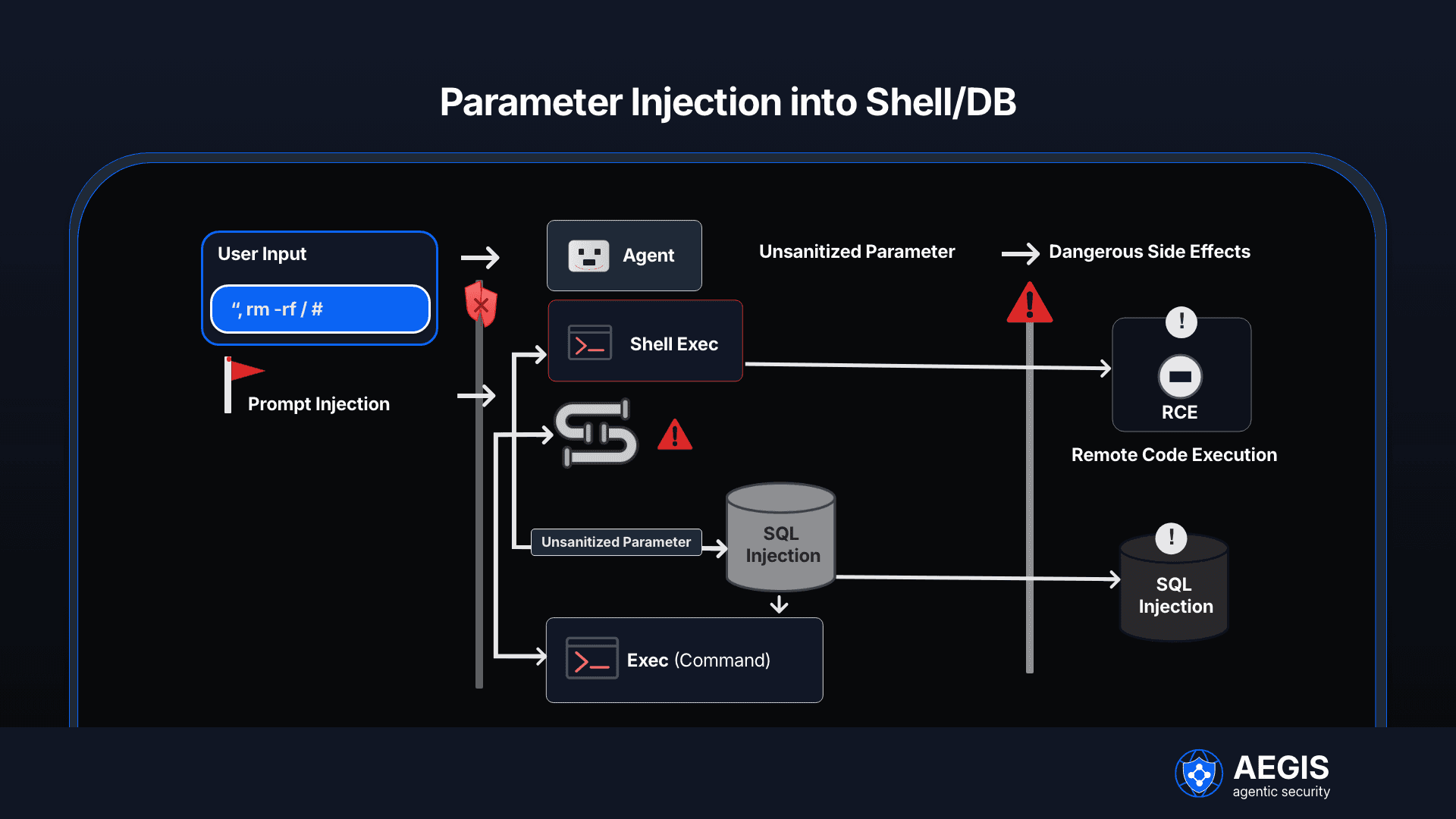
A robust AI governance program depends on policy artifacts and runtime enforcement. Leaders should require:
- Agent identity attestation: Every autonomous agent must have a verifiable identity and scope.
- Budget guardrails: Each AI workflow operates under financial and operational ceilings.
- Shadow-mode validation: Policies run in monitor-only mode before enforcement.
- Compliance attestation checklists: Each pilot passes measurable go/no-go gates.
These requirements align perfectly with Aegis Gateway’s architecture, which provides policy-as-code, agent identity, and tamper-proof auditability.
👉🏻 Accelerate innovation by integrating multi-agent AI into your experimentation labs
Governance Pillar | Executive Responsibility | Aegis Capability |
Policy Control | Approve baseline policies, ensure review cadence | YAML/JSON policy bundles with versioning |
Identity & Scope | Mandate authenticated agent identities | JWT-based short-lived tokens per agent |
Compliance Evidence | Require audit readiness for all pilots | OpenTelemetry + signed log spans |
Cost Oversight | Ensure FinOps alignment | Per-agent budgets, rate limits, and dashboards |
Quick Wins and Milestones for Executive Buy-In
Pilot-Stage ROI Levers
Leaders can secure board and budget confidence through visible short-term wins:
- Reduce manual toil – Automate approval workflows for repetitive finance or DevOps actions.
- Control spend automatically – Use policy-based throttling to cap API costs.
- Enforce audit-ready trails – Guarantee that every AI action leaves a traceable record.
A sample pilot pattern:
A CFO sponsors a payments automation project. Within 60 days, policy enforcement reduces manual approvals by 40% and blocks multiple unauthorized attempts—all logged with verifiable attestations.
Funding Through Objective Gates
Executives should structure AI funding around progressive validation gates—shadow-mode monitoring, limited enforcement, full rollout. Each gate includes measurable compliance and cost metrics. This “no-surprises” model ensures continued investment without compliance exposure.
How Aegis Enables Safe Executive Innovation
Aegis Gateway, developed by Aegissecurity is designed as an AI Security Mesh for multi-agent systems. It sits between agent orchestrators (like LangGraph, AgentKit, or CrewAI) and the tools they use, enforcing real-time decisions for every call—allow, deny, sanitize, or approval_needed.
Explore the full solution overview here.
Core Capabilities for Executives
- Policy-as-Code Governance
Executives can mandate uniform policy templates across teams. Aegis compiles YAML/JSON definitions into OPA bundles, version-controls them, and supports rollback. - Runtime Enforcement Layer
Every agent call passes through a proxy enforcement layer that validates identity, parameters, and budget. Unauthorized actions are blocked instantly. - Human-in-the-Loop Approvals
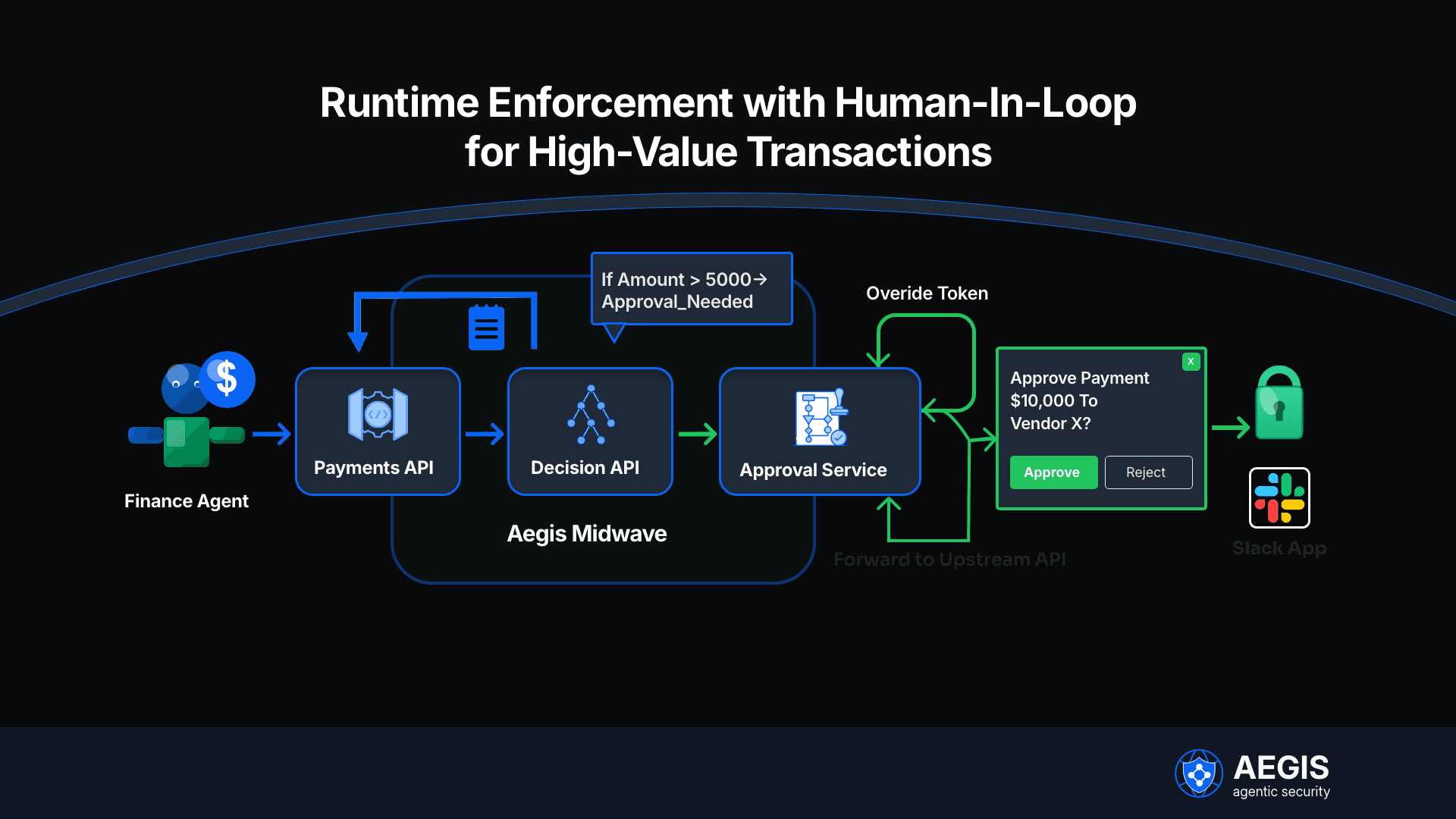
For high-risk actions (e.g., payments > $5 000), Aegis routes approval requests to Slack or Teams, pausing the operation until an authorized executive confirms it. - Observability and Auditability
All agent actions generate OpenTelemetry traces, linked to agents, policies, and cost metrics—forming an immutable compliance trail. - Shadow Mode and Policy Simulation
Before enforcement, policies run in observation mode to help teams fine-tune thresholds, ensuring executive teams can monitor impact before operational rollout.
Technical Foundation
Under the hood, Aegis combines an Envoy data plane, Go-based authorization service, and OPA evaluator for real-time decisioning with latency under 20 ms (P99). Tokens use Ed25519 signatures, ensuring agent identity and tenant isolation—crucial for multi-tenant MSSP operations.
By integrating FinOps metrics with security telemetry, executives gain a unified lens on operational safety and spend efficiency.
Communicating AI Success Across the Organization
Artifact-Driven Transparency
Executives must communicate AI program maturity clearly across teams and auditors. Recommended Aegis-supported artifacts include:
- Executive policy one-pager summarizing current enforcement coverage.
- Compliance heatmap highlighting enforced vs. shadow policies.
- ROI model mapping avoided incidents and cost savings.
- Attestation templates exported directly from Aegis telemetry.
Quantifying the Business Value
Aegis empowers executives to measure value in three axes:
Metric | Description | Outcome |
Incident Reduction | Blocked unauthorized actions vs. baseline | ↓ 40 % average |
Operational Efficiency | Reduced manual approvals, faster audits | ↓ 35 % overhead |
Cost Control | Budget enforcement and throttled APIs | ↓ 20 % monthly spend |
These results translate directly into executive scorecards and compliance narratives. By mandating runtime enforcement rather than relying on manual approvals, leaders build trustworthy automation ecosystems.
Aegis in Real-World Executive Use Cases
Drawing from deployments across industries, Aegis demonstrates how executives can lead with confidence:
- FinTech CFOs enforce per-agent payment ceilings and approve large transfers safely.
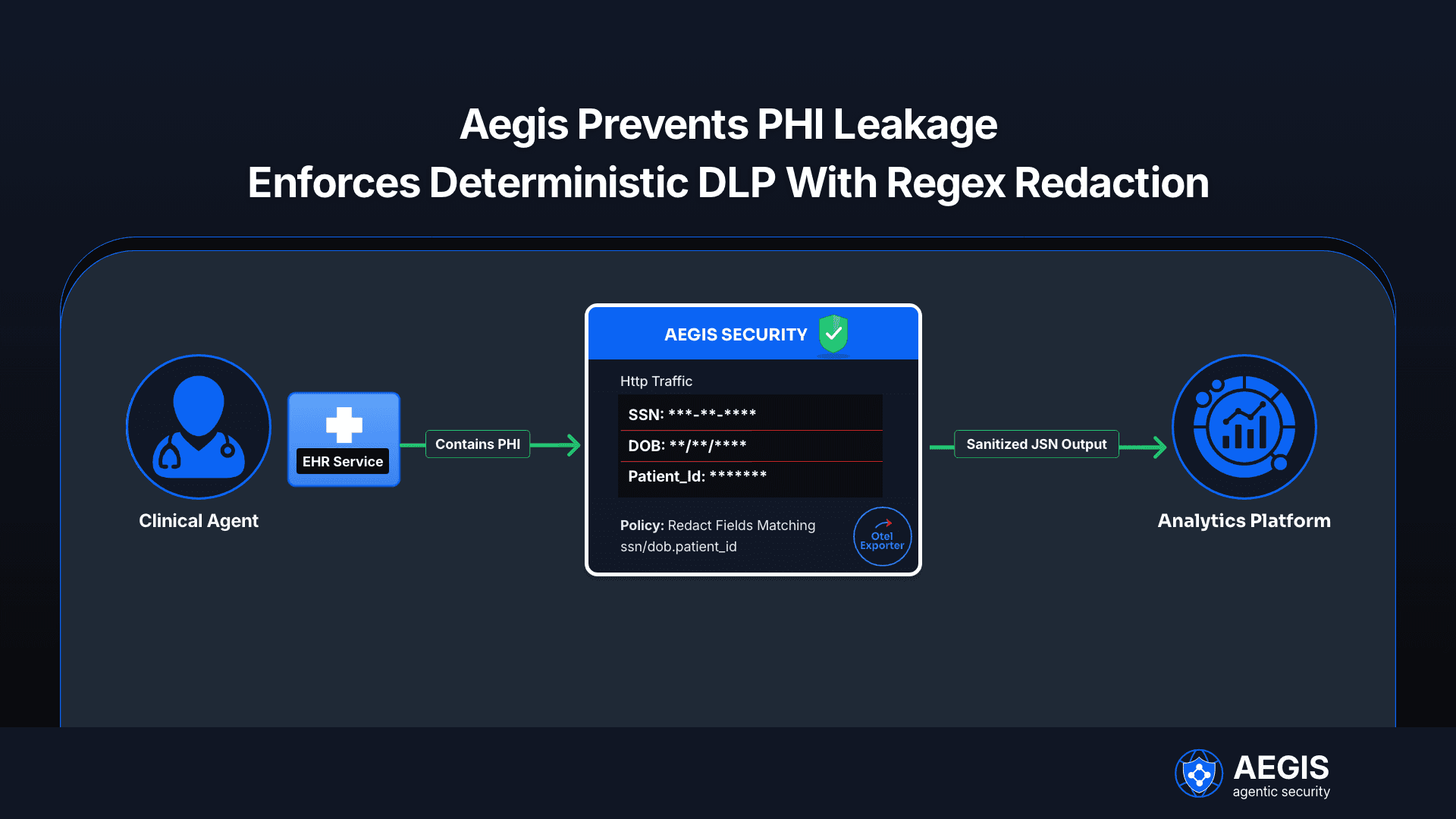
- Healthcare CIOs apply deterministic DLP, ensuring no PHI leaves controlled domains.
- SaaS COOs manage API cost governance through per-agent budgets.
- DevOps leaders gate deployment automations with production approval policies.
- MSSP executives enforce tenant-scoped rules, producing SIEM-ready logs for every client.
These scenarios align with the growing demand for agent identity, policy observability, and compliance readiness, which traditional IAM systems cannot provide.
Building the Executive Sponsorship Model for AI
Policy, People, and Platform Alignment
The most successful AI transformation programs follow a simple alignment model:
- Policy – Executives codify the “rules of engagement” using systems like Aegis.
- People – Cross-functional pods ensure AI governance is embedded, not appended.
- Platform – Enforce at runtime to maintain trust and auditability.
This triad allows executives to scale innovation without losing control—creating agentic enterprises that are both adaptive and compliant.
👉🏻 Learn from previous AI adoption cycles to avoid common pitfalls and move faster
A Measured Path Forward
Agentic AI is no longer optional. But its success depends on leaders who fund innovation with governance. Tools like Aegis Gateway make this practical—enabling safe experimentation, transparent compliance, and data-driven decision-making.
As one CISO at a major financial firm noted after implementing Aegis:
“We stopped treating AI governance as a report—it’s now a runtime reality.”
Frequently Asked Questions
1. What is “agentic AI,” and why does it matter to executives?
Agentic AI refers to autonomous software agents capable of performing actions, not just predictions. For executives, it represents both efficiency and new categories of operational risk.
2. How does Aegis differ from traditional IAM tools?
While IAM focuses on who can access an API, Aegis decides what each agent can do, with what parameters, under what conditions—enforcing policy at runtime.
3. Can Aegis integrate with existing orchestrators or workflows?
Yes. Aegis offers SDKs and middleware for LangChain, LangGraph, CrewAI, and others, requiring minimal code changes.
4. How does Aegis support compliance audits?
It generates tamper-proof, signed telemetry logs for every decision—providing traceability and audit evidence for SOC and regulatory reviews.
5. Is Aegis suitable for multi-tenant or MSSP environments?
Absolutely. Its design supports tenant-scoped policies, region routing, and SIEM-ready logs, enabling MSSPs to deliver secure, compliant AI services.
6. What are typical performance impacts?
Policy evaluations are cached and optimized, adding less than 20 ms latency at P99, which is negligible for most enterprise workloads.