Integrating Multi-Agent AI with Low-Code/No-Code Platforms
Secure agentic low-code workflows with runtime policy enforcement, observability, and policy templates for citizen developers.
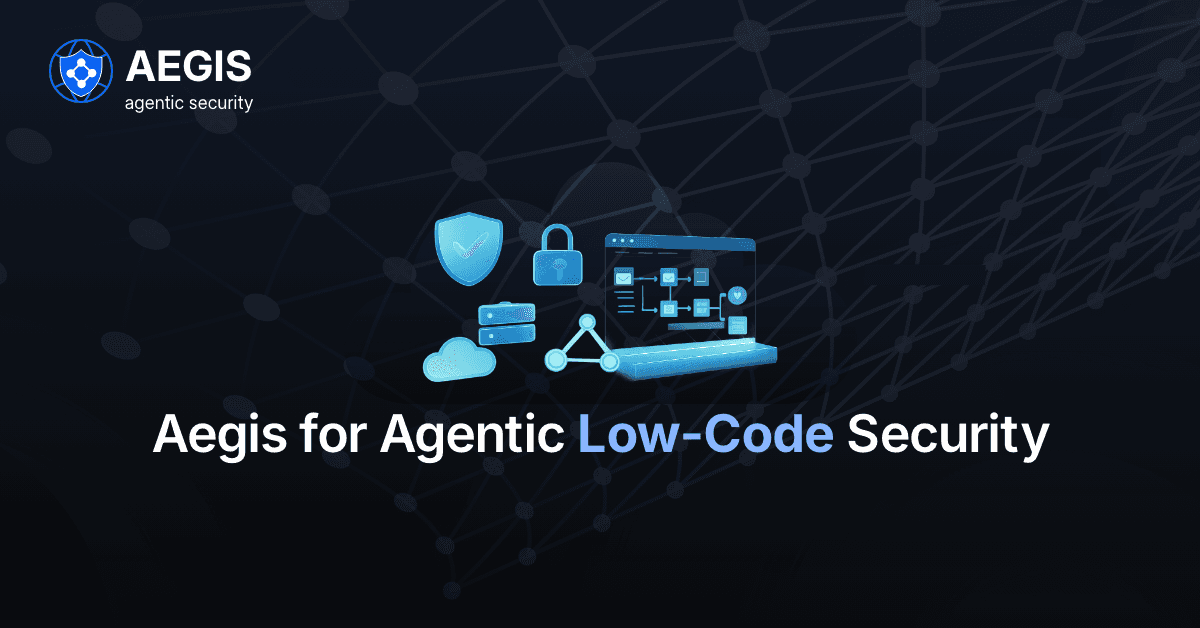
Aegis: Enforcing Safe Agentic Workflows in Low-Code/No-Code Platforms
Low-code/no-code platforms are embedding agentic building blocks—actions that can call APIs, move data, and automate business flows. The productivity upside is clear: citizen developers can assemble agent-powered automations without deep engineering. The security downside is also clear: connectors, tokens, and hidden parameters create risk vectors that traditional IAM and static controls do not address.
This article explains where enforcement must sit in the stack, how policy templates and governance patterns keep citizen development safe, and—crucially—how Aegis functions as the runtime enforcement and observability layer that makes agentic low-code viable at enterprise scale. For product and architecture details referenced here, see the Aegis technical brief.
The promise and the risk of agentic low-code platforms
Low-code platforms accelerate automation by exposing connectors and action blocks. Citizen developers can quickly prototype lead-sourcing bots, onboarding assistants, or invoice approval flows. But those same building blocks can:
• Embed long-lived tokens into flows.
• Expose PII in third-party calls.
• Chain agents so a planner coerces a finance agent into a payment.
• Consume expensive APIs without budgets or rate limits.
Adoption and risk have accelerated together: searches for agentic AI rose dramatically in recent years and enterprise adoption surveys highlight governance as a top barrier to production deployments. For enterprise readiness, low-code platforms must expose safety not just capability—centralised runtime controls, policy templates and audit trails.
👉🏻 Modernize legacy systems with AI agents without disruption
Integration architecture: where to place enforcement
The correct enforcement point is the agent↔tool boundary. Place a lightweight gateway between orchestrators (the low-code platform runtime/orchestrator) and external connectors so every tool call is evaluated in real time.
Core architectural responsibilities for the enforcement layer:
• Identity binding: short-lived tokens that tie each call to a registered agent identity.
• Parameter inspection: evaluate call parameters (amounts, filenames, destinations) against policy rules.
• Action decisions: allow, deny, sanitize (redact), or require human approval.
• Observability: emit structured telemetry and traces for compliance and FinOps.
Aegis implements this model as a runtime proxy + policy evaluator and telemetry engine. It intercepts outbound calls from the low-code runtime, evaluates policies (policy-as-code), and returns deterministic decisions while emitting OpenTelemetry spans for each call.
👉🏻 Integrate agents seamlessly with your existing tech stack
Where the gateway integrates with low-code platforms
- Register the low-code platform as an orchestrator client with Aegis.
- Route all connector/tool calls through the gateway (sidecar or forward proxy).
- Use SDK/middleware for non-HTTP connectors so enforcement is consistent.
This pattern ensures policies apply uniformly across citizen developers and automated agents, without changing the low-code UX.
Templates and governance patterns
Citizen developers need simple, safe building blocks. Security teams need guardrails that prevent misuse without blocking productivity. Templates and governance patterns are how both goals are met.
Key template categories (examples):
• Safe posting (Slack-like): allow posting only to approved channels; redact PII; enforce business hours.
• Email send: require subject/body validation; disallow attachments over a threshold; require approval for external recipients.
• File read: restrict SharePoint reads to tenant-scoped HR folders; block export operations.
• Payments: per-agent maximums (e.g., $5,000) with approval_needed beyond thresholds.
Aegis ships with curated policy templates and a policy cookbook to accelerate safe templates. Policies are authored as YAML/JSON, compiled into OPA bundles, and hot-reloaded so security teams can iterate quickly.
Governance patterns
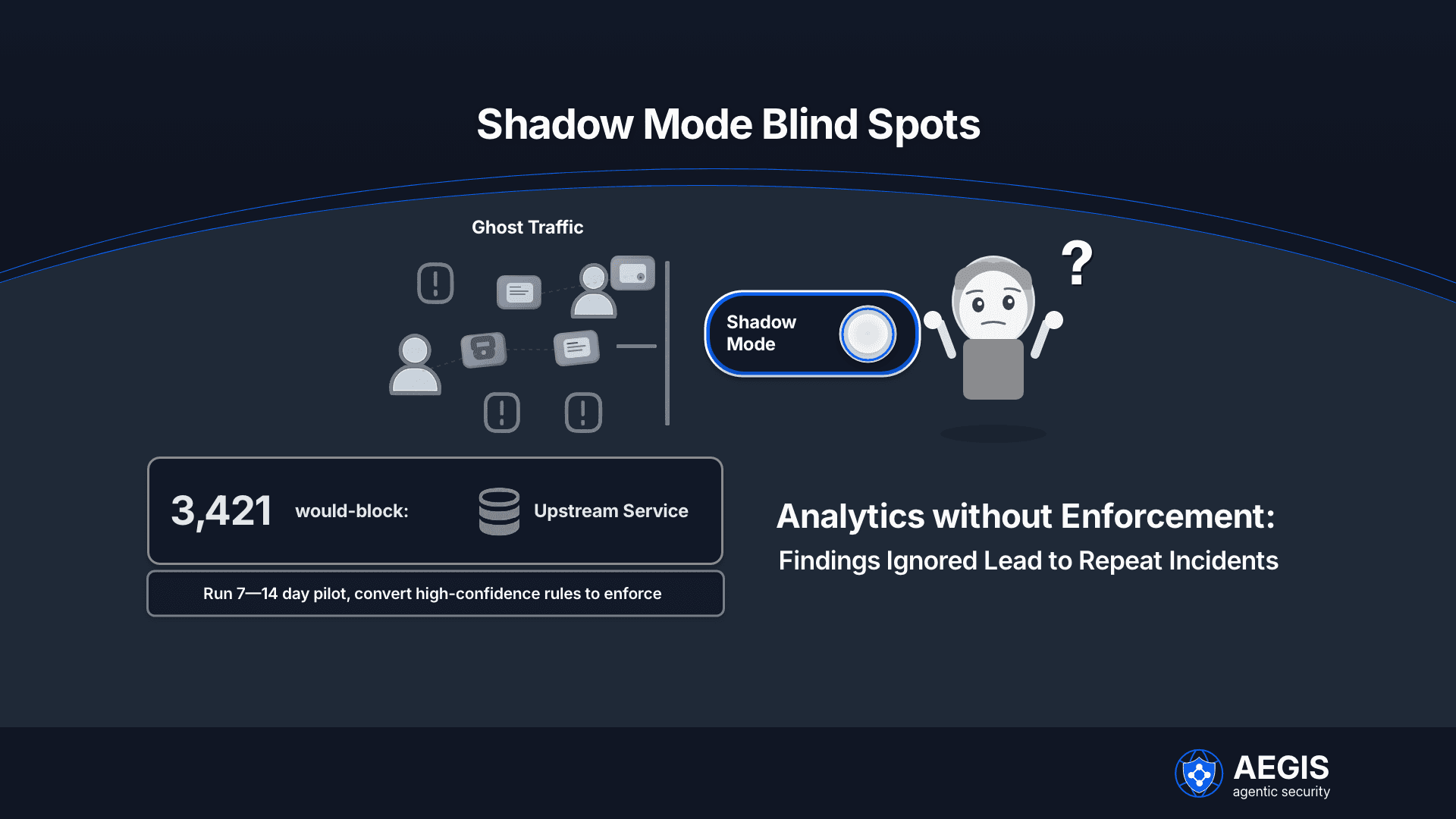
• Sandbox workspaces for citizen developers with shadow mode enabled—observe would-block events before enforcing.
• Policy linting integrated into the platform publish pipeline to catch overly broad denies.
• Per-agent budgets and rate limits to prevent runaway spend.
• Approval flows integrated with enterprise chat systems and override tokens for one-time retries.
• Audit trails and versioning for compliance reviews.
Examples and migration playbook
Below are concrete examples and a migration checklist to move existing citizen flows under Aegis enforcement.
Example: invoice-approval flow (policy enforced steps)
- Citizen flow composes an invoice and calls "payment" connector.
- Gateway evaluates: agent identity = finance-bot, action = create_payment, amount = $12,000.
- Policy checks: amount > 5,000 → approval_needed. Gateway sends approval to approvers and returns a pending response to the orchestrator.
- Approver approves via chat; gateway issues override token; flow retries and completes.
This prevents planner-to-finance coercion and creates an auditable approval trail. See the Aegis MVP scenarios for similar examples.
👉🏻 Start building AI agents with the right tools and frameworks
Migration checklist
• Map connectors in the platform to policy templates.
• Register the platform as an orchestrator client in Aegis.
• Run policies in shadow mode for 7–14 days and review would-block metrics.
• Tune regexes and parameter conditions; enable dry-run simulation.
• Flip to enforce; monitor dashboards and escalate exceptions via SOC/DevOps.
• Add per-agent budgets and per-flow SLA constraints.
-1.png&w=3840&q=75)
Operational comparison
Concern | Legacy low-code (no gateway) | With Aegis enforcement |
Connector token leakage | High risk (embedded tokens) | Short-lived tokens + identity binding |
Parameter validation | Ad-hoc in flows | Policy-as-code with parameter rules |
Approval workflows | Manual/fragile | Gateable, chat-integrated approvals |
Observability | Limited | OpenTelemetry spans & SIEM logs |
Cost control | Hard to enforce | Per-agent budgets & rate limits |
Policy primitives and enforcement actions
Primitive | Example rule | Enforcement action |
Max amount | amount <= 5000 | allow / deny / approval_needed |
Domain allowlist | domain in approved list | allow / deny |
Regex-based DLP | regex redact SSN | sanitize (redact) |
Time window | business_hours only | deny outside hours |
Budget | daily_budget <= $20 | deny when exhausted |
Both tables should be embedded into governance documentation and used by citizen developers when selecting templates.
Why Aegis — the enforcement solution
Aegis is designed to be the enforcement and observability fabric for multi-agent low-code platforms. It provides:
• Runtime policy enforcement at the agent→tool boundary (allow/deny/sanitize/approval_needed).
• Policy-as-code with versioning, dry-run, and schema validation so security teams can maintain an audit trail.
• Short-lived tokens and identity binding per agent to eliminate hidden long-lived secrets.
• OpenTelemetry traces and structured logs for SOC and FinOps consumption.
At least one-third of the operational guidance above describes Aegis’s runtime capabilities, policy lifecycle, and observability model—precisely the controls enterprises need to safely open agentic workflows to business teams.
Metrics and sample outcomes
Adopting runtime enforcement yields measurable results:
• Policy coverage: target ≥ 80% of critical tools in the pilot.
• Decision latency: target P99 ≤ 20 ms for policy lookups with caching.
• Cost control: per-agent budgets reduce unexpected third-party spend; dashboards show spend per agent and blocked vs allowed ratios.
Frequently Asked Questions
- How does enforcement affect developer velocity?
Run policies in shadow mode during onboarding; provide curated templates and a sandbox workspace so citizen developers iterate safely without interruption. - Can Aegis redact PII automatically?
Yes — deterministic DLP rules (regex) and sanitize actions allow PII redaction before external posting or storage. - What happens when a policy needs human approval at scale?
Policies can set thresholds to limit approval load; Aegis integrates with chat workflows and issues one-time override tokens upon approval. - Will this introduce latency for interactive agents?
Designed for low overhead: prepared queries, in-memory caching, and optional WASM compiled policies target P99 decision latency under 20 ms. - How do we migrate existing flows?
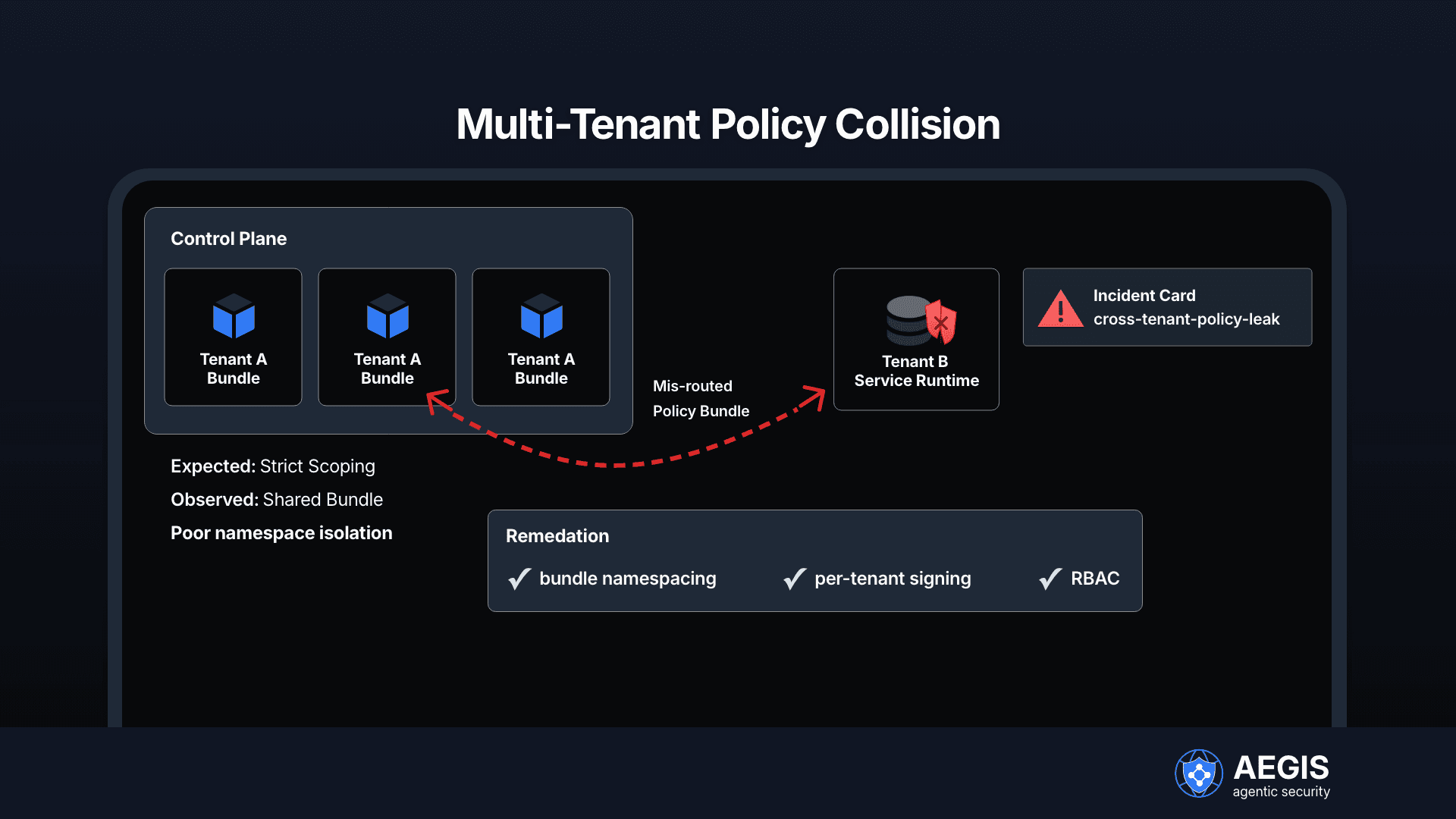
Map connectors → assign templates → run shadow mode → tune conditions → flip enforcement. Use the policy linting and dry-run tools to reduce misconfiguration risk. - Is multi-tenant separation supported?
Yes—policies and bundles are tenant-scoped with versioning; control plane ensures correct scoping and isolation.
Final notes
Agentic low-code platforms unlock fast automation, but doing so safely requires a runtime security fabric that understands agents, parameters and tool semantics. Aegis provides policy-as-code, runtime enforcement, approval workflows, and telemetry that let security, compliance and FinOps teams retain control without blocking citizen developer productivity. For implementation guidance, refer to the Aegis technical briefs and the Aegissecurity Solution pages linked above.