Integrating Multi-Agent AI into Legacy Systems: Where to Start
Runtime policy, telemetry, and approvals for secure multi-agent AI—practical integration guidance for security teams.
Aegis: Runtime Security for Agentic AI
Agentic AI — autonomous, chained agents that act and decide — creates new operational value and new attack surfaces. Security, compliance, and integration concerns are the top blockers for production adoption. This post explains a practical approach to safely bring multi-agent workflows into enterprise environments and describes Aegis: a runtime policy, telemetry, and approval gateway that enforces least privilege at the agent↔tool boundary.
👉🏻 Connect agents seamlessly to your existing tools and systems
Why agentic AI breaks old security assumptions
Enterprises built controls for synchronous, human-driven workflows. Agentic systems are different: agents act autonomously, spawn other agents, and submit parameterized calls to tools and APIs. This increases risk vectors in three ways:
- Parameter-level risk: Agents pass dynamic data into APIs (amounts, file paths, SQL, shell commands).
- Chaining risk: A low-privilege planner can coerce a high-privilege tool via intermediary agents.
- Egress & exfiltration: Autonomous agents can call arbitrary domains if not restricted.
👉🏻 Select the right deployment model based on your business needs
These concerns are supported by industry findings: organizations scaling agentic systems report meaningful adoption but also heightened security concerns — 23% of organizations say they’re scaling agentic systems while many more are experimenting. (McKinsey & Company) Major analyst research warns that a substantial share of early agentic projects will be scrapped without strong governance; over 40% may be discontinued by 2027 as vendors and projects mature. (Reuters) Security surveys also show practitioners treat AI agents as a growing security risk, with high rates of unintended actions and limited visibility. (TechRadar)
Practical integration pattern for legacy systems
Start small; integrate safely
Incremental gateway and sidecar approach
Legacy applications expect synchronous calls and familiar authentication. Rewriting is costly and risky. Use an adapter layer and an enforcement gateway that sits between orchestrator and legacy connectors. This lets you:
- Pilot with non-critical workflows (internal doc search) and observe would-block behavior in shadow mode.
- Add deterministic DLP and parameter validation before enabling enforcement.
- Throttle calls and use rate limits to protect fragile endpoints.
👉🏻 Enable faster adoption with low-code and no-code integrations
Inventory, adapter, shadow, map, protect
A simple practical checklist:
- Inventory endpoints, auth types, allowed actions.
- Build lightweight adapters that route through the Aegis gateway.
- Run policies in shadow mode for 1–2 release cycles to collect would-blocks.
- Map agent outputs to legacy API schemas; sanitize and validate parameters.
- Apply per-agent throttling and per-tool quotas.
Table 1 — Integration checklist (quick reference)
Step | Purpose | Example artifact |
Inventory | Find fragile endpoints & auth | CSV: endpoint, auth, allowed verbs |
Adapter | Lightweight connector to gateway | Sidecar or small reverse-proxy |
Shadow | Observe would-blocks; tune policies | Shadow-mode metrics, would-block list |
Mapping | Translate outputs to legacy schemas | JSON schema transforms, sanitizers |
Throttling | Protect legacy systems | Per-agent RPS limits & quotas |
What Aegis is and what it enforces
Aegis is a runtime policy and observability gateway for multi-agent AI systems — essentially “Istio + OPA for agents.” It is designed to enforce least privilege between agents and tools, prevent agent privilege escalation, and produce auditable traces for SOC and compliance teams.
Core capabilities
Identity, Policy-as-Code, and Runtime Decisions
- Agent identity: short-lived, signed JWTs bind actions to agent ID, tenant, and scope.
- Policy-as-code: security teams write YAML/JSON policies that compile into evaluation bundles (OPA/Rego). Policies support conditions (ranges, regex matches), budgets, rate limits, and actions such as allow, deny, sanitize, or approval_needed.
Enforcement, Telemetry, and Approval Flows
- Enforcement: Aegis sits as a proxy/sidecar between orchestrator and tools (HTTP/SDK). Each request is evaluated at runtime for agent identity, target tool, parameters, and call chain context. Decisions are returned synchronously with standardized error payloads when blocked.
- Observability: Every decision emits OpenTelemetry spans and structured logs (agent_id, tool, decision, policy_version, reason). Dashboards expose blocked counts, top agents, latency P99, and budget usage.
- Human approvals: For high-risk actions, policies can return approval_needed; Aegis integrates with Slack or Teams to request and obtain approvals, minting one-time override tokens for retry.
Table 2 — Aegis feature comparison vs legacy approaches
Capability | Legacy patterns | Aegis Gateway |
Parameter inspection | Ad-hoc in agent code | Centralized policy evaluation (OPA) |
Agent identity | None / static keys | Short-lived JWTs with agent claims |
Human approval | Manual, custom flows | Integrated approval_needed workflow |
Telemetry | Fragmented logs | OpenTelemetry spans + SIEM-ready logs |
Shadow testing | Manual | Shadow mode for would-blocks and tuning |
How Aegis protects common high-risk scenarios
- Preventing payment coercion: Enforce per-agent ceilings (e.g., max_amount 5,000) and require approval for anything higher — a Planner cannot trick Finance into an oversized transfer.
- PHI/PII protection: Deterministic DLP redaction at the gateway (regex-based SSN/DOB redaction) before outbound calls.
- Cost governance: Per-agent budgets and RPS rate limits to control LLM and third-party spend.
- Egress & allowlist control: Block outbound calls to unknown domains and route by tenant region for data residency.
Architecture & operational considerations
Data plane + Control plane
Data plane (runtime)
- Sidecar or forward proxy (Envoy ext_authz) intercepts calls; an external authorizer evaluates policies and returns allow/deny/sanitize/approval_needed decisions with attestation signatures. Hot-reloaded bundles and in-memory caches ensure low latency targets (P99 ≤ 20 ms is achievable with prepared queries).
Control plane (management)
- Console API for agent & policy management, bundle store for compiled policies, token service issuing short-lived JWTs, and approvals service integrated with collaboration tools.
Operational notes:
- Fail-closed for writes; configurable fail-open for read-only flows.
- Shadow mode is essential: run for a week, tune regexes and thresholds before enforcing.
- Versioning and signed policy history for audits and rollbacks.
.png&w=3840&q=75)
Deployment & rollout plan (pilot → scale)
Pilot plan (recommended)
- Select a non-critical connector (internal docs search).
- Deploy Aegis in shadow mode; run for 1–2 release cycles.
- Tune policies (parameter regexes, rate limits) and add DLP rules.
- Flip enforcement for the pilot workflow.
- Expand to high-risk connectors (payments, EHR) with staged approvals and rate limits.
Metrics that matter
- Policy enforcement latency (target < 20 ms P99).
- Percentage of tool calls traced and logged (goal: 100% of agent→tool calls).
- Number of would-block events in shadow mode converted to enforced rules.
- Per-agent spend and budget exhaustion events.
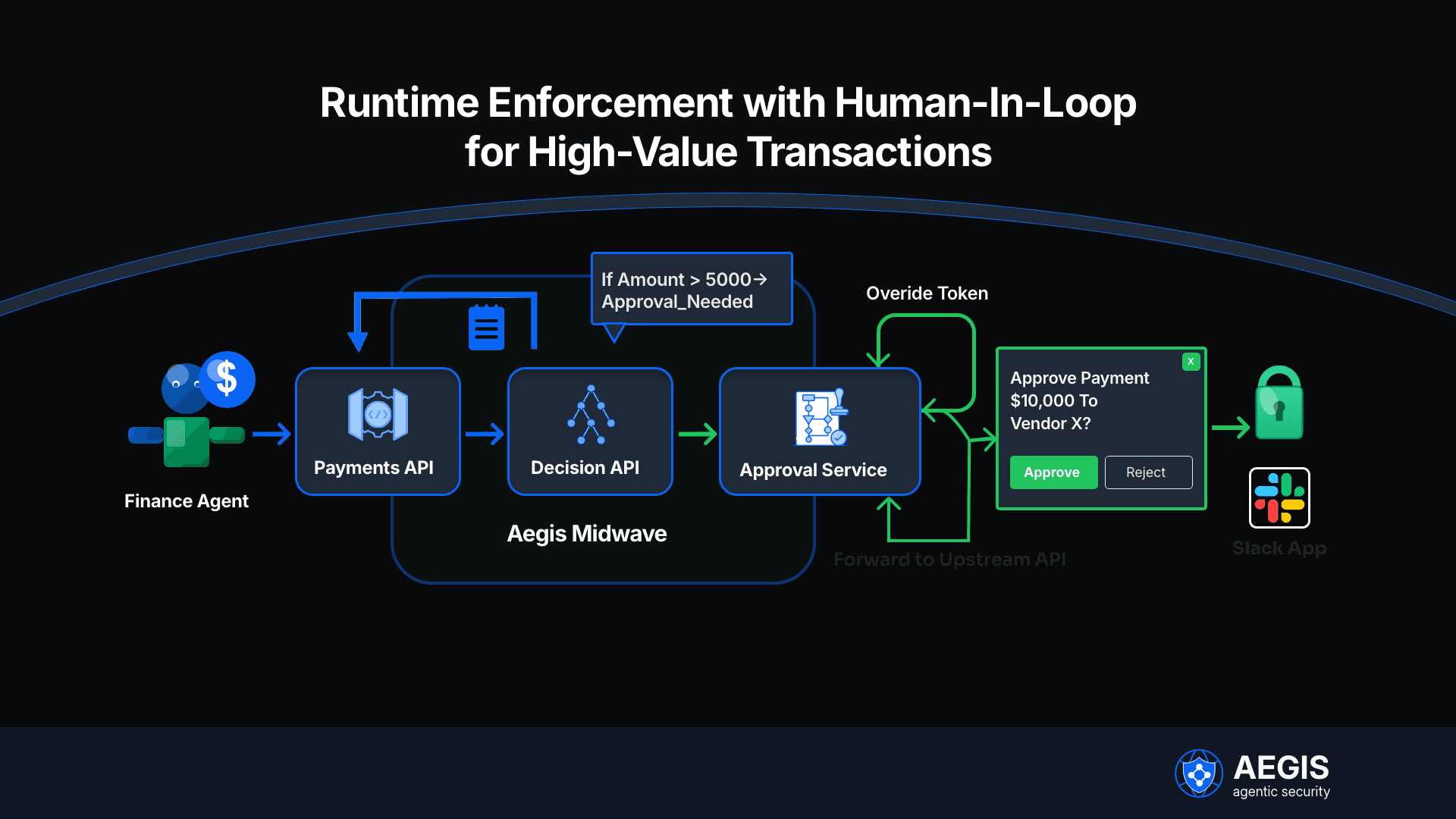
Table 3 — Example runtime metrics
Metric | Target | Why it matters |
Decision latency (P99) | ≤ 20 ms | Preserve agent UX & throughput |
Trace coverage | 100% | Auditability & incident investigation |
Policy coverage (critical tools) | ≥ 80% | Reduce blind spots in pilot |
Approval throughput | 10 reqs/min per approver | Prevent approval overload |
Table 4 — Example policy fragment
Policy element | Example |
agent | finance-agent |
allowed_tools | stripe-payments:create_payment |
conditions | amount <= 5000 |
action | allow; else approval_needed |
Links & further reading
- Research & market context: McKinsey’s State of AI notes adoption and experimentation figures for agentic systems. (McKinsey & Company)
- Analyst caution: Gartner coverage summarized by Reuters warns many agentic projects need governance to avoid failure. (Reuters)
Frequently Asked Questions
- What is the minimum footprint to pilot Aegis?
- A lightweight sidecar or middleware adapter plus policy bundles in shadow mode. Start with a single non-critical connector and one orchestrator integration.
- How does Aegis affect latency?
- Properly tuned OPA prepared queries and in-memory caches target P99 decision latency under 20 ms; proxy overhead is small if the data plane is colocated.
- Can Aegis prevent data exfiltration?
- Yes — via egress allowlists, DLP sanitization, and tenant-scoped routing; all outbound calls can be inspected and blocked if they violate policy.
- How are approvals handled at scale?
- Policies allow thresholding (only high-risk actions need approval) and integrate with Slack/Teams to queue and approve requests with one-time override tokens.
- Does Aegis replace IAM or service mesh?
- No. Aegis complements IAM and meshes: it enforces per-call parameterized policies, approval workflows, and agent-specific runtime decisions that IAM and meshes typically do not provide.
- What compliance artifacts does Aegis produce?
- Structured OpenTelemetry spans, signed audit logs, policy version history, and approval records suitable for SIEM ingestion and auditor review.
Closing: operational advice for security leaders
Agentic AI will continue to grow; leaders must shift from ad-hoc checks inside agents to a centralized runtime control fabric. Start with inventory, shadow testing, and a gateway pattern (sidecar/adapter) that enforces policy-as-code, DLP, approvals, and telemetry. Aegis implements this fabric: identity-bound tokens, OPA-backed policies, runtime enforcement, and audit-grade telemetry—letting teams scale multi-agent workflows with measurable controls and compliance evidence.