How to Build an Internal Agent Platform Team: Skills and Roles
Learn how to build an internal agent platform team with defined skills, roles, and KPIs to secure AI agents and reduce operational risks.
Building an Internal Agent Platform Team for AI Security
As autonomous AI agents move into production, enterprises are discovering that their infrastructure, security, and compliance models aren’t ready for them. Teams are spinning up agents on the fly — each with its own permissions, APIs, and budgets — without central oversight. The result? Gaps in ownership, security exposure, and rising costs.
The solution is not more ad hoc controls or isolated policy files. It’s the creation of an Internal Agent Platform Team (IAPT) — a dedicated unit that governs agent identities, runtime policies, and observability. This post explores how to build such a team, the roles and skills required, and how Aegis Gateway from Aegissecuirty enables this new operating model with agentic AI security.
.png&w=3840&q=75)
Why Enterprises Need an Internal Agent Platform Team
Fragmentation Without Central Ownership
Today’s AI development often resembles the early days of microservices: rapid innovation without guardrails. Engineering teams spin up their own agents using frameworks like LangGraph, CrewAI, or AgentKit, each with custom permissions and integrations. Without a central platform team, security engineers and SREs are left firefighting policy drift, while FinOps teams struggle to track spend.
Symptoms of this fragmentation include:
- No unified inventory of agents, tokens, or tools
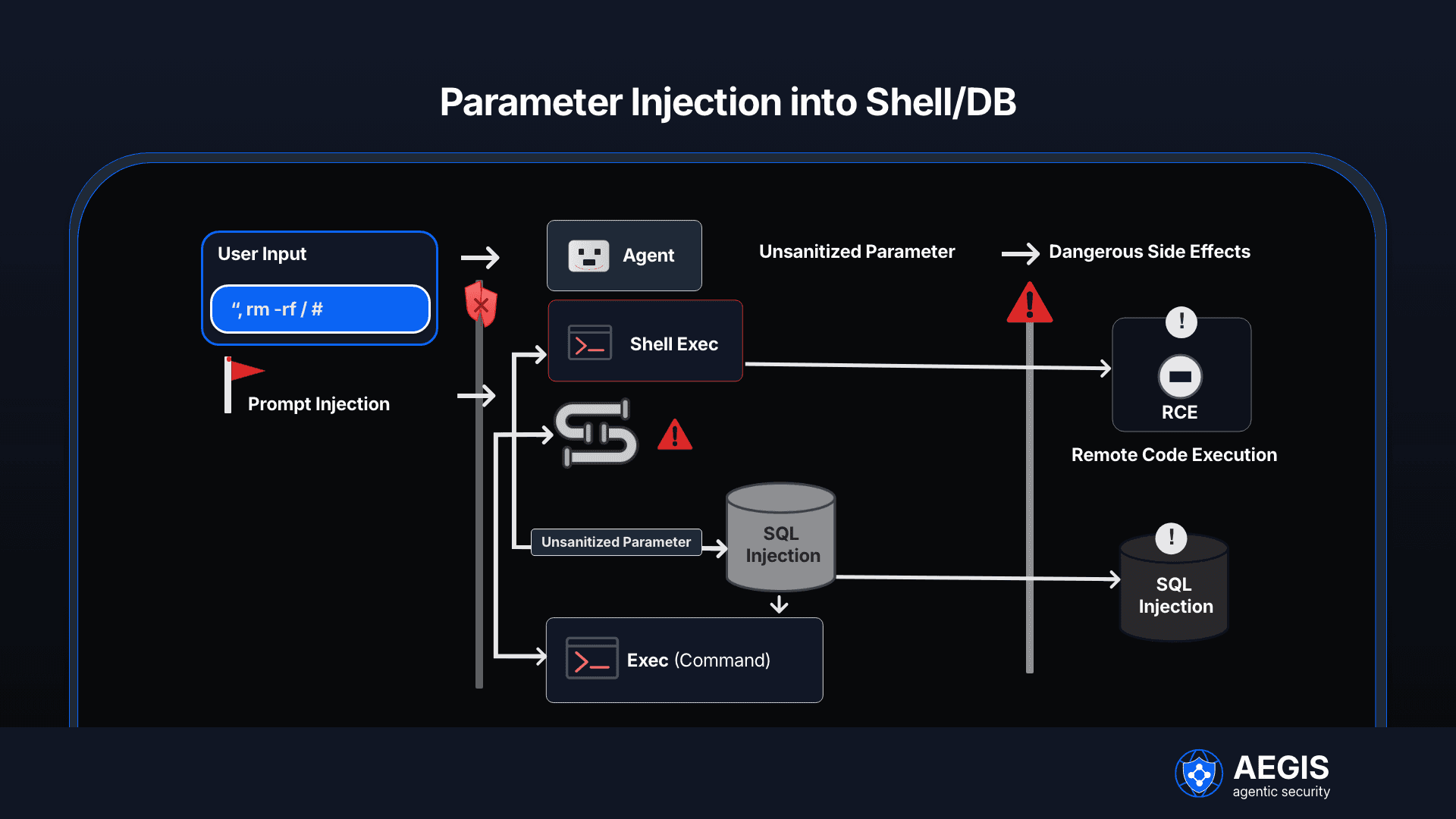
- Lack of runtime enforcement (agents can call any API)
- Policy duplication across YAMLs or repos
- Unmonitored agent-to-agent interactions
The Risk and Cost Impact
Recent research shows that over 50% of enterprise leaders cite security and compliance as the top barrier to adopting multi-agent workflows. The average cost overrun due to uncontrolled agent API calls can reach thousands of dollars per month. Meanwhile, prompt injection and privilege escalation risks continue to grow as agents gain more autonomy.
This operational sprawl makes clear why organizations must adopt a security mesh for agents — one managed by a skilled, cross-functional platform team.
👉🏻 Build the expertise your teams need to scale secure multi-agent innovation
The New Model: Centralized Agent Governance
The Mission of the Internal Agent Platform Team
The Internal Agent Platform Team (IAPT) acts as the control plane for agentic AI — owning identities, policies, telemetry, and compliance guardrails. Their job is to provide a safe and efficient runtime for all AI agents, balancing autonomy with accountability.
Their charter typically includes:
Responsibility | Description |
Agent Identity Management | Maintain registry of all active agents and associated keys |
Policy Governance | Define and validate policies (OPA/Rego, YAML) for agent behaviors |
Observability | Collect telemetry (OpenTelemetry spans, P99 latency, decision logs) |
Cost & FinOps | Track API budgets, rate limits, and per-agent cost visibility |
Compliance | Ensure audit trails and data residency through tamper-proof logs |
Developer Enablement | Provide SDKs, sample policies, and shadow rollout tools |
Key Roles and Skills in the Agent Platform Team
Building an IAPT means aligning engineering, security, and operations expertise under one team. Below is the recommended structure and skill matrix.
Team Roles
Role | Core Responsibility |
Platform Lead | Owns the overall governance model, KPIs, and cross-functional coordination |
Security Engineer (Policy/OPA) | Authors policy bundles, manages policy-as-code pipelines, and tunes enforcement |
DevOps Engineer (Proxy/Sidecar) | Implements sidecar deployment (Envoy/forward proxy), manages shadow mode rollouts |
SDK Engineer | Builds and maintains developer SDKs for LangChain, LangGraph, and other orchestrators |
FinOps Analyst | Tracks spend, budgets, and rate limits using telemetry data |
Compliance/SOC Liaison | Maps policies to audit controls, ensures tamper-proof logs and approval records |
Product Manager | Aligns team goals with enterprise risk posture and developer experience needs |
Required Skills
Domain | Example Skills & Tools |
Policy-as-Code | Rego/OPA, YAML schema validation, shadow enforcement |
Networking & Proxy Config | Envoy ext_authz, eBPF observability, sidecar topology |
Telemetry | OpenTelemetry, Grafana dashboards, log aggregation |
Security & Identity | JWT key management, mTLS, secret rotation |
FinOps | Cost aggregation, rate limiters, per-agent spend tracking |
Compliance | SOC2 controls, audit log verification, region routing |
From Shadow Mode to Enforcement: The Operating Model
Step 1: Shadow Mode Rollout
Start with non-blocking “shadow” policies that observe agent calls and record potential violations. This phase helps the platform team calibrate thresholds, regex filters, and approval flows before enforcement begins.
Step 2: Policy Coverage and Metrics
Track policy coverage (percentage of agents/tools under governance) and the would-block ratio — how many calls would be denied if enforcement were active. Target at least 80% coverage within the first 90 days.
Step 3: Gradual Enforcement
Flip enforcement on for critical connectors (e.g., Stripe, Slack) while maintaining shadow mode for less-sensitive ones. Apply fail-closed vs fail-open decisions based on operational risk.
Step 4: Continuous Improvement
Regularly review telemetry and update the policy cookbook and incident playbooks based on findings. Each policy change should trigger automated validation and versioning.
KPI | Definition | Target |
Policy Coverage | % of connectors with enforced policies | ≥ 80% |
Blocked/Would-block Ratio | % of violations in shadow mode vs active | ≤ 1:1 |
P99 Latency | Max policy evaluation time | ≤ 20 ms |
Cost Savings | Reduction in runaway spend | ≥ 25% |
Audit Completeness | % of actions with traceable decisions | 100% |
Aegis Gateway: The Security Mesh for Agent Teams
Enter Aegis Gateway — the agent security mesh built by Aegisecurity to operationalize all of the above. Aegis provides a runtime policy and observability fabric for multi-agent AI architectures such as LangGraph, CrewAI, and AgentKit.
Core Capabilities
- Policy-as-Code for Agents
Define YAML or JSON policies per agent. Aegis compiles these into Open Policy Agent (OPA) bundles, supporting actions like allow, deny, sanitize, and approval_needed. - Runtime Enforcement
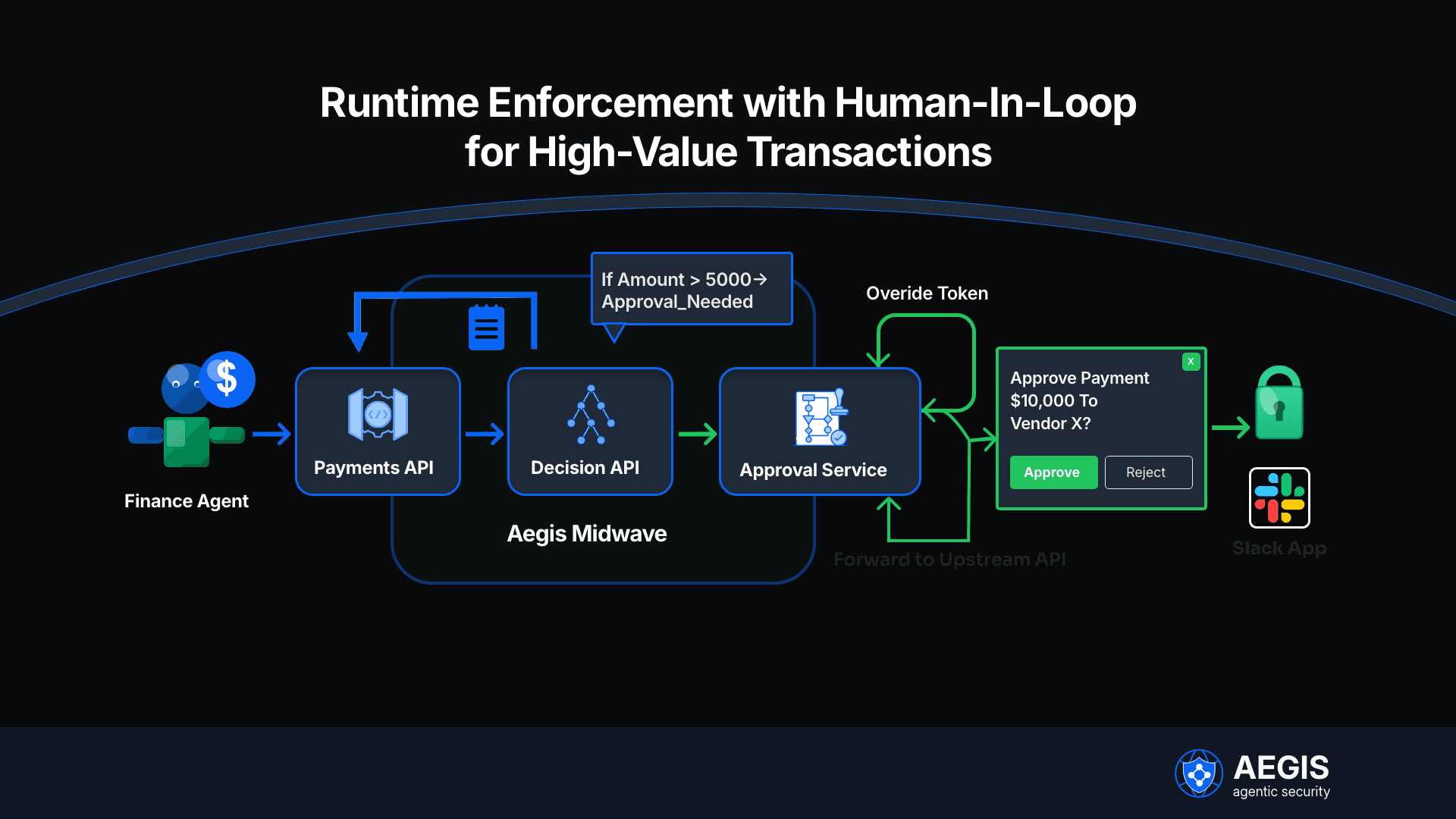
The Aegis sidecar proxy intercepts every agent→tool call, evaluates the policy in real time, and enforces allow/deny decisions within 20 ms latency. High-risk actions can pause for human approval in Slack or Teams. - Egress and Identity Control
Enforces strict allowlists for outbound domains and issues short-lived JWTs per agent, embedding organization, tenant, and scope claims. - Observability & FinOps Integration
Aegis emits structured OpenTelemetry traces for every decision. Dashboards show cost per agent, latency, blocked actions, and spend breakdowns — closing the loop for both SecOps and FinOps. - Shadow and Audit Modes
Policies can run in shadow mode before enforcement. Every decision is logged with cryptographic integrity, creating a compliance-ready audit trail.
Function | Description | Benefit |
Policy Enforcement | OPA/Rego-based rules evaluated via Envoy ext_authz | Prevent privilege escalation |
Identity Management | JWT + Ed25519-signed tokens per agent | Stop impersonation |
Observability | OTel traces, Grafana dashboards | Full runtime visibility |
Human Approvals | Slack/Teams approval flow | Safe escalation for high-risk actions |
FinOps Controls | Budgets, rate limits, spend telemetry | Prevent runaway costs |
Example Scenarios Across Industries
Aegis Gateway’s architecture aligns directly with the needs of internal agent platform teams across verticals.
FinTech
Prevent a planner agent from coercing a finance agent into unauthorized transfers. Policies cap payment amounts and require approval for any transaction above threshold.
Healthcare
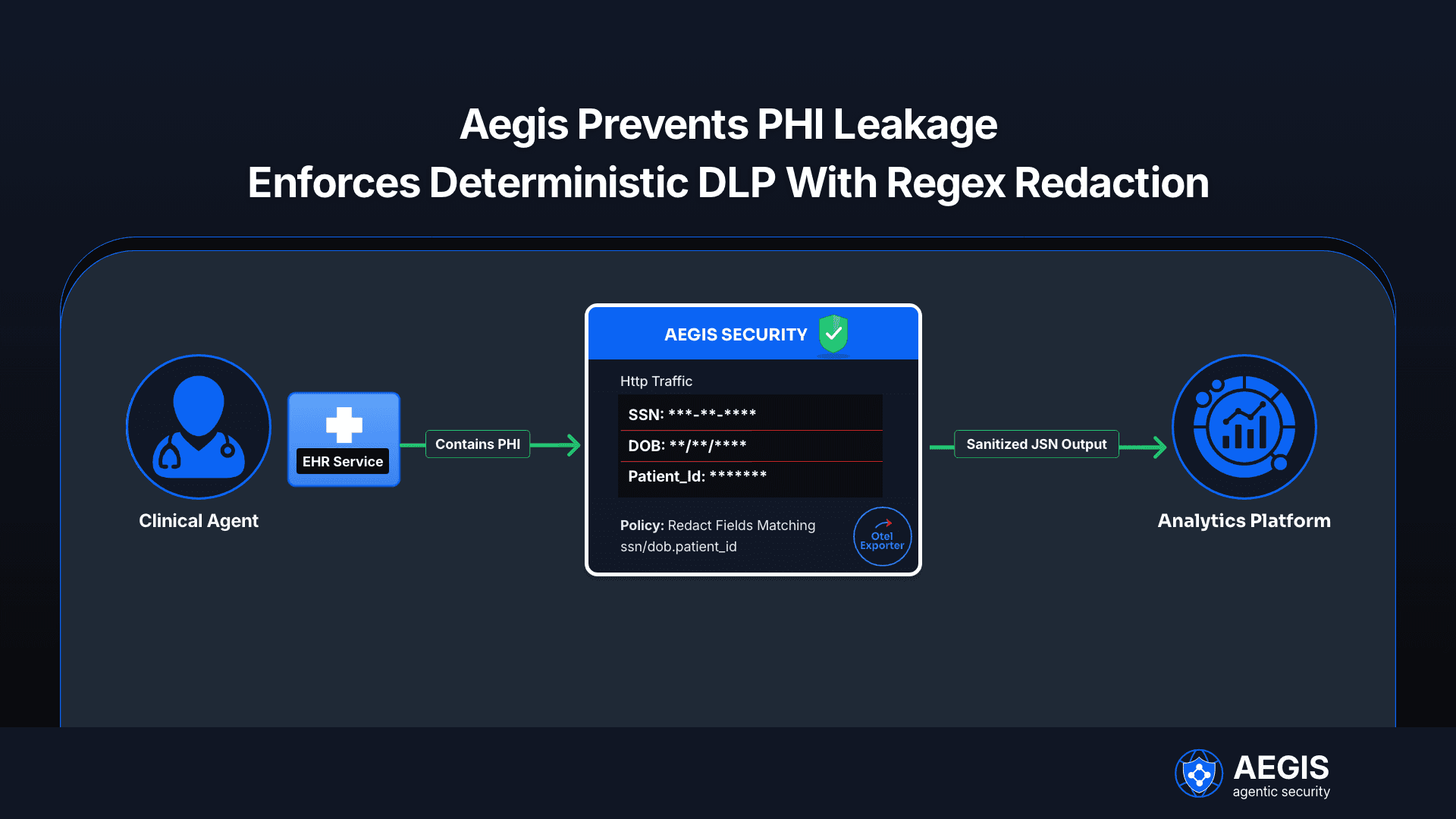
Redact PHI/PII using deterministic data loss prevention (DLP). Enforce egress controls to stop data exfiltration beyond approved domains.
SaaS / FinOps
Throttle API usage with per-agent budgets and rate limits. Provide cost breakdowns per tenant for real-time visibility.
DevOps / CI Automation
Control deployment agents by requiring approvals for production actions and validating container image digests.
MSSP / Multi-Tenant
Generate tenant-scoped, tamper-proof telemetry for SOC and compliance reviews — critical for managed service providers.
How to Build and Operate Your Agent Platform Team
Hiring and Training
Use a hiring rubric that tests candidates on policy design and incident response. Run OPA workshops and telemetry exercises to upskill engineers. A baseline goal: writing and validating a policy in under 5 minutes.
👉🏻 Foster a security-first culture that supports responsible agent development
90-Day Success Plan
- Shadow-mode rollout for top 3 connectors
- Block one high-risk incident
- Live dashboards for policy coverage and latency
- Monthly risk report showing would-block and policy drift
Budget & Tooling
Allocate for:
- Observability (Grafana/Prometheus)
- Policy storage and signing
- Token service
- CI/CD for policy bundles
How Aegis Accelerates Team Maturity
With Aegis in place, your internal team gains an immediate operational advantage:
- Central visibility: Unified dashboards show agent activity, violations, and budget consumption.
- Policy agility: Hot-reload policies without downtime.
- Audit readiness: Tamper-proof logs with versioned history.
- Developer enablement: SDKs and sample policies accelerate onboarding.
- Scalable model: Multi-tenant controls for MSSPs and distributed teams.
👉🏻 Accelerate innovation by bringing multi-agent AI into your experimentation labs
Frequently Asked Questions
1. How large should an internal agent platform team be?
Start small — 5–7 members — scaling as the number of agents and integrations grows.
2. How does shadow mode reduce deployment risk?
Shadow mode collects metrics on potential policy violations without enforcing them, allowing safe tuning before activation.
3. What KPIs matter most for the team?
Policy coverage, P99 latency, blocked/would-block ratio, audit completeness, and cost savings.
4. How does Aegis integrate with orchestrators like LangChain or LangGraph?
Through SDK middleware and proxies that wrap agent tool calls with runtime policy checks and telemetry emission.
5. Can Aegis support multi-tenant or MSSP environments?
Yes. Each tenant has isolated policy bundles, audit logs, and telemetry streams to prevent policy collisions.
6. How do we measure ROI for this team?
By quantifying prevented incidents, cost savings from throttled spend, and compliance hours saved through automated reporting.