
Ensuring HIPAA Compliance in Healthcare AI Agents
Practical guide to HIPAA-ready agentic AI: ABAC, deterministic DLP, approvals, and how Aegis enforces compliant agent workflows.
Ensuring HIPAA Compliance for Healthcare AI Agents
Healthcare organizations are piloting and deploying agentic AI that interact with EHRs, schedule care, triage patients, and automate clinical workflows. Those agents often process protected health information (PHI) and therefore must obey HIPAA’s privacy, security, and breach-notification requirements. This article explains a pragmatic control set for agentic systems — attribute-based access control (ABAC), deterministic DLP with optional ML sanitization, per-tenant routing, and immutable auditing — and shows how Aegis (the Aegis Gateway by Aegissecurity) can enforce these controls in production environments. Key industry signals and practical examples are cited where relevant. (McKinsey & Company).
Why agentic AI changes the HIPAA risk model
Agentic AI differs from classic integrations because agents can chain calls, generate parameters dynamically, and act autonomously across multiple tools. That increases risk vectors: prompt injection, lateral coercion between agents, silent egress to unapproved endpoints, and parameter-based exfiltration (for example, an agent exporting a patient list to an external analytics API). 2024–2025 market research shows meaningful uptick in agentic deployments — with many organizations experimenting and a rising share moving toward scaled pilots. This growth coincides with a spike in healthcare breaches reported for 2024, making runtime controls urgent. (McKinsey & Company)
Key regulatory note: HIPAA still applies to PHI processed by AI systems and their vendors; covered entities must ensure business associate agreements and technical controls are in place when AI vendors process PHI. Recent guidance and commentary reiterate this point for AI-specific risks. (The HIPAA Journal)
👉🏻 Protect patient data with HIPAA-aligned security best practices
Core controls required for HIPAA-compliant agentic workflows
ABAC mapped to purpose, role and field
Use purpose-and-role attributes (purpose=care|research, role=clinician|researcher) to decide which fields an agent may access or whether an export is permitted.
Deterministic DLP + ML sanitization
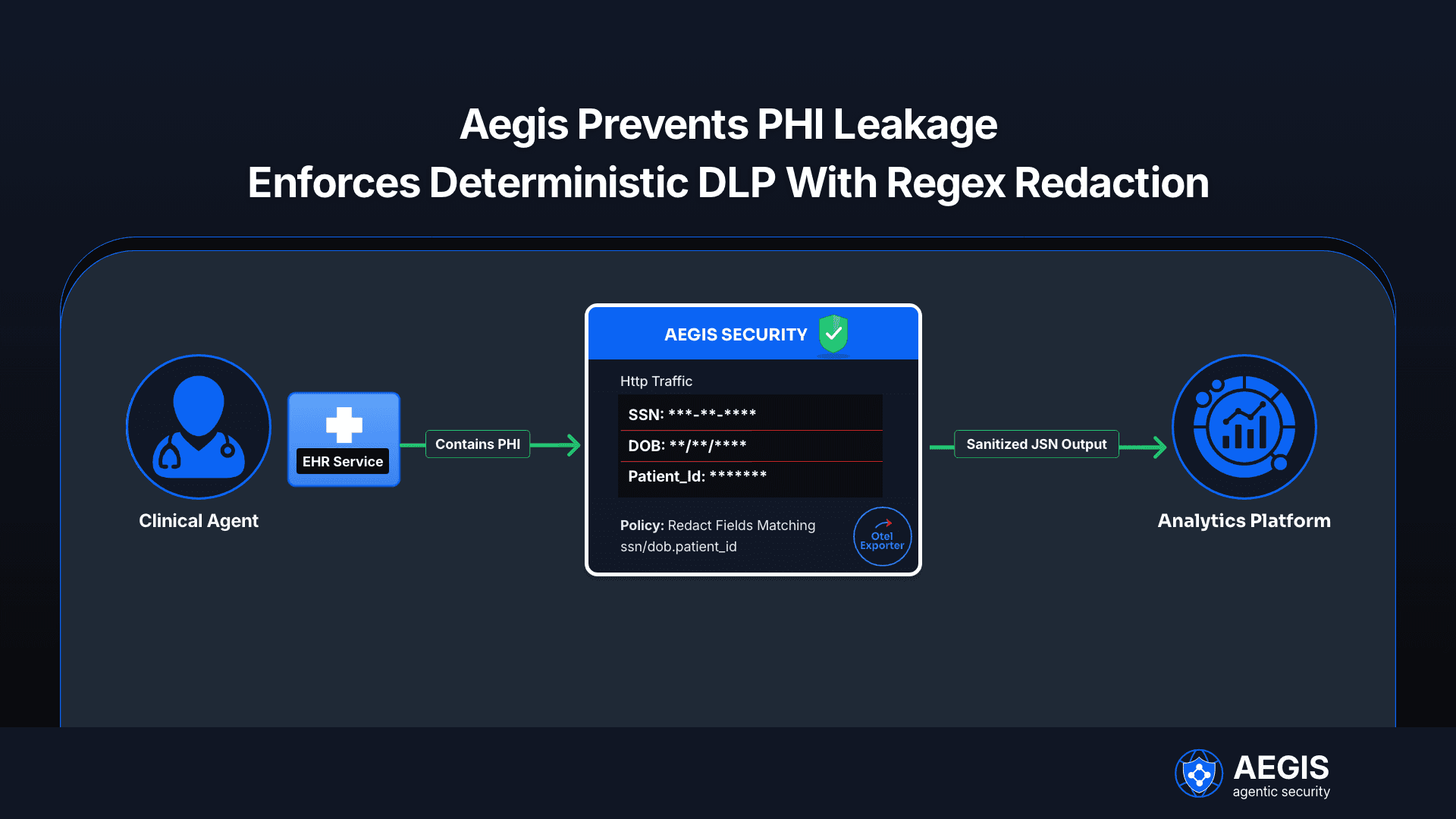
Deterministic regex-based redaction reliably removes structured PHI (SSN, MRN, DOB) at the gateway. Optionally add an ML pipeline to sanitize ambiguous text or unstructured data that regexes miss. Microsoft and industry DLP guidance endorse regex patterns as a foundational control. (Microsoft Learn)
Egress controls and per-tenant routing
Route outbound calls to approved, regionally compliant endpoints (per-tenant routing) so PHI never leaves approved legal jurisdictions. Enforce domain allowlists and signed tokens for destination verification.
Approval workflows & auditable traces
High-risk actions (exports, payments, bulk reads) require “approval_needed” state: the gateway pauses, posts an approval to an external channel, then issues a one-time override token if approved. Maintain tamper-resistant spans and signed logs as HIPAA evidence.
Logging redaction and retention policies
Keep metadata and decision reasoning in logs but redact PHI. Store an immutable audit trail (signed or hash-chained) with retention aligned to regulatory needs.
Aegis in practice — product description and architecture
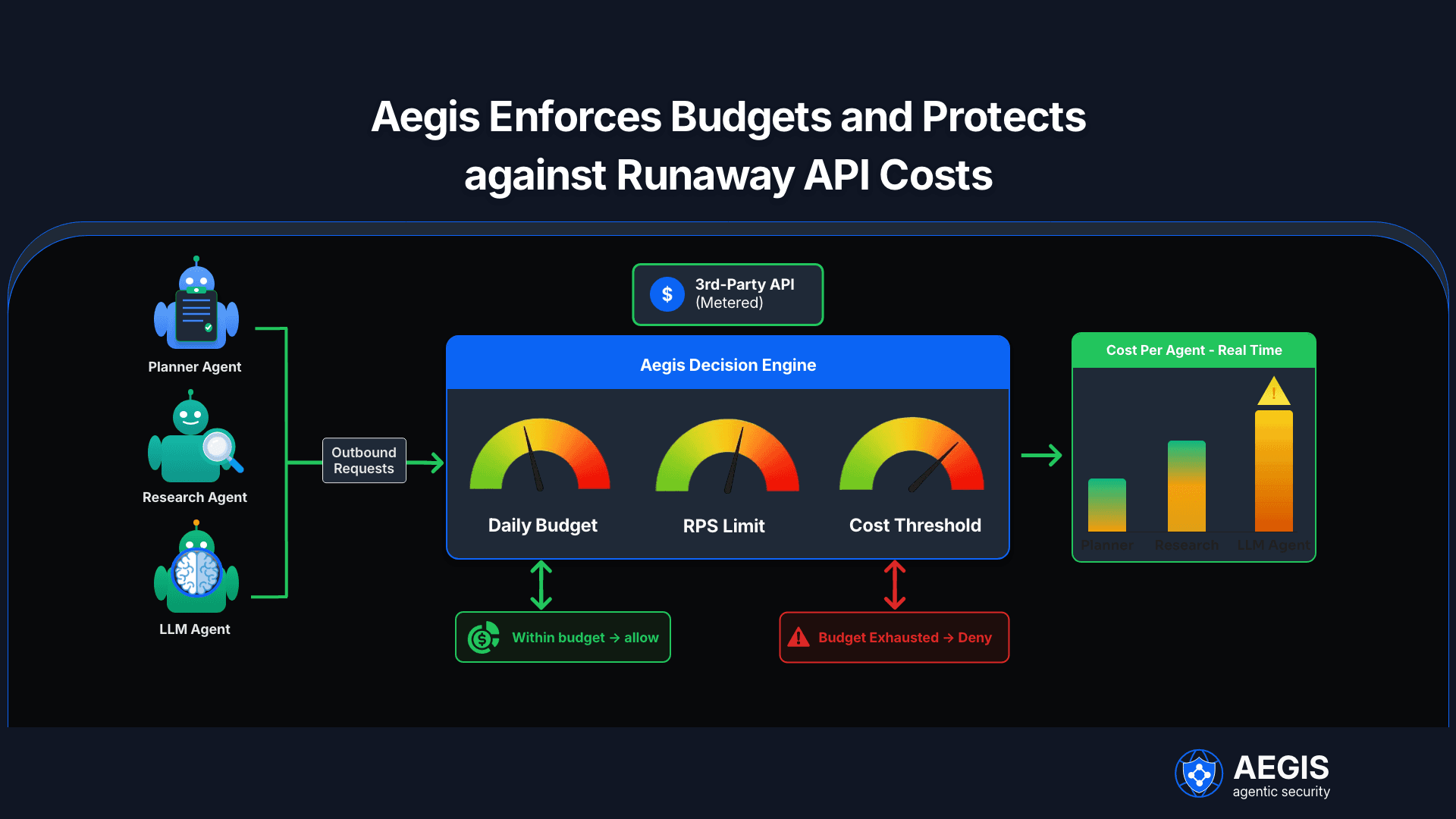
Aegis Gateway is a runtime policy and observability fabric for multi-agent AI — a lightweight, agent-aware policy enforcement layer that sits between orchestrators and external tools. It is designed to enforce the exact controls outlined above at the agent↔tool boundary, producing SIEM-ready telemetry and tamper-evident audits suitable for HIPAA compliance reviews. Key capabilities include policy-as-code, deterministic DLP, approvals, tokenized identity, per-tenant routing, and OpenTelemetry spans for every decision.
How Aegis enforces HIPAA controls (technical flow)
- Agents call tools via Aegis (either as a sidecar/proxy or middleware). Aegis extracts agent identity (short-lived JWT with tenant and role claims).
- Policy evaluator (OPA/Rego compiled bundles) checks ABAC rules: purpose, role, resource field-level conditions. If the action is allowed, the request proceeds; if it matches sanitize rules, deterministic regex redaction executes; if it’s high-risk, the request transitions to approval_needed.
- All decisions emit signed OpenTelemetry spans and structured logs (agent_id, policy_version, decision_reason, approval_id). Logs redact PHI but preserve metadata for forensic review.
Developer & operational ergonomics
Aegis offers SDKs, CLI tools for agent registration, dry-run/shadow modes for tuning policies, and a control plane to publish OPA bundles and maintain policy version history. Shadow rollout captures would-block events to minimize disruption when enforcing policies in production.
👉🏻 Identify and mitigate privacy risks in healthcare AI workflows
Concrete HIPAA-enabled scenarios
EHR read/write gating
Policy: clinical-agent may read /patients/{tenant}/records only if purpose=care; deny export=true. For any attempted export, Aegis blocks and logs the event, or requires approval when consent is present.
PHI redaction before external APIs
Pipeline: deterministic regex redact SSN/MRN/DOB → optional ML sanitization → tokenization for analytics payloads. This prevents raw PHI from reaching third-party APIs.
Controlled clinical automation
Automated triage agent drafts a patient export for research. Aegis enforces: (1) purpose==research, (2) patient consent present, (3) export destination approved. If any condition fails, the action is blocked and logged; if allowed, redaction and tokenization proceed and an auditable span is produced.
👉🏻 Enable secure and compliant healthcare automation with AI agents
Two comparison tables
Control Area | Legacy Approach | Aegis Approach |
Access model | Role-only IAM, static allowlists | ABAC (purpose, role, tenant, fields) with policy-as-code. |
DLP | Point tools, inconsistent coverage | Deterministic regex redaction + optional ML sanitization in gateway. (Microsoft Learn) |
Auditability | Fragmented logs across services | Signed OpenTelemetry spans + versioned policies. |
HIPAA concern | Minimal viable control |
Unauthorized export | Approval workflow + ABAC export rules |
Log leakage | Redact PHI; retain metadata-only logs |
Regional compliance | Per-tenant routing to approved endpoints |
Evidence for audit | Immutable, signed traces with policy versions. |
Testing, validation and operational playbooks
- Adversarial prompt injection tests: simulate malicious planner agents to validate the DLP and parameter sanitizers.
- Shadow rollout metrics: measure “would-block” rates, approval latency, and prevented PHI exports.
- Incident response templates: pre-defined playbooks for PHI exposure with patient notification triggers and evidence bundles for OCR. Recent legal analysis and guidance re-affirm the need for BAAs and documented technical safeguards when vendors process PHI. (Frost Brown Todd)
Deployment & scaling considerations
- Latency targets and caching: compile OPA queries to prepared queries or WASM for P99 policy evaluation under 20 ms. Aegis’s architecture uses hot-reloadable bundles and in-memory caches to meet runtime SLAs.
- Multi-tenancy: strong tenant scoping in bundles and control-plane separation prevents policy cross-contamination.
- Fail-closed defaults for writes; configurable fail-open for low-risk reads to preserve availability during outages.
Integration and governance checklist (short)
- Inventory agentic workflows that touch PHI.
- Map ABAC policies to purpose/role/fields.
- Create deterministic regex patterns for known PHI fields; augment with ML for unstructured text.
- Configure per-tenant egress allowlists and BAA-validated connectors.
- Run shadow mode for 7–14 days and iterate policies before enabling enforcement.
- Maintain training for clinicians and approvers on the approval UX and incident flows.
Resources and further reading
- Market and adoption signals: McKinsey “State of AI” report (2025) shows meaningful enterprise agentic experimentation. (McKinsey & Company)
- HIPAA-specific guidance on AI and PHI handling. (The HIPAA Journal)
Frequently Asked Questions
1. Can regex DLP be relied on alone?
Regex patterns are foundational for structured PHI (SSN, MRN). For unstructured clinical notes, combine regex with ML-based classifiers and tokenization for stronger coverage. (Microsoft Learn)
2. What evidence does Aegis provide for audits?
Aegis emits signed OpenTelemetry spans and structured logs including policy_version, decision_reason, agent_id and approval_id; those artifacts can be exported as audit bundles.
3. How do approvals scale?
Policies can tune thresholds to limit approvals (e.g., require approval only over amounts or bulk exports). Integrations with Slack/Teams and override tokens streamline human-in-the-loop flows.
4. How should I test for prompt-injection attacks?
Use adversarial test harnesses to send crafted prompts through orchestrators and validate that gateway DLP, parameter validation and approval gates prevent unsafe actions. Shadow mode helps surface would-block events safely.
5. Does routing to approved endpoints solve residency issues?
It’s necessary but not sufficient. Combine per-tenant routing, contractual BAAs with connectors, encryption at rest/in transit, and backup residency policies for full compliance. (Frost Brown Todd)
Operationalize protection, not hope
Agentic AI offers productivity benefits but raises distinct HIPAA risks. The correct response is a practical, layered control plane: ABAC decisioning, deterministic DLP with ML augmentation, per-tenant egress, approvals, and signed audit traces. Aegis implements these controls at the runtime boundary where agents meet tools—enabling teams to deploy agentic automation while preserving compliance, auditability, and operational control.