
Designing Approvals for Varying Risk Levels
Practical guidance for designing scalable, low-fatigue approval workflows for agentic AI with Aegis' runtime policy and approvals.
Policy-driven approvals for agentic systems
Agentic AI systems can accelerate operations — but without the right guardrails they quickly generate overwhelming approval queues, audit gaps, and operational risk. This post explains why approvals matter for agentic systems, how policy-driven approval patterns reduce fatigue, and how Aegis (the Agentic AI Security Mesh) implements scalable approval workflows that are auditable, low-latency and integrable with Slack/MS Teams.
👉🏻 Strike the right balance between agility and enforcement
Approval problems in agentic systems
Agentic systems chain calls, invoke tools, and act with minimal human supervision. Two operational realities follow:
- Risk is variable. Some agent actions are low-risk (e.g., reading a public status), others are high-risk (e.g., payments, pushing production infra changes). Treating all actions the same creates noise.
- Humans are a scarce resource. Blast approval requests to on-call channels and the result is alert fatigue, missed approvals, slow MTTR and shadow overrides.
Industry evidence: adoption of agentic AI is growing fast — market estimates put the global agentic AI market at roughly USD 6 billion in 2024, with strong CAGR projections into the later 2020s. (Fortune Business Insights) Research and surveys show substantial enterprise interest but also operational and governance concerns in 2024–2025. (Architecture & Governance Magazine) Gartner additionally cautions that many agentic projects will fail without clear value and controls. (Reuters)
👉🏻 Stay audit-ready with compliance-aligned agent policies
Why naive approvals fail
- Manual, ticket/email-based approvals lack context (payload, policy reason, telemetry) so approvers must hunt for evidence.
- All-or-nothing approval routing treats low-risk and high-risk uniformly.
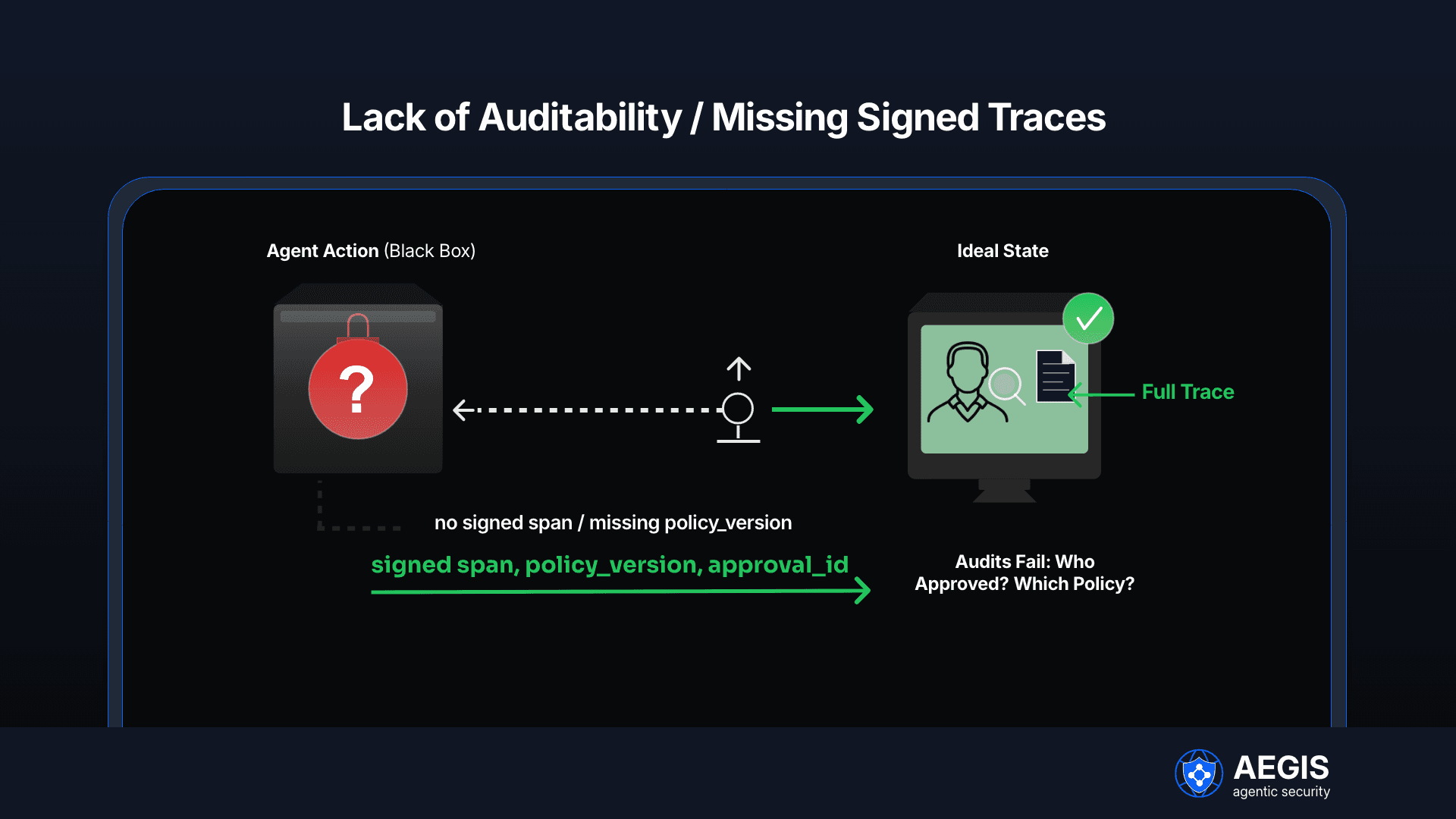
- No structured attestation — approvals are ephemeral, not cryptographically recorded.
- High frequency of requests (incident storms or batch tasks) overwhelms approvers.
Policy-driven approvals and Aegis implementation
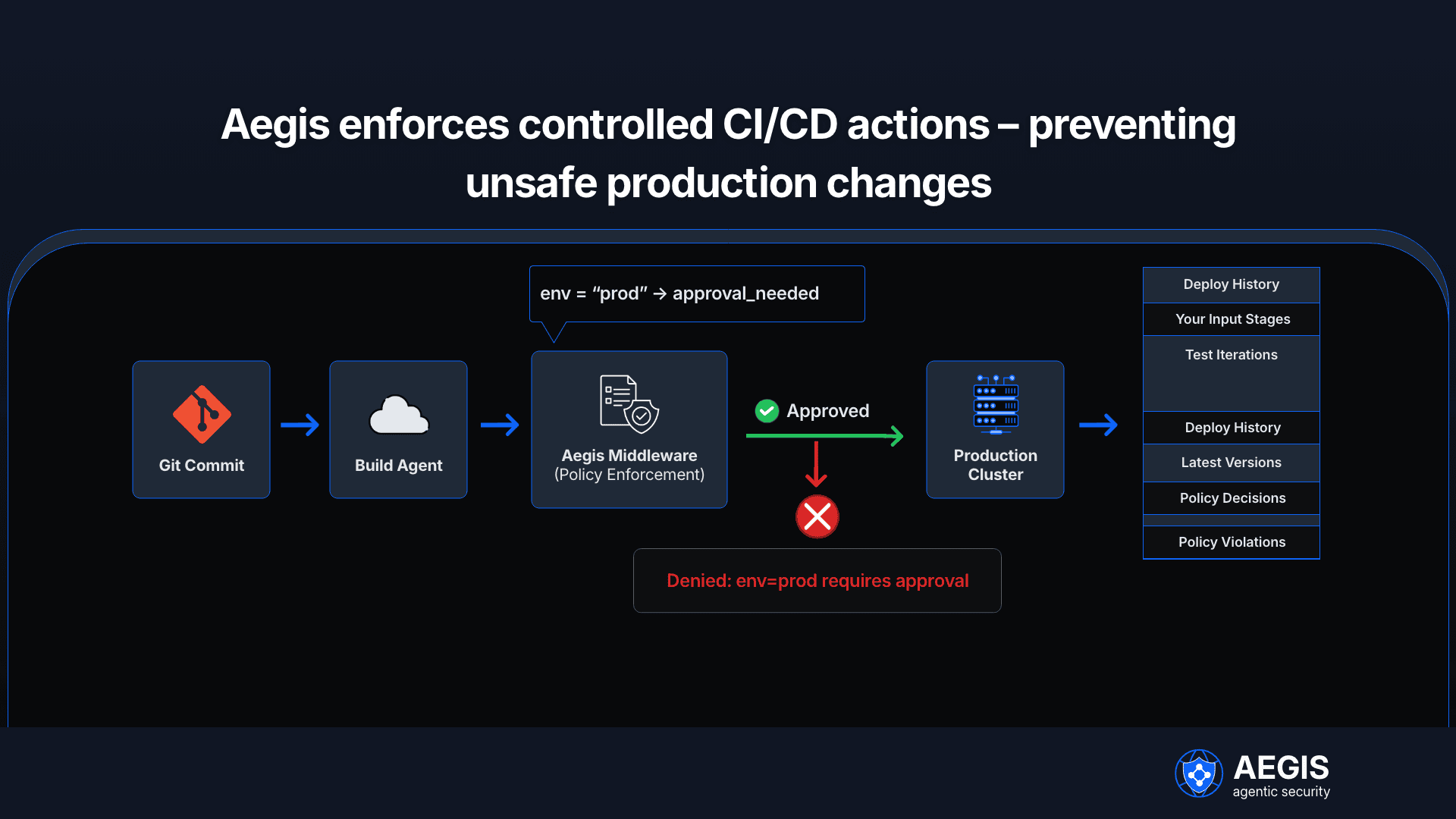
Aegis treats approvals as a policy outcome, not a separate process. Policies evaluate agent identity, tool, parameters and context and return one of four runtime outcomes: allow, deny, sanitize, or approval_needed. When approval_needed is returned, Aegis orchestrates a compact, auditable human-in-the-loop flow.
Key capabilities (Aegis-focused)
- Policy-as-code: YAML/JSON policies map risk tiers (low/medium/high) to approval paths and thresholds, including parameter ranges (e.g., payments > $5,000 → approval_needed). Aegis compiles policies into fast runtime bundles.
- Interactive approvals: Aegis posts an approval request to Slack/MS Teams with a contextual payload snapshot (agent ID, caller chain, parameter excerpt, OTel trace link) and structured accept/deny buttons. On approval, a one-time override token is minted and returned to the caller for a retry.
- Timeboxing & TTL: Pending approvals have TTLs and escalation rules; missed approvals follow automated escalation to on-call or service accounts.
- Auto-allow ranges and bulk patterns: Policies support auto-approve when parameters fall in safe ranges (e.g., payments < $2,000) and bulk approval rules for batched low-risk actions.
- Signed attestation: Each approved override mints a signed attestation record that is preserved in SIEM and audit stores, ensuring traceability for compliance.
How the approval message is structured
Approval messages are minimal but evidence-rich:
- Title: action, agent, risk tier
- Snapshot: truncated parameters, target tool, parent-agent chain
- Telemetry: link to OTel trace and decision span
- Buttons: Accept (mint override), Deny, Request More Info
- Structured rationale field for approver input (required for high-risk)
Designing for scale and minimizing fatigue
Approval volume is the fundamental scalability problem. These patterns reduce human load.
1. Risk-tiered routing
Map actions to low/medium/high risk tiers and attach default paths:
- Low: auto-approve or batched bulk approvals.
- Medium: single approver via Slack/Teams with required rationale.
- High: multi-approver or designated approver group, escalation policy and signed attestations.
2. Parameter-aware auto-approval
Policies must evaluate parameters. Example: payments with amount ≤ $2,000 and destination in approved vendor list → allow. Payments > $2,000 require approval. Parameter conditions are encoded in policy-as-code and tested in dry-run before rollout.
3. Throttles, rate-limits and backpressure
Rate-limit approval actions per approver and globally during incident storms. Aegis supports policies that return “deferred” decisions with exponential backoff recommendations to the caller.
4. Approver selection & scheduling
Automated approver selection uses RBAC + on-call schedules; policies can specify role-based selectors and fallbacks. If primary approver misses TTL, escalate automatically.
5. Simulate & dry-run approval rules
Use a shadow/dry-run mode to collect would-be approval events and tune thresholds. Shadow-mode telemetry feeds dashboards that show would-block rates, queue depth, and top offenders.
Table: Example approval policy mapping
Risk tier | Parameter rule | Approval path | Attestation |
Low | payments ≤ $2,000 | Auto-approve (policy) | Recorded (audit) |
Medium | $2,000 < payments ≤ $10,000 | Single approver (Slack) | Signed override token |
High | payments > $10,000 | Group approval (2-of-3) | Signed token + required rationale |
Operational KPIs and playbooks
Measure the effectiveness of approvals with KPIs that matter operationally.
Suggested operational KPIs
KPI | Why it matters | Target (example) |
Approval MTTR | How quickly actions unblock | < 10 minutes for medium risk |
Approval queue depth | Indicator of approver overload | < 50 pending |
Would-block ratio (shadow→enforce) | Policy tuning signal | Reduce to < 2% false positives |
Signed attestation retention | Compliance evidence | 100% of override tokens retained |
Approval rate per approver/hour | Fatigue monitoring | < 15 approvals/hr per approver |
Playbook highlights
- Preflight: shadow-run for 7–14 days to gather would-blocks and parameter distributions.
- Policy rollout: staged flip from shadow → alert-only → enforced with automatic rollback on KPI regressions.
- Incident mode: automatic raise of thresholds and batched approvals when multiple dependent automations run.
- Audit: export signed attestations to SIEM and retain policy change history.
Implementation notes (practicalities)
- Use a runtime policy engine (Aegis compiles to fast evaluation bundles; underlying engines like OPA are proven in cloud-native stacks). For policy fairness and performance rely on prepared queries and in-memory caches to keep P99 decision latency low. (Open Policy Agent)
- Integrate OpenTelemetry to attach decision spans to traces so approvers can jump to full context. OpenTelemetry provides standard SDKs and exporters to build those links. (McKinsey & Company)
- Keep approval tokens one-time and short-lived; design retry helpers in the client SDK to avoid replay attacks.
- Preserve tamper-proof logs (hash chains or signed manifests) for compliance audits.
Why this matters for MSSPs and regulated industries
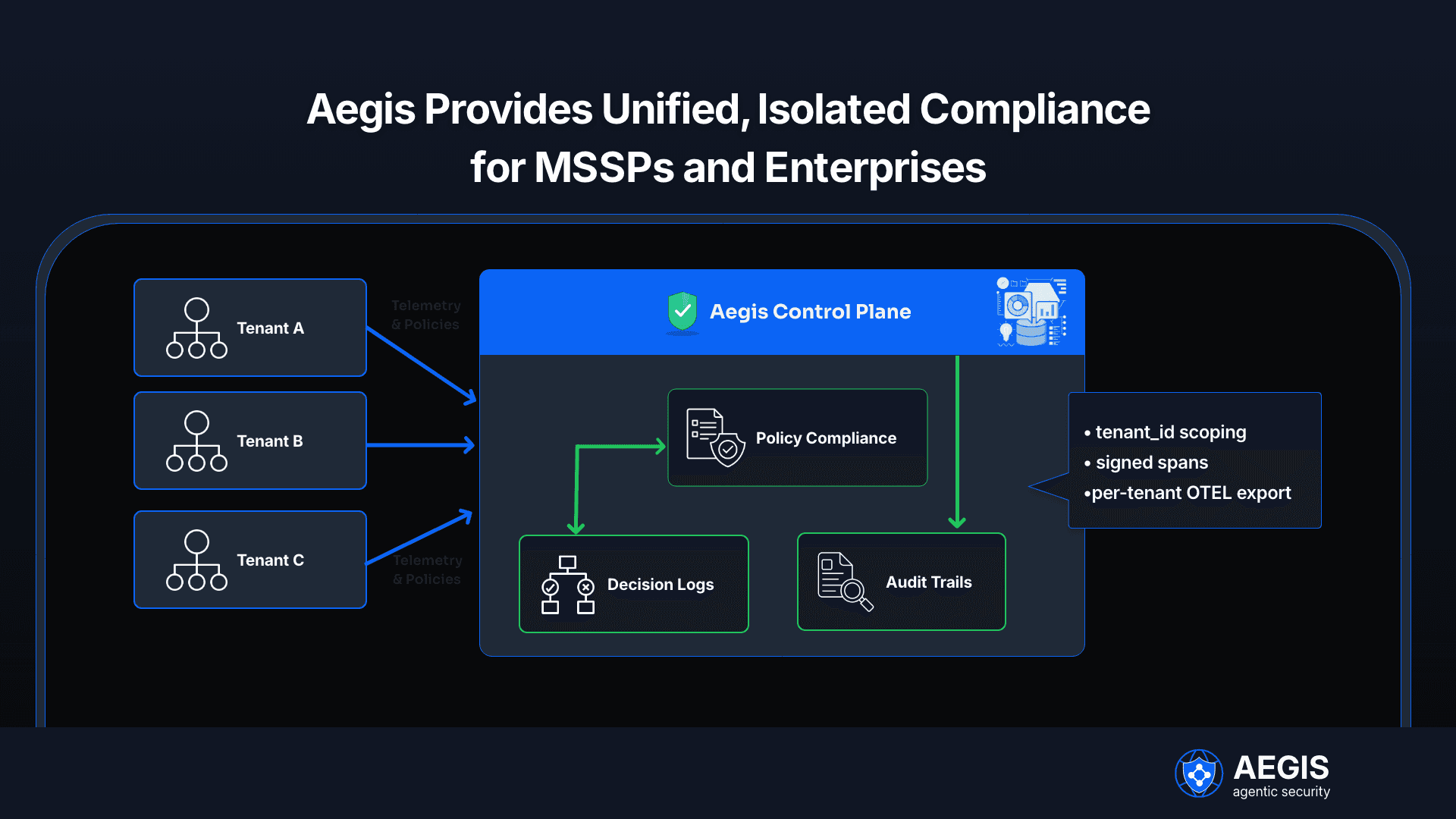
MSSPs and regulated verticals (finance, healthcare) require multi-tenant scoping, region-aware routing and auditable approvals. Aegis supports tenant-scoped bundles, region-tagged policies and SIEM-friendly signed records — making it usable for multi-tenant managed services and compliance teams. Practical use cases include high-value payment gating, EHR access control with deterministic DLP, and CI/CD production deploy gating where human attestation is legally required.
👉🏻 Create a single trusted source for all agent governance rules
Quick checklist to implement policy-driven approvals
- Define risk tiers and map top 50 actions to tiers.
- Author parameter-aware policies (YAML/JSON) and run dry-run for 7 days.
- Integrate Slack/MS Teams interactive approvals; include telemetry links.
- Implement TTL, escalation and rate-limits per approver.
- Ensure signed override tokens and SIEM export for attestations.
- Monitor KPIs and iterate.
Further reading & references
- Open Policy Agent — policy-as-code foundations. https://openpolicyagent.org/. (Open Policy Agent)
- OpenTelemetry — tracing for approval context. https://opentelemetry.io/. (McKinsey & Company)
- Market and adoption signals (agentic AI market estimates and enterprise surveys). (Fortune Business Insights)
- Gartner analysis on agentic project attrition and need for governance. (Reuters)
Frequently Asked Questions
Q: When should I require approvals vs auto-approve?
A: Base the decision on risk tier and parameter rules. Auto-approve when parameters fall in pre-approved safe ranges and the action has low business impact. Use policy dry-run to validate thresholds.
Q: How do I prevent approval token replay?
A: Use one-time tokens with jti replay protection in a token store; set short TTLs and require signed attestations that are checked by the gateway on retry.
Q: Can approvals be batched?
A: Yes — policies can define bulk approval flows for low-risk batched actions, reducing human load. Ensure batch summaries include representative payload samples.
Q: How do I preserve auditability?
A: Store signed override records, policy versions, and the decision traces in your SIEM or audit store. Hash-chains or signed manifests help demonstrate tamper-resistance.
Q: How do I measure if approvals are causing delays?
A: Track Approval MTTR, queue depth, and approver throughput. If MTTR rises or queue depth exceeds thresholds, raise automatic throttles or add approvers.
Q: Is shadow mode necessary?
A: It's strongly recommended — shadow mode yields would-block telemetry you need to tune policies without disrupting production.
This article described the problem space, operational prescriptions, and the design Aegis uses to provide scalable, auditable approvals for agentic systems. Aegis implements policy-as-code, parameter-aware thresholds, Slack/MS Teams interactive approvals, one-time override tokens, TTL-based escalation and signed attestation — all the primitives enterprise security and compliance teams need to safely scale agentic automation.