
Building a Single Source of Truth for Agent Policies
How to centralize, version and enforce agent policies at runtime for secure, auditable agentic AI.
Building a Single Source of Truth for Agent Policies
Enterprises adopting agentic AI need more than access control; they need a single, versioned registry that defines which agents can call which tools, with what parameters and under what conditions. This post explains why decentralised policy artifacts break governance, the design goals for a central policy control plane, concrete implementation patterns (schema, bundling, signing), governance workflows (PRs, CI, audit), and a pragmatic migration playbook — illustrated with examples from Aegis, a policy & observability gateway built for multi-agent architectures.
Why many “policy” problems are really decentralization problems
Fragmented policies are the root cause of most agent governance failures. Teams scatter rules across SDK decorators, ad-hoc spreadsheets, and embedded checks in agent code; this creates:
• Inconsistent enforcement across environments and tenants.
• Audit gaps that fail compliance reviews.
• Slow incident response due to missing provenance and versioning.
Recent adoption figures show roughly 39% of organizations experimenting with agents; however, only a minority have formalised agent policies — a gap that amplifies misconfigurations and cross-team friction. Centralising policies reduces blast radius, standardises review paths, and enables reproducible audits.
👉🏻 Drive consistency with automated policy enforcement at scale
.png&w=3840&q=75)
Design goals for a single source of truth
A robust central registry must satisfy operational, security, and compliance constraints:
- Canonical schema & policy-as-code — define a simple, explicit schema (agent_id, tool_id, actions, conditions, risk_tier). Validate YAML/JSON against that schema in CI.
- Versioning & immutability — every published policy bundle must be versioned, signed, and stored immutably (ETags + manifest signing).
- Tenant scoping & RBAC — bundles must be tenant-scoped; editors and approvers have distinct roles.
- Hot-reload & low-latency — control plane should compile policies into lightweight runtime bundles (OPA/wasm) delivered to the data plane with hot-reload to avoid restarts.
- Dry-run & diff preview — teams need would-deny simulation and diffs so they can measure impact before enforcement.
- Auditability & compliance exports — exportable reports, linkable approvals, and tamper-evident logging.
- Developer ergonomics — CLI/SDK for policy dry run, linting, sample templates and policy PRs to mirror code workflows.
Implementation patterns (schema, bundling, signing)
Policy schema (example)
Use a concise, enforceable schema. Example keys:
- agent_id: string
- tool_id: string
- actions: list (create_payment, read_file)
- conditions: map (amount <= N, regex, allowed_channels)
- risk_tier: enum (low, medium, high)
Validate at commit-time and gate with CI unit tests that run sample inputs through the policy logic (dry-run vectors). Store the canonical schema in the control plane repo and require schema lint in PR checks.
👉🏻 Ensure safe deployments with controlled policy versioning
Bundling and signing
Compile YAML/JSON policies into runtime bundles (e.g., OPA bundle or WASM). Bundles should include:
- data.json (tenant/agent specifics)
- policy.rego (shared evaluation logic)
- manifest.json (version, timestamp, author, ETag, signature)
Serve bundles from an object store (S3/GCS) and deliver ETags to the data plane. The data plane validates manifest signatures before applying bundles; if validation fails the system falls back to the last known-good bundle or a configured fail-closed mode.
Runtime integrity
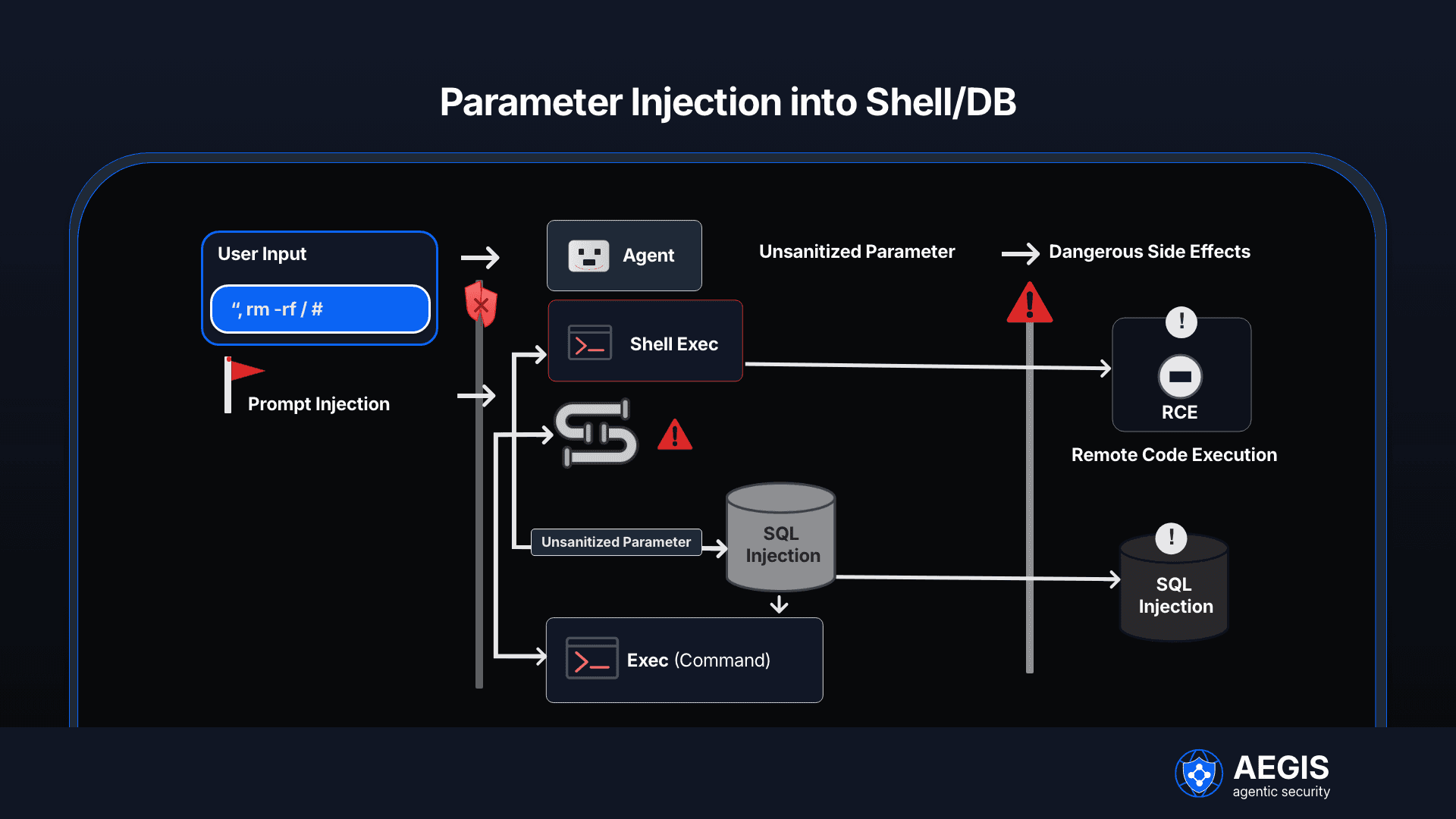
At enforcement time, the gateway evaluates agent_id, tool_id, parameters and call chain. Decisions must emit structured telemetry (OpenTelemetry spans with policy_version, decision_reason, approval_id). Keep eval hot-reloadable and aim for minimal additional latency (target P99 ≤ 20ms).
Governance and workflow (PRs, CI, audit)
Policy PRs & branching model
Treat policy changes like code. Policy PRs include:
- intent (why change)
- test vectors (sample inputs)
- shadow-mode run output (would-deny counts)
- reviewer(s) and approver(s)
Use branching for staged rollout: feature branch → integration → shadow → partial enforcement → global enforcement.
CI gating & unit tests
Every PR runs policy lint, schema validation, and sample evaluations. CI should reject policies that are syntactically invalid or that produce regression in test vectors.
Approval workflows & audit
Policies must carry metadata linking to approval tickets. For high-risk policy changes, require approver signoff. Maintain an immutable audit trail that records who changed what and when; sign manifests and store them with timestamps for forensic review. Integrate exportable reports for auditors and SOC teams.
Migration playbook with Aegis examples
Below is a pragmatic rollout plan that maps to stages used in pilots and early customers.
Stage | Action | Key outputs |
Discover | Inventory agents & connectors; detect policy artifacts in repos | Agent registry, map of gaps |
Import & Reconcile | Auto-import found policies; flag conflicts | Reconciled policy drafts |
Shadow rollout | Deploy bundles in shadow mode for 7–14 days | Would-deny metrics & parameter distributions |
Partial enforcement | Enforce for a limited tenant or agent cohort | Reduced false positives |
Global enforcement | Switch to enforced mode with monitoring | Full audit logs & alerts |
Aegis implements this flow as an opinionated control plane: import helpers, shadow analytics, and rollout toggles enable teams to convert ad-hoc checks into governed, versioned policies.
Aegis AI Security As A Solution
Aegis is designed to be the policy & observability fabric for agentic systems. Its approach aligns tightly with the design goals above and maps directly to enterprise operational needs:
• Control plane — administrators author policy-as-code (YAML/JSON). Aegis compiles these into signed OPA bundles and stores manifest metadata (version, author, tags). It provides policy dry-run, validation, and a PR-driven workflow to mirror existing developer processes.
• Data plane (Gateway) — a lightweight sidecar/forward proxy intercepts agent → tool calls, evaluates policy with a local OPA evaluator and returns allow/deny/sanitize/approval_needed decisions. The gateway supports hot-reload of bundles and minimal latency (P99 targets in the 10–20ms range).
• Telemetry & audits — every decision emits OpenTelemetry spans and structured logs that include policy_version and decision_reason. These are exportable to SIEMs for compliance and forensic investigations.
• Developer UX — CLI and SDKs make it simple to register agents, run dry-runs locally, and push policies through CI. Sample policy templates for finance, EHR and CI/CD reduce onboarding friction.
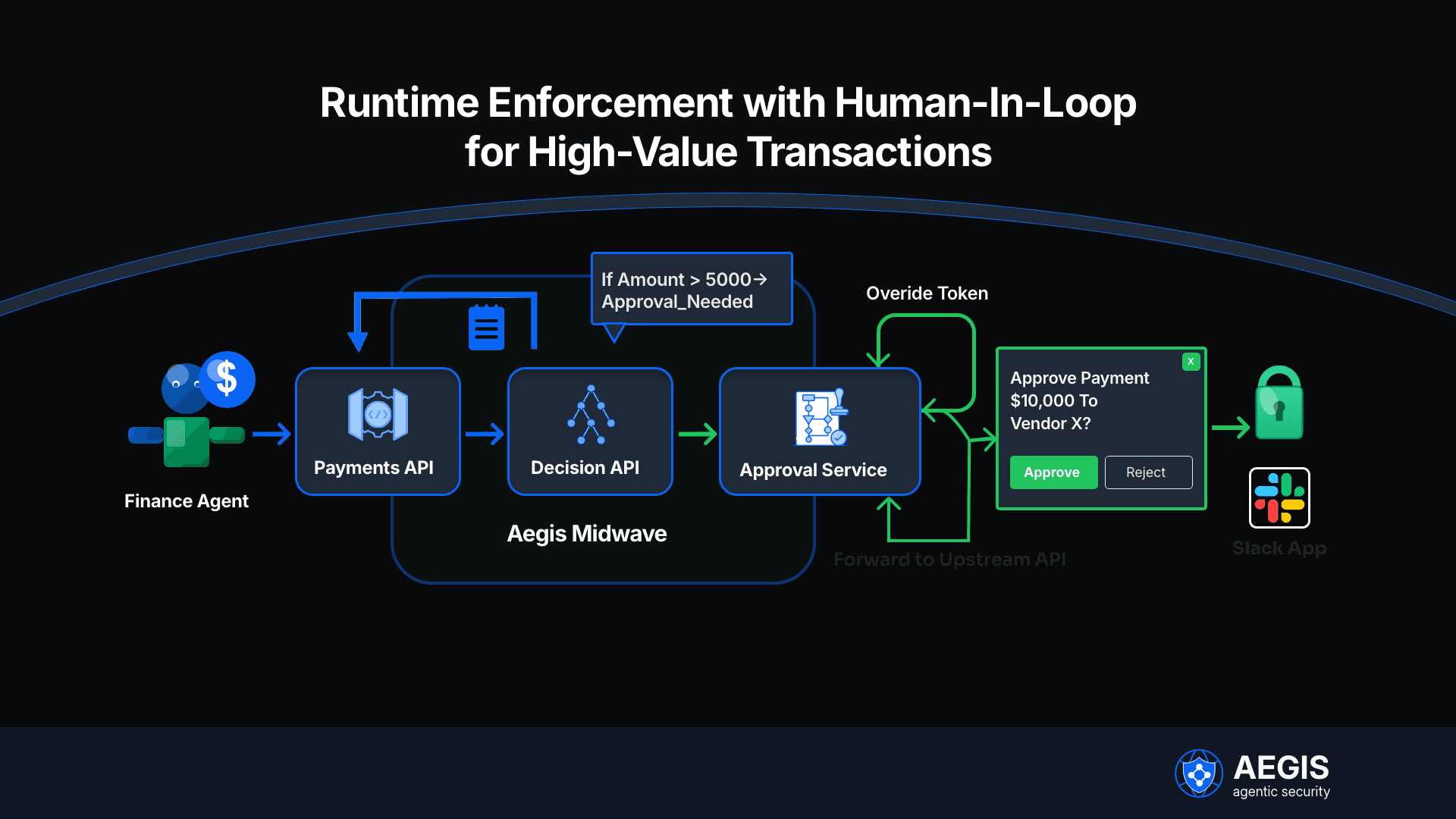
• Safety controls — Aegis enforces per-agent budgets, rate limits, escape hatches (approval workflows with Slack/MS Teams integration), and emergency rollback switches to freeze policies during incidents.
Operational example: a planner agent tries to coerce a finance agent into a $50,000 payment. The finance agent’s policy enforces max_amount: 5000 and approval_needed above threshold. Aegis blocks the call, emits a PolicyViolation event, and if configured, sends a Slack approval request. The control plane records the manifest and approval transaction for auditors.
👉🏻 Align your agent policies with SOC and regulatory requirements
Policy examples and technical comparison
Policy example | YAML fragment | Enforcement outcome |
High-risk payment | agent: finance\nactions: [create_payment]\nconditions: {max_amount:5000} | Block above 5k; approval_needed otherwise |
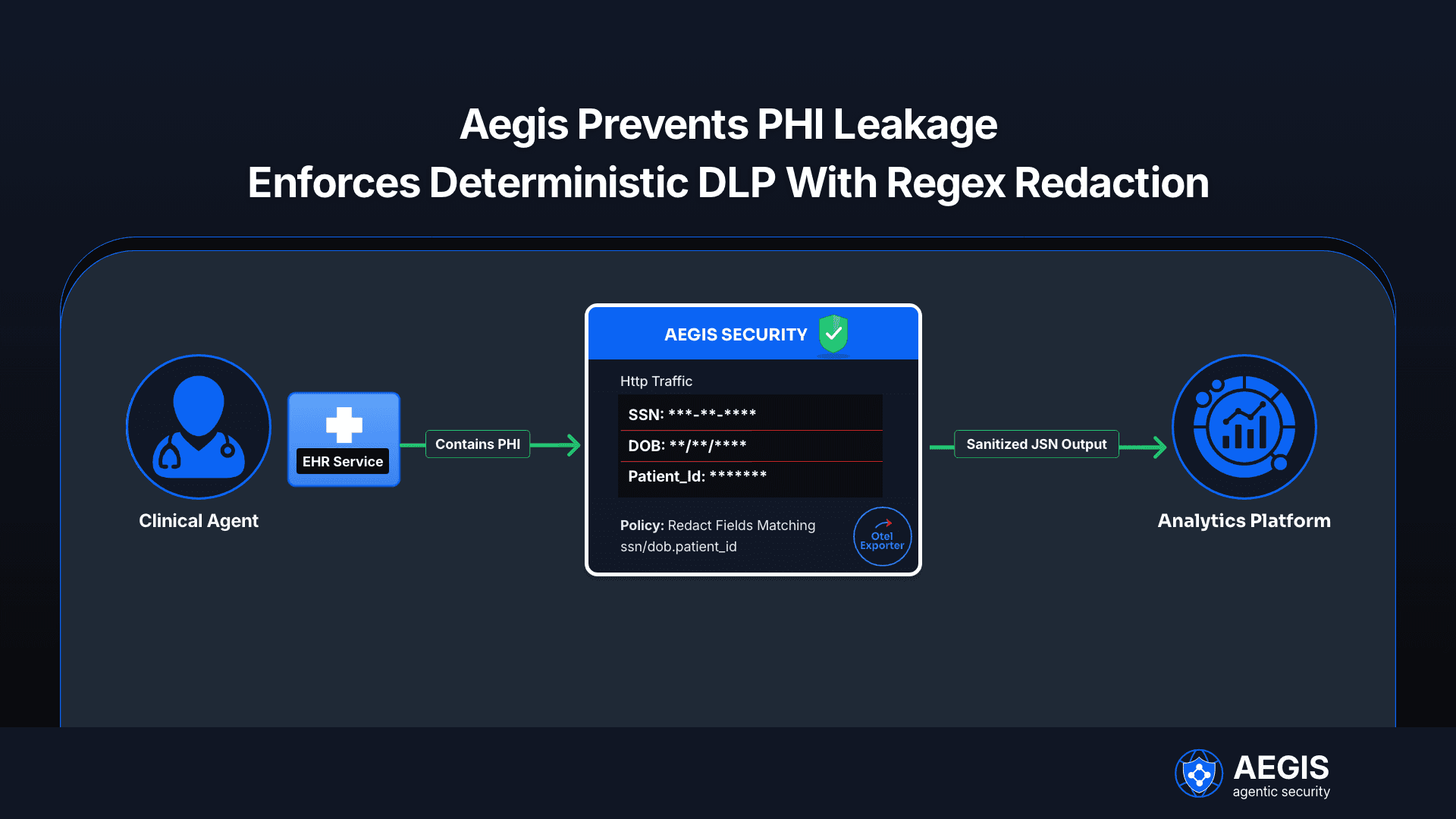
EHR read-only | agent: clinical\ntools: [ehr]\nconditions: {purpose: care, dest: internal-ehr} | Deny export or off-region calls |
Component | Legacy ad-hoc checks | Centralized registry (Aegis style) |
Versioning | None / manual | Immutable bundles + signatures |
Review process | Informal | PRs + CI + approvers |
Runtime enforcement | Embedded in code | Gateway + OPA bundles |
Auditability | Sparse logs | Signed manifests + OTel traces |
Operational checklist & monitoring
- Policy coverage metrics by agent/tool (target ≥80% for critical tools).
- Shadow run period and conversion thresholds (e.g., 7–14 days, <1% false positives).
- CI gates: schema lint, sample vectors, dry-run diff.
- Emergency rollback: manifest freeze + data plane freeze switch.
Frequently Asked Questions
Q: How do we scope policies for multi-tenant environments?
A: Use tenant-scoped bundles and RBAC for editors/approvers; include tenant IDs in token claims.
Q: What happens if bundle signature verification fails?
A: The data plane should fall back to last known-good bundle or a preconfigured fail-closed behaviour.
Q: Can we perform dry-runs on production traffic?
A: Yes — route decisions in shadow mode and collect would-deny metrics without blocking.
Q: How are approvals handled at scale?
A: Policies can apply thresholds to reduce approvals and route only high-risk events to human approvers; integrate with Slack/MS Teams with queued override tokens.
Q: Which telemetry fields are must-haves for compliance?
A: agent_id, tool, decision, policy_version, decision_reason, approval_id, timestamp — exportable to SIEM.
Q: How does Aegis integrate with existing orchestrators?
A: Via lightweight middleware or sidecar proxies for LangChain/LangGraph/AgentKit-style orchestrators; SDKs and Helm charts simplify deployment.