Designing Agentic AI to Work with Quantum Computing
Practical design patterns for hybrid classical–quantum agents and how Aegis enforces safe, auditable quantum calls.
Designing Agentic AI to Work with Quantum Computing: Practical Patterns and How Aegis Enforces Safe Calls
Introduction
Agentic AI is moving from lab experiments to targeted production pilots. Quantum computing promises acceleration for tightly scoped problems, but the reality remains: quantum endpoints are noisy, expensive, and rare. This article gives a practical reality check for architects, patterns for hybrid agent design, a pilot playbook, and a detailed look at how Aegis enforces safe, auditable quantum calls in production. It draws on common enterprise constraints and the Aegis Gateway design brief.
👉🏻 Connect AI agents with IoT for real-time intelligent operations
Quantum reality check for agent architects
Quantum computing today is best seen as a niche accelerator, not a drop-in replacement for classical compute. Industry surveys in 2024–2025 show organizations experimenting aggressively with agents while remaining cautious about unproven tech: roughly 23% of firms report scaling agentic AI and many more experimenting. Hybrid approaches—classical pre/post processing with small quantum kernels—are the sensible path forward. (McKinsey & Company)
Practical constraints to accept up front:
• NISQ devices remain noisy and latency-prone. Expect retries and higher failure rates for quantum jobs. (The Quantum Insider)
• Vendor endpoints are often third-party; egress, attestation, and billing are real operational concerns.
• Cost/performance tradeoffs make quantum suitable only where marginal gains justify long queues or high price per shot (e.g., derivatives pricing, combinatorial optimization).
.png&w=3840&q=75)
Hybrid design patterns (classical pre/post + quantum core)
Design agents so that quantum calls are small, well-defined, and sandboxed behind tool interfaces.
1. The “quantum subroutine” pattern
Agents perform classical preprocessing to convert domain data into the small, structured inputs quantum runtimes require. The quantum call returns a compact result the agent integrates with classical postprocessing. This reduces serialization costs and limits expensive quantum usage to high-value operations.
2. Batching and aggregation
Batch multiple candidate problems into a single quantum job when the algorithm and provider support it. Batching amortizes initialization costs and reduces the number of expensive calls.
3. Simulators and shadow mode
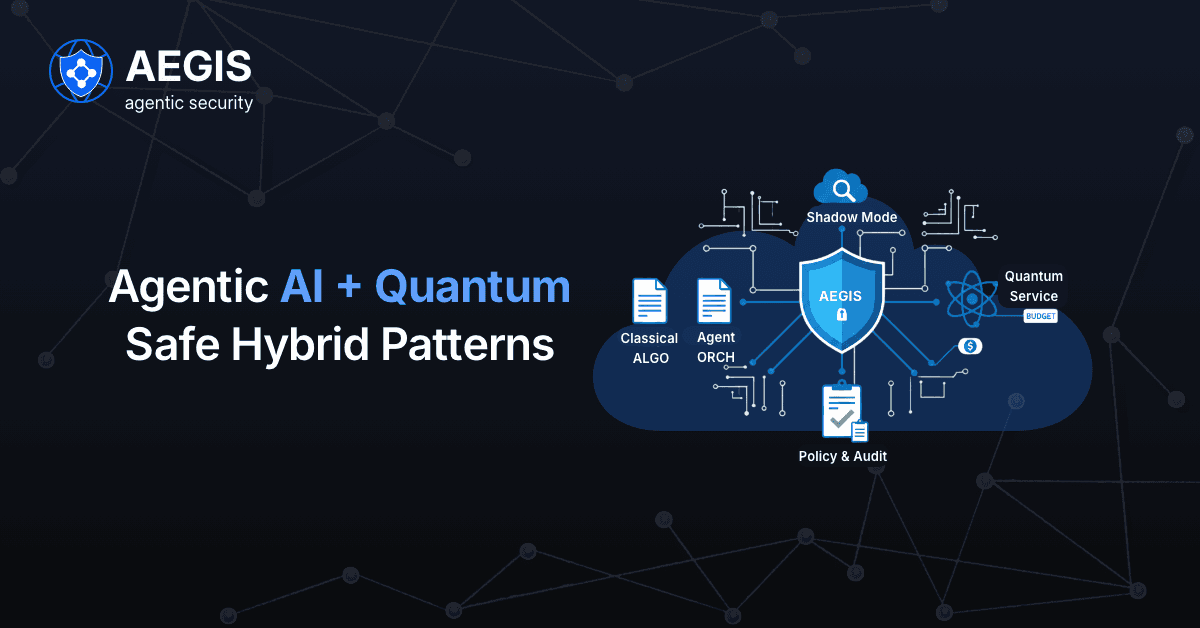
Run quantum calls against simulators in dev and shadow-mode in prod to collect telemetry without billing. Shadow-mode lets you measure would-be costs, latency distribution, and success rates before enabling live charging. Aegis supports shadow-mode for policy tuning and telemetry collection.
Security and policy controls
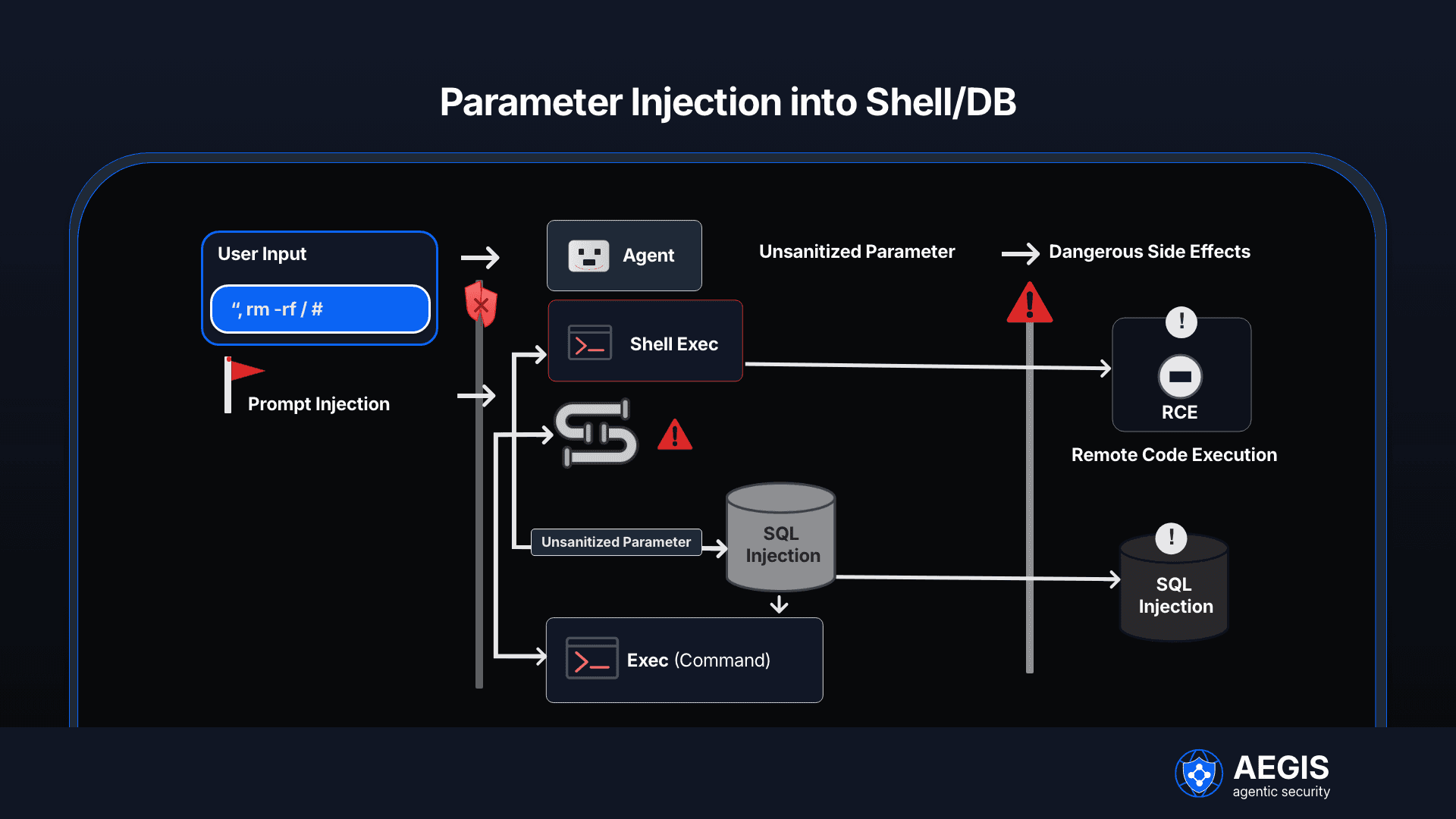
Agent and quantum integrations create several security vectors: runaway costing, repeated submissions, egress to untrusted endpoints, and parameter injections. Apply strict controls:
• Policy-as-code: define allowed agents, approved quantum providers, parameter ranges, rate limits, and budget tokens. Aegis compiles YAML policies to OPA bundles and enforces them at runtime.
• Budgeting and rate limits: set per-agent daily budgets and RPS caps for quantum calls; block calls that exceed budgets. Telemetry ties each call to cost and decision.
• Attestation and egress allowlist: approve only known quantum provider domains, require endpoint attestation, and restrict egress paths via the gateway proxy.
• Parameter validation and sanitization: validate shapes, ranges, and types before submitting any quantum job; sanitize or reject payloads that include unexpected fields.
Practical use cases and pilot playbook
Target pilots where small improvements matter (logistics, schedule recomputation, portfolio micro-optimizations). The recommended pilot playbook:
- Select high-value, low-frequency workload (monthly route optimizer, nightly portfolio rebalance).
- Implement a classical fallback path; quantum augmentation runs as an experimental pass.
- Use simulators for dev; enable shadow-mode to collect production telemetry without spending.
- Enforce budgets, require human sign-off for production override, and collect ROI metrics per job.
Pilot KPIs
KPI | Target | Why it matters |
ROI per quantum job | > 1.2x | Justify expense |
Cost per successful job | <$500 | Controls spend |
Job success rate | >70% (initial) | Measure feasibility |
% jobs requiring override | <5% | Operational scalability |
Use the Aegis checklist before flipping enforcement to “on”:
• Tool adapter present for quantum provider.
• Policy schema with parameter ranges validated.
• Budget token and rate limits configured.
• Shadow-mode telemetry collected for at least one billing cycle.
How Aegis enforces safe quantum calls
At run time, Aegis operates as a gateway between the orchestrator and external tools. For quantum calls Aegis enforces identity, policy, budgets, and telemetry.
👉🏻 Combine cloud, edge, and on-prem for flexible AI deployments
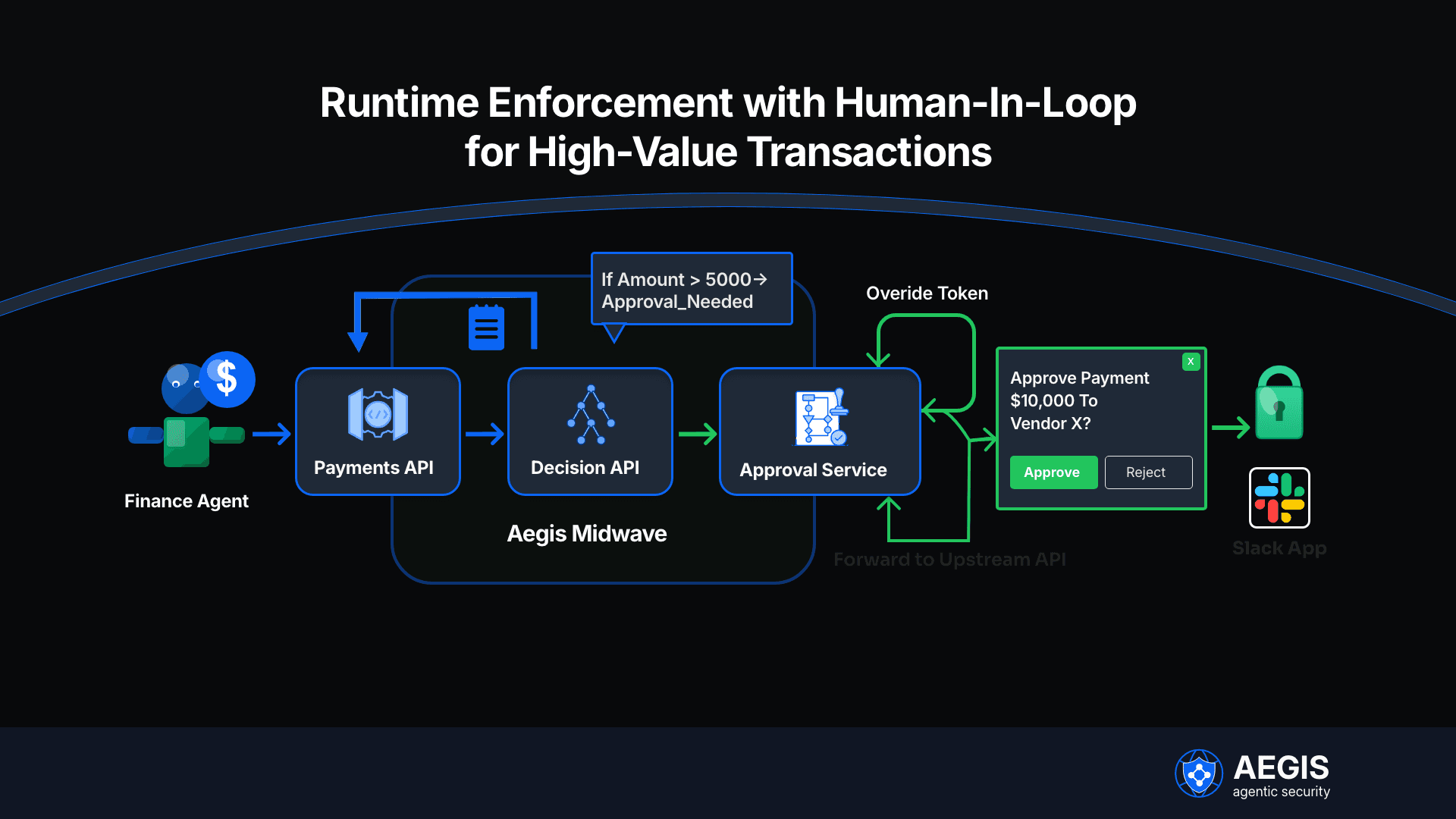
Runtime controls and flow (4-step)
Operationally:
- Agent sends request through orchestrator to Aegis with agent_id and parent chain.
- Aegis validates the request schema and parameter ranges against policy bundles compiled to OPA. Decision returns allow/deny/sanitize/approval_needed.
- If allowed, budget accounting occurs (atomic decrement). If budget exhausted, Aegis returns PolicyViolation: BudgetExceeded.
- Telemetry emitted (OpenTelemetry spans) with policy_version, decision_reason, estimated_cost, and attestation signature for audit.
Aegis enforcement primitives
Primitive | Enforcement example | Observable output |
Identity & token | Short-lived JWT per agent | agent_id claim, expiry |
Parameter validation | Reject amounts outside range | PolicyViolation + logs |
Budgeting | Per-agent daily quantum budget | BudgetConsumed metric |
Approval workflow | approval_needed posts to Slack | override_token on approval |
Shadow mode | Would-block metrics only | WouldBlock telemetry |
Aegis design choices to reduce latency and scale
• Compile policies to OPA bundles and hot-reload to keep evaluation under tens of milliseconds using prepared queries and caches. Community guidance and engineering reports indicate single-digit millisecond OPA evals in optimized setups; design for P99 budget in system planning. (Open Policy Agent)
• Use batching patterns and on-path proxies to minimize round trips. • Fail-closed for writes; configurable fail-open for low-risk reads.
Operational risks and mitigations
Risk: agents repeatedly resubmit failed quantum jobs → cost blowout. Mitigation: rate limits, exponential backoff, and budget tokens.
Risk: policy misconfiguration blocking production. Mitigation: schema validation, dry-run, shadow-mode, and rollbackable policy versions.
Integrations and governance
Aegis is orchestrator-agnostic: provide client SDKs and middleware for common orchestrators, and use sidecar proxies (Envoy) to intercept outbound calls. Control plane features include policy versioning, signed bundle manifests, and audit trails suitable for SOC reviews.
👉🏻 Leverage cloud ecosystems to scale and manage agent workloads
FAQ (practical operational questions)
- How often should I call quantum during production? — Only when marginal benefit exceeds cost; start monthly or nightly, not per-transaction. Shadow-mode helps decide frequency.
- What if a quantum provider goes down? — Use retries with exponential backoff, fallback to classical heuristic, and circuit-breaker policies. Aegis supports fail-closed write semantics and configurable fail-open reads.
- Who approves expensive quantum experiments? — Define human sign-off policies. Aegis integrates approval flows (Slack/Teams) and mints one-time override tokens.
- How do we prove compliance? — Aegis emits signed telemetry and versioned policies that provide audit traces for SOC and regulators.
- Can Aegis limit multi-tenant collisions? — Yes: per-tenant bundles and scoping prevent cross-tenant policy influence.
Conclusion
Hybrid classical–quantum agents are a practical middle ground: keep quantum calls small, auditable, and budgeted. Use simulators and shadow-mode for safe experimentation and only promote to paid runs after measurable ROI. Aegis Gateway implements the runtime policy, budget enforcement, identity controls, and telemetry that make controlled quantum experiments viable for regulated enterprises. The core engineering motto: treat quantum like a rare, expensive accelerator behind a hardened policy gateway.