
The Intersection of Multi-Agent AI and IoT
Practical guidance for securing multi-agent IoT systems with runtime policies, identity, DLP and edge governance.
Aegis: Securing Agentic AI at the IoT Edge
Enterprises are deploying agentic AI across production — from factory robots to smart traffic control — and IoT scale and latency requirements mean the old cloud-only model no longer fits. This article explains the problem, the technical patterns that matter, and how Aegis — a runtime policy and observability gateway — enforces identity, least privilege, egress control, DLP and approval workflows across edge and cloud agents.
Problem statement: why IoT + agentic AI is different
Agentic AI moves beyond single-call LLMs; agents plan, negotiate and act. Real-world IoT use cases require local, deterministic decisions (safety interlocks, low-latency actuation) while still preserving central governance and audit. Market signals show many organizations are piloting or scaling agentic AI — ~23% report scaling agentic systems and another large cohort experimenting. (McKinsey & Company)
At the same time the IoT footprint and data volume are growing rapidly: connected devices numbered in the billions in 2024 and continue to expand, driving edge compute demand and huge telemetry growth. Edge spending and real-time processing forecasts underscore the need for local enforcement. (IoT Analytics)
👉🏻 Combine cloud, edge, and on-prem for flexible AI deployments
Core operational problems:
- Latency: roundtrips to cloud for every check break real-time safety requirements.
- Cost & FinOps: runaway agents can spawn expensive API calls.
- Security: agents can be coerced or compromised to perform unauthorized actions.
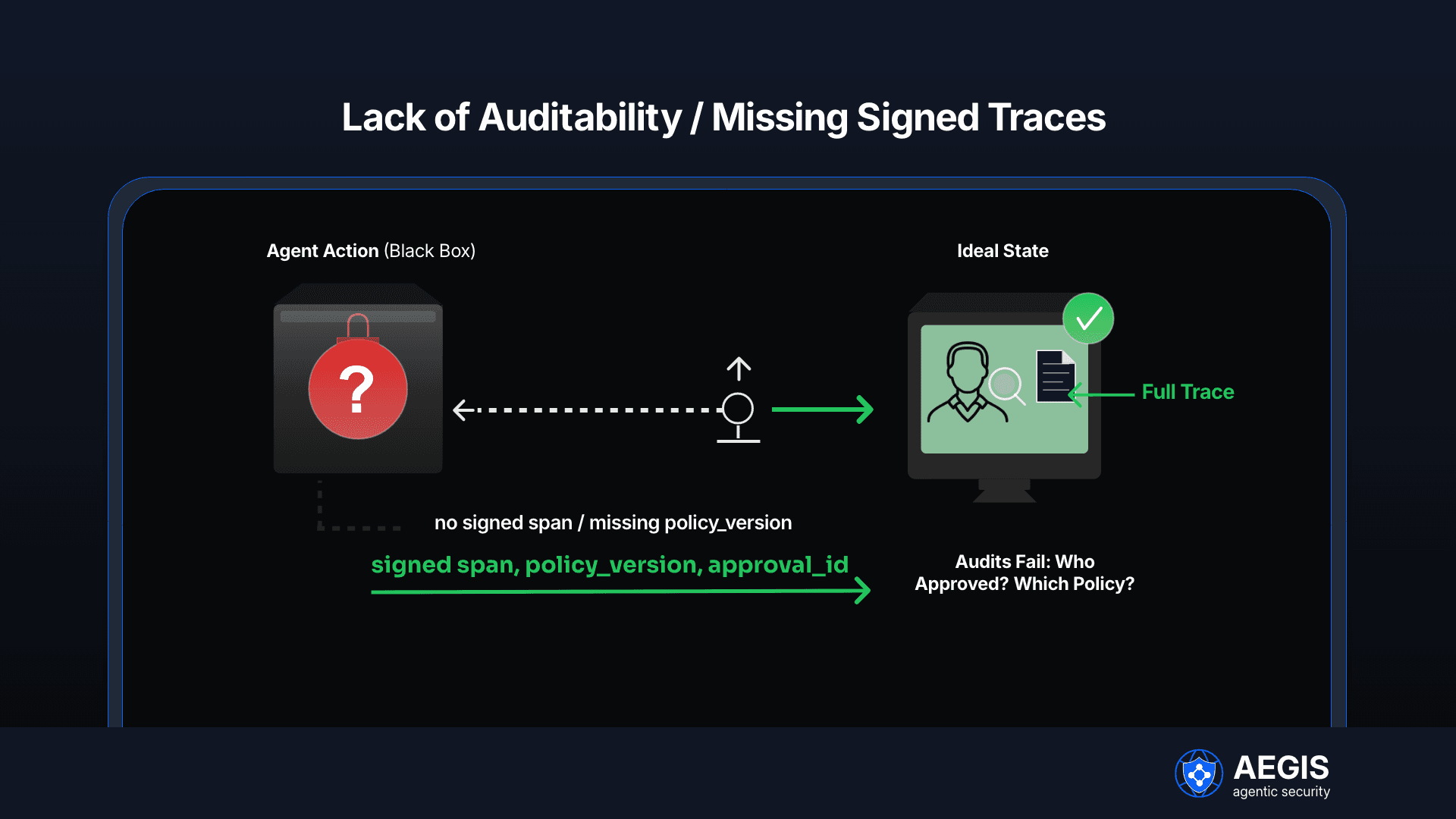
- Auditability: compliance requires tamper-evident traces per agent action.
Old approach: centralized cloud logic — limitations
Traditional architectures funnel decisions to centralized services or rule engines. They suffer from:
- Unacceptable latency for safety-critical actuation.
- Fragile update cycles — OTA updates to many devices are slow or risky.
- Limited parameter inspection — IAM or API keys don’t validate per-call semantics.
- No unified audit trail across agents, edge, and cloud.
New approach: distributed agents at the edge + orchestration
The pragmatic pattern: push pre-processing, policy checks and low-latency safety enforcement to edge agents; keep heavy reasoning, episodic approvals and long-term audits in the cloud. Agents coordinate using lightweight pub/sub (MQTT) or message buses; cloud agents provide episodic oversight and policy bundles. This hybrid model reduces risk and latency while preserving centralized governance.
Key adoption signals: analyst and industry reports warn that many agentic AI projects will be re-scoped or need governance attention — firms are concerned about security and may scrap inadequate projects if governance is absent. (Reuters)
👉🏻 Prepare for next-gen computing with quantum-ready AI design
Technical patterns and security guardrails
Protocols and messaging
- MQTT (pub/sub) and lightweight HTTP/gRPC for agent↔tool calls.
- Use a unified namespace or broker with per-client authentication to prevent ad-hoc egress.
Identity & tokens
- Device and agent identity are primary: short-lived JWTs with organization, tenant and agent claims, signed (Ed25519) and with jti replay protection.
- Mutual TLS for gateways and brokers for high-risk actuations.
Policy evaluation & distribution
- Policy-as-code (YAML/JSON) compiled to OPA bundles; hot-reload on edge.
- WASM or native OPA prepared queries for low-latency evaluation (<20 ms target).
Telemetry & observability
- Emit OpenTelemetry spans for every agent-tool call: agent_id, tool, decision, policy_version, cost estimate.
- Ship structured logs to SIEM and retain signed manifests for audits.
Fail-safe modes
- Fail-closed for critical writes (robot motion, payments); configurable fail-open for reads.
- Circuit breakers and cached allowlists for intermittent control-plane outages.
.png&w=3840&q=75)
Aegis for edge governance
Aegis is a runtime policy and observability gateway that implements the above patterns as a deployable mesh for multi-agent systems. It operates as a sidecar/proxy plus control plane that compiles policy-as-code into fast OPA bundles, issues short-lived tokens, enforces egress allowlists, performs deterministic DLP, and emits auditable telemetry.
Core Aegis capabilities:
- Agent Identity & Policy: register agents, assign per-agent scopes and parameter constraints (regex, numeric ranges, whitelists).
- Runtime Enforcement: an Envoy sidecar or lightweight proxy intercepts calls; an external authz service evaluates policies and returns allow/deny/sanitize/approval_needed decisions.
- Approvals: for high-risk actions Aegis queues an approval request to integrated channels; approved actions receive a one-time override token.
- Observability: Aegis emits OpenTelemetry spans and structured logs (agent_id, decision_reason, policy_version) for SOC and FinOps teams.
- Developer UX: CLI/SDKs for LangChain/LangGraph and simple policy dry-run mode for safe rollout.
Aegis addresses specific IoT+agent risks:
- Prevents privilege escalation via inter-agent chaining by validating parent_agent_id headers and enforcing least-privilege policies at runtime.
- Redacts or blocks sensitive telemetry before it leaves the edge, preventing silent exfiltration.
- Implements per-agent budgets/rate limits to stop runaway spend on billed APIs.
Use cases and exemplar flows
Manufacturing robot coordination
Robotics agents negotiate task assignments; safety agent enforces forbidden zones locally. Aegis policies block any motion command that would move a robot into a red zone. High-risk maintenance overrides require human approval through the approvals service.
👉🏻 Deploy and manage agents at scale with Kubernetes ecosystems
Healthcare EHR access control
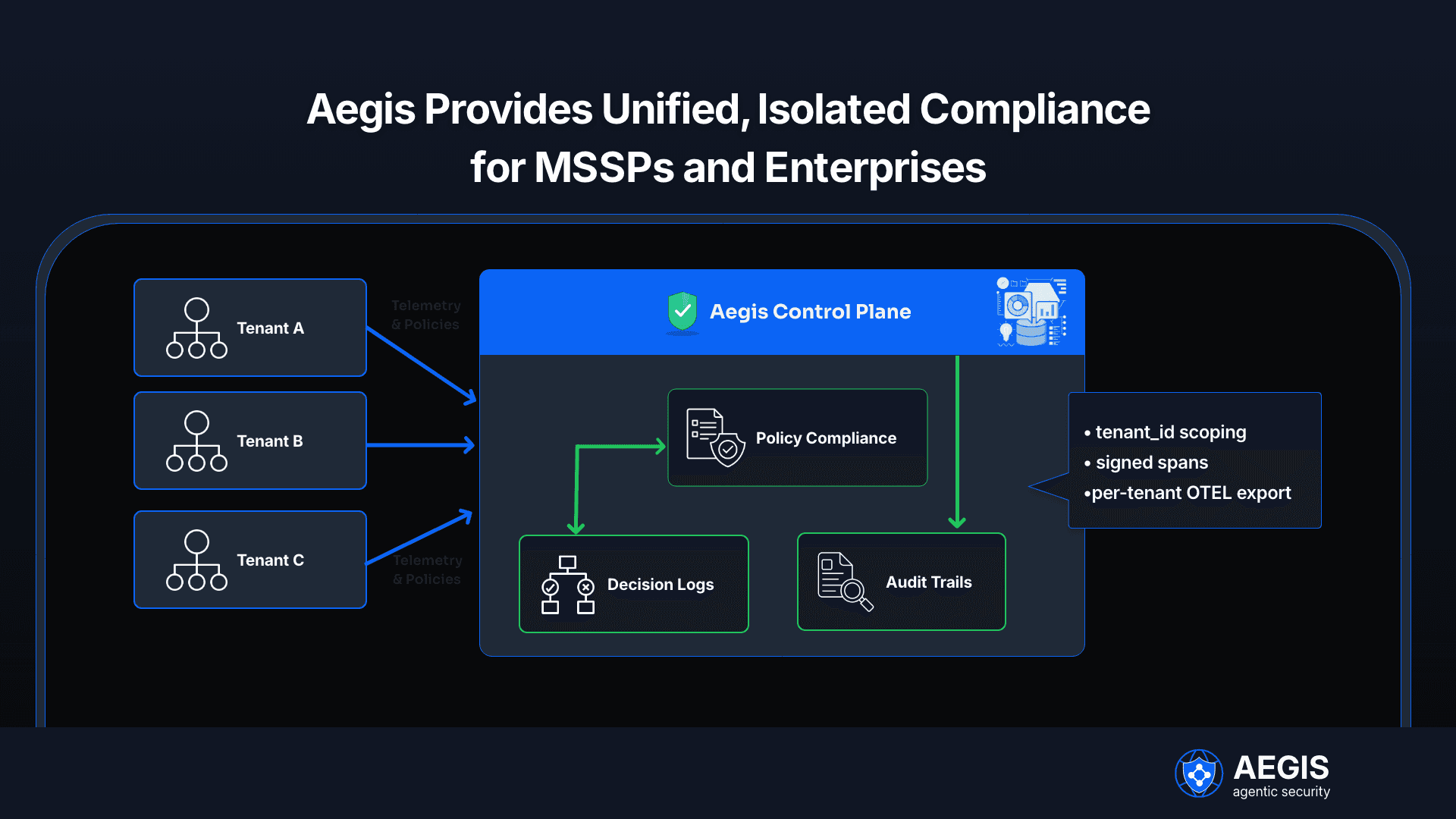
Clinical agents can query EHR read-only for care purposes; any export attempt triggers DLP redaction and audit. Aegis enforces per-tenant routing and prevents off-region egress.
Edge gateway sample flow
Placeholder Image: A flowchart illustrating the 4-step process of Aegis's agentic response to a runtime threat.
- Agent requests tool call through sidecar.
- Sidecar sends authz request to Aegis decision service.
- Decision: allow/sanitize/approval_needed/deny.
- Action executed or blocked; span emitted.
Implementation tips & engineering patterns
- Use WASM for on-edge OPA evaluations when runtime constraints demand it.
- Embed short-lived JWTs; refresh bundles during maintenance windows to reduce jitter.
- Use MQTT with per-client certs and ACLs for sensor orchestration and light negotiation.
- Apply deterministic DLP (regex redaction) before any telemetry leaves the gateway.
Risk model and mitigations
Risks include compromised agents, replay attacks, and policy misconfiguration. Mitigations:
- Mutual TLS, short-lived tokens with jti replay protection.
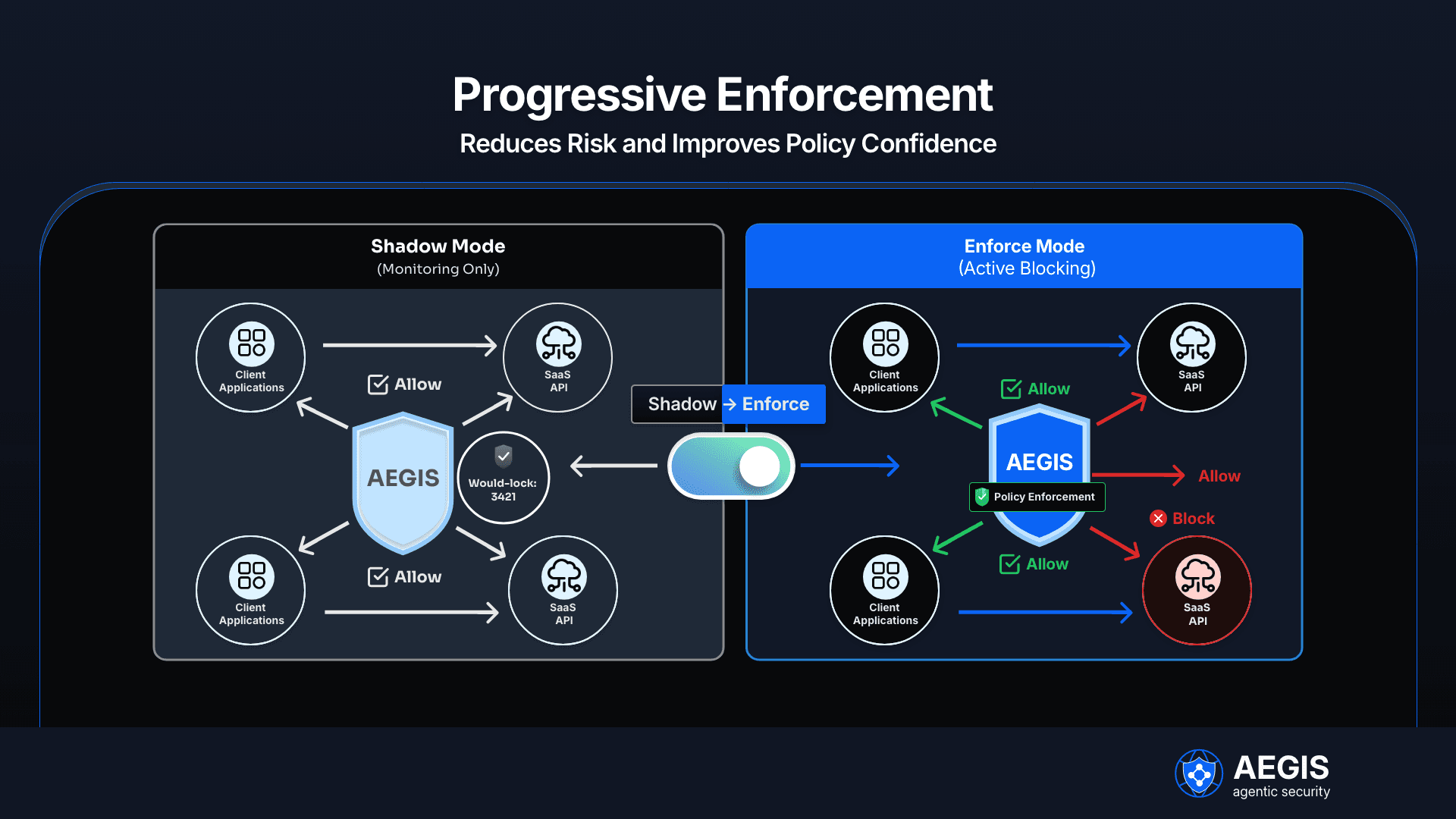
- Fail-closed for critical writes; shadow mode for policy tuning to avoid accidental blocking.
- Policy schema validation, dry-run metrics and rollback/versioning.
Comparison and recommended policy templates
Policy enforcement outcomes and recommended actions
Decision | Typical trigger | Recommended action |
allow | low-risk read or bounded write | proceed; emit span |
sanitize | contains PII or unsafe param | redact fields; emit span |
approval_needed | payment > threshold or production deploy | pause, notify approvers, issue one-time override on approval |
deny | egress to unknown domain or forbidden action | block; emit policy violation alert |
Edge implementation checklist
Area | Minimum config for safety |
Identity | Short-lived JWTs, JWKS, jti replay store |
Policy | OPA bundles, hot-reload, schema validation |
Networking | MQTT with ACLs, broker auth, allowlists |
Failures | Fail-closed for writes, cached allowlists for reads |
Observability | OpenTelemetry spans, SIEM integration, signed logs |
FAQ (practical enterprise questions)
Q: Can Aegis run offline at the edge?
A: Yes — Aegis supports local policy bundles and a cached allowlist for offline operation; critical writes can be configured to fail-closed.
Q: How do we prevent approval overload?
A: Use thresholds, budgets and contextual conditions to reduce unnecessary approvals; batch low-risk approvals and only escalate meaningful events.
Q: What protocols are recommended for agent coordination?
A: MQTT for pub/sub sensor orchestration and lightweight HTTP/gRPC for tool calls; both should be authenticated with certs or short-lived tokens.
Q: How does Aegis support multi-tenancy?
A: Policies and bundles are tenant-scoped, versioned and cryptographically signed; telemetry includes tenant claims for SOC review.
Q: Can policies be tested before enforcement?
A: Yes — Aegis offers shadow/dry-run modes and policy simulation tools to collect would-block metrics before flipping to enforce.
Q: How do we onboard existing orchestrators?
A: Aegis provides SDKs and middleware for common orchestrators and runs as a sidecar/proxy to minimize code changes.
Conclusion
Securing agentic AI at IoT scale requires runtime, identity-first enforcement close to the edge and strong observability back to the cloud. Aegis brings policy-as-code, low-latency OPA evaluations, DLP and approval workflows into a deployable gateway, helping teams enforce least privilege, prevent exfiltration and retain auditable control across distributed agents.