
Hybrid Agent Architectures: Cloud, Edge, and On-Prem
Secure hybrid agent architectures: central policy control, regional enforcement, and runtime audit for edge, cloud, and on-prem workloads.
Hybrid agent architecture: securing cloud, edge and on-prem agents with Aegis
Enterprises adopting agentic AI face a new operations and security surface: autonomous agents that span cloud, on-prem, and edge. Latency, data residency, intermittent connectivity and strict regulatory controls drive hybrid deployment patterns — yet legacy approaches fork functionality across environments and produce inconsistent policy enforcement. This article explains why hybrid is the necessary pattern, the practical architecture for secure hybrid agents, how policy distribution works in constrained networks, and operational controls required to run agentic systems at scale. One third of this piece focuses on Aegis — Aegissecurity runtime policy and observability fabric — showing how it addresses the operational gaps.
👉🏻 Eliminate integration bottlenecks slowing your AI progress
Why hybrid agent architectures matter
Agentic AI use cases (manufacturing robots, local payment processing, clinical automation) often require decisions close to the device for latency and data-residency reasons while still needing central governance. Market research and industry reports document rapid enterprise interest in agentic AI and early adoption pressures for governance and security. Interest and research into agentic systems surged in 2024–2025, and enterprise leaders consistently list governance and security as primary adoption barriers. (Harvard Business Review)
👉🏻 Connect AI agents with IoT for real-time intelligent operations
Drivers for hybrid deployments
- Latency: sub-100ms local decisions for robotics and industrial control.
- Data residency: PHI/PII must remain in-region for compliance.
- Intermittent connectivity: retail or field sites may be offline for periods.
- Regulatory constraints: regionally unique legal obligations demand local policy overrides.
Business KPIs that matter
- Policy propagation lag (seconds/minutes).
- Offline denials and safety posture during outages.
- Audit lag (buffered signed logs vs central SIEM ingestion).
Architecture: central control plane, regional data planes
At the core of a robust hybrid model is separation of concerns: a central control plane authors and signs policies; regional (edge/on-prem) data planes enforce them locally using signed bundles and compact runtime services.
Key components and flows
- Central control plane: policy authoring, bundle signing, tenant & agent registry, JWKS and manifest store.
- Regional data plane: lightweight sidecars/forward proxies + local decision servers, token minting, and local audit buffer.
- Sync & integrity: signed manifests, ETags, and bundle versioning to avoid drift.
- Fail modes: cached policy bundles with fail-closed semantics for critical writes; configurable fail-open for read-only actions.
👉🏻 Deploy and manage agents at scale with Kubernetes ecosystems
Example runtime flow
- Developer publishes policy to the control plane; compiler builds an OPA bundle and signs a manifest.
- Edge node pulls the bundle (ETag check); control plane stores the manifest and exposes JWKS for signature verification.
- Local sidecar receives an agent request, evaluates the policy via an embedded OPA evaluator, and returns allow/deny/sanitize/approval_needed.
- If connectivity is down, the sidecar uses cached bundles and a tamper-proof audit buffer; critical writes use fail-closed behavior.
.png&w=3840&q=75)
Policy distribution and token lifecycle
Policy distribution for hybrid deployments must be bandwidth-aware and integrity-first. Signed manifests and ETags provide versioning guarantees; bundles are compact (tenant/agent data + generic Rego). Sync cadence should be tuned per region based on change velocity and bandwidth costs.
Token lifecycle & local minting
- Short-lived JWTs issued by the control plane for ephemeral operations.
- Regional token minting: within a region, a local token minting service mints region-scoped tokens (signed, verifiable with replicated JWKS).
- Attestation: TPM or cloud attestation services should gate issuance of sensitive tokens to ensure device integrity.
Table: Policy distribution considerations
Requirement | Design pattern | Operational check |
Integrity | Signed manifests + ETags | Manifest signature verification on pull |
Bandwidth | Delta bundles + cadence tuning | Bundle size and sync frequency metrics |
Offline safety | Cached bundles, fail-closed for writes | Offline deny rate / business impact |
Regional overrides | Central authoring + scoped overrides | Audit of override policy changes |
How Aegis implements hybrid runtime security (one-third of article)
Aegis is designed as a policy & observability fabric for agentic systems: a control plane for policy-as-code and a data plane for runtime enforcement. Its design emphasizes minimal trust in the control plane, strong audit chains, and operational controls that MSSPs and regulated enterprises require.
- Policy compiler & signed bundles: YAML/JSON policies compiled to OPA bundles and signed manifests to guarantee integrity at the edge.
- Lightweight regional data plane: sidecar proxies (forward proxy / Envoy ext_authz pattern) + an external authorisation server with embedded OPA for sub-20ms decision targets.
- Local token service: regionally scoped token minting with JWKS replication, reducing cross-region token hops and maintaining stateless verification.
- Fail-closed semantics & audit buffering: critical write operations default to deny when policy or attestation fails; local logs are signed, buffered and shipped when connectivity resumes.
- Integration surface: OpenTelemetry for structured spans and metrics so SOC and FinOps teams can correlate violations and cost spikes. OpenTelemetry is now broadly adopted across cloud native stacks and is a natural fit for Aegis telemetry. (OpenTelemetry)
Aegis addresses common operational pitfalls
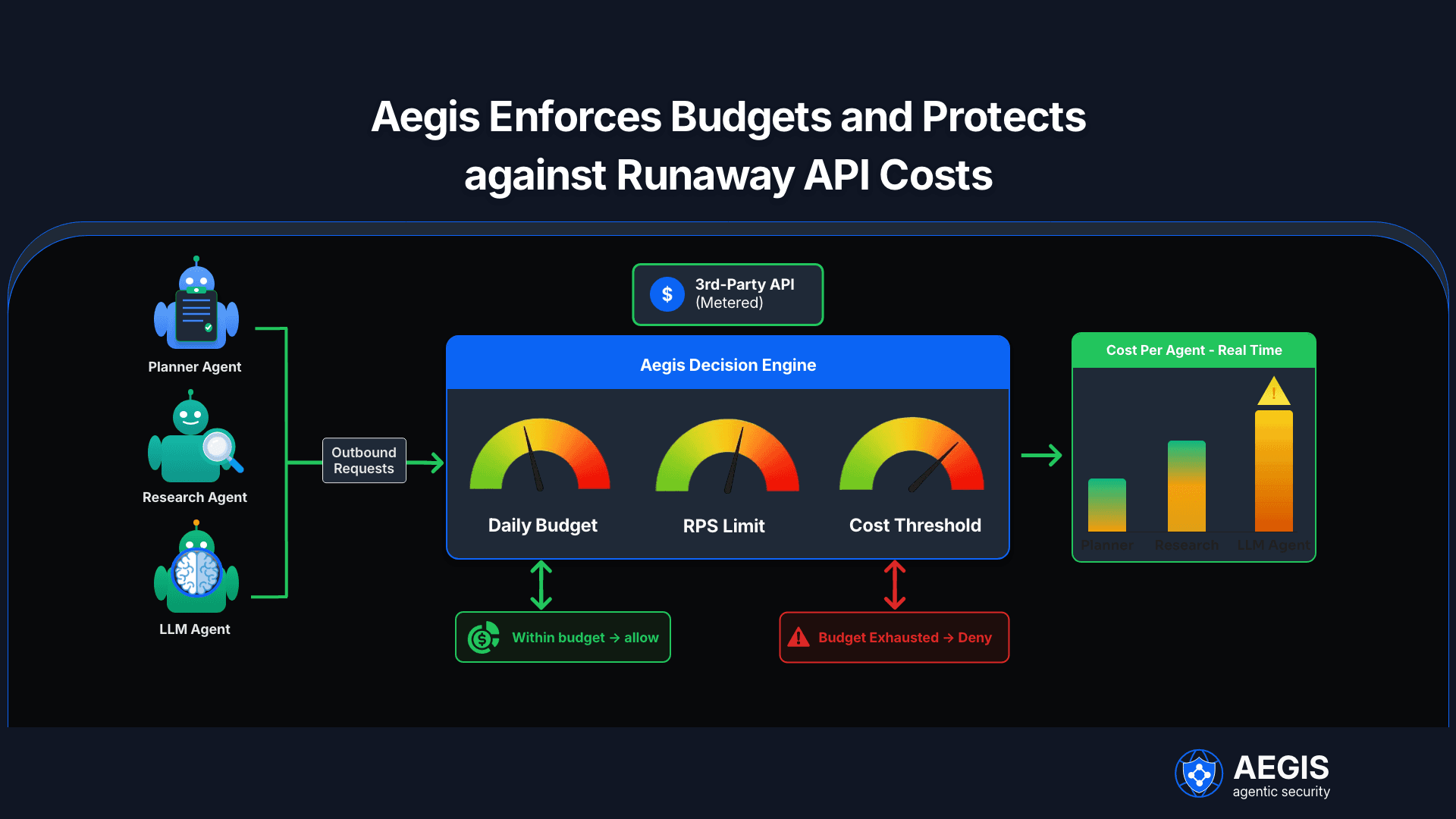
- Inconsistent versioning: uses ETags and signed manifests to prevent drift.
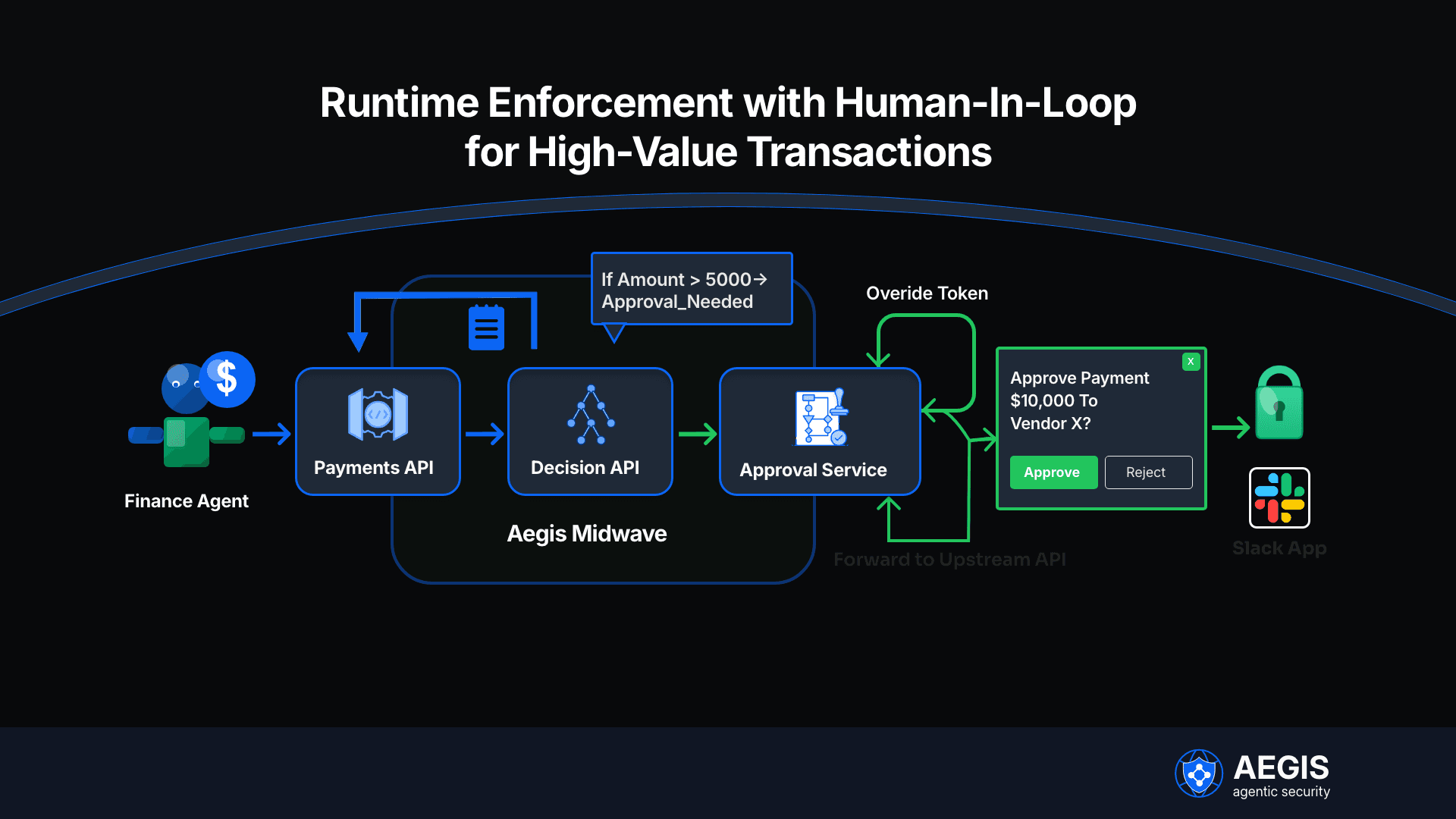
- Approval workflow overload: policies can specify thresholds, rate limits and priority queues for approvals to reduce human fatigue.
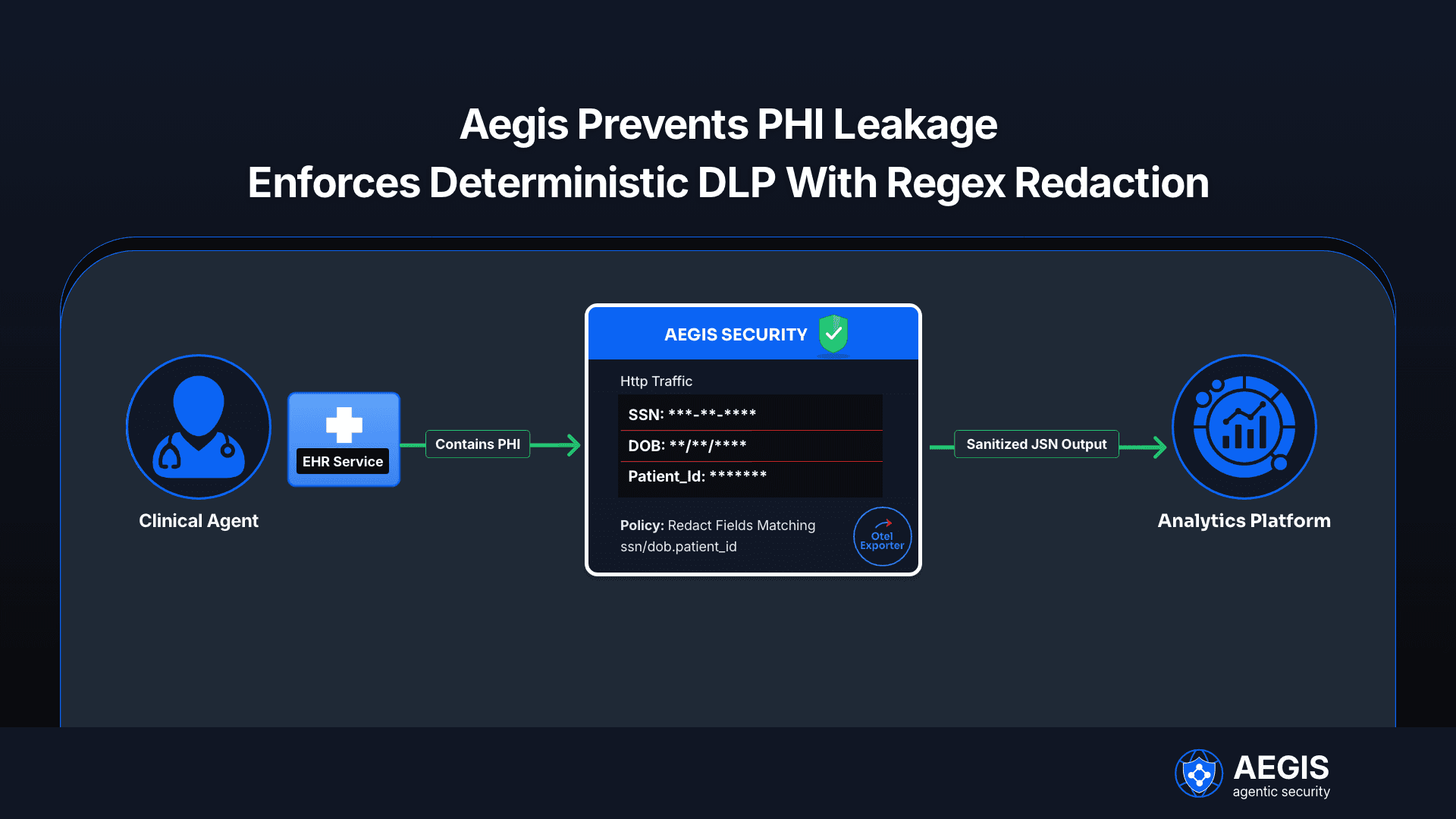
- Data residency compliance: per-tenant routing and deterministic DLP ensure PHI stays in-region while sending redacted telemetry to central SIEMs.
Table: Aegis enforcement outcomes
Decision | Typical action | Audit output |
allow | Forward request | OTel span + decision_reason + policy_version |
deny | Block & return PolicyViolation | Signed audit log buffered |
sanitize | Redact parameters & forward | Redaction summary in span |
approval_needed | Pause + send approval request | Approval_id & override token on success |
Ops & security: running hybrid agents at scale
Operationalizing hybrid agents requires instrumentation and processes beyond code.
Observability & KPIs
- Measure policy propagation lag, offline denials, P99 decision latency, and audit buffer size.
- Export OpenTelemetry spans so traces link agent actions to downstream tool calls and approvals. Vendors and community projects report growing OpenTelemetry adoption, which simplifies integration. (OpenTelemetry)
Attestation & identity
- Enforce device attestation (TPM, hardware roots) before granting sensitive tokens.
- Rotate keys and maintain minimal control plane trust: sign bundles and verify in data plane.
Compliance & audit trail
- Regionally sign audit logs and keep tamper chains. Ship redacted telemetry to central SIEM for analytics while retaining full signed logs locally as required by regulation.
Automation & rollout strategies
- Shadow mode: deploy policies in observe-only for a defined period to collect would-deny events before flipping enforcement.
- Staged rollouts: use rolling updates for sidecars and bundle servers; reconcile versions via orchestrator agents.
- Emulate edge behavior in staging (developer tip): provide emulators that simulate offline and token-minting behavior so teams can test fail-closed scenarios.
Practical pitfalls and mitigations
- Pitfall: inconsistent policy versions across regions. Mitigation: require manifest signature verification and ETag checks on pull.
- Pitfall: approval overload. Mitigation: policy thresholding + automated approvals for low-risk ranges.
- Pitfall: bandwidth cost and egress. Mitigation: send redacted telemetry; use delta bundles and cadence tuning to minimize repeated downloads.
Two short reference tables
Table: Hybrid deployment tradeoffs
Tradeoff | Edge agents | Central enforcement |
Latency | Low | Higher (network dependent) |
Data residency | Local | Centralized (may violate regs) |
Offline resilience | High (local cache) | Low without redundancy |
Operational cost | Higher infra at edge | Higher egress & central compute |
Table: Recommended sync cadence (example)
Environment | Typical cadence | Notes |
Retail store (low bandwidth) | 1–6 hours | Use delta bundles; fail-closed for payments |
Manufacturing floor | 5–15 minutes | Tight policy updates for safety |
Cloud region | <1 minute | Fast updates; low bandwidth cost |
Frequently Asked Questions
- What is a hybrid agent architecture?
A hybrid architecture pairs a central control plane (policy authoring, signing) with regional data planes (sidecars and local decision servers) that enforce policies near the workload to meet latency and data-residency needs. - How does Aegis prevent agent privilege escalation?
Aegis enforces per-agent policies at runtime, inspects parameters, applies deterministic DLP, and requires approvals for high-risk actions — blocking tool chaining that could escalate privileges. - Can policies be tested before enforcing?
Yes — shadow/dry-run modes collect would-deny events and metrics to tune policies before enforcement. - How are audit logs protected in disconnected sites?
Local logs are signed and buffered; signed manifests and tamper chains ensure integrity. When connectivity returns, logs are shipped to central SIEMs. - Where can I learn more about policy engines used by Aegis?
Aegis compiles policies to OPA bundles for fast evaluation; Open Policy Agent is the underlying, battle-tested engine for policy-as-code. https://openpolicyagent.org/ (Open Policy Agent)