Building a Robust Audit Trail for Multi-Agent Systems
Learn how Aegis Gateway enforces runtime security, compliance, and observability for agentic AI systems using policy-as-code and runtime enforcement.
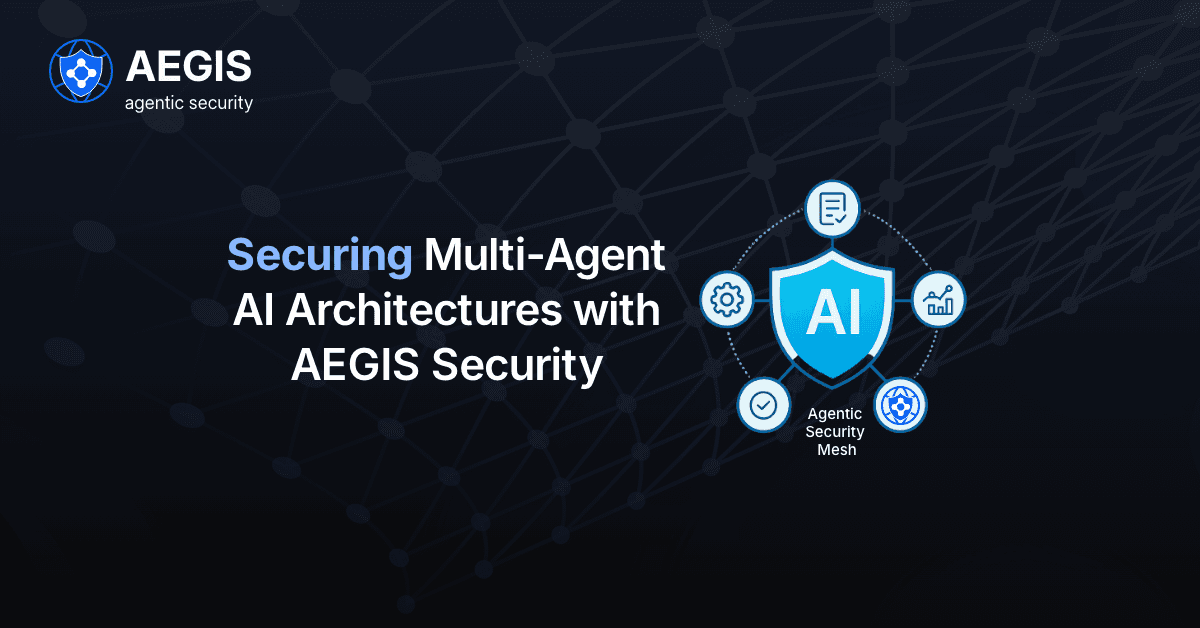
Securing Multi-Agent AI Architectures with Aegis Gateway
Autonomous AI agents are moving rapidly from prototypes to production systems. As enterprises embrace frameworks like LangChain, LangGraph, CrewAI, and OpenAI’s AgentKit, they are encountering new attack surfaces—uncontrolled egress, cross-agent coercion, and unbounded API spend. Traditional IAM and service mesh tools lack awareness of the semantics and behavior of autonomous agents. Aegis Gateway by CloudMatos addresses this gap as an AI Agent Security Mesh designed to enforce runtime policies, observability, and compliance across multi-agent systems.
Why Agentic AI Demands a New Security Model
The Rise of Autonomous Agents
Searches for “agentic AI” have risen by over 800% year-over-year as enterprises explore AI-driven automation in operations, customer service, and finance. However, a 2024 Architecture & Governance survey found that security and compliance are the top barriers to enterprise adoption of multi-agent workflows.
These systems introduce new dimensions of risk:
- Privilege escalation between cooperating agents.
- Prompt injection leading to unintended actions.
- Egress violations and data exfiltration to unknown domains.
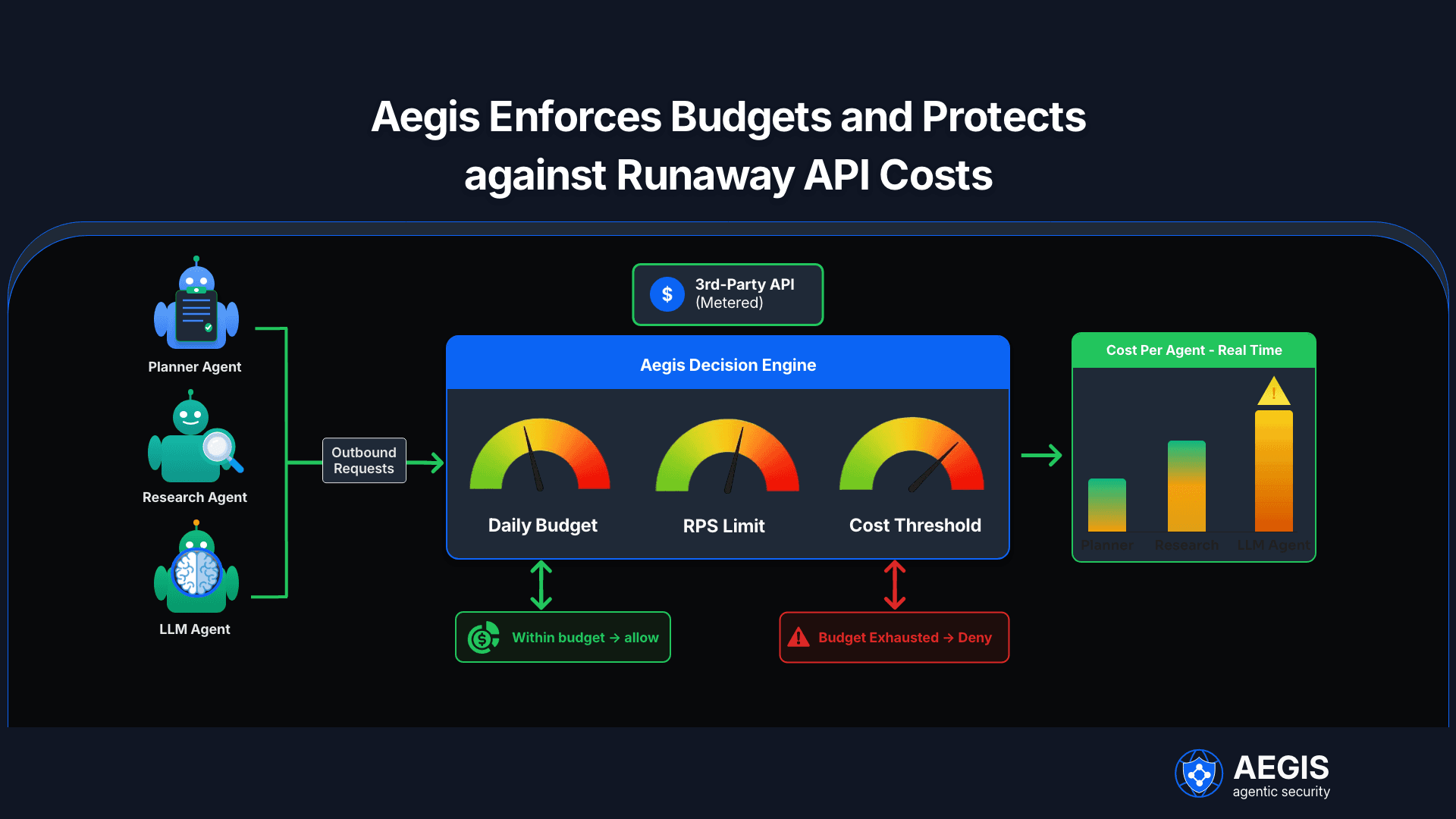
- Runaway API costs from uncontrolled spawning of agents.
From IAM to Runtime Policy Enforcement
Traditional IAM systems only determine who can call an API. In contrast, Aegis decides what an autonomous agent may do on each individual call, under specific contextual conditions—parameters, chain of calls, approval states, and budgets. This paradigm shift turns static access control into contextual, runtime governance.
👉🏻 Gain full visibility into agent performance with actionable observability metrics
Architecture and Core Capabilities of Aegis Gateway
Aegis Gateway is built as a policy and observability fabric for multi-agent AI systems—essentially, the Istio + OPA for Agents. It operates between agent orchestrators and tools, enforcing least-privilege and generating auditable telemetry.
Architectural Overview
Data Plane:
- Sidecar/Forward Proxy (Envoy) routes agent tool calls.
- External Authorization Service (Go) evaluates policies using compiled Open Policy Agent (OPA) bundles.
- OPA Evaluator executes rules (allow, deny, sanitize, approval_needed) within 10–20 ms latency targets.
Control Plane:
- Policy Compiler & Bundle Store transforms YAML/JSON into signed OPA bundles.
- Token Service issues short-lived Ed25519 JWTs identifying tenant, agent, and scope.
- Approvals Service integrates with Slack or Microsoft Teams for high-risk workflows.
- Observability & Dashboards export OpenTelemetry traces to Grafana or SIEM pipelines.
Policy-as-Code: Fine-Grained Governance for AI Agents
Declarative Policy Definitions
Aegis enables security engineers to write policies as code—in JSON or YAML—specifying which agents can access which tools, under what parameters and thresholds. For example:
agent: finance-agent
allowed_tools:
- name: stripe-payments
actions:
- create_payment
conditions:
max_amount: 5000
approval_needed_if: amount > 5000
Policies can specify:
- Regex-based validation for input fields.
- Rate limits and budgets (e.g., $20/day or 5 req/s).
- Sanitization rules to redact PII before transmission.
- Approval workflows for specific thresholds.
Runtime Enforcement
When an agent attempts a tool call, the Aegis Gateway intercepts it, evaluates the corresponding policy, and returns a decision—allow, deny, sanitize, or approval_needed. For high-risk actions, the request pauses until a human approves through an integrated workflow.
👉🏻 Stay audit-ready with transparent and compliant agent systems
Telemetry, Observability, and Compliance
Full-Lifecycle Visibility
Every decision Aegis makes is emitted as an OpenTelemetry span, recording:
- agent_id
- tool_name
- decision
- policy_version
- latency
- estimated_cost
These events feed into Grafana, Prometheus, or a SIEM pipeline for analytics and audit purposes.
Metric | Description | Purpose |
allow/deny ratio | Percentage of allowed vs blocked calls | Detect overblocking or drift |
policy_version | Current rule set hash | Ensure consistency across tenants |
latency (P99) | Decision response time | Optimize runtime performance |
budget_usage | Cost tracking per agent | Enables FinOps governance |
Compliance & Auditability
Each enforcement action and policy change is tamper-proof and auditable:
- Logs signed via hash-chains or Merkle proofs.
- Policy histories versioned in storage (S3/Postgres).
- Audit dashboards show who approved what, when, and under which policy.
This satisfies common audit frameworks (SOX, HIPAA, GDPR) by providing provable accountability for every AI-driven decision.
👉🏻 Build trust with clear, traceable documentation of every agent decision
Key Enterprise Use Cases
Aegis Gateway’s architecture supports multiple high-value enterprise scenarios, derived from regulated domains and operational pain points.
1. Secure Payment Workflows (FinTech)
- Enforce per-agent ceilings (amount ≤ $5000).
- Require human approval via Slack/Teams for high-value transactions.
- Block unauthorized planner-to-finance coercion attempts.
2. PHI/PII Protection (Healthcare)
- Intercept agent access to EHRs.
- Apply deterministic DLP—regex-based redaction of SSN, DOB, or health IDs.
- Block exports to non-approved endpoints.
3. SaaS and FinOps Governance
- Enforce per-agent budget ceilings and rate limits.
- Halt calls upon exceeding budgets with clear telemetry feedback.
- Enable dashboards showing cost per tool and tenant.
4. Controlled CI/CD Automation (DevOps)
- Restrict agent-triggered deployments by environment or digest.
- Enforce approvals for production actions.
- Validate image hashes before rollouts.
5. Multi-Tenant Audit & Compliance (MSSPs)
- Generate tenant-scoped telemetry and SIEM logs.
- Enforce data residency via regional routing and scoped JWT claims.
- Support auditors with signed, queryable event histories.
Performance and Scalability Considerations
To operate effectively across high-throughput agentic systems, Aegis focuses on:
- Latency Optimization: Prepared OPA queries and WASM compilation yield ≤ 20 ms P99 decision times.
- Scalability: Stateless horizontal scaling to support 10 000 RPS per region.
- Resilience: Fail-closed for writes; configurable fail-open for reads.
- Security: End-to-end TLS, signed tokens, and encrypted policy storage.
- Privacy: Region-based routing and deterministic PII redaction.
In internal benchmarks, the policy enforcement latency adds < 5 ms overhead per request under typical enterprise loads.
Comparison: Aegis vs Traditional Approaches
Capability | IAM Systems | Service Mesh | Aegis Gateway |
Identity Enforcement | ✅ | ✅ | ✅ |
Parameter-Level Policy | ❌ | ❌ | ✅ |
Runtime Decision (OPA) | ❌ | Limited | ✅ |
Human Approvals | ❌ | ❌ | ✅ |
Observability (OTel) | ✅ | ✅ | ✅ |
Agent Context Awareness | ❌ | ❌ | ✅ |
Multi-Tenant Audit Logs | ❌ | Limited | ✅ |
Aegis stands out as the first runtime enforcement and telemetry layer designed for multi-agent AI workflows, offering the precision of OPA with the operational context of an AI orchestrator.
Implementation and Rollout Strategy
A typical Aegis deployment unfolds in four stages:
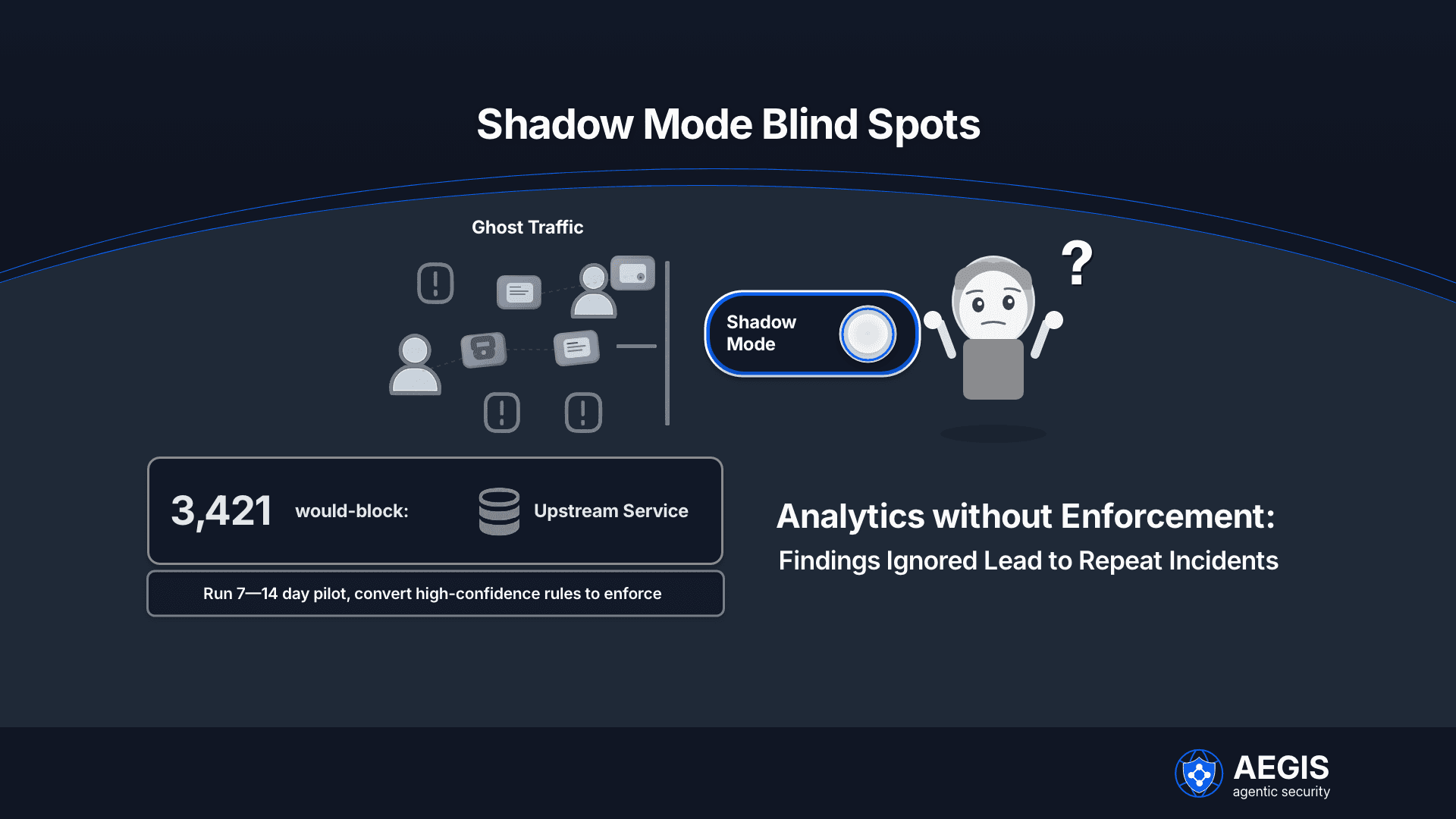
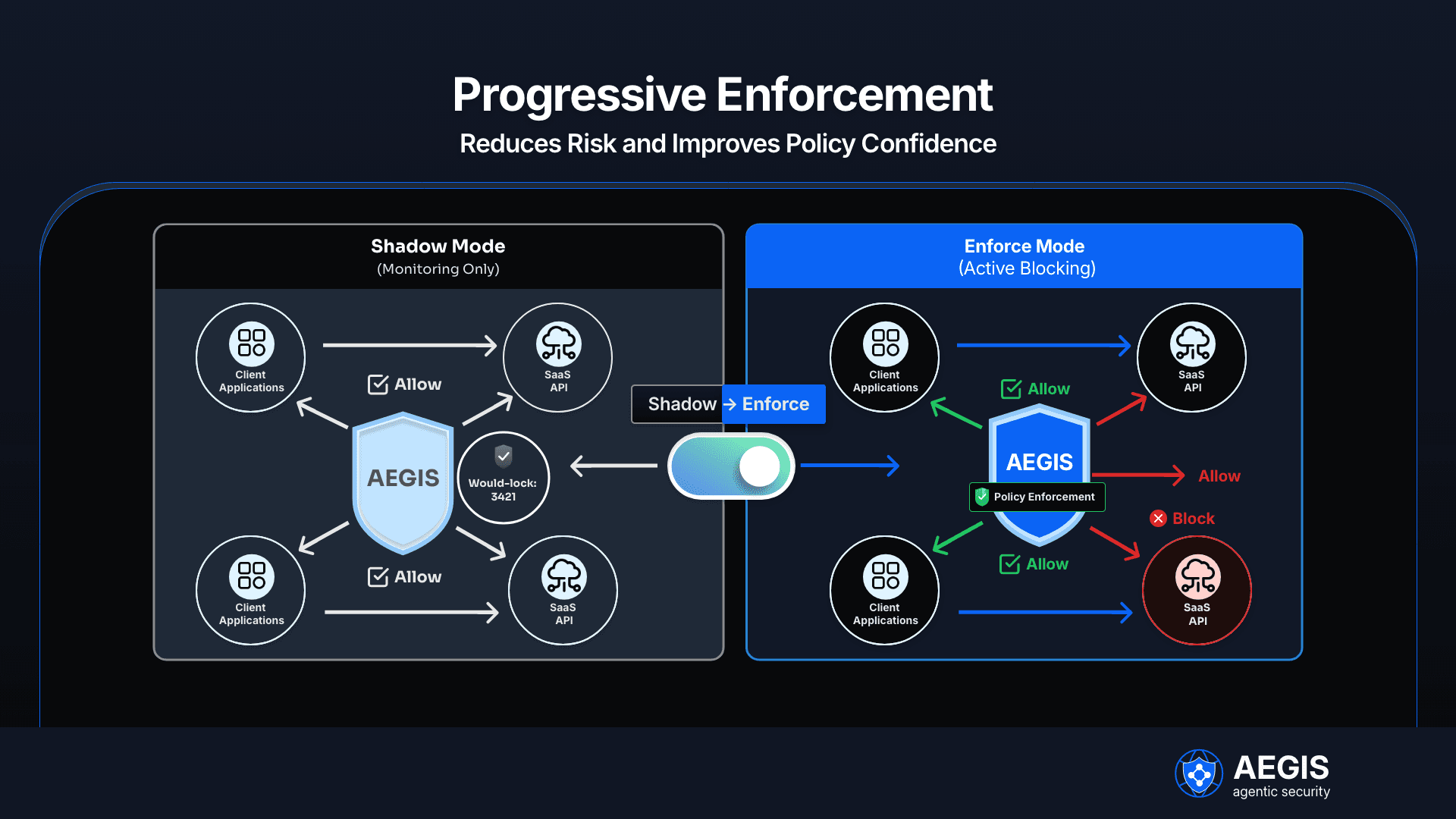
- Shadow Mode: Observe would-block events without enforcing policies.
- Progressive Enforcement: Activate enforcement on low-risk tools.
- Budget & Approval Integration: Add cost governance and Slack/Teams workflows.
- Audit & Reporting: Enable full SIEM forwarding and dashboard views.
This gradual rollout ensures zero disruption to production workflows while establishing an auditable runtime control plane for autonomous agents.
Future Extensions and Post-MVP Capabilities
While the MVP centers on runtime enforcement and observability, future enhancements may include:
- GraphQL-based policy queries and visualization UI.
- Anomaly detection for agent chain coercion patterns.
- Terraform provider for policy lifecycle automation.
- Integration with external identity backends (e.g., Descope, SSO systems).
- Expanded policy marketplaces with industry templates (FinTech, Healthcare, DevOps).
Frequently Asked Questions
1. How is Aegis different from IAM or API gateways?
IAM defines static user permissions; Aegis enforces context-aware runtime policies between agents and tools, with telemetry and approvals.
2. Does Aegis integrate with existing orchestrators?
Yes. Aegis supports LangChain, LangGraph, CrewAI, and AgentKit through lightweight SDKs and middleware, requiring minimal code changes.
3. What performance impact should be expected?
Typical decision latency is ≤ 20 ms at P99, with optimized OPA caching and WASM evaluation ensuring negligible runtime overhead.
4. How does Aegis handle compliance auditing?
All actions—decisions, approvals, and policy changes—are logged with signed, tamper-proof entries for SOC and regulatory audit readiness.
5. Can Aegis operate in multi-tenant or MSSP environments?
Yes. It includes tenant-scoped JWTs, policy bundles, and telemetry segregation for multi-tenant deployments.
6. What if a policy blocks a legitimate action?
Policies can run in shadow mode or dry-run simulation before enforcement, allowing teams to tune thresholds safely.
Closing Thoughts
As multi-agent AI becomes foundational to enterprise automation, security must evolve beyond static IAM and perimeter control. Aegis Gateway provides a runtime, auditable, and policy-driven control fabric for agentic ecosystems—bridging the gap between automation velocity and enterprise governance. By combining enforcement, observability, and human approvals, Aegis ensures that AI agents act within defined boundaries—safely, transparently, and at scale.