
Agents for Incident Response in Cybersecurity Operations Centers
Enforce safe agentic incident response with per-agent identity, rate limits, and tamper-proof telemetry for SOCs and regulated enterprises.
Aegis for Safe Agentic Incident Response for SOCs
Agentic AI — autonomous agents that plan and act across systems — are moving quickly from pilots into production. For Security Operations Centers (SOCs) and MSSPs, agentic automation promises faster triage and reduced manual toil. But without runtime governance, agents can cause noisy or destructive remediation at scale, complicate forensics, and open novel attack surfaces. This post unpacks the risks and practical controls for safe agentic incident response, and describes how Aegis — a runtime policy and observability gateway — enforces per-agent identity, allowlists, rate limits, approval workflows, and signed telemetry to keep automated remediation safe, auditable, and compliant.
Risks and rewards of agentic incident response
Agentic workflows let SOCs shift from manual playbooks to automated triage: agents can gather indicators, run queries across environments, and trigger containments (block IP, isolate host, revoke keys). That speed reduces mean-time-to-contain (MTTC) but increases systemic risk when many agents act concurrently or when tool-chaining allows privilege escalation.
Two operational realities are important:
- Organizations are experimenting and scaling agentic systems: surveys show a meaningful share of enterprises are already scaling agents or experimenting with them. (McKinsey & Company)
- Many agentic projects face governance and value challenges; analysts predict a significant fraction of early projects will be discontinued if controls are lacking. (Reuters)
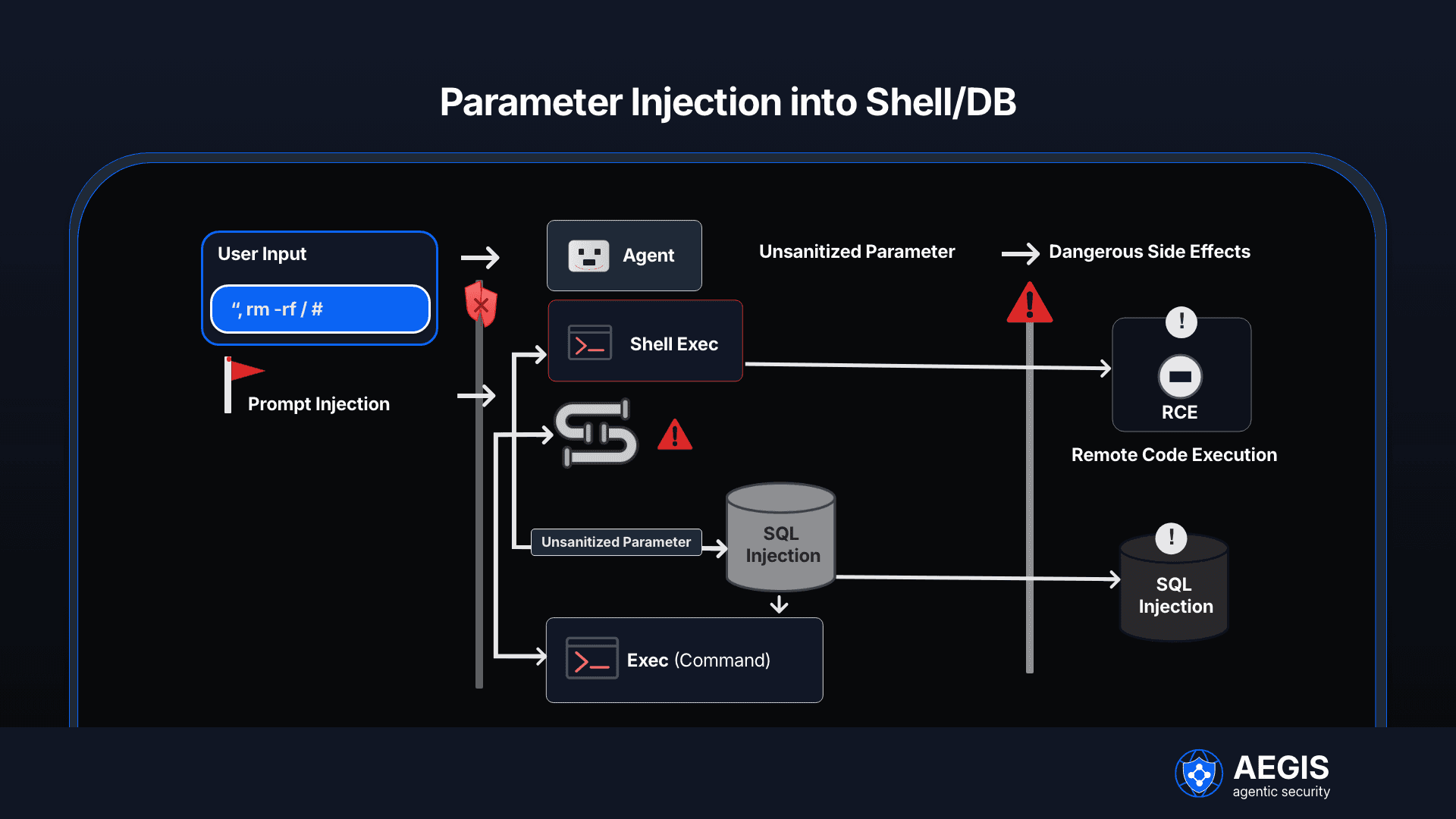
For SOCs, the top-threat vectors from agentic use include: (1) uncontrolled parallel containment leading to mass disruption, (2) parameter injection (malformed inputs causing dangerous tool behavior), (3) silent data exfiltration via unguarded egress, and (4) lack of per-agent provenance for forensic timelines. These risks are manageable with layers of runtime policy, identity, and signed telemetry.
👉🏻 Gain instant visibility into agent behavior and performance
Policy controls for safe automation
Aegis is designed as a lightweight policy-and-observability fabric that sits between orchestrators (AgentKit, LangGraph, LangChain-like frameworks) and downstream tools or APIs. It enforces least privilege at the agent↔tool boundary in real time and emits tamper-resistant telemetry for compliance and SOC analysis.
Key safety primitives (action → control)
Action (example) | Safety primitive enforced by Aegis | Why it matters |
Create payment > $5k | Threshold + approval_needed (human-in-loop) | Prevents high-value unauthorized transfers |
Modify firewall rules across tenants | Per-agent allowlist + rate limit (RPS) + tenant-scope check | Prevents mass network disruption and cross-tenant impact |
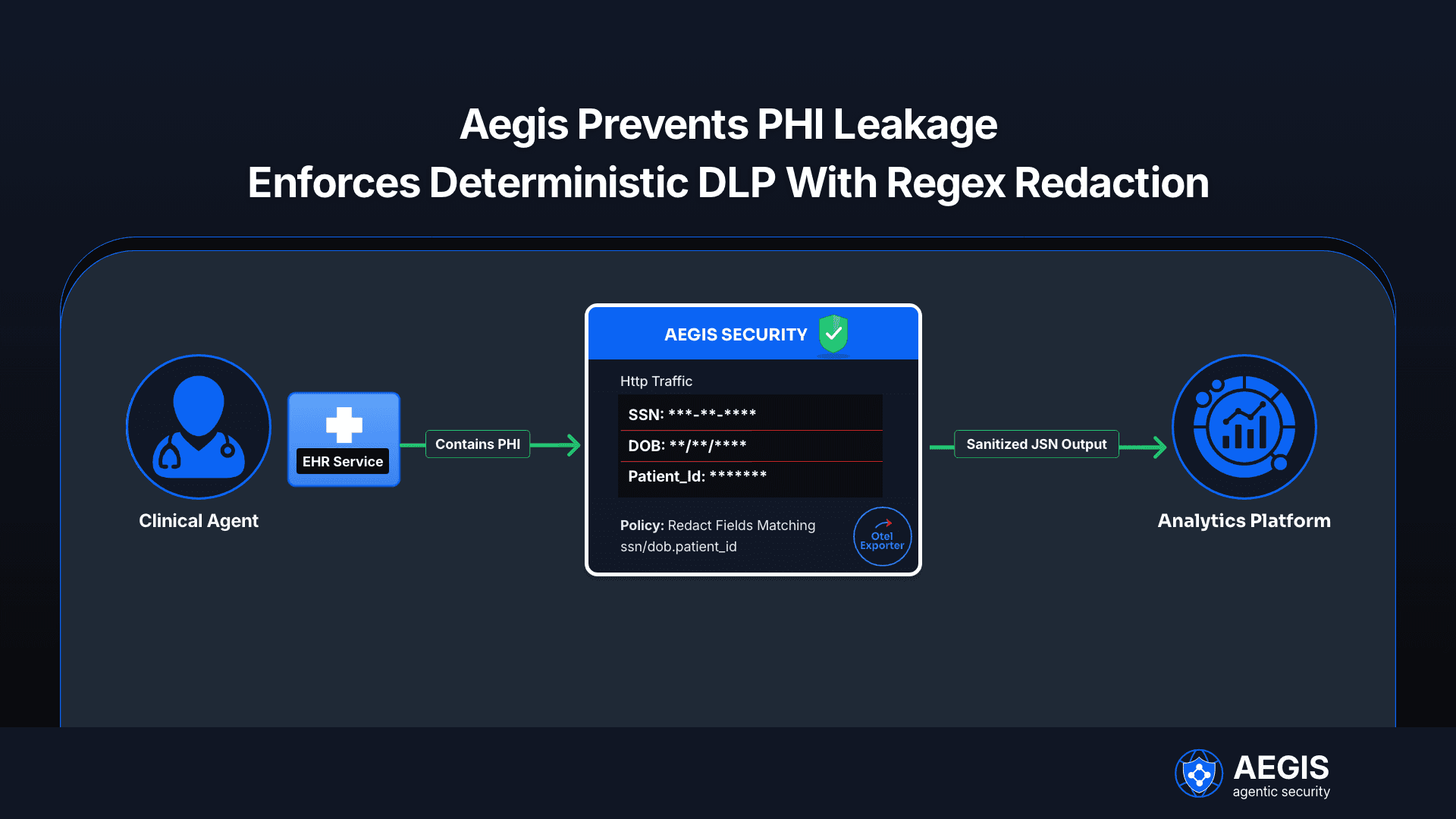
Post to Slack channel | Channel whitelist + PII redaction (sanitize) | Prevents leaks and enforces data policy |
Call external domain | Egress allowlist + domain validation | Blocks exfiltration to unknown endpoints |
Aegis implements policies as code (YAML/JSON) compiled into fast evaluators (OPA or prepared queries). Policies support conditions (ranges, regex), rate limits, budgets, and actions: allow, deny, sanitize, approval_needed. Runtime decisions are returned synchronously to the caller with a standardized error model for blocked calls.
Example: throttle and approval
When an agent requests a cross-tenant firewall modification, Aegis enforces a per-agent and per-tenant rate limit. If the request exceeds a safe concurrency threshold or scope, the gateway returns approval_needed, posts an interactive approval to Slack/Teams, and upon authorized override issues a single-use token to retry the call. This prevents simultaneous mass containments while preserving emergency overrides.
Forensics, telemetry and audit playbook
Good telemetry is as crucial as enforcement. Aegis emits structured OpenTelemetry spans and signed decision records that include agent_id, tool, policy_version, decision, and decision_reason. Signed telemetry and versioned policies allow SOCs and auditors to reconstruct an incident timeline and attribute each action to an agent identity and approval chain.
Telemetry artifacts and their forensic use
Artifact | Contents | Forensic benefit |
Decision span | agent_id, tool, params (sanitized), policy_version, decision, timestamp | Reconstruct allowed/blocked sequence |
Approval record | approver_id, approval_id, policy_id, timestamp, override_token_hash | Show who authorized exceptions |
Policy bundle manifest | bundle_id, checksum, commit metadata | Shows exactly which rules applied at time of action |
Signed log chain | prev_hash, current_hash, signature | Tamper-evident trail for compliance audits |
Integrating these spans into a SIEM or trace store (via OpenTelemetry) gives analysts immediate context: which agent initiated a containment, which policy blocked a call, and whether a human override occurred.
👉🏻 Build audit-ready systems with comprehensive logging practices
Aegis as a solution for operational details
Aegis intentionally focuses on the agent↔tool boundary. Its core components are:
- Gateway (data plane): a sidecar or forward proxy (Envoy/fast proxy) that intercepts outbound calls and forwards authorization requests to the decision service.
- Decision service (external authorizer): evaluates policies (compiled into OPA-like bundles), returns allow/deny/sanitize/approval_needed decisions, and signs attestations.
- Control plane: policy management, versioning, and bundle store (S3/GCS) with hot-reload capability.
- Telemetry engine: OpenTelemetry spans, metrics, and structured logs routed to Grafana/SIEM.
- SDKs & CLI: lightweight middleware for orchestrators, CLI for policy operations, and dry-run mode for safe rollouts.
Operational capabilities that matter to SOCs and MSSPs:
- Per-agent identity: short-lived JWTs bind each request to an agent and tenant, preventing "shadow" agents from masquerading as trusted agents.
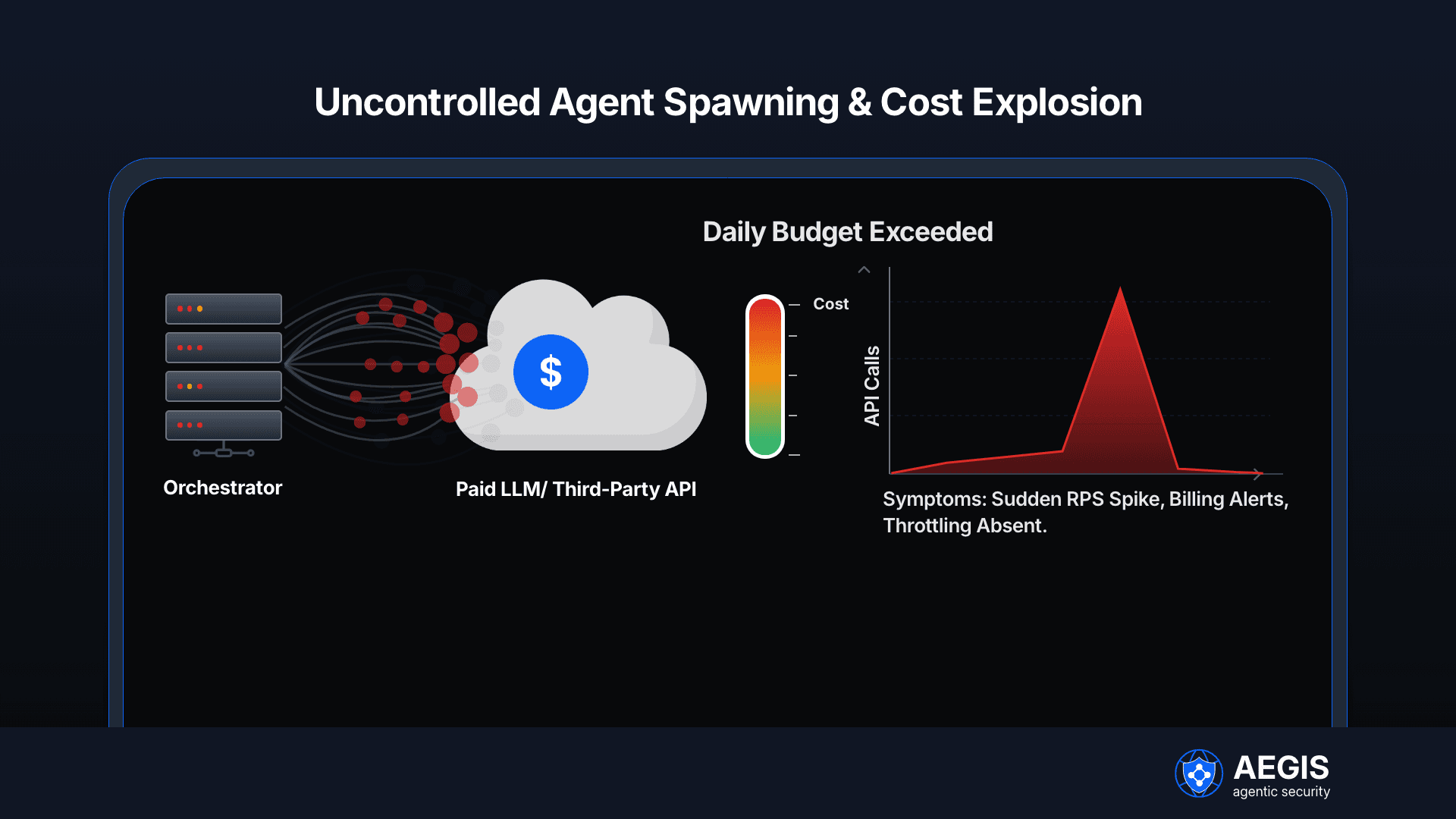
- Per-agent budgets & rate limits: prevent runaway costs and noisy remediation actions.
- Approval workflows: granular thresholds that scale approvals via Slack/Teams integrations with override tokens.
- Shadow mode: observe-only dry runs that show would-block events and parameter distributions before enforced rollout.
- Audit-ready telemetry: signed, versioned traces that map back to policy commits for compliance.
Aegis's pattern mirrors well-understood infrastructure concepts (service mesh + OPA) but adapts them to agent semantics: parameter-level checks, agent chaining (parent_agent_id validation), and approval gating tailored to SOC workflows. For organizations already investing in OpenTelemetry, Aegis integrates seamlessly into existing telemetry pipelines. (OpenTelemetry)
Operational patterns and templates
Sensible rollout path for SOCs:
- Inventory & shadow — register critical agents and run policies in shadow mode for 1–2 weeks to gather metrics.
- Tune & whitelist — refine regexes, thresholds, and allowlists based on observed parameter distributions.
- Enforce selectively — flip to enforce for low-risk actions first (read-only), then high-risk with approval flows.
- Audit & automate — use signed telemetry to close compliance evidence loops and automate common approvals.
Policy examples (short):
- finance-agent: create_payment amount ≤ 5000 → allow; >5000 → approval_needed.
- deploy-agent: deploy env == staging → allow; env == production → approval_needed + image_digest whitelist.
Aegis vs traditional controls
Capability | Legacy IAM / API GW | Service Mesh (Istio) | Aegis Gateway |
Per-agent parameter checks | No | Limited | Yes |
Approval workflows | No | No | Yes (Slack/Teams) |
Signed telemetry for audits | No | Partial | Yes (signed spans) |
Policy-as-code tuned to agents | No | Partial | Yes |
Safety primitives and recommended thresholds
Primitive | Default starting value | Rationale |
Cross-tenant firewall concurrency | 1 parallel change per agent per minute | Minimize blast radius |
Payment approval threshold | $5,000 | Balance velocity and risk |
External egress allowlist | Only approved domains | Prevent exfiltration |
Per-agent daily budget (LLM usage) | $20 | Control cost & abuse |
Integrations and standards
Aegis compiles policy bundles compatible with OPA and emits OpenTelemetry spans so it fits into established enterprise pipelines. Linking policy decisions with OPA and telemetry with OTel makes it possible to reuse existing invest- ments while adding agent-specific governance. Learn more about policy tooling and telemetry standards at Open Policy Agent and OpenTelemetry. (blog.openpolicyagent.org)
👉🏻 Keep your agent ecosystem healthy with continuous monitoring
Frequently Asked Questions
Q: How does Aegis prevent an agent from coercing another agent into a dangerous action?
A: Aegis enforces per-agent allowlists and validates parent_agent_id chains. If the child agent attempts actions outside its declared permissions, the gateway blocks and logs the event.
Q: Will policy evaluation add unacceptable latency?
A: Policy evaluation uses prepared queries and caching with target decision latencies at P99 in the low tens of milliseconds; shadow rollout helps tune policies before enforcement.
Q: How do approvals scale for high-volume environments?
A: Policies can raise thresholds to avoid noisy approvals, group similar actions for batch approvals, and integrate with Slack/Teams; override tokens are single-use to avoid replay.
Q: Can Aegis integrate with my existing SIEM and observability stack?
A: Yes—Aegis emits OpenTelemetry spans and structured logs which can be routed to common SIEMs and trace backends for correlation.
Q: How does Aegis support multi-tenancy for MSSPs?
A: Tenant-scoped bundles, per-tenant policy versions, and routing rules enforce scoping to prevent cross-tenant policy leakage while producing tenant-isolated telemetry.
Q: What is shadow mode and why use it?
A: Shadow mode logs would-block events without enforcing them. It’s essential for tuning conditions and regexes to avoid unexpected outages when first applying policies.
Operational discipline for agentic automation
Agentic systems offer measurable productivity gains, but only when paired with runtime governance that handles identity, parameter validation, throttling, and auditable approvals. Aegis places enforcement where it belongs — at the agent↔tool boundary — and gives SOCs the primitives they need to automate incident response without trading safety for speed. For teams piloting agents in regulated environments, start with shadow mode, define tight per-agent policies, and iterate toward enforcement backed by signed telemetry. This approach turns agentic risk into manageable, auditable automation.
External references and further reading: Open Policy Agent, OpenTelemetry, and recent enterprise surveys on agent adoption and governance. (blog.openpolicyagent.org)