Creating and Managing Agent Policies with OPA and Rego
Learn how to structure, version, and optimize OPA/Rego agent policies using Aegis for secure, low-latency, multi-agent AI environments.
Creating and Managing Agent Policies with OPA and Rego
Modern enterprises adopting multi-agent AI systems face a growing need for precise, fast, and maintainable policy control. Tools like Open Policy Agent (OPA) and its policy language, Rego, provide a powerful foundation for enforcing decisions at runtime. Yet as organizations scale, teams struggle with the sprawl of unstructured Rego snippets, inconsistent versioning, and policy latency.
This article explores best practices for structuring and managing large-scale OPA/Rego policies—then demonstrates how Aegis, the Agentic AI Security Mesh by Aegissecurity, simplifies this through automated policy compilation, prepared-query optimization, and observability across thousands of agents.
👉🏻 Enforce fine-grained controls using OPA and Rego policies
The Challenge: Policy Complexity in Multi-Agent AI Systems
As agentic AI moves into production, organizations are no longer dealing with isolated microservices—they’re managing dozens of semi-autonomous agents interacting with sensitive systems. Each agent may call APIs, perform payments, or post messages autonomously. Without structured, high-performance policy enforcement, the result is chaos.
Fragmented Policy Snippets and Latency Bottlenecks
In traditional setups, developers embed small Rego fragments within apps or rely on local validation checks. This approach quickly fails when:
- Policies expand across multiple repositories.
- Teams duplicate logic without central governance.
- Rego evaluations add unpredictable latency.
CNCF guidance recommends precompiling OPA bundles and leveraging prepared queries and WASM compilation to achieve millisecond-level evaluations at scale. However, implementing and maintaining this optimization manually across agents is non-trivial.
Deterministic Evaluation Across Agents
A core requirement for enterprise security is deterministic policy behavior. Agents performing similar actions under similar contexts must receive identical allow/deny decisions—irrespective of node, region, or orchestrator. That requires centralized policy definitions, consistent data inputs, and efficient query reuse.
👉🏻 Accelerate governance with reusable, standardized policy libraries
.png&w=3840&q=75)
The Modern Approach: Structured Policy Management with OPA and Rego
1. Designing Modular and Scalable Rego Layouts
Large Rego sets should separate data from logic:
package agent.policy
default allow = false
allow {
input.agent == data.allowed_agents[_]
input.action == data.allowed_actions[_]
input.amount <= data.limits.max_amount
}
Here, the policy logic (policy.rego) is generic, while tenant or agent-specific data lives in data.json. This enables versioning and hot-reloading without changing logic.
2. Compiling OPA Bundles and Using Prepared Queries
OPA supports bundle distribution, where compiled policy and data are packaged and served from a control plane (e.g., S3/GCS). When combined with prepared queries, evaluation can reuse parsed ASTs and cache hot paths.
Optimization Technique | Description | Impact on Latency |
Prepared Queries | Pre-parsed query objects reused across evaluations | Reduces CPU overhead by 40–60% |
WASM Compilation | Converts Rego to WebAssembly for embedding in clients | Lowers decision latency to <10ms |
Hot Reloading | Reloads bundles dynamically without restarting the engine | Zero-downtime policy updates |
(Source: CNCF and OPA performance documentation)
3. Testing and Version Control
Every policy bundle should include unit tests with representative inputs. A structured CI/CD pipeline runs lint → test → compile → sign → deploy, ensuring traceability and rollback.
Introducing Aegis - Agentic AI Policy Fabric
Aegis by Aegissecurity is built on the principle that AI agents require runtime policy enforcement and observability as tightly integrated layers—not optional add-ons.
Aegis acts as a policy and observability gateway for multi-agent AI environments, combining OPA/Rego, YAML-based policy-as-code, and real-time enforcement to protect agent workflows. It transforms complex OPA/Rego management into an automated, scalable process.
👉🏻 Safely evolve policies with version control and rollback strategies
How Aegis Manages OPA/Rego at Scale
Automated Compilation and Hot Reloading
Aegis compiles human-readable YAML policies into OPA bundles behind the scenes. Security teams define rules like:
agent: finance-agent
allowed_tools:
- name: stripe-payments
actions:
- create_payment
conditions:
max_amount: 5000
Aegis then translates this YAML into Rego and data objects, compiles them, and distributes signed OPA bundles to all agents. Bundles can be hot-reloaded at runtime—no downtime, no redeploys.
Runtime Enforcement and Prepared Query Caching
At runtime, Aegis intercepts every agent↔tool call through a proxy or sidecar (similar to Istio). It evaluates policies using prepared queries stored in-memory, ensuring sub-20ms decision times even under high concurrency. For heavy workloads, Aegis compiles Rego into WASM for client-side execution.
Aegis Optimization | Function | Example Outcome |
In-memory Cache | Reuses parsed queries | Stable 15ms avg latency |
WASM Compilation | Portable decision logic | Offline policy checks |
Canary Bundle Rollout | Progressive versioning | Safe policy evolution |
Practical Use Cases Enabled by Aegis
1. Fine-Grained Security and Compliance Controls
- Healthcare: Block PHI leaks by matching payload regexes and approved destination domains.
- FinTech: Enforce per-agent payment ceilings and require Slack approval for high-value transfers.
- SaaS: Limit API usage per day, stopping budget overruns.
2. Time and Rate Constraints for Operational Safety
Aegis supports time-of-day, rate-limit, and conditional gating policies:
deny {
input.time < "09:00" || input.time > "18:00"
}
deny {
count(data.calls_today[input.agent]) > data.limits.daily_calls
}
These rules prevent agents from running sensitive operations outside approved windows or exceeding thresholds.
3. Version Control and Governance
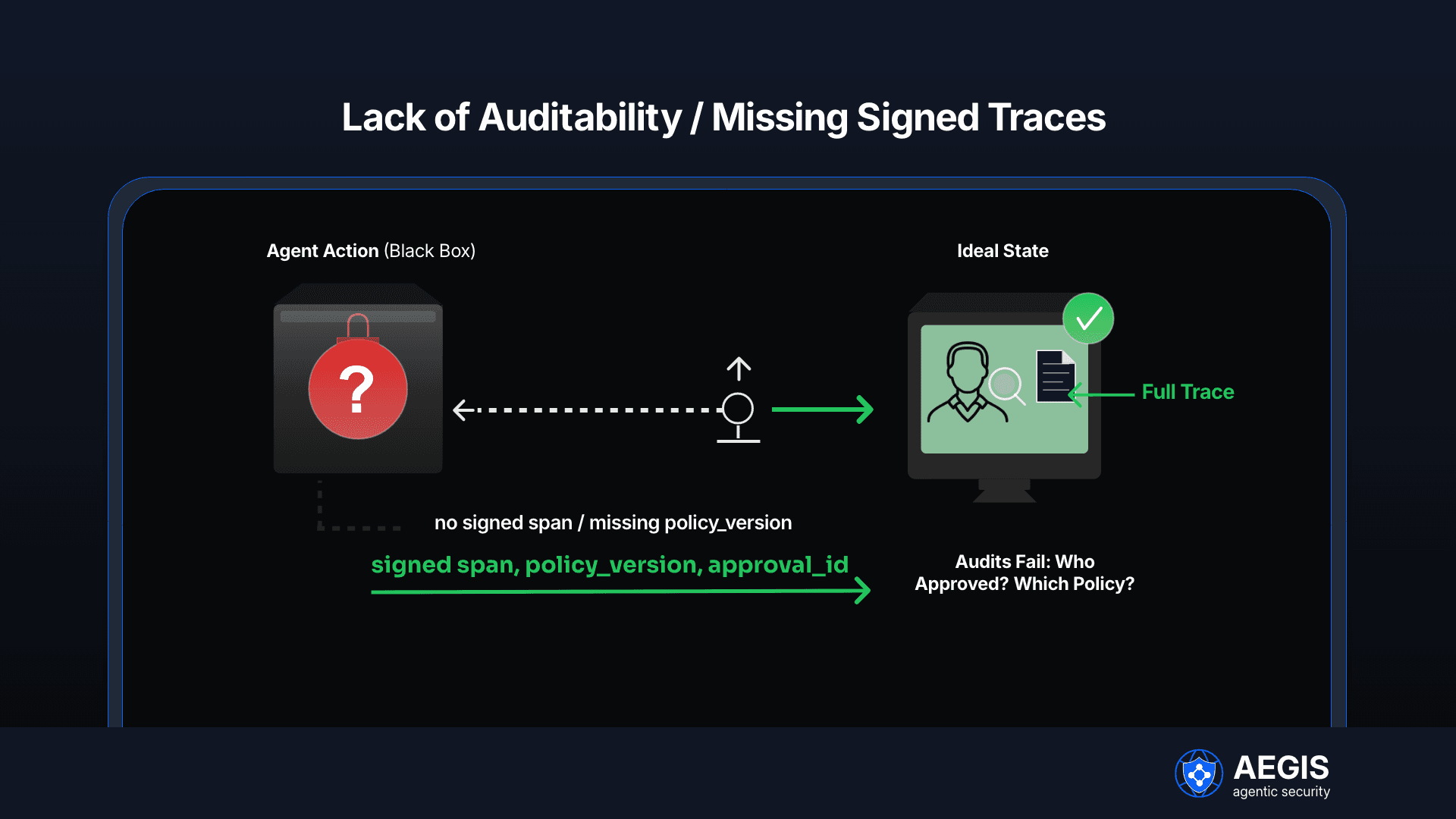
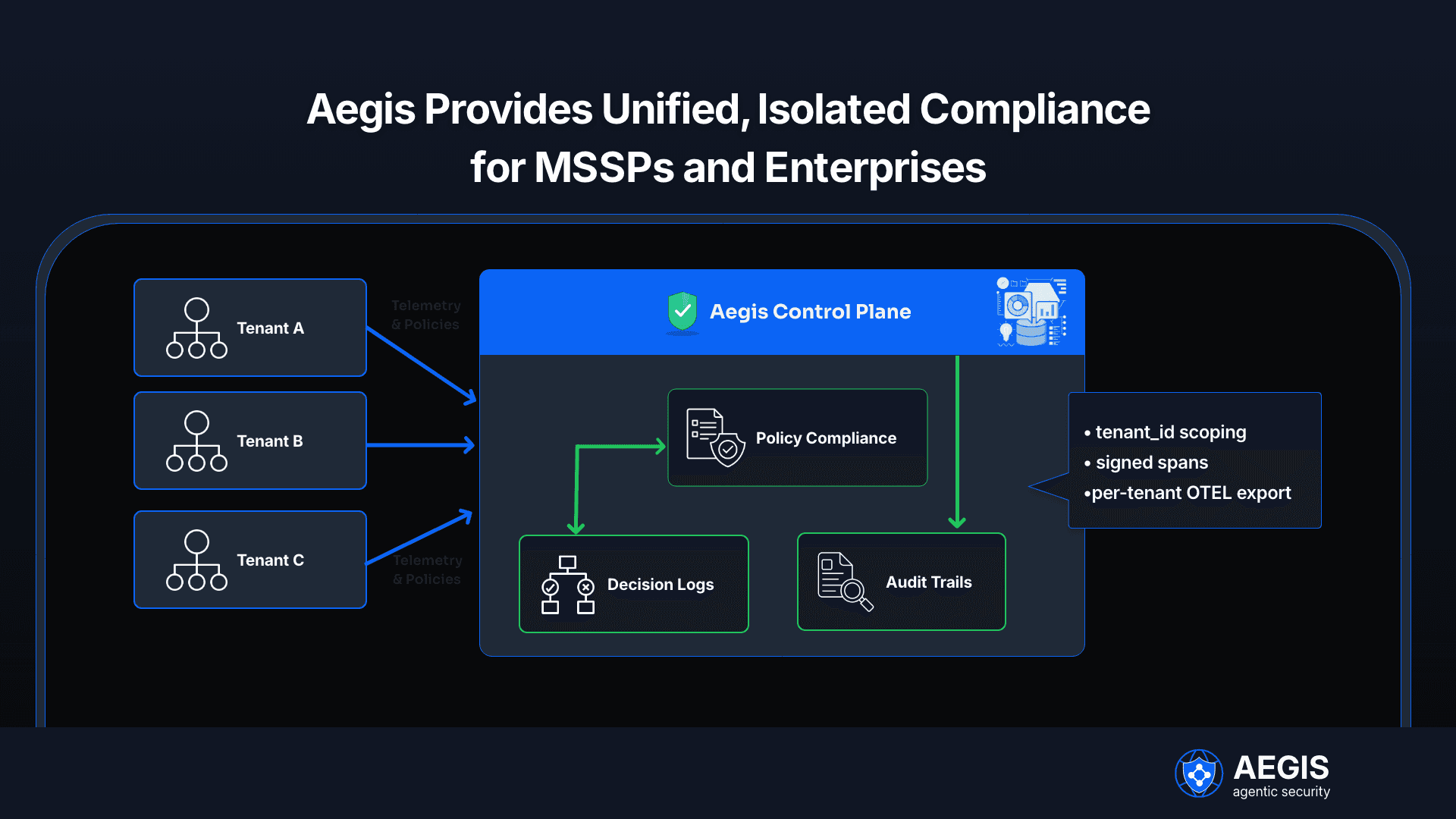
Aegis maintains tamper-proof logs, signed policy histories, and audit-ready change reports—critical for MSSPs and regulated sectors. Each decision record links back to a specific policy version, agent ID, and input payload hash, simplifying compliance reviews.
Governance Feature | Purpose | Benefit |
Signed Policy Bundles | Verifiable integrity | Prevent tampering |
Audit Chains | Traceable decisions | Simplify SOC reporting |
Canary Deployment | Gradual rollout | Safer updates |
Operational Workflow with Aegis
- Author policies in YAML with data and condition fields.
- Validate and compile via Aegis CLI or API—errors flagged pre-deployment.
- Distribute bundles to agents; policies hot-reload automatically.
- Enforce decisions via proxy or SDK middleware.
- Observe and tune through real-time dashboards.
This structured approach eliminates policy drift, ensures low latency, and centralizes governance.
Performance and Observability at Scale
Aegis integrates with OpenTelemetry, exporting traces that include agent IDs, decisions, policy versions, and latencies. Metrics such as “policy evaluation time” and “blocked requests per minute” provide immediate feedback loops.
Example observability dashboard metrics:
Metric | Description | Target |
Policy Eval Latency | End-to-end decision time | ≤ 20 ms |
Enforcement Accuracy | Decisions without false negatives | 100% |
Coverage | Agents under active policies | ≥ 80% |
Blocked Violations | Policy-triggered denies | Continuous trend data |
Performance profiling ensures teams can measure, iterate, and optimize continuously.
Common Policy Anti-Patterns and How Aegis Avoids Them
Anti-Pattern | Problem | Aegis Solution |
Large unoptimized Rego files | High CPU & memory | Modular YAML → compiled bundles |
Unversioned rules | Drift and audit gaps | Signed bundle versioning |
Hardcoded data | Difficult tenant scoping | Tenant-specific data.json |
Manual caching | Latency spikes | Automatic prepared-query caching |
Inconsistent dry-runs | False confidence | Live dry-run with comparative reports |
These design patterns help teams operationalize policy-as-code effectively, without deep OPA expertise.
Integrating Aegis with Multi-Agent Orchestrators
Aegis integrates seamlessly with LangChain, LangGraph, and AgentKit, functioning as a transparent security mesh layer. Developers need only minimal middleware changes—Aegis handles identity tokens, approval workflows, and telemetry automatically.
Each agent tool call is evaluated against a policy bundle. If a call violates conditions (e.g., exceeds amount, off-hours execution, unapproved API), Aegis blocks it and logs the event with full traceability.
Future Outlook - Policy Evolution and Training
Aegis encourages an iterative policy evolution model:
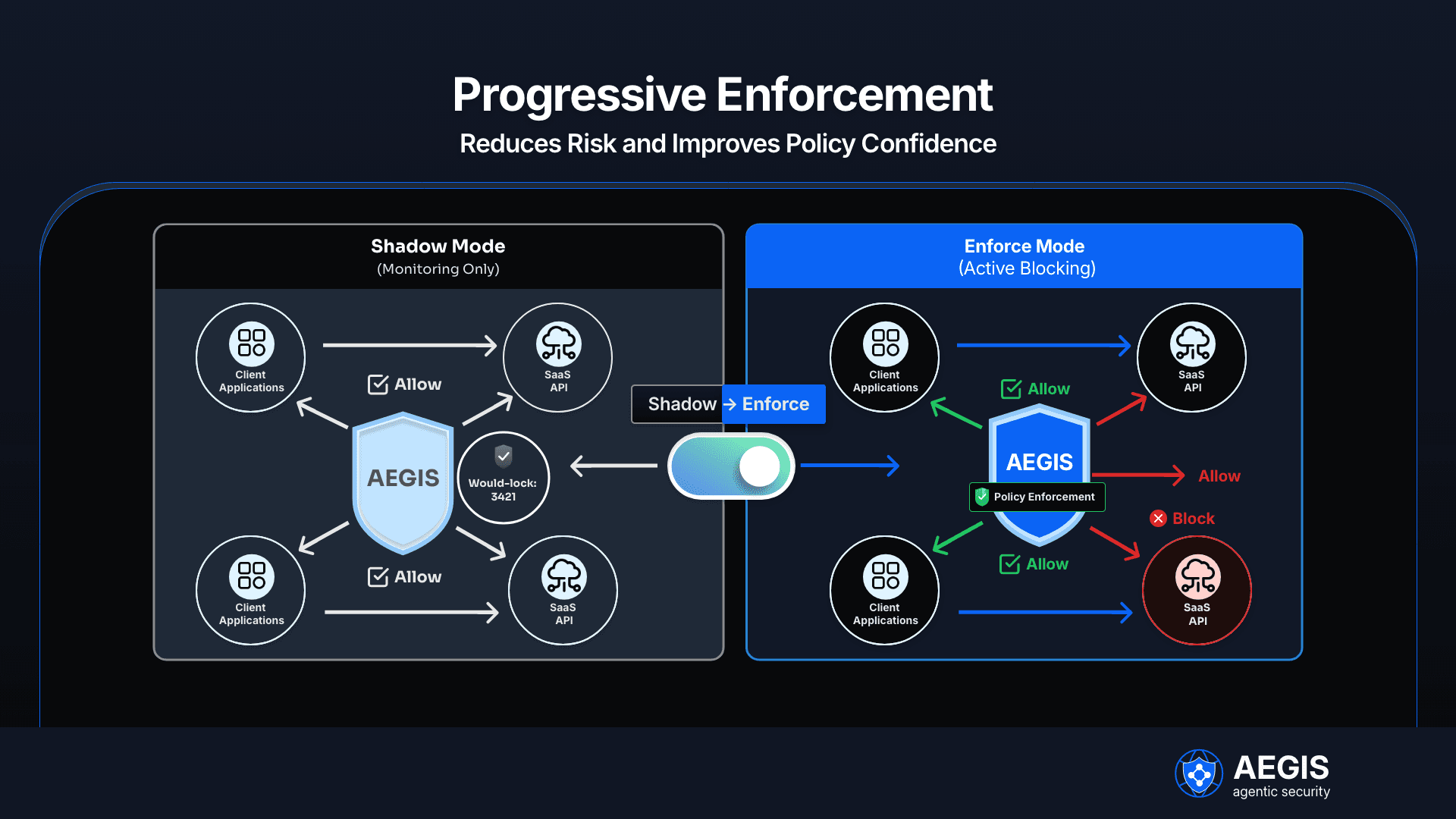
- Deploy in shadow mode to collect would-deny events.
- Measure impact and false positives via dashboards.
- Iterate on regexes and thresholds.
- Flip to enforce once validated.
This “measure-iterate-enforce” cycle keeps security adaptive without breaking agent workflows.
A recommended engineering path includes Rego fundamentals, prepared-query usage, and Aegis’s test harness for simulated agent inputs—ensuring developers maintain strong operational hygiene across all agent policies.
Frequently Asked Questions
1. Why use Aegis instead of standalone OPA?
Aegis automates OPA/Rego bundle management, caching, and observability. It’s designed for multi-agent environments where thousands of runtime decisions per second require optimized evaluation and unified governance.
2. Can Aegis work with existing orchestrators like LangChain or AgentKit?
Yes. It provides lightweight middleware and proxies that integrate seamlessly without code rewrites.
3. How does Aegis ensure low-latency evaluations?
Through prepared queries, in-memory caching, and optional WASM compilation, achieving sub-20ms decisions even at high concurrency.
4. What governance features does Aegis provide?
Version-controlled policy history, signed bundles, audit logging, and policy canary rollouts—all essential for regulated industries.
5. Can Aegis support approval workflows?
Yes. For high-risk actions (e.g., large payments), Aegis pauses execution, requests approval via Slack/Teams, and resumes once approved with an override token.
6. What industries benefit most from Aegis?
FinTech, Healthcare, SaaS, Manufacturing, and MSSPs—anywhere runtime AI agents interact with sensitive or regulated data.