
Creating an Agent Policy Library for Enterprise Reuse
How to build a versioned, parameterized policy library for secure, reusable agent controls and compliant runtime enforcement.
Building an Agent Policy Library for Enterprise Reuse
Enterprises adopting agentic AI consistently hit the same operational roadblock: teams reinventing policies for identical connectors and workflows, producing inconsistent controls and noisy audits. A centralized, versioned Agent Policy Library—backed by runtime enforcement, test vectors, and a governed publishing workflow—eliminates duplicated effort, speeds safe adoption, and measurably reduces policy-related incidents.
This article lays out why templates accelerate safe agent adoption, how to design a governed library (structure, lifecycle, and metrics), practical migration patterns, and an operational view of Aegis as a concrete solution for policy enforcement and telemetry. It draws on current adoption trends and technical best practices. For broader industry context on agentic AI growth see McKinsey and the Stanford AI Index.
👉🏻 Automate governance with policy-driven security frameworks
Why templates accelerate safe agent adoption
Enterprises face two friction vectors when rolling out agents: (1) security uncertainty—teams don’t know the exact safe parameter checks for a connector; (2) slow change control—ad hoc policy changes create audit gaps. Templates solve both.
Repeatable safety patterns
Templates encode common constraints (e.g., payment ceilings, read-only EHR access, allowed domains) as parameterized artifacts. Teams only fill tenant-specific values (amount thresholds, allowed channels) and inherit vetted logic and test vectors.
.png&w=3840&q=75)
Faster, measurable rollout
A template library enables predictable shadow-mode rollouts: deploy templates in observation mode, collect "would-block" telemetry, tune, then flip to enforcement. This pattern lowers blast radius and provides clear guardrails for compliance teams.
Industry context: large surveys from 2024–2025 show rapid interest in agentic AI but persistent trust gaps; e.g., McKinsey reports 23% of organizations scaling agentic systems and an additional 39% experimenting, highlighting the need for governance at scale. (McKinsey & Company)
Library design and governance model
A usable library is more than files in a repo—it’s a lifecycle: create → review → publish → monitor → retire. Below are core components.
Categories, schema and templating
Organize by connector, vertical, and action:
- Connectors: stripe-payments, sharepoint, slack.
- Verticals: healthcare, fintech, retail.
- Actions: create_payment, read_record, post_channel.
Use a simple policy schema (YAML/JSON) that supports:
- Parameter placeholders (max_amount, allowed_channels).
- Conditions, regex validation, rate limits, budgets.
- Metadata: maturity (beta/audited/enterprise), compliance mappings (HIPAA/PCI), changelog.
Example snippet
template: finance-payments
params:
max_amount: 5000
currency: USD
actions:
- create_payment
conditions:
- amount <= {{max_amount}}
- currency == {{currency}}
Governance, publishing workflow and tagging
Implement a publishing workflow:
- Draft (team creates parameterized template).
- Review (security and compliance stamp).
- Shadow (deploy in dry-run for N days).
- Certified (audited templates flagged “enterprise”).
Tagging must include maturity, last-reviewed date, and compliance mappings.
Build automated checks: schema validation, test vector execution, and an auto-suggestion engine in the admin UI that surfaces existing templates when a team begins authoring a policy. The Aegis control plane brief details a similar model for policy validation and versioning.
Metrics that matter
Track:
- Reuse rate (percentage of new policies derived from templates)
- Reduction in policy-related incidents (ops tickets, blocked workflows)
- Shadow→Enforce conversion time
- Average time to author a policy
Table 1 — Key library metrics and targets
Metric | Target (pilot) | Why it matters |
Reuse rate | ≥ 60% | Shows standardization |
Policy incidents | ↓ 50% | Fewer misconfigurations |
Shadow period | 7–14 days | Time to gather safe telemetry |
Time to author | < 10 min | Developer productivity |
Sample templates and migration stories
Below are representative templates and migration patterns enterprises will use immediately.
Example templates
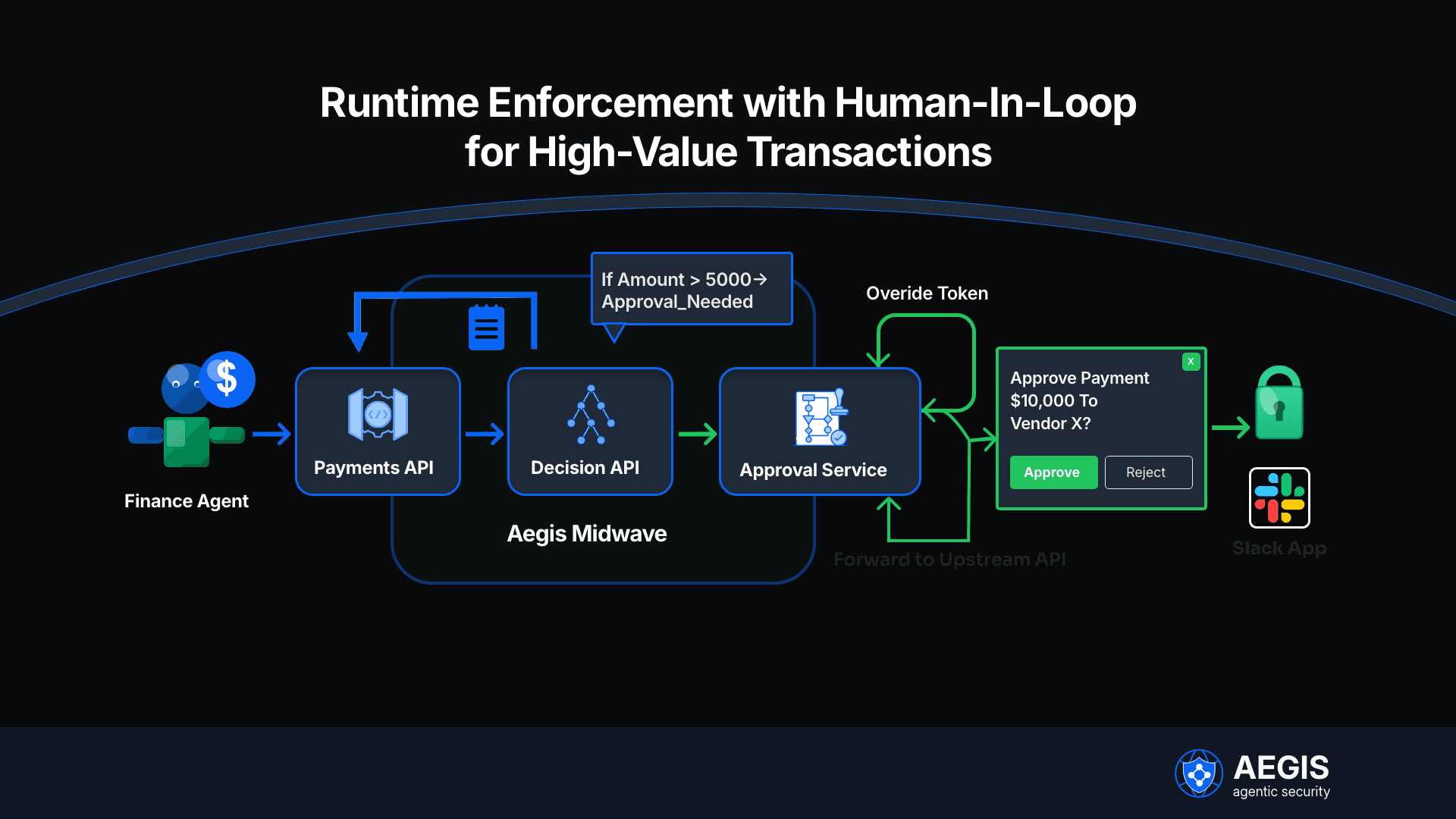
- finance-payments — payment_ceiling + approval flow (amount thresholds → approval_needed if > threshold).
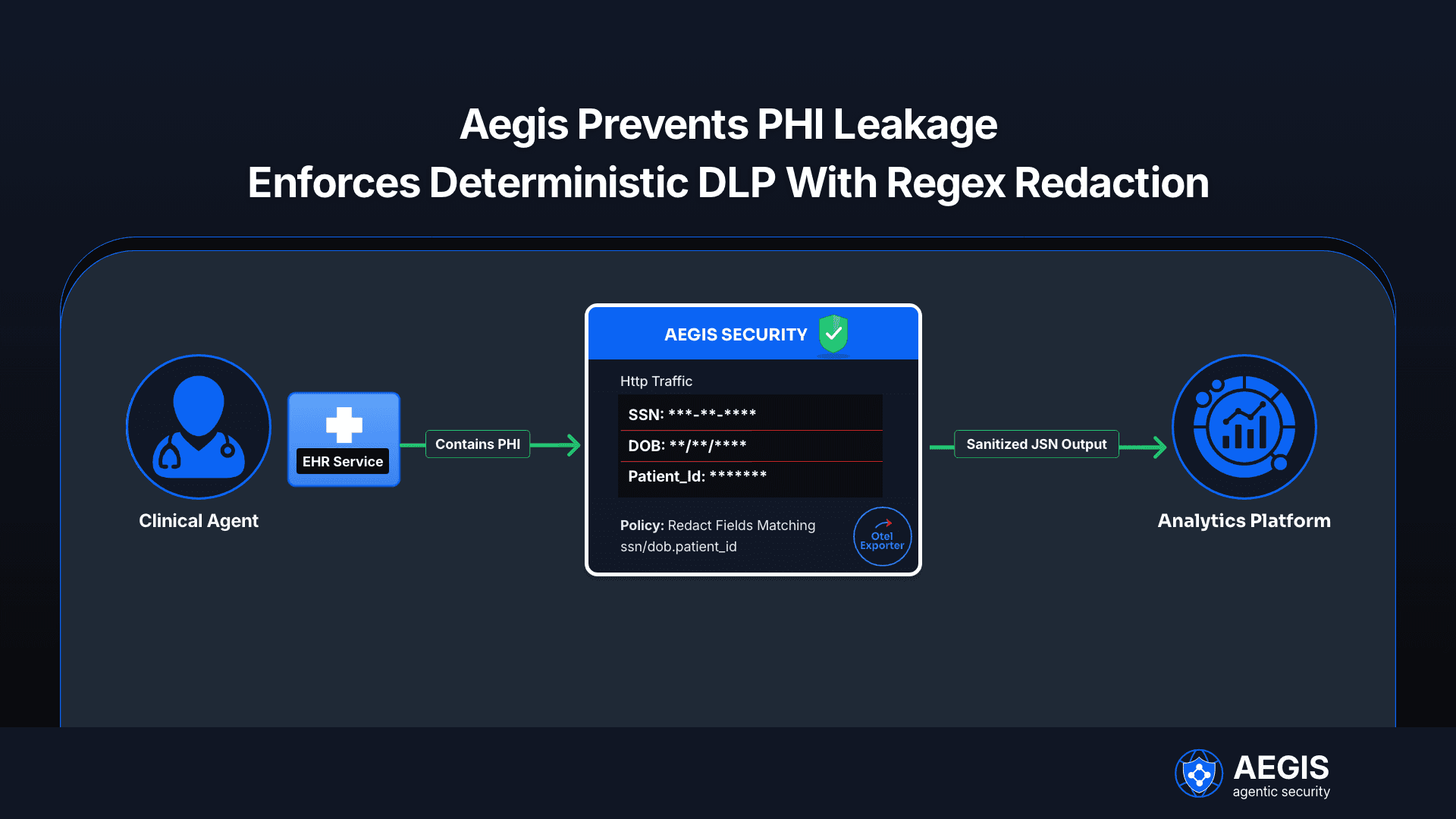
- ehr_read_only — only GET operations, export blocked, DLP regex to redact SSNs.
- deployment_production_approval — allow deploy to staging; require approval for production and validate image digests.
Provide test vectors with each template: inputs that should pass, inputs that should be sanitized, and inputs that should be blocked. These vectors make automated CI checks possible and speed audits.
👉🏻 Simplify policy lifecycle management with OPA and Rego
Table 2 — Example templates and controls
Template | Core checks | Example action |
finance-payments | amount <= param, currency regex, approval_needed | Block and request approval if >5000 |
ehr_read_only | method==GET, destination==internal-ehr, DLP redact | Deny export=true |
deployment_prod | env!=production or approval_needed, image digest whitelist | Pause and notify approver |
Migration patterns
- Discovery: scan repos for bespoke rules and common connectors.
- Normalize: extract logic into parameterized templates.
- Shadow run: deploy templates in shadow mode to collect would-block telemetry.
- Promote: after tuning, publish templates and deprecate bespoke rules.
- Export: provide MSSP customers with exportable template bundles.
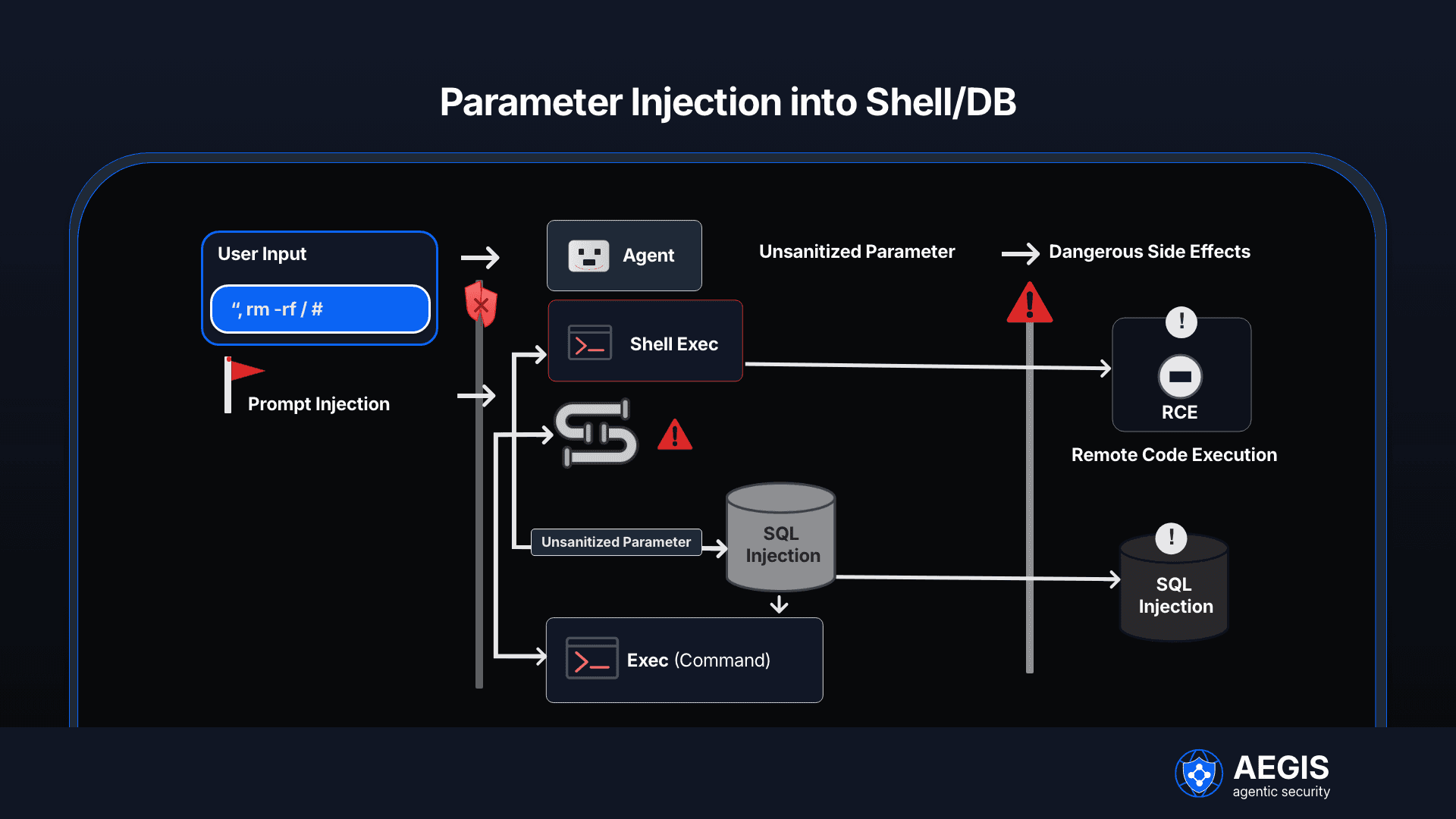
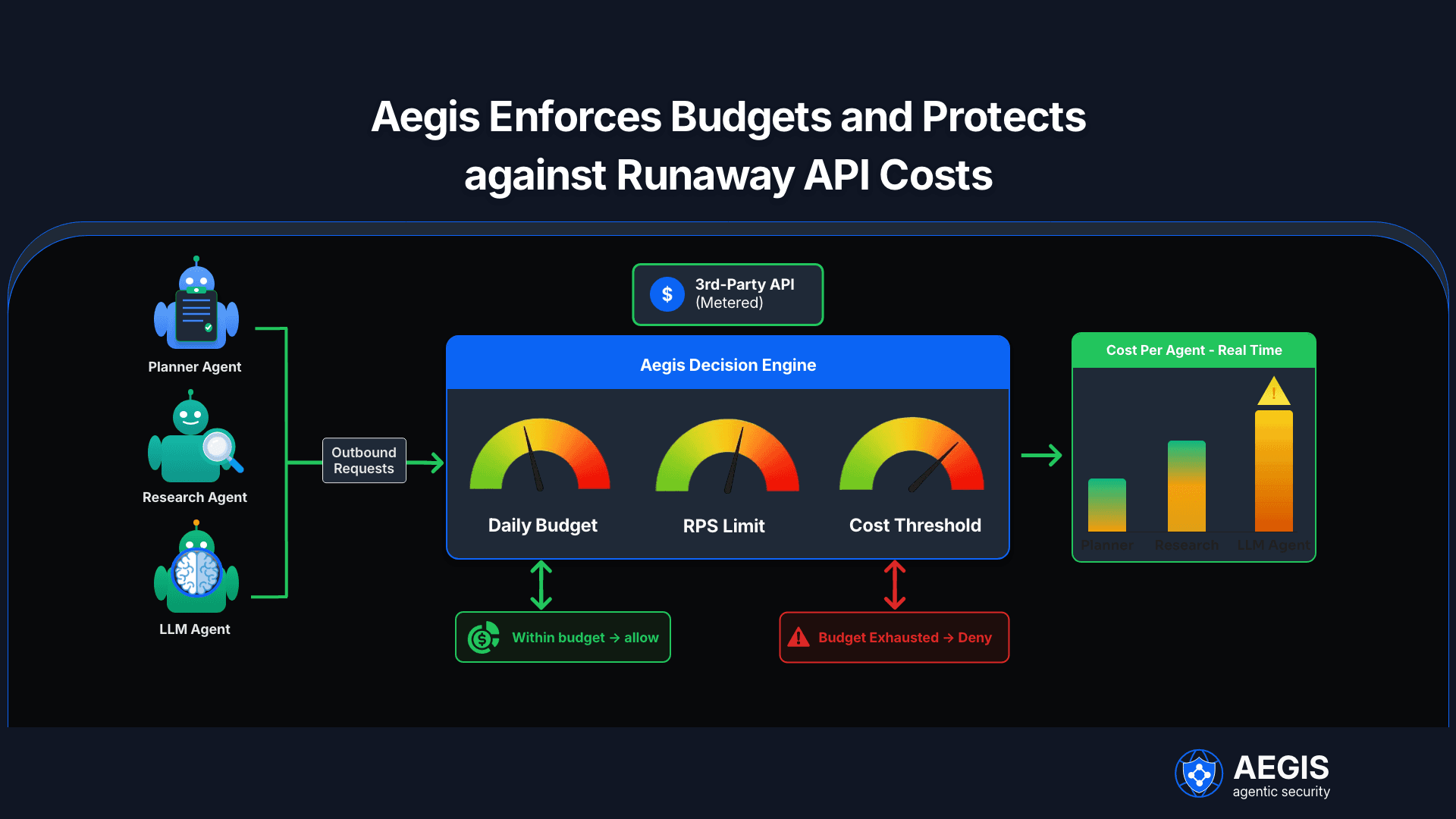
Concrete migration examples and problem statements for agent privilege escalation, parameter injection, and cost governance are documented in our internal use-case notes.
👉🏻 Bring clarity and control with centralized policy visibility
Aegis: operationalizing AI with runtime enforcement
Aegis Gateway implements the control and data plane necessary to make a policy library enforceable and auditable in production. It acts as a runtime policy and observability fabric between orchestrators (AgentKit, LangGraph, etc.) and tools (Stripe, SharePoint, Slack), performing three tightly coupled roles: identity & policy management, runtime enforcement, and telemetry/audit export. See the Aegis technical brief for full architecture.
What Aegis provides
- Policy-as-code + bundling: Admin console compiles YAML/JSON templates into OPA bundles, stores versions with changelogs, and hot-reloads data to the runtime evaluator.
- Runtime enforcement: A lightweight gateway (sidecar/proxy) inspects agent_id, tool target, parameters and call chain; returns allow/deny/sanitize/approval_needed. For writes, fail-closed behavior prevents unauthorized actions.
- Approval workflow: For high-risk thresholds, Aegis pauses the call and routes approval requests to Slack/Teams; an override token allows a one-time retry after approval.
- Telemetry & SIEM integration: Every decision emits OpenTelemetry spans and structured logs that include agent ID, policy_version, decision_reason and approval_id—suitable for SOC workflows and compliance audits.
How it maps to the library
- Templates live in the control plane and compile into OPA bundles that the Aegis runtime consumes.
- Shadow mode is supported: templates run in observation to generate would-block metrics without workflow disruption.
- Versioned templates, maturity tags, and exportable bundles support MSSP multi-tenant operations.
Operational targets for the Aegis data plane include sub-20ms policy decision latency at P99 and full trace emission for every agent→tool call. The Aegis MVP and technical brief provide concrete design and telemetry expectations.
Implementation tips and infra-as-code
- Store templates in a Git-backed registry with CI that runs test vectors on each PR.
- Provide Terraform/Helm modules to deploy the control plane and inject sidecars; templates should be promotable by CLI.
- Ensure short-lived JWTs and mutual TLS for agent identity; integrate with enterprise SSO for admin RBAC.
- Use OpenTelemetry collectors to centralize spans (OpenTelemetry adoption and collector usage remain high across cloudnative orgs). (OpenTelemetry)
Quick compliance mapping
- Map templates to regulatory checklists (HIPAA, PCI) and store mappings as metadata.
- Produce tamper-evident audit bundles (signed manifests + policy_version + approval trace) for regulators.
Frequently Asked Questions
Q: What is the fastest way to get teams using templates?
A: Ship an initial set of 8–12 high-value templates (payments, EHR read, Slack posting, deploy staging) and make them discoverable in the admin UI with auto-suggestions. Run shadow mode for 7–14 days.
Q: How do we avoid approval fatigue?
A: Use tiered thresholds: small exceptions auto-approve, mid-risk require manager approval, high-risk require senior approver. Add budgets and rate limits to reduce noisy approvals.
Q: Can templates be exported for MSSPs?
A: Yes—versioned bundles with metadata and changelogs can be exported and re-imported into customer control planes.
Q: How do we test template changes safely?
A: Each template must include test vectors and a CI job that executes them in a sandbox or shadow mode before promotion.
Q: Which telemetry standards should we use?
A: OpenTelemetry for spans and metrics plus structured JSON logs for SIEM ingestion; this matches current industry practice. (OpenTelemetry)
Final checklist for teams
- Create template taxonomy (connector / vertical / action)
- Add schema, test vectors, and compliance metadata
- Implement review → shadow → enforce publishing flow
- Wire enforcement to a runtime gateway (e.g., Aegis) with OpenTelemetry spans
- Measure reuse rate and incident reduction
Building a versioned, governed Agent Policy Library combined with a runtime enforcement fabric like Aegis delivers the operational controls enterprises need for safe, scalable agent deployments—reducing duplicated work, improving auditability, and enabling teams to ship autonomous workflows with confidence.