Code Generation Agents: Opportunities for Developers and Risks
Explore how code generation agents enhance productivity yet introduce security risks, and how Aegis provides runtime controls for safe adoption.
Code Generation Agents: Productivity Gains Meet Security Risks
AI-driven code generation agents have become a mainstay of modern development pipelines, rapidly transforming how teams ship, test, and deploy code. Stack Overflow’s 2024 developer survey reports that over 70% of developers now use AI-assisted coding tools, up from 58% in 2023, citing improved scaffolding, test generation, and documentation speed.
But this acceleration comes at a price: supply-chain vulnerabilities, insecure code patterns, and uncontrolled credential propagation. As organizations push these agents into CI/CD environments, they face the growing challenge of ensuring that automation doesn’t bypass human oversight or compliance safeguards.
The emergence of agentic AI—AI systems capable of performing multistep actions autonomously—has amplified these risks. In this article, we explore how enterprises can embrace code generation agents responsibly, and how Aegis, Aegissecurity Agentic Security Gateway, provides runtime guardrails for safe automation.
The Productivity Case for Code Generation Agents
Faster Scaffolding, Testing, and Refactoring
Developers increasingly rely on agentic systems to handle repetitive tasks:
- Generating project scaffolds, documentation, and boilerplate code.
- Auto-writing unit tests and refactoring legacy code for modernization.
- Performing inline CI/CD actions such as linting, build triggers, and deployment checks.
A typical workflow today might look like:
Developer → prompts agent → agent scaffolds API → runs tests → pushes PR → triggers CI
.png&w=3840&q=75)
This process, which once took hours, now completes in minutes—an efficiency leap that drives measurable productivity. In enterprise pilots, guarded code generation (agents with enforced policies) has improved development velocity by 40–50% while maintaining compliance alignment.
👉🏻 Modernize IT support with AI agents that resolve issues faster and smarter
Expanding Developer Capacity without Expanding Risk
For teams with strict SLAs or regulatory requirements, AI agents act as multipliers—handling routine work so senior engineers can focus on architecture and design. However, without controls, this productivity edge can introduce security debt.
Benefit | Example | Measured Impact |
Automated scaffolding | Backend API templates with test stubs | ~60% time savings |
Inline documentation | Auto-generated docstrings | +30% consistency |
CI pipeline suggestions | Automated YAML lint and version pinning | 25% fewer CI failures |
Security and Supply Chain Risks
The Hidden Cost of Speed
Unchecked code generation introduces subtle but critical risks:
- Insecure dependency injection: Agents may pull unverified libraries or outdated versions.
- Credential leakage: Generated code occasionally hardcodes tokens, environment variables, or database URLs.
- Cryptographic misuse: Agents default to weak algorithms (e.g., MD5, static salts).
- Prompt injection: Malicious user prompts may cause agents to execute unvetted shell commands.
Recent analyses show 30–40% of AI-generated code snippets contain at least one security flaw if left unreviewed. When scaled across CI/CD pipelines, even minor lapses can cascade into production vulnerabilities.
👉🏻 Empower teams with instant access to the right knowledge at the right time
Supply Chain and Provenance Concerns
Modern enterprises depend on layered dependencies. When a code generation agent automatically adds new packages or APIs, it expands the organization’s software bill of materials (SBOM) and attack surface.
To mitigate these risks, teams must:
- Force SBOM generation before merges.
- Apply license and vulnerability scoring checks to all new dependencies.
- Maintain provenance headers in agent-generated commits for auditability.
Common Risk | Example Trigger | Recommended Mitigation |
Insecure dependency import | Agent adds library without version pinning | Require SBOM + CVE check |
Credential leakage | Agent prints .env file for debugging | Deny secret access outside secrets manager |
Over-permissioned CI/CD | Agent deploys directly to prod | Policy gate requiring human approval |
Runtime Controls and CI Integration (Aegis Patterns)
Aegis by Aegissecurity bridges the gap between autonomy and accountability. Designed as an AI Agent Security Mesh, Aegis provides real-time runtime enforcement for multi-agent systems, integrating seamlessly with developer workflows.
Enforcing Least Privilege through Policy-as-Code
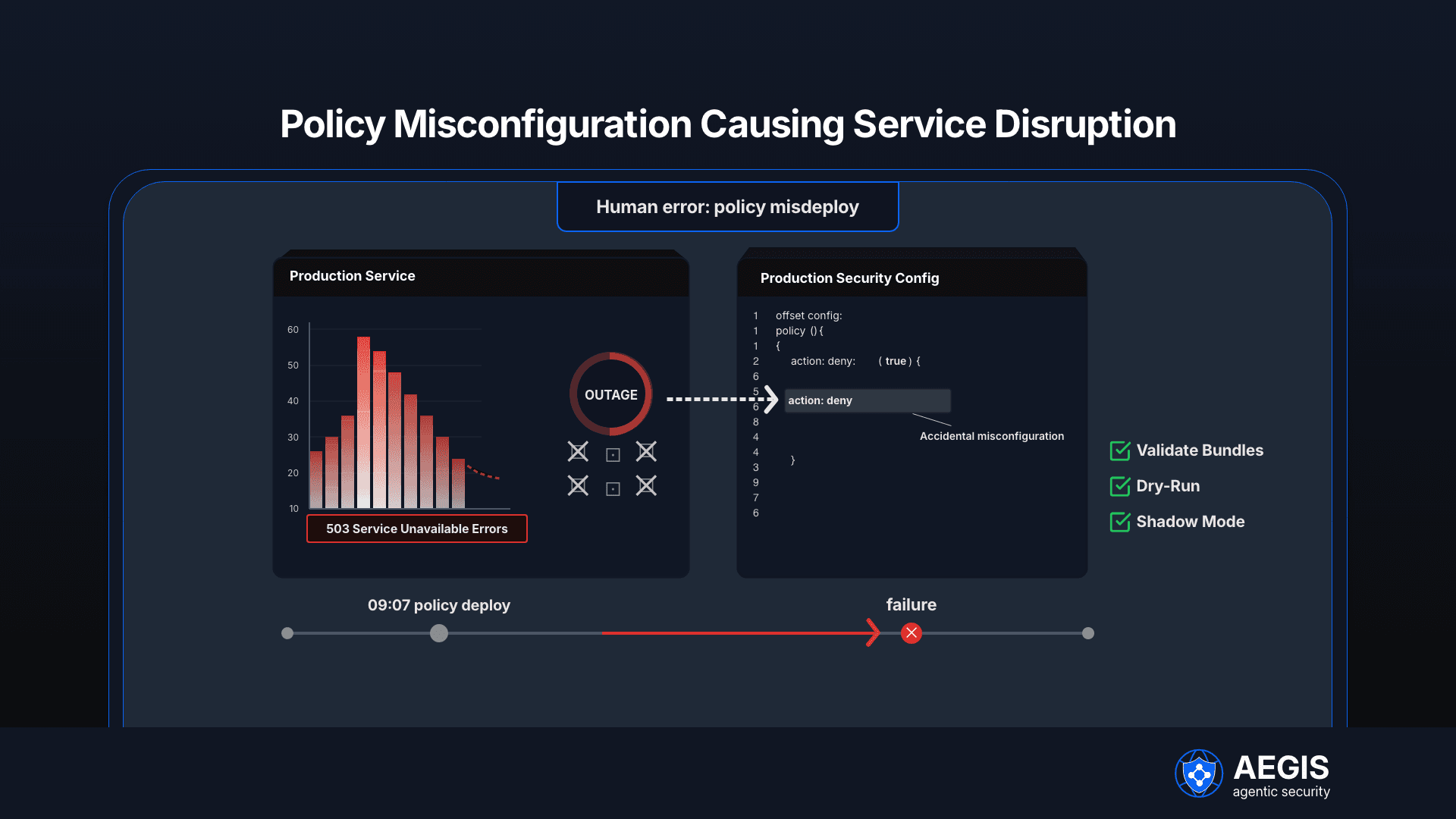
Aegis enables teams to define granular runtime policies using YAML/JSON, compiled into Open Policy Agent (OPA) bundles. These govern which agents can access which repositories, APIs, or secrets—and under what parameters.
For example:
agent: codegen-agent
allowed_tools:
- name: git
actions: [commit, push]
- name: ci-pipeline
actions: [run_tests]
conditions:
approval_needed: true if branch == "main"
Each agent call is evaluated in real time:
- Allow – Proceed under policy.
- Deny – Block unsafe operation.
- Sanitize – Redact sensitive parameters.
- Approval_needed – Pause until authorized via Slack/Teams.
Aegis emits OpenTelemetry traces for every decision, generating an auditable trail across agent-tool interactions.
[Placeholder for Image 1: A flowchart showing Aegis enforcing runtime policy — agent → Aegis Gateway → CI/CD → Approval (if needed) → Merge.]
👉🏻 Transform document-heavy workflows with faster, more accurate AI extraction
Integration Across the CI/CD Lifecycle
Aegis extends beyond static scanning. It embeds directly into CI/CD flows:
- Code generation → Aegis validates agent identity and request scope.
- Static analysis (SAST/DAST) → Auto-triggered pre-merge checks.
- Runtime enforcement → Controls egress domains, repository access, and API scope.
- Audit and telemetry → Structured logs feed into SIEM and compliance dashboards.
This transforms the CI pipeline into a self-auditing, policy-aware system, ensuring that no autonomous action bypasses review.
Developer Best Practices and Governance Checklist
Policy, Telemetry, and Human-in-the-Loop Controls
To safely adopt code generation agents at scale, organizations should operationalize governance through:
- Scoped agent identities – Unique tokens per agent to prevent privilege escalation.
- Telemetry-first security – Use decision traces for continuous monitoring.
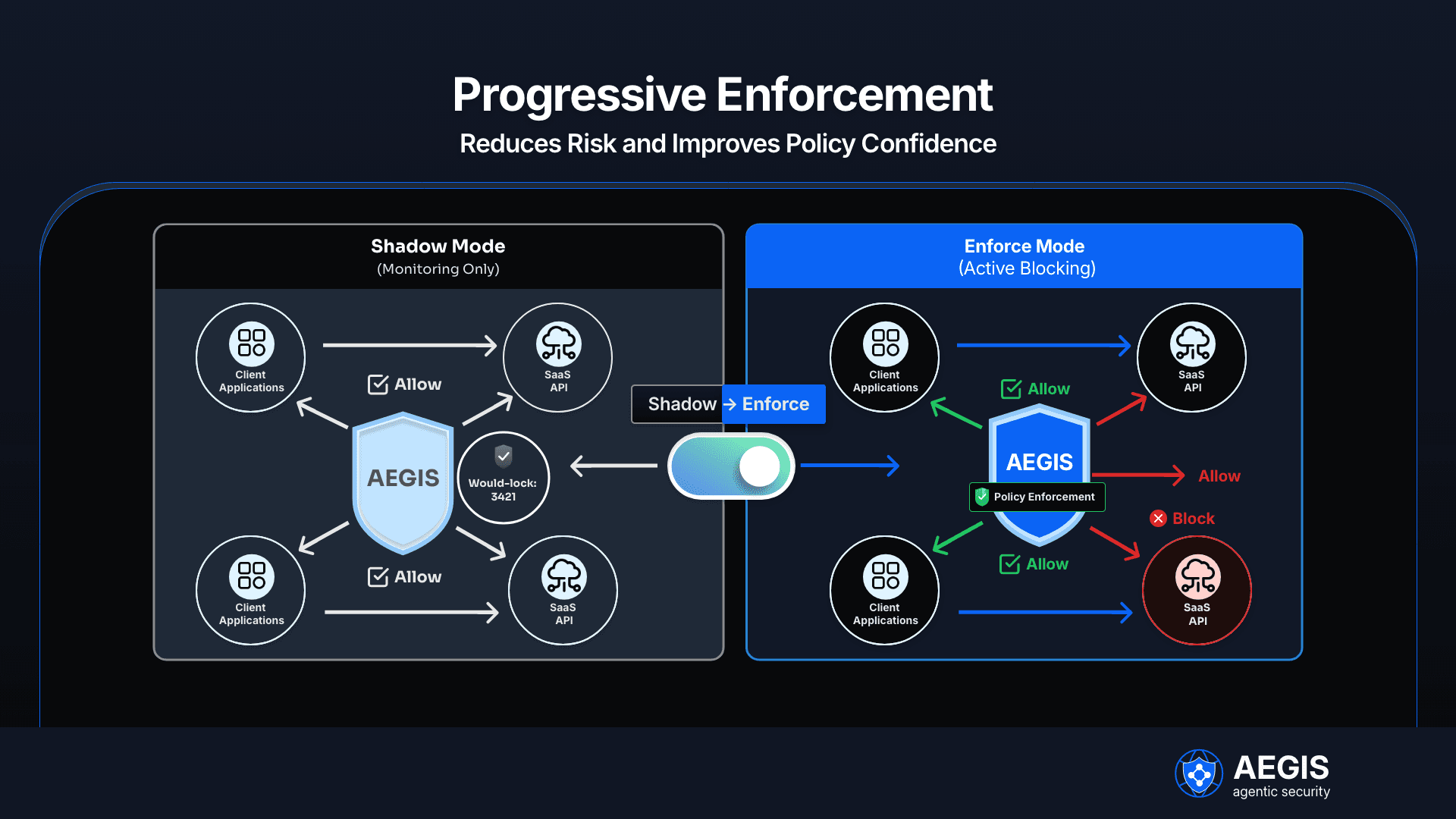
- Shadow mode deployment – Observe potential violations before enforcing.
- Human approvals for critical actions – Route sensitive merges or deploys through Slack/Teams.
Governance Area | Description | Tooling via Aegis |
Access control | Define which repos/tools each agent may access | Policy-as-code via YAML |
Approval workflow | Pause risky actions for human sign-off | Integrated approval service |
Observability | Track allow/deny ratios, latencies, budgets | OpenTelemetry dashboards |
Cost management | Apply API usage caps per agent | FinOps policy parameters |
Continuous Improvement Through Measurement
Enterprises can monitor the percentage of agent-generated pull requests (PRs) containing vulnerabilities before and after Aegis enforcement.
Example metrics:
- PRs with security issues: reduced from 14% → 3%.
- Approval-needed events: 18% of total agent actions (balanced governance).
- Policy decision latency: <20 ms at P99.
Aegis AI Security for Enabling Safe and Scalable Code Generation
Aegis is more than a monitoring gateway—it’s a runtime policy and observability fabric designed for the agentic era. Built with the same principles that power cloud security meshes, Aegis operates as an intermediary between agent orchestrators (like LangGraph, AgentKit) and developer tools.
Core Capabilities at a Glance
Capability | Description |
Policy-as-Code | Define, compile, and version policies in YAML/JSON; enforce at runtime with OPA. |
Runtime Enforcement | Enforce allow/deny/sanitize/approval decisions for every agent call. |
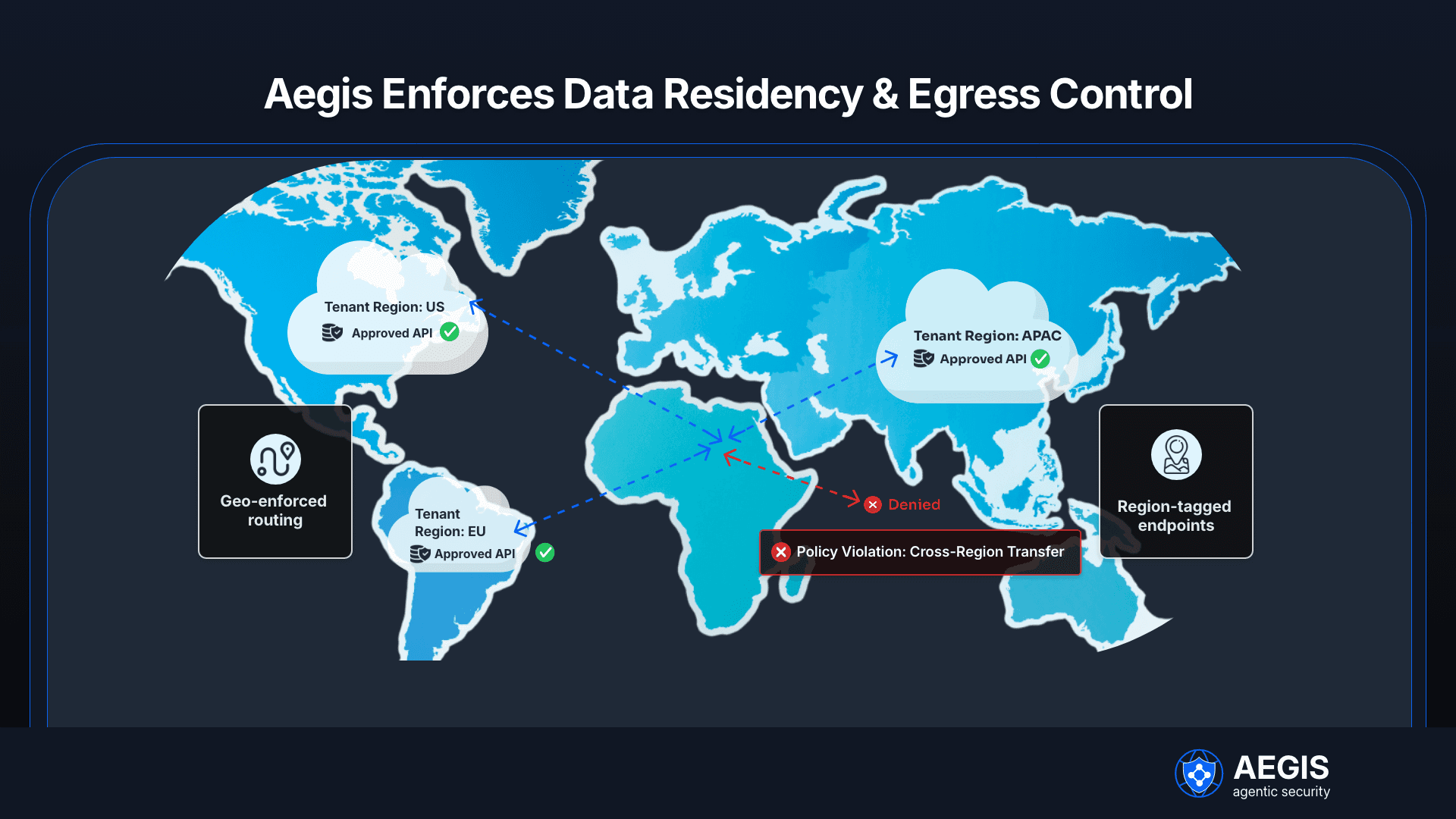
Egress Control | Restrict outbound domains to prevent data exfiltration. |
Identity & Tokenization | Issue short-lived JWTs with per-agent scopes. |
Observability | Export traces and metrics for auditing, FinOps, and compliance. |
Shadow Mode | Run policies in observe-only mode to tune before enforcement. |
This design ensures that every autonomous action is observable, enforceable, and reversible—a foundational requirement for enterprise-grade AI systems.
Industry Use Cases
Aegis already secures workflows across regulated verticals:
- FinTech: Prevent unauthorized payments by enforcing transaction limits and approval workflows.
- Healthcare: Redact PII in EHR data before transmission.
- SaaS: Enforce per-agent budgets and API rate limits to control costs.
- DevOps: Require approvals before production deploys.
- MSSPs: Provide tenant-level audit logs and regionally scoped policy isolation.
The Strategic Imperative for Guarded Autonomy
AI agents are reshaping development, but speed without control leads to fragility. Security and compliance teams must evolve from static gatekeepers to policy authors who shape how autonomy operates safely.
The future of developer productivity lies in governed automation—where every line of code produced by an agent carries verifiable provenance and passes runtime enforcement. Aegis positions enterprises to achieve exactly that: a balance of trust, velocity, and oversight.
Frequently Asked Questions
1. How does Aegis differ from traditional IAM or API gateways?
IAM systems manage who can call an API. Aegis governs what each AI agent can do—evaluating runtime parameters, enforcing budgets, and issuing approvals.
2. Can Aegis integrate with existing CI/CD pipelines?
Yes. Aegis plugs into GitHub Actions, Jenkins, or GitLab CI as a policy check layer, validating each step against runtime rules before merge or deploy.
3. Does Aegis introduce latency?
Minimal. Its OPA-based evaluator and in-memory cache maintain sub-20 ms latency at P99, even under high load.
4. What’s “shadow mode,” and why use it?
Shadow mode lets teams monitor policy effects without blocking actions—ideal for tuning rules before enabling enforcement.
5. How does Aegis help with compliance audits?
Aegis emits signed telemetry logs and OpenTelemetry spans for every decision, providing traceable proof of policy enforcement for SOC and GRC reviews.
6. Can Aegis prevent data exfiltration or credential leakage?
Yes. Egress allowlists and parameter sanitization policies prevent unauthorized domain calls and redact secrets before transmission.