Agents for Enterprise Knowledge Management and Search
Enforce least-privilege, provenance, and approvals for enterprise AI agents with Aegis — policy-as-code, runtime enforcement, and OTel tracing.
Aegis: A Pragmatic Security Mesh for Agentic Enterprise Search and Retrieval
Agentic retrieval systems (RAG + agents) unlock powerful workflows — but they also create new, operational attack surfaces: lateral coercion between agents, silent data exfiltration, PII leakage in synthesized answers, and uncontrolled third-party spend. This article explains why conventional enterprise search fails in an agentic world, lays out a clear agentic retrieval architecture, and describes how Aegis — a runtime policy and observability gateway — enforces least privilege, provenance, and approvals at the agent↔tool boundary. It draws on 2024–2025 adoption data and operational best practices and includes concrete policy examples and implementation guidance.
Why Enterprise Search Often Fails for Agents
Search in enterprises frequently returns low-precision or unsafe results because knowledge lives in silos, metadata is inconsistent, and search lacks runtime trust signals. Traditional keyword search plus manual curation and heavy taxonomy projects don't scale when you add agentic retrieval: agents can autonomously choose sources, synthesize content, and forward outputs to external endpoints — amplifying problems of stale content, PII exposure, and hallucination.
Key operational failure modes:
- Silos: vectors, metadata, and access controls differ between systems; agents have no uniform view.
- No provenance: answers lack clear retrieval headers or evidence links.
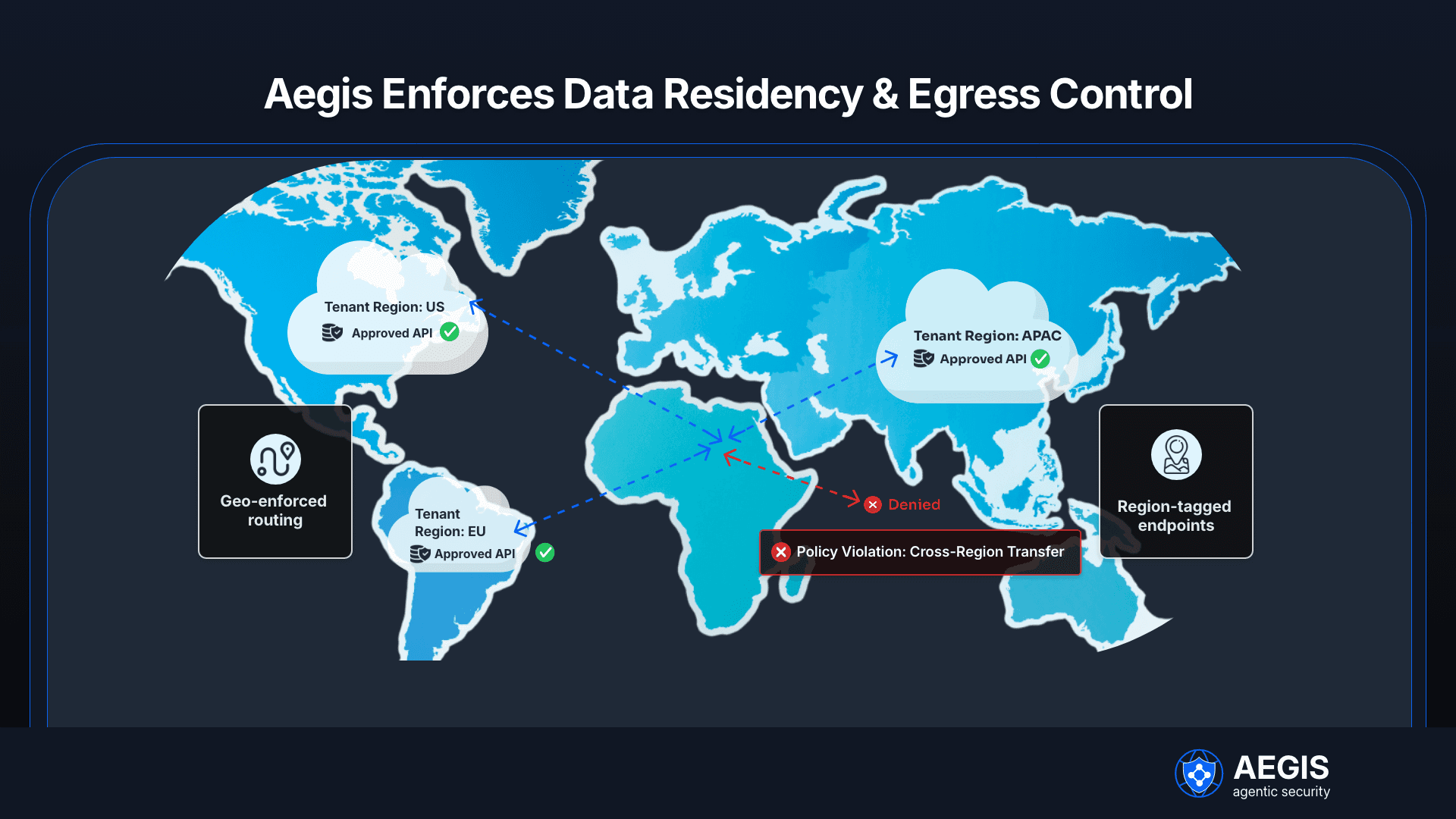
Unchecked egress: agents may forward sensitive snippets to external LLMs or services without consent.
These failure modes explain why organizations asking “is this answer trustworthy?” need runtime controls, not just better indexes.
👉🏻 Eliminate manual document bottlenecks with AI-driven extraction workflows
Business context: industry surveys show organizations are moving agentic systems beyond pilots — roughly 23% report scaling agentic AI deployments and another ~39% are experimenting, indicating a rapid shift from experimentation to production that increases the need for runtime governance. (McKinsey & Company)
👉🏻 Transform IT support with AI agents that balance speed and reliability
Agentic Retrieval Architecture
A reliable runtime architecture separates orchestration from enforcement and telemetry. The recommended pattern is:
Orchestrator → Aegis Gateway (policy + telemetry) → Tools / Vectordb / External LLM endpoints
Components and responsibilities
- Orchestrator: constructs agent plans and invokes domain agents (HR, Legal, Sales).
- Aegis Gateway: a lightweight data plane (sidecar / forward proxy + decision server) that inspects each agent call, evaluates policies (allow, deny, sanitize, approval_needed), emits OpenTelemetry spans, and either forwards the request or blocks/attests it. See architecture notes in the Aegis spec.
- Tool endpoints: vectordbs, internal APIs, external LLMs, payment APIs — each is treated as a tool with declared actions and parameters.
Why runtime enforcement matters
Runtime checks stop attacks that static IAM or per-agent hardcoding miss: a Planner agent cannot coerce Finance into high-value transfers if the gateway enforces per-agent action limits and parameter validation. Aegis enforces identity and parameter scoping and returns structured PolicyViolation errors when a call is blocked.
Policy Templates for RAG
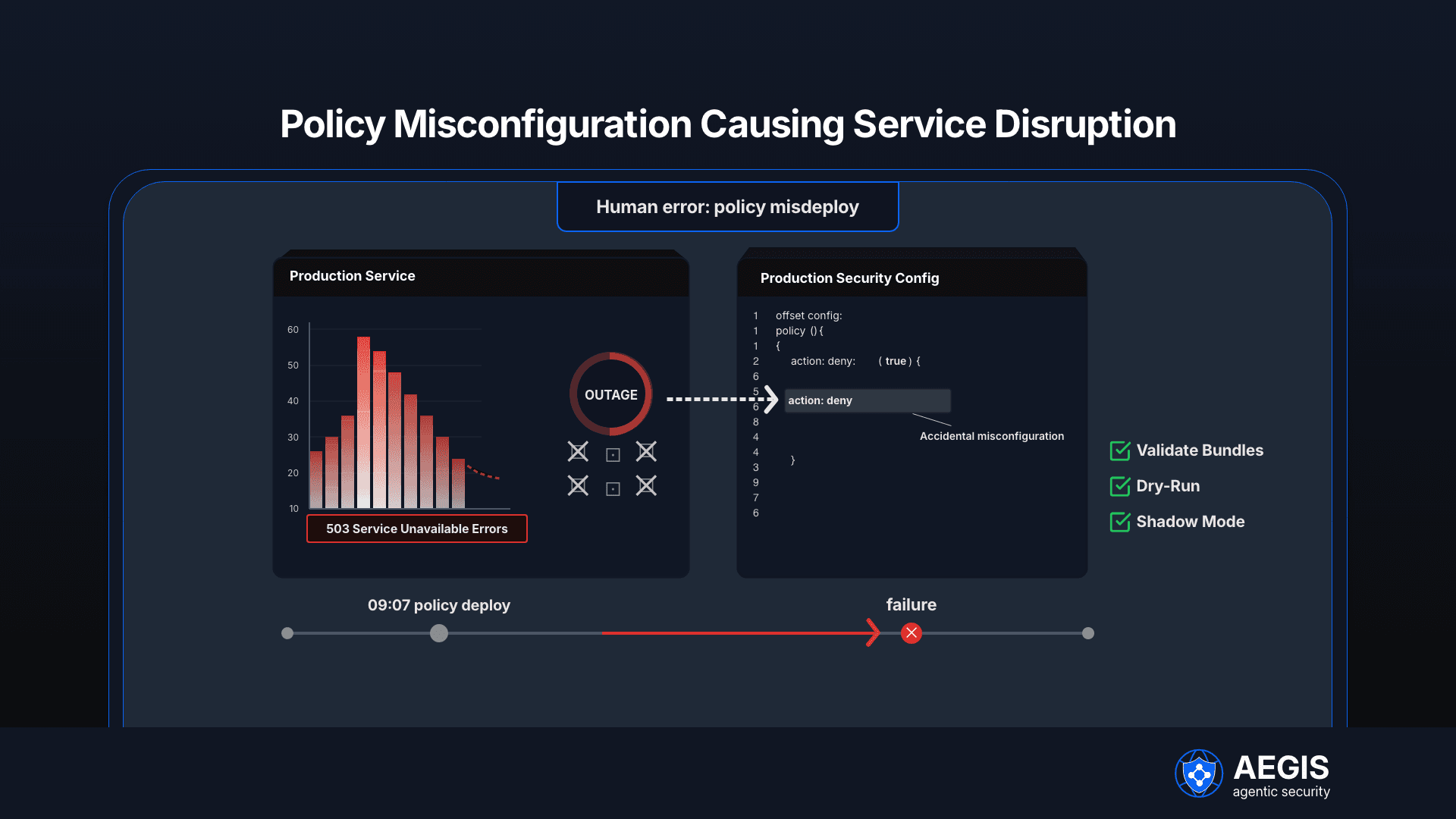
Policies must be expressive but auditable. Use policy-as-code (YAML → OPA bundles) with versioning and dry-run/ shadow mode.
Example policy snippet (YAML-like):
agent: search_agent
allowed_tools:
- name: vectordb
actions: [read]
- name: external_llm
actions: [invoke]
conditions:
- approval_needed: true
- data_class != 'sensitive'
deny:
- external_storage: write
A practical rule: allow: vectordb:read; deny: external_llm:invoke unless approval_needed and data_class != 'sensitive' — this ensures that external LLM calls require either non-sensitive data or an explicit approval token. Include per-field sanitization rules (PII regex redaction) for sensitive returns. Aegis compiles policies into OPA bundles for fast evaluation and hot-reload.
👉🏻 Accelerate onboarding with AI agents that automate repetitive HR tasks
Implementation: telemetry, provenance, and DLP
Operational checklist (short):
- Map data domains to agent identities (catalog each agent + its intended tools).
- Declare per-agent tool scopes and parameter conditions (amount ranges, allowed channels).
- Attach provenance headers to every retrieved snippet (source ID, doc version, vector score).
- Emit OpenTelemetry spans for each agent-tool call, including policy_version, decision, and approval_id where applicable.
- Run policies in shadow mode 1–2 weeks to collect would-block metrics before enforcement.
OpenTelemetry is the recommended standard for spans and trace context; defining a consistent span schema for agent decisions (agent_id, parent_agent_id, tool, decision, policy_version, reason) greatly simplifies SOC audits and SIEM ingestion. (OpenTelemetry)
Performance and OPA
Runtime policy evaluation must be fast. Use prepared queries, in-memory caches, and OPA bundles to keep decision latency low (target P99 ≤ 20 ms for typical policies). OPA supports bundles and performance optimizations to meet these targets; compile and cache tenant-specific data to avoid repeated parsing at runtime. (Open Policy Agent)
Table: Policy enforcement comparison (example)
Capability | Traditional IAM / Gateway | Aegis (policy-as-code) |
Per-call parameter inspection | No | Yes (field conditions) |
Human approval workflow | Manual, ad-hoc | Built-in approval_needed + override tokens |
Runtime provenance | Rare | Structured headers + OTel spans |
Shadow/dry-run | Limited | First-class (shadow mode) |
Policy versioning & rollback | Difficult | Built-in bundles & version history. |
Table: Operational metrics to track
Metric | Why it matters | Target/Example |
Allow / Deny ratio | Detect misconfigurations | Expect high allow in tuned policies |
Policy decision P99 latency | UX/throughput impact | ≤ 20 ms. (Open Policy Agent) |
Blocked high-risk calls | Security effectiveness | Show drop after policy tuning |
Approval volume & avg SLA | Human burden | Reduce via thresholds & budgets. |
Aegis as a Agentic Framework Security Solution
Aegis is designed to be the runtime policy and telemetry fabric for multi-agent systems: a secure gateway that enforces least privilege per agent, inspects parameters, performs deterministic DLP, and emits attested telemetry for compliance. Its core properties:
- Identity & least privilege: agents register with unique IDs and short-lived JWTs containing agent/tenant scope claims; Aegis enforces allowed_tools and actions per agent.
- Policy-as-code → OPA bundles: administrators author YAML/JSON policies; the control plane compiles these into OPA bundles and hot-reloads them to the data plane. This supports dry-run and quick rollback.
- Runtime enforcement modes: allow, deny, sanitize (redact), approval_needed (pause + Slack/Teams approval); override tokens enable safe human-approved retries.
- Provenance & observability: every decision emits an OpenTelemetry span with policy_version, decision_reason, and optional attestation signature to satisfy auditors and SOC teams.
Operational examples:
- Legal retrieval agent: returns contract clause excerpts — Aegis redacts PII, appends provenance headers (doc_id, chunk_id, score), and logs the decision for audit.
- Sales enablement agent: synthesizes a one-pager — Aegis enforces masking of customer PII and blocks external LLM calls unless masked or approved.
Architecturally, Aegis is a lightweight policy mesh (proxy + external authz + OPA evaluator + telemetry pipeline) that integrates with orchestrators and vector search systems without requiring agent rewrites. The MVP targets policies for Stripe-like payment connectors, SharePoint-like document stores, and LLM endpoints; it ships with SDKs and a CLI for easy adoption.
External reading and standards (raw links used for technical claims and further reading):
- McKinsey state of AI (agent adoption stats): https://www.mckinsey.com/capabilities/quantumblack/our-insights/the-state-of-ai. (McKinsey & Company)
- Open Policy Agent performance & bundles: https://openpolicyagent.org/docs/policy-performance and https://openpolicyagent.org/docs/management-bundles. (Open Policy Agent)
- OpenTelemetry guidance on traces and agent observability: https://opentelemetry.io/docs/concepts/signals/traces/ and https://opentelemetry.io/blog/2025/ai-agent-observability/. (OpenTelemetry)
Frequently Asked Questions
Q1: How does Aegis prevent an agent from coercing another agent?
A1: By enforcing per-agent tool scopes and checking parent_agent_id chains at runtime. Calls outside declared flows are blocked.
Q2: Will policy evaluation add unacceptable latency?
A2: Optimize with OPA prepared queries, bundle caching, and local evaluation; target P99 ≤ 20 ms. Use shadow mode to measure impact before enforcement. (Open Policy Agent)
Q3: How do I handle PII inside retrieved snippets?
A3: Use deterministic DLP rules (regex/field redaction) and sanitize responses before allowing external egress or synthesis. Aegis supports sanitize decisions.
Q4: Can Aegis work with existing orchestrators?
A4: Yes — it integrates via lightweight middleware or a forward proxy; minimal changes to agent code are required.
Q5: What telemetry is recorded for audits?
A5: Agent ID, tool name, parameters (masked), decision, policy_version, policy_reason, span_id, and approval_id (if used); logs are SIEM-ready.
Q6: How should MSSPs consume Aegis telemetry?
A6: Route OTel spans and structured logs into per-tenant dashboards and SIEM, and use signed attestation traces for compliance reports.
Takeaways and operationally focused next steps
Agentic retrieval is rapidly moving from labs to production. Enterprises should treat agentic workflows like any other privileged execution path: inventory, policy-as-code, shadow tuning, runtime enforcement, and signed telemetry. Aegis offers a pragmatic gateway approach that minimizes agent changes while providing the controls auditors and SOC teams demand.