Automating the IT Service Desk with AI Agents: Benefits and Pitfalls
How to automate IT service desks with agentic AI safely: threat model, runtime policies and Aegis Gateway patterns for traceable, least-privilege automation.
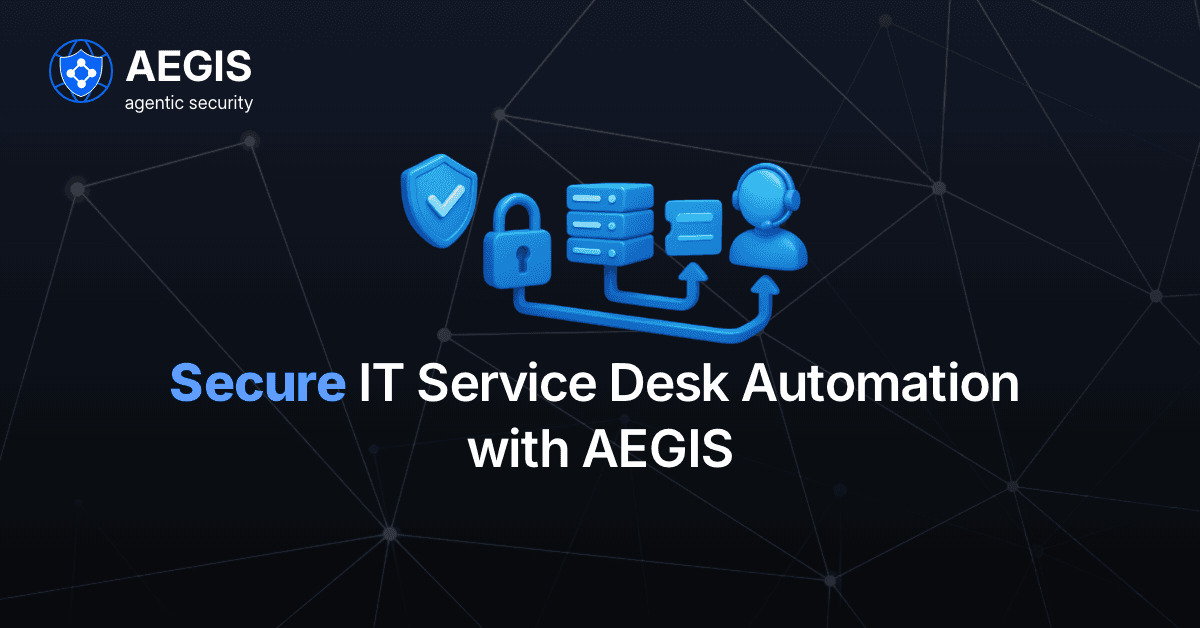
Secure IT Service Desk Automation with Agentic AI (Aegis Gateway)
Automating routine IT service desk tasks (password resets, account provisioning, basic triage) is low-hanging fruit for enterprises — analysts often estimate that 50–70% of low-risk requests are automatable with current tooling. But agentic automation (multi-agent workflows that act autonomously) introduces a new attack surface: agents wield tools and parameters that, if ungoverned, can cause data leaks, privilege escalation or large-scale destructive actions. This post lays out what agents can and cannot do, a compact threat model, runtime policy patterns, and an implementation checklist — and shows how Aegis Gateway enforces least-privilege, traceability and safe rollout for service desk automation. (ServiceNow)
What IT automation agents can — and cannot — do
Capabilities
- Fast triage: classify incidents and map to KB articles or runbooks.
- Low-risk resolution: password resets, account unlocks, license grants.
- Chaining: triage → resolver → approver agents that reduce L1 load and mean-time-to-resolution (MTTR).
- Integration: call identity providers (Okta/AD), ticketing systems (ServiceNow/Jira), and messaging channels.
Limits & dangerous gaps
- Agents should never be implicitly trusted with high-impact operations (user deletion, bulk writes, payments) without clear constraints.
- Parameter injection (user-controlled inputs forwarded verbatim to tools) can turn an innocuous action into a destructive one.
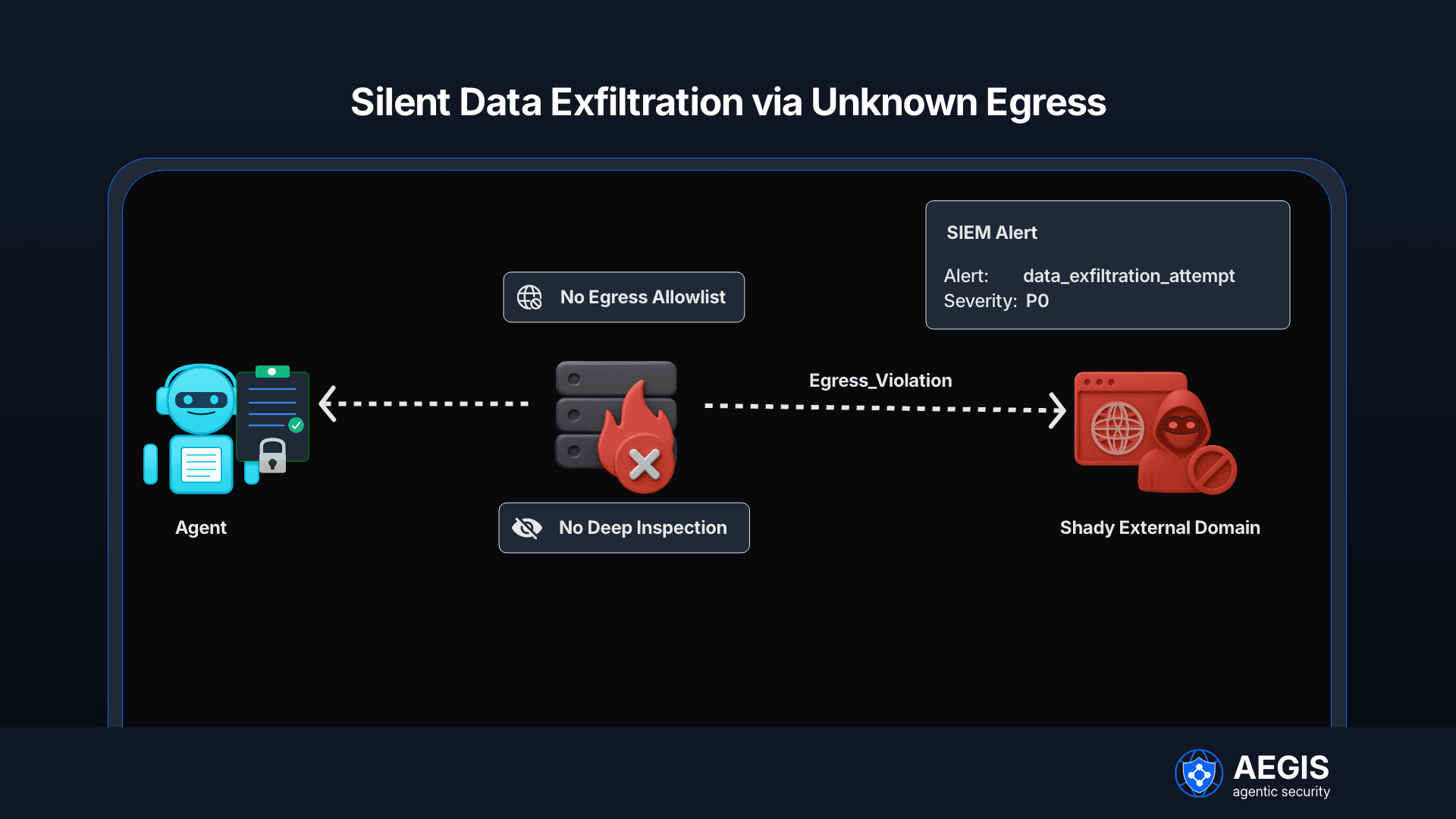
- Egress and unbounded outbound calls can lead to exfiltration of ticket content or secrets.
Operational rule of thumb: treat every agent as a non-human identity that must be given the narrowest set of permissions, runtime checks, and an auditable decision trail. Industry benchmarks show automation shortens resolution times significantly when used correctly. (ServiceNow)
👉🏻 Cut response times with AI agents handling support at scale
Threat model for service desk automation
Key adversary goals
- Unauthorized changes (delete or modify accounts)
- Data exfiltration (sensitive ticket contents, PII/PHI)
- Financial fraud via coerced tool calls (payments, invoices)
- Supply-chain abuse through malicious agents or prompt-poisoning
👉🏻 Unlock enterprise knowledge with intelligent search agents
Attack vectors
- Prompt/parameter injection: user-supplied or attacker-supplied text that becomes a tool parameter (e.g., a payment amount).
- Over-privileged connectors: an agent with broad connector scopes (full admin) abused by another agent or a compromised prompt.
- Uncontrolled egress: agents calling arbitrary domains or uploading ticket contents to external endpoints.
- Approval fatigue: excessive human approvals leading to auto-approvals or stale overrides.
Mitigation priorities (high-level)
- Per-agent least-privilege on connectors and per-action parameter whitelists.
- Deterministic DLP and egress allowlists before outbound calls.
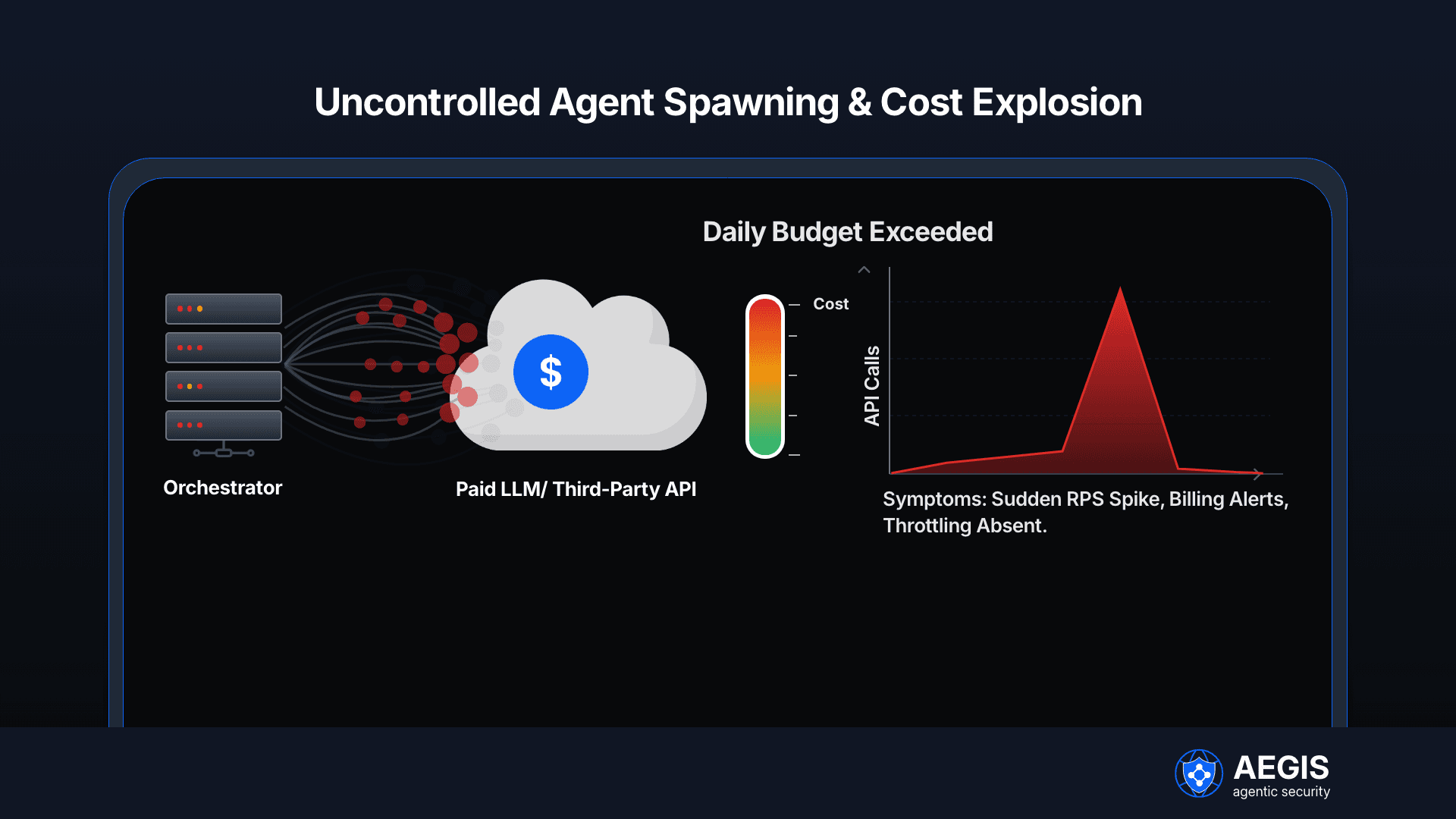
- Rate limits and per-agent budgets to prevent runaway actions or cost spikes.
- Shadow mode rollouts plus robust telemetry to tune policies before blocking production traffic. (McKinsey & Company)
Runtime policy patterns and examples
Below are practical policy patterns to embed in any automation pipeline, followed by how Aegis implements them.
Pattern 1 — Per-agent least-privilege & parameter validation
- Policy example: finance-agent allowed stripe:create_payment only when amount <= 5000 and currency == "USD". For amount > 5000 return approval_needed.
- Implementation notes: validate types, ranges and regexes at the gateway so no malformed parameter reaches the tool.
Pattern 2 — Approval gating for high-impact actions
- Approval flow: resolver agent requests action → gateway returns approval_needed → approvals service posts to Slack/Teams → human approves → gateway mints one-time override token for retry.
- KPI: % of approvals that become overrides vs rejections; aim to minimize approvals via tighter conditions.
Pattern 3 — Shadow/dry-run mode for safe rollout
- Run policies in shadow for 7–14 days; collect would-block metrics (would_block_rate) and adjust conditions before enabling enforcement.
Pattern 4 — Egress allowlists & deterministic DLP
- Only allow outbound domains in tenant allowlists. Sanitize or redact PII before posting to public channels; block attachments with base64 blobs that match secrets patterns.
Pattern 5 — Rate-limiting & budgets
Per-agent RPS and daily budgets for expensive LLM calls or paid APIs. Return PolicyViolation: BudgetExceeded when breached.
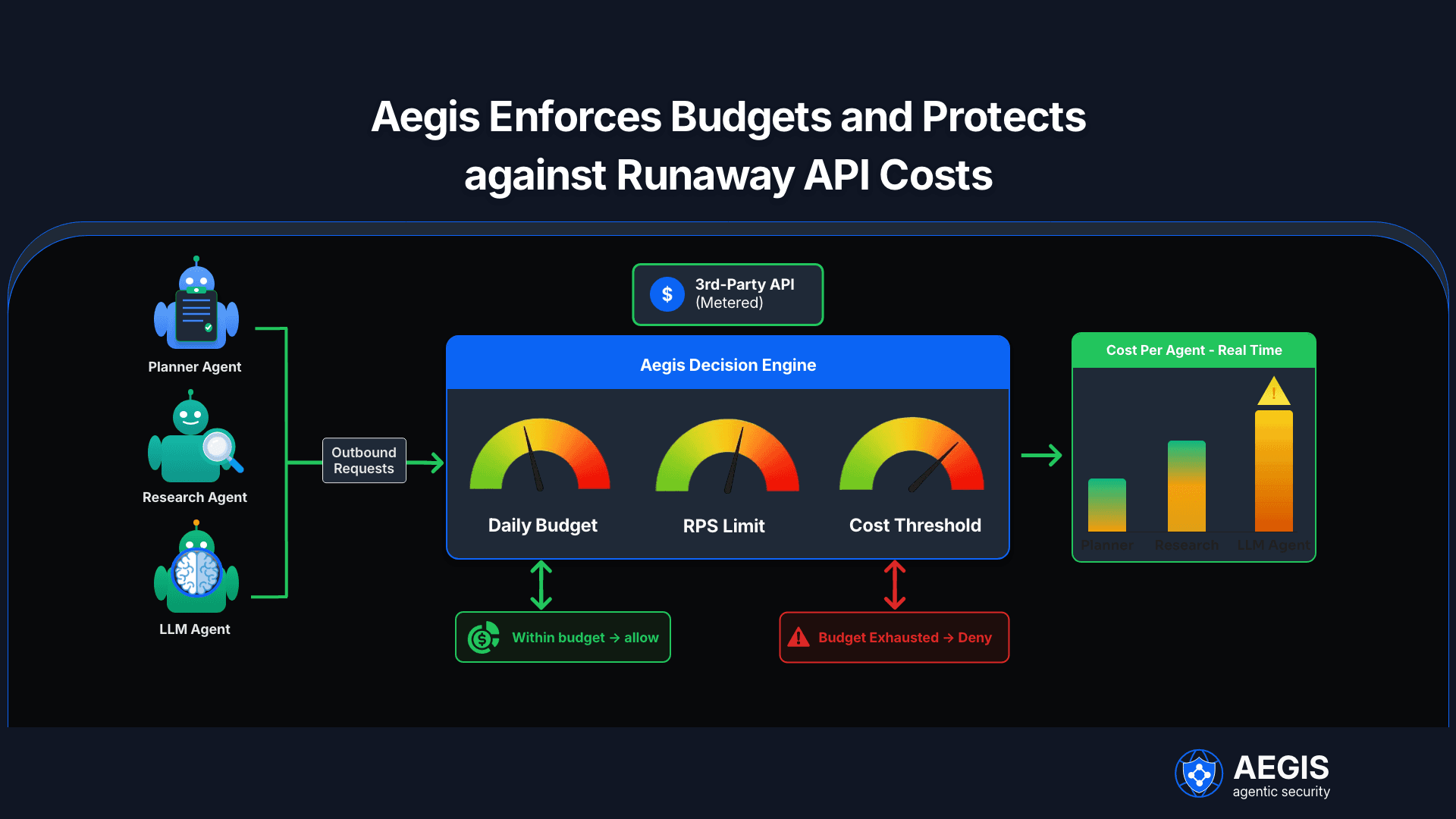
Table 1 — Policy examples (quick reference)
Pattern | Example rule | Action on violation |
Least-privilege | agent=hr-agent → sharepoint:read → path regex /hr/.* | Deny |
Approvals | amount > 5000 for payments | approval_needed |
Egress | domain not in allowlist | Deny + alert |
Budget | > $20/day for LLM agent | BudgetExceeded (deny) |
How Aegis implements these patterns
Aegis Gateway sits as a runtime policy and observability fabric between orchestrators and connectors (a sidecar/proxy model). Its core responsibilities are identity, inspection, decisioning, enforcement and telemetry:
- Identity & short-lived tokens: Each agent is registered with a unique ID and tokens carry organisation/tenant/agent scope claims. This prevents secrets reuse across agents.
- Policy-as-code: Security teams author YAML/JSON policies that Aegis compiles into OPA bundles for fast evaluation, supporting conditions (ranges, regex), rate limits, budgets and approval_needed.
- Runtime enforcement: Every tool call is proxied through Aegis which inspects agent identity, tool target and parameters; decisions are allow, deny, sanitize or approval_needed. Blocks emit standardized PolicyViolation errors.
- DLP & egress control: Deterministic regex-based redaction can sanitize PII; an outbound allowlist blocks unknown domains, preventing data exfiltration.
- Shadow mode and dry-run: Teams can simulate enforcement and collect would-block metrics before flipping to enforce.
- Telemetry & audit trail: Aegis emits OpenTelemetry spans and structured logs for every decision (agent_id, tool, reason, policy_version, approval_id). These are SIEM-ready and tamper-evident for compliance audits.
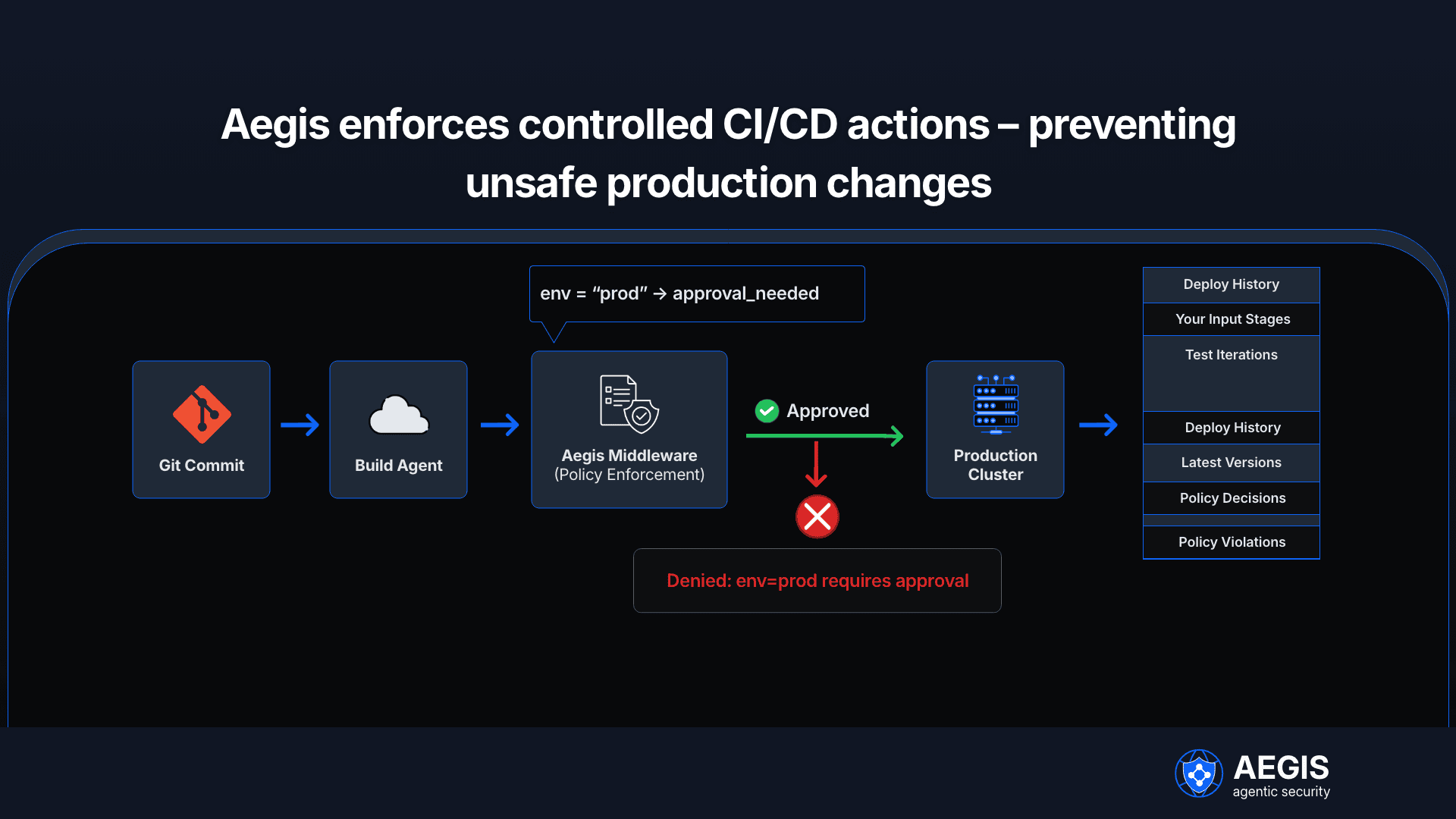
Table 2 — Aegis capability mapping
Requirement | Aegis behavior | Expected outcome |
Prevent agent privilege escalation | Per-agent policy + call-chain header validation | Blocked cross-agent coercion |
Prevent data exfiltration | Egress allowlist + DLP | Fewer exfil attempts |
Approvals for high-risk ops | Approval service + override tokens | Human-in-loop for risky actions |
Observability | OTel spans + logs | Auditable traces for SOC/compliance |
Operational details (practical)
- Deploy as Envoy sidecar or forward proxy; support non-HTTP tools via SDK middleware.
- Target decision P99 latency ≤ 20 ms using OPA prepared queries and in-memory caches.
- Provide CLI/SDK for policy dry-run, rollbacks and agent registry management.
Implementation checklist for secure rollout
- Inventory: map all agentic flows, connectors (Okta, AD, ServiceNow/Jira), and high-risk operations.
- Register agents centrally and assign minimal scopes.
- Author policies for low-risk operations first (password reset, license grants), run in shadow mode.
- Configure egress allowlists and DLP rules for ticket fields.
- Add approval workflows for destructive or multi-tenant ops.
- Monitor would-block rate, approval volumes and MTTR; iterate.
Operational KPIs to track
- % tickets automated vs escalation ratio
- Would-block rate during shadow mode
- Approval requests per 1,000 automated tickets
- Policy enforcement latency (P99)
- Number of blocked exfiltration attempts
Real-world examples & caveats
- MSPs using guarded multi-agent flows can reduce L1 load (common result: substantial L1 deflection but dependent on solid KB coverage and precise policies).
- Beware “approval fatigue”: tune thresholds and use contextual conditions (time windows, requester trust score) to reduce unnecessary approvals.
- Gartner warns that many early agentic projects fail or are scrapped without clear ROI and governance; measure automation accuracy, false-positive safety events, and cost per ticket to justify expansion. (Reuters)
Frequently Asked Questions
- How many service desk tickets can realistically be automated?
Estimates for low-risk tickets range 50–70% in domains with mature KBs; your mileage depends on KB quality and classification accuracy. (usepylon.com) - Should policies be defined by security or service teams?
Collaborative — security defines guardrails and schemas, service teams define operational conditions and approval thresholds. - How do we prevent prompt injection?
Sanitize and validate all parameters at the gateway; avoid forwarding raw user content into command or payment parameters. - What if enforcement introduces latency?
Use prepared OPA queries, caching and WASM compilation where needed; target P99 ≤ 20 ms for decisions. - How do we audit agent actions?
Emit OpenTelemetry spans with agent_id, policy_version, decision, and reason; store signed logs for compliance reviews.
Closing notes
Automating the IT service desk with agentic AI delivers measurable MTTR and cost gains — but only with robust runtime controls. The pattern is straightforward: centralize identity, enforce per-agent least-privilege, validate parameters, gate high-risk operations with approvals, and keep comprehensive telemetry. Aegis Gateway embodies these patterns, providing a lightweight runtime layer that lets organizations adopt agentic workflows with predictable risk and auditable governance. For teams piloting agentic automation, start in shadow mode, tune policies, then flip enforcement for targeted ticket classes — and track the KPIs above to scale safely.
👉🏻 Accelerate development with AI code agents while managing risks
References & further reading
- ServiceNow ITSM Help Desk statistics (automation benefits). (ServiceNow)
- Freshservice ITSM benchmark report (2024). (Freshworks)
- Gartner coverage on agentic AI project outcomes. (Reuters)