
Building Resilient Agent Ecosystems through Redundancy
Practical engineering patterns for redundancy, detection, and DR in agentic AI systems, with concrete Aegis enforcement and runbooks.
Building Resilient Agent Ecosystems through Redundancy
Agentic systems accelerate workflows by automating multi-step tasks, but they also amplify mistakes and failures rapidly. This article explains why resilience matters for agents, describes redundancy patterns and tradeoffs, maps common failure modes and detection signals, and — in practical detail — shows how Aegis (the Aegis Gateway) enforces resilient behaviors and supports DR/IR runbooks for production deployments.
Why resilience matters for agents
Agentic systems can act autonomously across services and APIs. That autonomy multiplies blast radius: a single bad decision (a malformed parameter, a coerced tool call, or an unintended approval) propagates through downstream services and human workflows. Enterprise surveys show many organizations are already experimenting with agentic systems: 23% report they are scaling agentic systems in production and an additional 39% are experimenting — adoption is real and rising. (McKinsey & Company)
At the same time, independent analysts warn that a significant portion of early agent projects will be discontinued due to cost, unclear value, or immature controls — Gartner estimated over 40% of agentic projects may be scrapped through 2027. That underscores the need to design resilient architectures up front; resilience is not optional. (Reuters)
Key resilience goals for agent ecosystems:
- Minimize blast radius for a compromised or buggy agent.
- Ensure predictable, auditable fallback behaviors.
- Preserve availability for low-risk read operations while failing safe for writes.
- Provide observable signals to detect anomalous agents quickly.
Redundancy patterns and tradeoffs
Redundancy for agents takes many forms. Below are patterns with the typical tradeoffs security and reliability teams must weigh.
Active-active agent replicas
Run two or more instances of a decision agent in parallel and reconcile outputs (majority vote or deterministic tie-break). This improves availability and can detect output deviations, but increases surface area and cost. Use for non-sensitive, high-availability read workflows.
Leader election (active-standby)
Elect a single primary agent for write-capable operations and keep a standby that can take over. Simpler than active-active but needs robust leader election (etcd/raft or orchestrator-level support) and consistent state replication to avoid split-brain.
Intent replication and deterministic replays
Record incoming intents and deterministic random seeds so replicas can re-evaluate identical inputs. This supports forensic replay and simplifies consensus but requires careful handling of external side effects (idempotency tokens, replay-protected tokens).
Sandboxed retries and circuit breakers
When an agent calls a downstream tool and the call fails repeatedly, circuit breakers and exponential backoff prevent noisy retries. Sandboxed retries (re-executing in read-only mode) allow safety checks without side effects.
Degraded-mode policies (readonly escrow agents)
In degraded mode, switch write-capable agents into read-only escrow agents that can return safe, conservative responses and queue actions for manual approval. This pattern preserves availability for low-risk queries while preventing unsafe actions.
👉🏻 Coordinate agents to complete complex workflows faster
Comparison of redundancy patterns (tradeoffs)
Pattern | Best for | Pro | Con |
Active-active replicas | High read availability | Fast failover, output comparison | Higher cost, complex reconciliation |
Leader election | Critical-write workflows | Simpler correctness model | Requires robust election/state sync |
Intent replication | Forensic analysis & replay | Deterministic debugging | Storage + replay complexity |
Sandboxed retries | Flaky downstreams | Avoids side effects | May mask persistent errors |
Degraded-mode escrow | Safety-first incidents | Keeps read availability | Manual approval bottleneck |
Failure modes and detection
Understanding failure modes lets you instrument the right signals.
Common failure modes
- Prompt/parameter injection resulting in dangerous tool arguments.
- Privilege escalation via chained agent calls.
- Cost runaway from unbounded API calls.
- Silent data exfiltration via unknown egress.
- Approval workflow overload (flood of approval_needed events).
.png&w=3840&q=75)
Detection signals and observability primitives
- Synthetic heartbeats — agents periodically emit signed heartbeats with basic health and capability claims; missing heartbeats trigger tiered alerts.
- Anomaly scoring on decisions — compare current decision vectors to an agent’s baseline (tools used, argument distributions, success/failure ratios) and score anomalies.
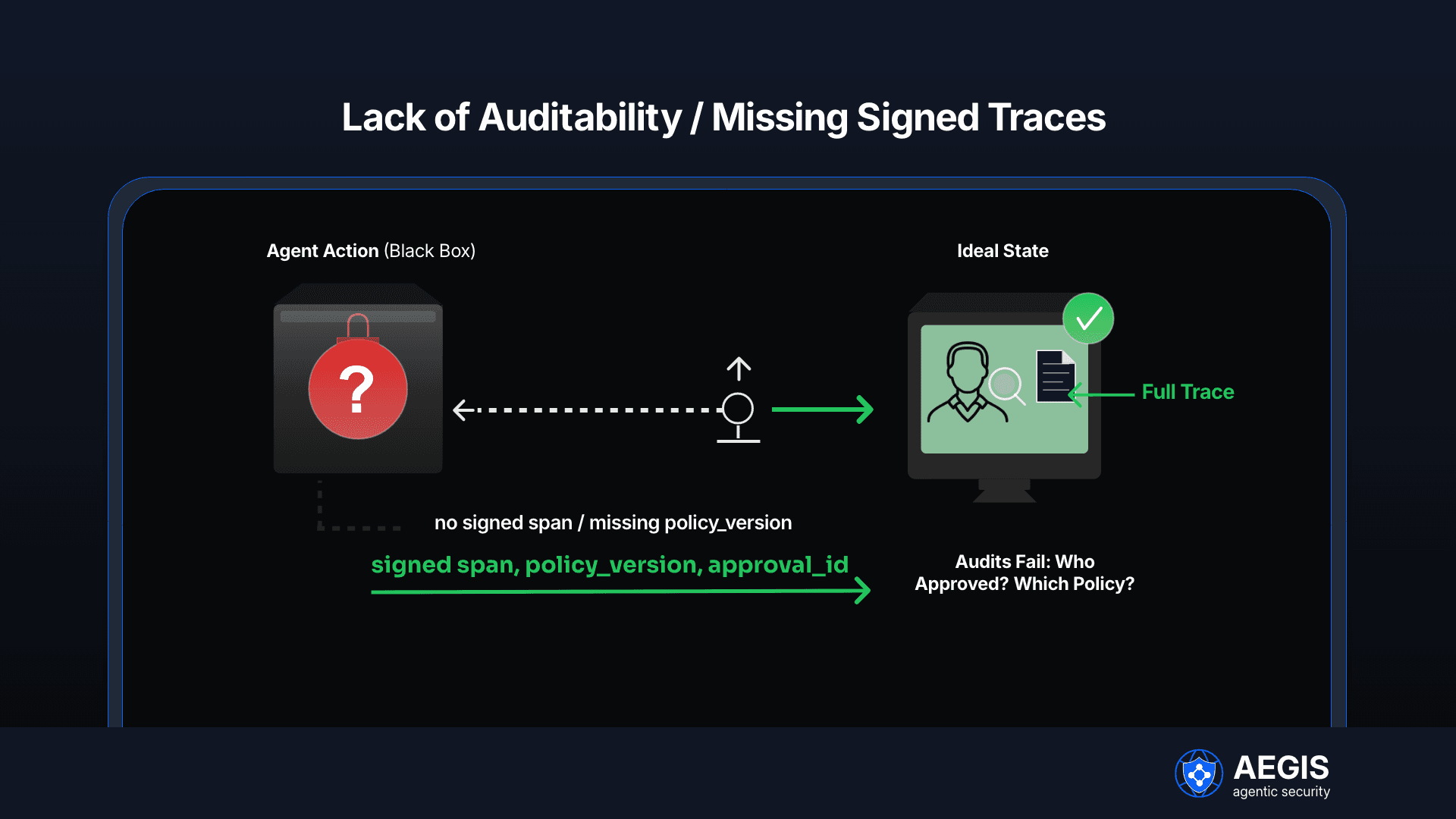
- OpenTelemetry spans & structured logs — include agent_id, tool, decision, policy_version, decision_reason, and cost estimate in every span for trace-based detection.
- Replay-protected token failures — monitor jti replay errors as an indicator of misuse or attempts to reuse override tokens.
Tooling: collect OTel traces, push high-cardinality feature vectors into a feature store or streaming scoring system, and run real-time anomaly detectors against per-agent baselines.
👉🏻 Measure and optimize performance across agent ecosystems
Aegis contributions to resilience
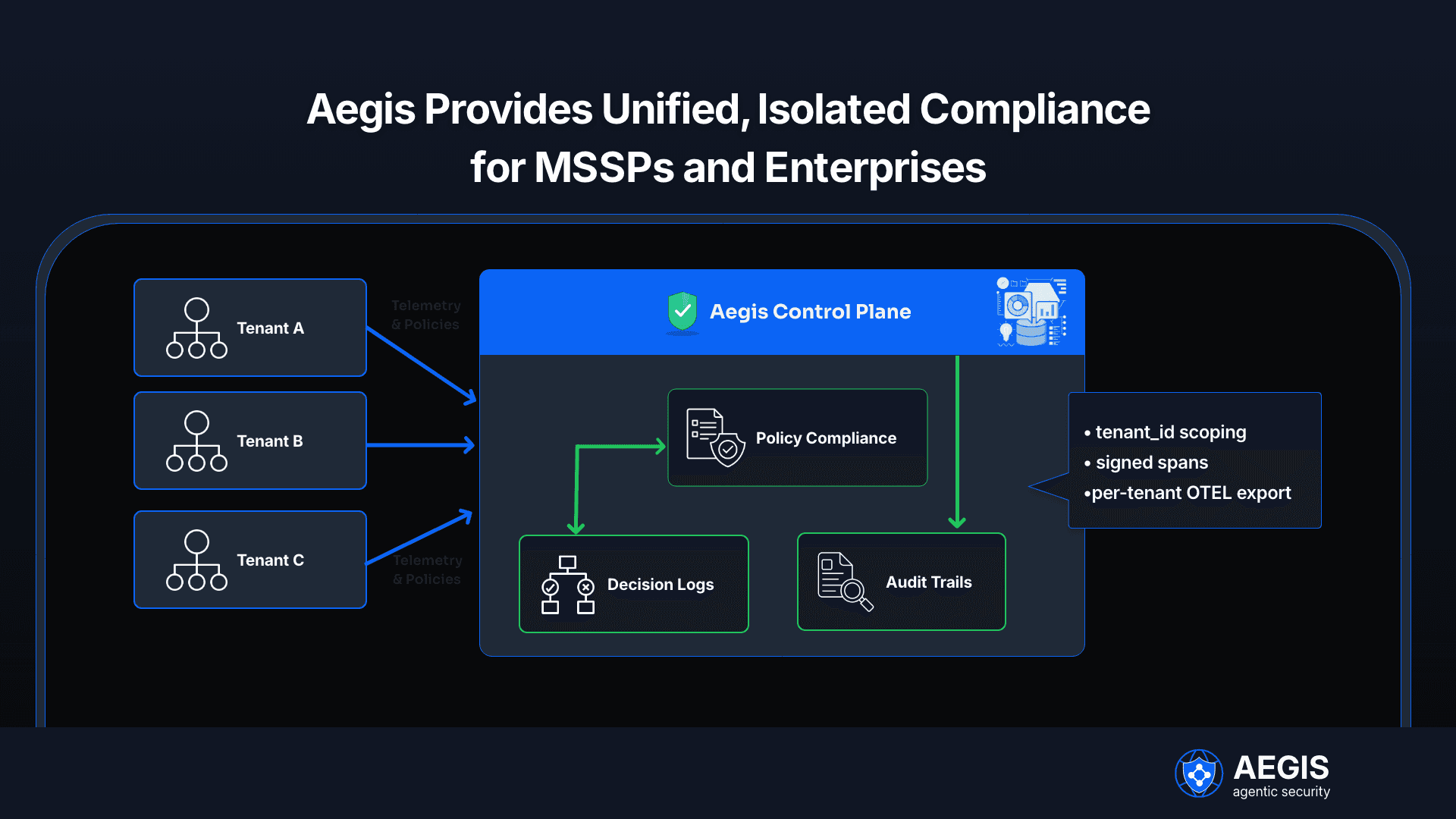
Approximately one third of enterprises’ resilience effort should be product-level policy, enforcement, and telemetry — this is where Aegis (Aegis Gateway) is designed to be prescriptive and operational. The Aegis Gateway implements a runtime policy and observability fabric that enforces least privilege between agents and tools, prevents agent privilege escalation, and produces auditable traces suitable for SOC and compliance review.
Core enforcement rules and resilience features
- Fail-closed for writes / configurable fail-open for reads — by default, high-risk write actions are blocked on policy evaluation failure; low-risk read calls can be configured to fail-open to preserve availability.
- Replay-protected tokens & signed audit chains — short-lived JWTs with jti replay protection and audit logs chained with cryptographic signatures simplify post-incident forensics and regulators’ evidence requirements.
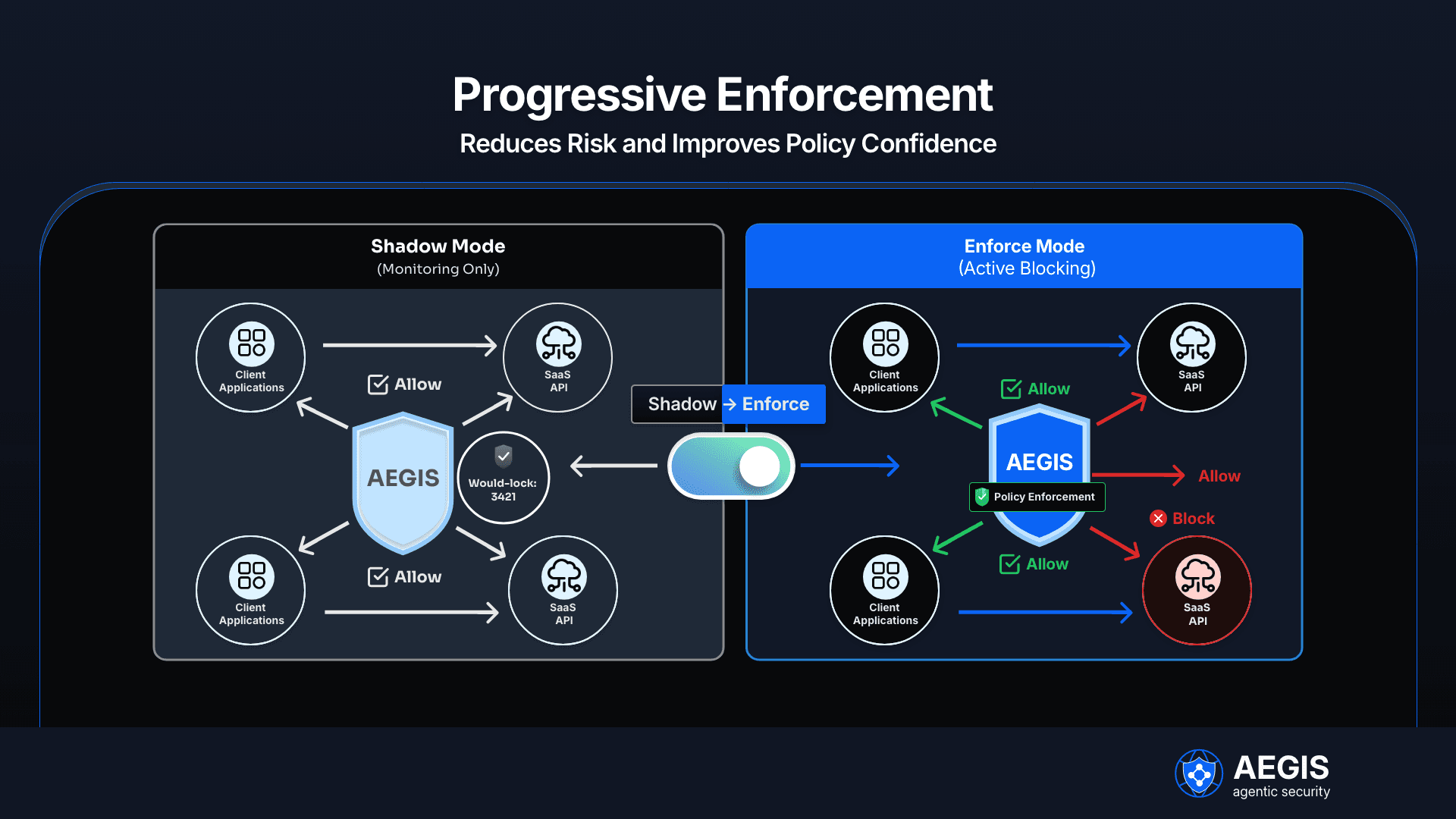
- Policy-as-code and shadow mode — policies are authored as YAML/JSON, compiled to OPA bundles, and can run in shadow mode to capture would-deny events prior to enforcement; this supports safe rollouts and tuning.
- Deterministic DLP & parameter sanitization — Aegis can sanitize or redact PII and enforce per-field conditions (e.g., currency format, account ID regex) before a tool call proceeds.
- Approval flows & override tokens — high-risk decisions return approval_needed and pause the call; a human approver issues a one-time override token that the agent retries with. This is rate-limited and auditable.
Example fallback flow (operational)
- Primary finance agent attempts stripe:create_payment amount $75,000.
- Aegis policy: finance-agent max_amount <= 5000 → decision = approval_needed.
- The call is paused, details posted to Slack/Teams for approval. If approver declines, the action is logged, blocked, and a conservative escrow response is returned. If approver accepts, Aegis mints a one-time override token (single retry).
Table — Aegis enforcement decision outcomes
Outcome | When used | Observable fields emitted |
allow | Policy & conditions satisfied | agent_id, tool, decision, policy_version |
deny | Violates policy | agent_id, tool, decision, reason, policy_version |
sanitize | Sensitive params detected | sanitized_payload, decision, reason |
approval_needed | High-risk thresholds crossed | approval_id, pending_state, policy_version |
Practical runbooks for DR and incident response
Below are concise, operational runbooks security and SRE teams should adopt when running agentic systems with Aegis in production.
Runbook: Agent anomaly detected (score > threshold)
- Step 1: Isolate agent traffic at the Aegis Gateway (temporary deny for write endpoints).
- Step 2: Switch agent to degraded read-only mode via policy hot-reload.
- Step 3: Export OTel trace window (last 5 minutes) and hash-signed audit chain for SOC review.
- Step 4: Run deterministic replay in a sandbox using intent replication and stored seeds to reproduce behavior.
- Step 5: Patch policy or agent model; roll forward with shadow mode for 24 hours before enforcement flip.
Runbook: Downstream outage (e.g., payments API)
- Step 1: Circuit-break outbound calls and mark dependent agents’ policies to use read-only escrow.
- Step 2: Notify Ops and enable shadow fallback (queue actions for manual processing).
- Step 3: Once upstream recovers, reconcile queued actions using idempotency keys and signed approvals.
Quick checklist: Pre-deployment resilience validation
- Policies in shadow mode for 7 days with coverage >= 80% of critical tools.
- Per-agent budgets and RPS limits configured.
- OTel traces include policy_version and decision_reason.
- Approval workflow tested end-to-end (Slack/Teams) with override replay protection.
Implementation notes & integrations
Aegis is designed to sit as a lightweight runtime layer (sidecar or forward proxy) between orchestrators (e.g., LangGraph/AgentKit) and tools; it emits OTel and ships structured logs to SIEMs, integrates with Slack/Teams for approvals, and supports hot-reloadable policy bundles
👉🏻 Accelerate threat response with intelligent AI agents
Frequently Asked Questions
- How does Aegis avoid adding unacceptable latency?
Aegis compiles policies into OPA bundles, uses prepared queries and in-memory caching, and targets P99 decision latencies under 20 ms — proxy overhead is minimized by sidecar deployment and selective deep inspection. - Can Aegis be used in shadow mode?
Yes — policies can run in shadow mode to capture would-block events and tune rules before enforcement, enabling safe rollouts. - What happens if the Aegis control plane is unavailable?
The data plane supports local caches and configurable fail-open behavior for read-only operations; high-risk writes default to fail-closed unless explicitly configured otherwise. - How are approvals handled at scale?
Approval policies support thresholds and rate limits; high-volume low-risk events can be batched for human review, while extreme cases require single-action approvals. Integrations with Slack/Teams provide an approver UX and mint one-time override tokens. - Does Aegis provide forensic artifacts for compliance audits?
Yes — every decision emits signed telemetry with policy_version, decision_reason, agent_id, and optional attestation signatures forming a tamper-evident audit chain.
Agentic AI Security Framework Takeaways
Designing resilient agent ecosystems means treating agents like any other trusted runtime: limit privileges, plan redundancy, instrument comprehensive telemetry, and bake safe fallbacks into the runtime. Aegis provides a focused enforcement and observability fabric that turns policy into runtime behavior — enabling teams to scale agentic automation with predictable safety, auditability, and operational control.
References and further reading:
- McKinsey, The State of AI 2025. (McKinsey & Company)
- Reuters / Gartner coverage on agentic AI project attrition (Gartner estimate). (Reuters)
- Tray.ai enterprise survey on stack upgrades and security concerns for agents. (Tray)