
Benchmarking Agentic AI Performance: What to Measure
Practical guide to measuring agentic AI: metrics, methods, and how Aegis captures telemetry for secure, auditable benchmarks.
Benchmarking Agentic AI: What to Measure and How Aegis Supports It
Agentic AI systems — autonomous, multi-step agents that call services and tools — need a fundamentally different benchmarking approach than single-model evaluation. Enterprises must measure not only task success but safety, policy compliance, latency at SLO percentiles, cost, and chain reliability. This post lays out a pragmatic metric taxonomy, measurement methods, an example benchmark suite, and how the Aegis Gateway captures the telemetry you’ll need to make agentic systems operable, auditable, and safe.
Why this matters now
Enterprise interest in agentic AI has exploded as organizations move from proof-of-concept to production; surveys and analyst reports show rapid adoption of agentic workflows and a clear emphasis on governance, risk and observability.
Why benchmarking agentic systems is different
Traditional LLM benchmarks (accuracy on a dataset, ROUGE, etc.) measure model outputs; agentic systems interleave LLM reasoning with tool calls, orchestration logic, and external services. A single success/fail tag misses:
- Hidden policy violations (an agent produced a correct answer but used an unauthorized tool).
- Chain fragility (parent-child agent coercion, timeouts).
- Operational costs (API spend per completed task).
- Temporal distribution of latency (interactive agents are sensitive to P50/P95/P99 tail latency).
Agentic benchmarking must therefore be telemetry-first and policy-aware. The Aegis Gateway concept provides runtime enforcement and emits structured telemetry for every decision — agent_id, tool, decision, policy_version, latency, cost_estimate — which is exactly the raw data a benchmark runner needs.
👉🏻 Optimize performance with data-driven testing strategies
Candidate metrics (functional, safety, cost)
Below is a concise taxonomy you can adopt. Each metric is actionable and computable from structured traces and logs.
Metric | What it measures | How to compute | Sample threshold |
Task success rate | End-to-end completion of a workflow | (# successful runs) / (total runs) | ≥ 99% for non-critical, ≥ 99.9% for payments |
Policy violation rate | Fraction of calls that violate policy | (# blocked or sanitized calls) / (total calls) | policy eval P99 < 0.1% violations |
End-to-end latency (P50/P95/P99) | User-perceived response time | percentile of total trace durations | P95 ≤ 2s (interactive), P99 ≤ 5s |
Decision latency (policy eval) | Time to evaluate policy & return decision | percentile of ext_authz eval time | P99 ≤ 20 ms. |
Cost per task | API/tool cost allocated to task | sum(tool_costs) / completed tasks | configurable per FinOps SLO |
Approval latency | Time human approvals take (if approval_needed) | avg/percentiles of approval roundtrip | ≤ 60s for urgent flows |
False positive/negative safety triggers | QA of safety module | manual labeling against traces | FP rate < 1%, FN = 0 for critical rules |
Recovery time / MTTR | Time to recover from failure | time between failure detection and successful retry | MTTR ≤ 5 min for infra faults |
Measurement methods and tooling
To measure the metrics above reliably you need deterministic runners and fault-injection. Use a mix of:
- Synthetic replay — Replay recorded prompts and inputs against current agent build; assert expected decisions and outputs in each span.
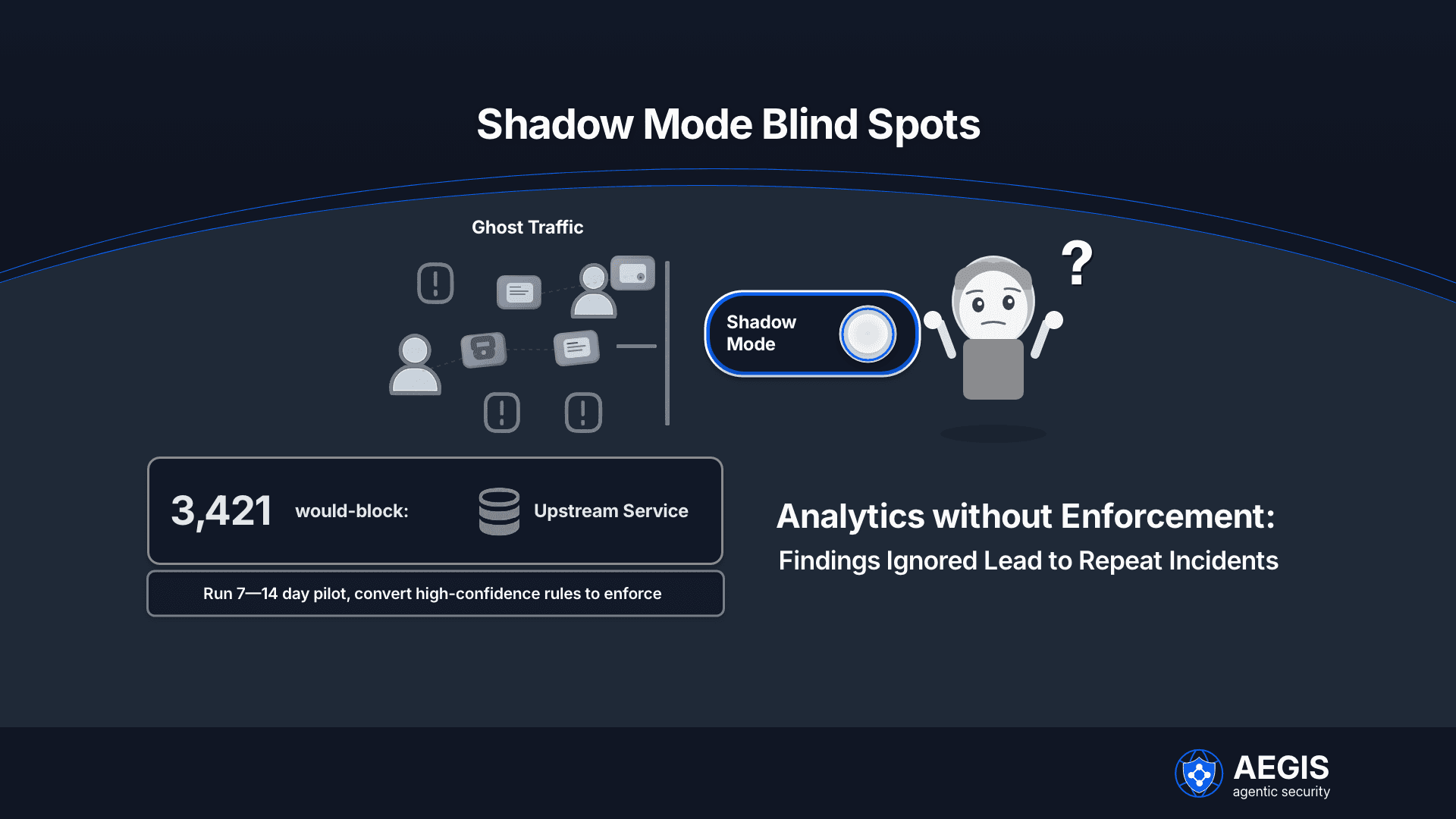
- Shadow mode — Run policies in “would-block” mode (observe-only) to collect would-deny telemetry before enabling enforcement. Aegis supports shadow mode for safe rollouts.
- Chaos / fault injection — Inject timeouts, 5xx responses, or tool latencies to measure chain resiliency and recovery time.
- Cost simulation — Replay workloads with priced APIs to project monthly spend and identify high-cost agents.
- CI integration — A benchmark runner should be part of CI: recorded prompt replays + policy assertions prevent regressions. Aegis spans make these assertions precise by including policy_version and decision_reason in each trace.
Aegis telemetry for benchmarking
Aegis is designed as a runtime policy and observability gateway — the “policy fabric” between orchestrator and tools. Its telemetry model is intentionally structured for benchmarking:
- OpenTelemetry spans per call with attributes: agent_id, tool, decision, policy_version, parent_agent_id, latency_ms, estimated_cost. These spans are the canonical source of truth for computing the metrics above.
- Decision kinds (allow / deny / sanitize / approval_needed) are annotated with reason codes and approval IDs; this makes automated assertions deterministic.
- Shadow mode generates would-block telemetry without blocking production flows; teams use that to derive thresholds before flipping to enforce.
- Policy-as-code versioning provides traceable policy_version per span so you can compare benchmark runs across policy changes and roll back if regressions appear.
- Budget & FinOps signals: Aegis emits cost estimates per call so benchmarking can include cost-per-task and simulate spend caps for SLO enforcement.
Aegis architecture (brief): sidecar/forward proxy (Envoy ext_authz) → external authorisation server (OPA-based) → telemetry export (OTel → Prometheus / Grafana). This design lets you capture both the policy decision latency (a critical micro-metric) and the end-to-end user-perceived latency (macro-metric).
👉🏻 Build fault-tolerant systems that keep agents running under pressure
Example benchmark suite and tables
A minimal benchmark runner should include these tests:
- Functional replay: 1000 recorded successful runs and 1000 adversarial prompts (injection attempts).
- Latency stress: Gradually increase concurrent agents to measure decision P99 and proxy overhead.
- Approval throughput: Simulate 100 concurrent approval_needed flows and measure average approval latency.
- Shadow-to-enforce conversion: Run policy in shadow for 7 days, tune thresholds, then flip to enforce and run regression suite.
Test | Data source | KPI | Pass threshold |
Payment safety | recorded high-value prompts | policy violation rate | 0 violations (payments) |
CI deploy gating | synthetic deploys | approval latency & allow rate | approvals < 60s, success > 99% |
Cost cap | replayed LLM calls | cost per task | ≤ budget per agent |
How to operationalize results
- SLOs & alerts: Convert metrics into SLOs (e.g., Decision P99 ≤ 20 ms) and wire alerts to SRE/SOC when SLOs breach.
- CI gates: Fail builds when benchmark assertions fail (policy regressions, safety FN).
- Policy CI: Treat policy changes like code — dry-run in CI using the benchmark runner and require green before policy promotion.
- Dashboarding & runbooks: Surface top offenders (agents, tools, policy versions) in dashboards and link runbooks to decision_reason codes emitted by Aegis.
- Audit & compliance: Store signed spans and policy history for SOC and compliance review to produce tamper-evident evidence.
-1.png&w=3840&q=75)
Operational metrics by persona:
Persona | Metrics they care about | Primary dashboards |
Security Engineer | policy violation rate, FP/FN safety | Allow/deny ratio, top violating agents |
FinOps Lead | cost per task, budget exhaustion events | cost-by-agent, daily spend heatmap |
SRE | P99 latency, MTTR | decision latency histogram, error traces |
Sample policy metrics schema (for benchmarking ingest)
Field | Type | Notes |
agent_id | string | unique agent identity |
policy_version | string | tag from policy-as-code bundle |
decision | enum | allow/deny/sanitize/approval_needed |
latency_ms | integer | end-to-end trace duration |
decision_ms | integer | policy eval time |
estimated_cost_usd | float | per-call cost estimate |
parent_agent_id | string | optional chain context |
Closing recommendations
- Instrument policies and agent-tool boundaries with structured telemetry from day one — this is non-negotiable for benchmarking.
- Use shadow mode to collect “would-block” signals before enforcement.
- Integrate benchmarks into CI to avoid regressions across policy or agent updates.
- Allocate at least 1–2 weeks of observation (shadow data) before enforcing policies on critical flows.
👉🏻 Monitor, measure, and improve agent system efficiency
Frequently Asked Questions
Q: What percentile should I watch for policy decision latency?
A: Target P99 ≤ 20 ms for policy eval; P99 decision latencies > 50 ms can materially impact interactive agent flows.
Q: How long should shadow mode run before enforcement?
A: Collect representative traffic (7–14 days) covering business cycles; tune regexes and thresholds from would-block histograms.
Q: Can benchmarks include cost projections?
A: Yes — replay workloads with per-call pricing to compute cost-per-task and monthly projections; Aegis emits estimated_cost per span for this purpose.
Q: How do I prevent approval workflow overload?
A: Use risk tiers in policy to only require approval for high-risk thresholds; throttle or batch lower-risk approvals and surface aggregated requests to on-call reviewers.
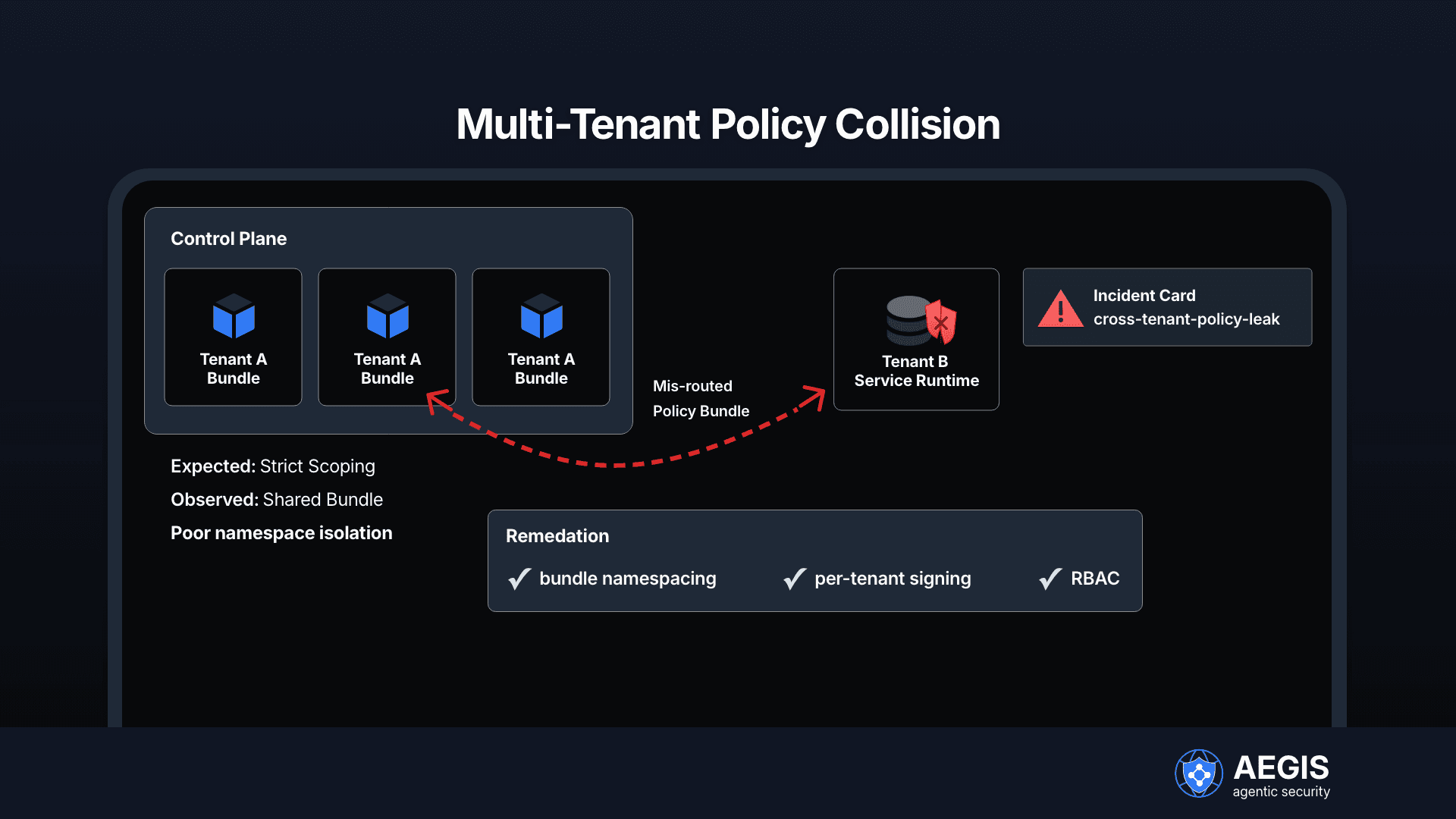
Q: How do I ensure multi-tenant policy isolation?
A: Scope bundles by tenant and include tenant_id in policy selection. Maintain separate bundle namespaces and test cross-tenant regressions in CI.
Q: Is Aegis compatible with popular orchestrators?
A: Aegis is designed to integrate via SDKs and middleware with orchestrators like LangChain / LangGraph / AgentKit; the sidecar/proxy model minimizes app changes.