Preventing Unauthorised Data Access in Autonomous Workflows
Enforce per-agent, parameter-level access and egress controls in multi-agent AI workflows with runtime policies, telemetry, and auditable enforcement.
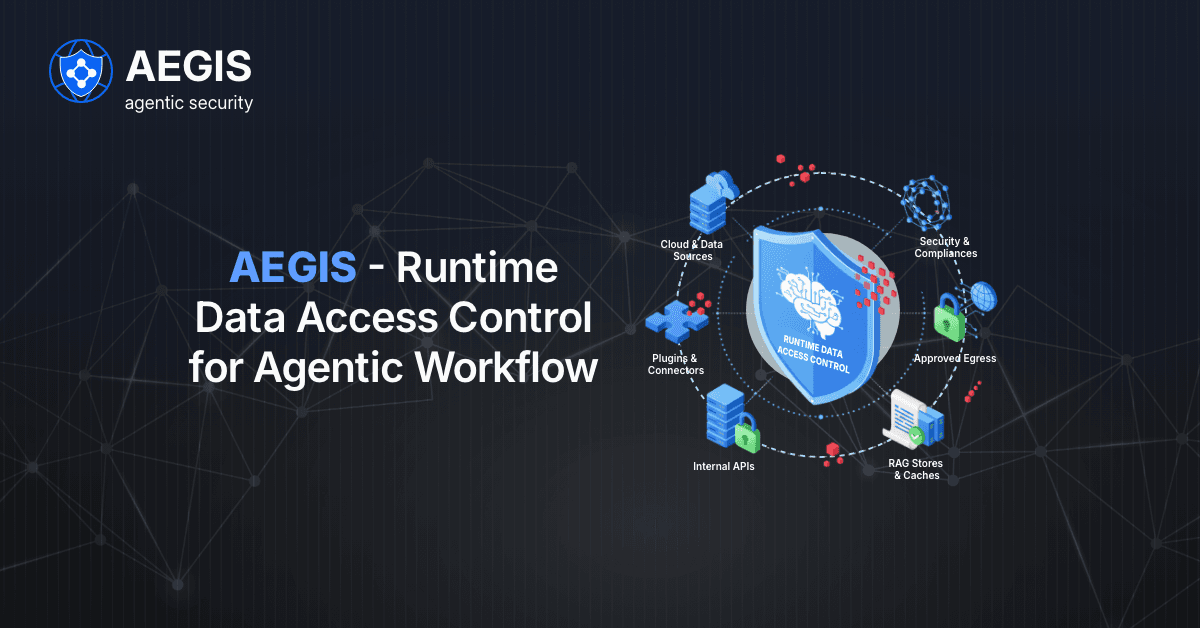
Aegis — Preventing Unauthorized Data Access in Autonomous Workflows
Autonomous, multi-agent workflows are valuable because they let systems coordinate across APIs, storage, and tools. They are also risky: agents routinely traverse connectors (Slack, Google Drive, SharePoint), internal APIs, and retrieval-augmented stores (RAG), and can — intentionally or accidentally — read or exfiltrate restricted data. This article explains common access patterns and failure modes, specifies runtime controls and telemetry needed in production, and describes how Aegis enforces policy-as-code to prevent unauthorized agent access and egress.
Access patterns in autonomous workflows
Agents rarely act alone. Typical agent architectures use an orchestrator to run specialized agents (planner, finance, HR, deployer) that call external tools and internal APIs. This creates an expanded attack surface across three vectors:
- Connectors — third-party plugins or integrations with Slack, SharePoint, Google Drive, etc.
- Internal APIs — business systems (payments, HR, EHR) that expose privileged data.
- RAG stores & caches — vector DBs or file stores used for context retrieval.
Common failure modes
- Parameter injection: an agent forwards unvalidated user text into a tool parameter (e.g., path=/legal/*), causing unexpected access.
- Tool coercion via chaining: a Planner coerces Finance to misuse payment APIs by crafting prompts that appear authorized to the Finance agent.
- Silent egress/exfiltration: compromised or rogue plugin posts sensitive excerpts to external domains.
- Shadow agents & runaway costs: orchestrators spin agents that call billed LLMs or external APIs without constrained budgets.
Industry surveys show these concerns are widespread: many organizations are exploring or scaling agentic AI (McKinsey reports ~23% scaling some agentic systems) and security/compliance is a top adoption barrier. (McKinsey & Company)
👉🏻 Stay ahead of the most critical risks in agent ecosystems
Runtime controls + telemetry
A production-grade defense requires both enforcement and observability. Controls without telemetry are blind; telemetry without enforcement is reactive. Aegis is designed as a runtime policy and observability gateway that enforces decisions in real time and emits structured traces for SOC, compliance, and FinOps teams.
Core runtime controls (what to enforce)
- Per-agent allowlists: map each agent to permitted tools/endpoints (e.g., finance-agent → stripe-payments:create_payment).
- Parameter-level allow/deny: enforce conditions on parameters — allowed folder paths, numeric ranges (amount ≤ 5000), regex validation for account IDs.
- Domain egress allowlist & proxying: block outbound calls to unknown destinations; route approved egress through Aegis for inspection.
- Token scoping & short lifetimes: issue scoped JWTs with agent identity, tenant, and expiry (short lived, Ed25519 signatures recommended).
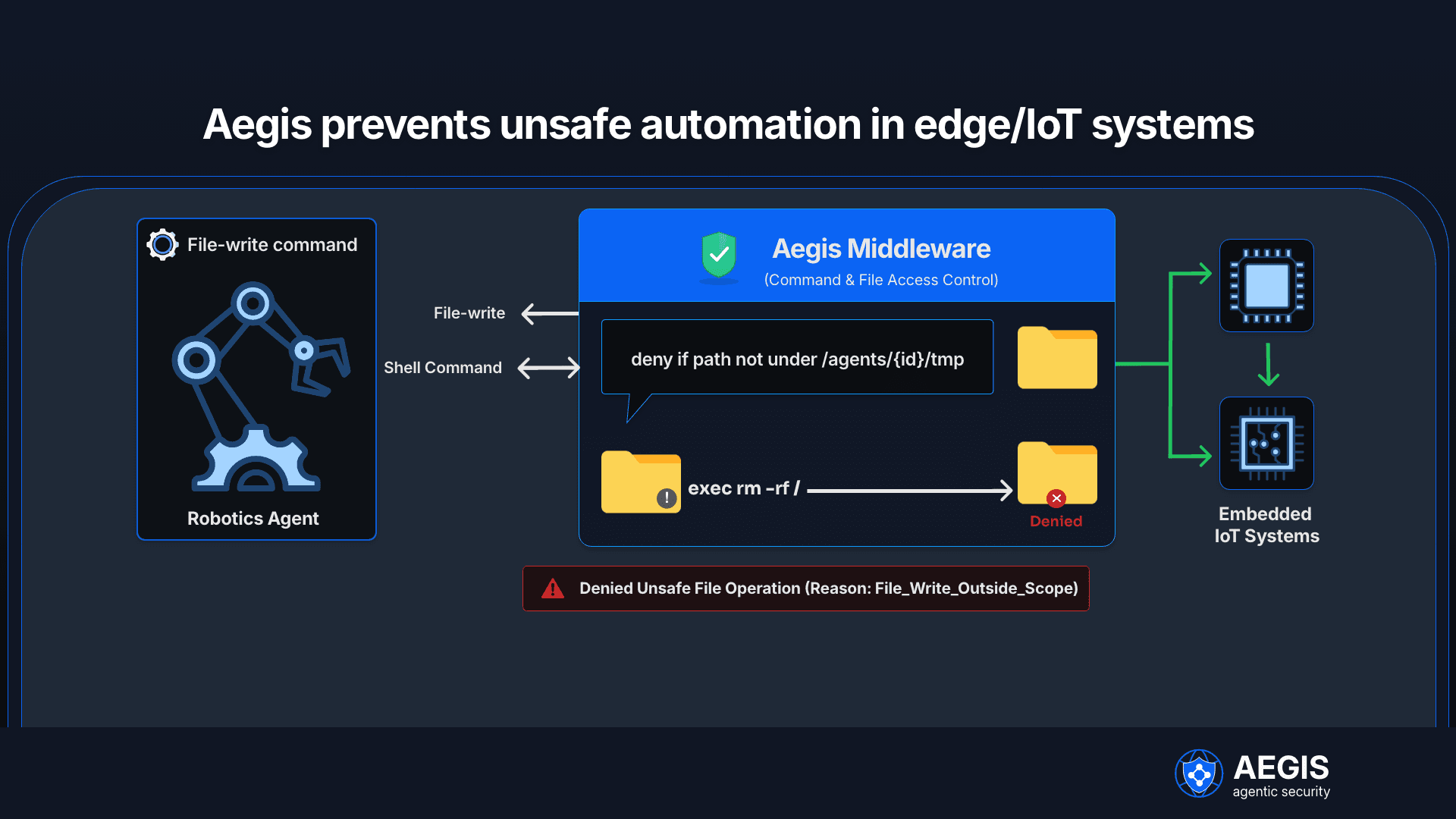
- File and local code sandboxing: constrain file writes to approved directories and limit file sizes; deny arbitrary exec calls.
- Approval gates: approval_needed decisions for high-risk actions that pause the call until human approval (Slack/Teams integration).
Aegis enforces these policies at the agent→tool boundary and returns structured errors like { "error":"PolicyViolation", "message":"Agent not allowed to call this tool." }, enabling deterministic handling by orchestrators.
Telemetry & incident playbook (how to observe and respond)
- Emit OpenTelemetry spans for every decision (agent_id, tool, policy_version, decision, reason). OpenTelemetry adoption is growing across observability stacks; integrate traces into dashboards and SIEM. (OpenTelemetry)
- Produce structured logs shipped to SIEM with signed audit chains for compliance review.
- Alerting rules: anomalous read patterns (e.g., an agent performing many reads of high-sensitivity files), repeated egress attempts, or budget exhaustion. Correlate with identity events and parent-agent chains.
- Playbook steps: triage via trace + logs → isolate agent (revoke token) → replay trace in dry-run mode to assess scope → remediate policy gaps → require approval and re-deploy tightened policy.
Example: a rogue third-party plugin attempted to exfiltrate configuration to an external domain. Aegis blocked the egress (deny), emitted an OTel span with decision_reason=egress_allowlist_violation, and created a SIEM alert. SOC triaged via signed logs and rotated the compromised token.
How Aegis works to Prevent Unauthorized Data Access
Aegis is a runtime policy and observability gateway positioned between orchestrators (AgentKit, LangGraph, custom runners) and downstream tools. It functions as a lightweight "security mesh" specialised for agent semantics.
- Data plane: sidecar/forward proxy intercepts outbound tool calls and forwards authz queries to the decision service. The decision service evaluates policies (compiled OPA bundles) and returns allow/deny/sanitize/approval_needed. Policies include parameter constraints and rate/budget limits. Telemetry is emitted as OpenTelemetry spans for every request.
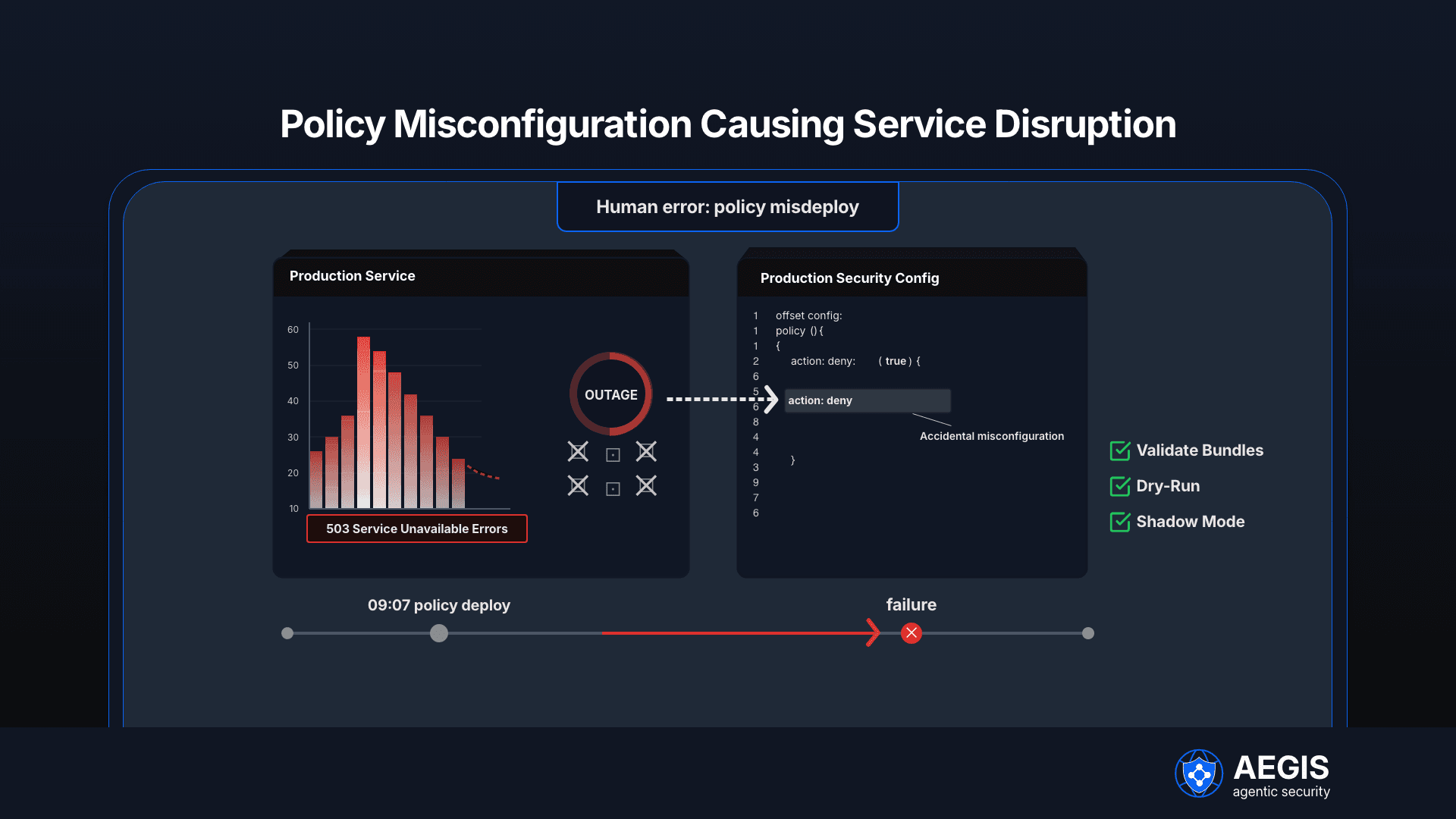
- Control plane: policy compiler and bundle store (YAML → OPA), policy versioning, CLI/SDK for registering agents and running dry-runs. Policies hot-reload without service restarts; shadow mode lets teams observe would-block events before enforcement.
- Identity & egress: Aegis issues short-lived JWTs (scoped to org/tenant/agent). The gateway enforces egress allowlists and can re-originate or redact requests for deterministic DLP.
Developer experience: Python/Node SDKs and small decorators for LangChain/LangGraph make integration low friction; Helm charts and Terraform modules ease deployment.
Aegis in practice: three concrete policies
Use case | Policy snippet (conceptual) | Outcome |
High-risk payments | finance-agent: amount <= 5000 else approval_needed | Blocks large transfers, prompts human approval |
EHR reads | clinical-agent: allowed_paths=/patients/{tenant}/records; export=false | Prevents data export to external domains |
Egress allowlist | agent.*: domains == [internal-api, api.openai.com] | Prevents outbound exfiltration |
Aegis also provides per-agent budgets and rate limits to prevent runaway costs and enforces fail-closed behavior for writes (configurable fail-open for reads).
👉🏻 Safeguard agent communication with strong encryption
Operational patterns and deployment guidance
- Shadow rollout: run policies in shadow mode for 7 days to collect would-deny metrics and tune regexes.
- Start with high-risk connectors (payments, HR, EHR). Sample policies for Stripe/SharePoint accelerate pilots.
- Integrate OTel traces into dashboards and set SIEM rules for anomalous patterns; many orgs are still maturing observability — expect additional work to instrument end-to-end. (Logz.io)
- Test approval workflows under load; approvals should be scoped to thresholds to reduce human fatigue.
Traditional controls vs Aegis runtime enforcement Comparison
Capability | Traditional IAM / Gateway | Aegis (runtime) |
Who can call API | Yes (IAM) | Yes (identity tokens) |
Parameter inspection | Limited | Full parameter-level allow/deny, regex |
Human approvals | Ad hoc | Integrated approval_needed flow |
Egress allowlist | Per-network | Per-agent domain allowlist + proxying |
Auditable traces | Partial | Signed spans + SIEM-ready logs |
Shadow testing | Not common | Built-in shadow mode |
.png&w=3840&q=75)
FAQs
Q: Which connectors should I protect first?
A: Prioritise payment systems, HR/EHR stores, and any RAG stores with PII. These have the highest compliance and financial risk.
Q: How does Aegis prevent coercion between agents?
A: Aegis requires identity and enforces parameter constraints and parent-agent headers so one agent cannot coerce another into forbidden actions.
Q: Can policies be tested before enforcement?
A: Yes — shadow mode collects would-deny telemetry for tuning before flip to enforce.
Q: What telemetry does Aegis export?
A: OpenTelemetry spans plus structured logs capturing agent_id, tool, decision, policy_version and approval_id for traceability. For reference, OpenTelemetry adoption and observability guidance is available at https://opentelemetry.io/blog/2024/. (OpenTelemetry)
Q: How do I get started with pilots?
A: Start by instrumenting two critical connectors, enable shadow mode for one week, tune policies, then enable enforcement.
👉🏻 Strengthen API security to prevent exploitation
Closing practical checklist
- Map agents to tools and classify data sensitivity.
Write per-agent allowlists plus parameter constraints. - Deploy Aegis in shadow mode, collect OTel traces for 7 days.
- Tune policies, add budget/rate rules, then enable enforcement.
- Integrate signed logs into SIEM and establish SOC playbooks.
Agentic workflows deliver operational leverage — but only with runtime guardrails. Aegis provides focused, low-latency policy enforcement, parameter inspection, egress control, and an observability fabric that makes agentic automation auditable and safe for regulated environments. For technical teams evaluating a security mesh for agents, the architecture and practical rollout patterns above provide a repeatable path to production.