
AI Agents in Insurance Claims Processing: Improving Efficiency
How Aegis enforces runtime policy, prevents fraudulent payouts, and produces auditable traces for agentic claims automation.
Aegis for Runtime Policy & Audit for Agentic Claims Automation
Claims processing teams are adopting agentic AI to accelerate triage, OCR, and settlement decisions. That speed unlocks efficiency but also elevates operational risk: PII handling, duplicate payouts, and invisible fraud vectors. This article describes the common pain points in claims automation, the policy controls required to reduce fraud and leakage, and a practical implementation playbook. One third of the article focuses on Aegis — a runtime policy and observability gateway designed for multi-agent architectures — and how it enforces anti-fraud checks, duplicate blocking, and SIEM-ready audit traces.
Claims processing pain points
Agentic automation improves OCR throughput and decisioning speed, but it concentrates risk in several predictable ways.
Operational gaps
- Parameter injection: Agents may pass unvalidated user-supplied values into payment APIs (amounts, account IDs), enabling overpayments or transfers to unauthorized accounts.
- Duplicate claims: Without deterministic lookup and idempotency checks, auto-settling agents can issue duplicate payouts.
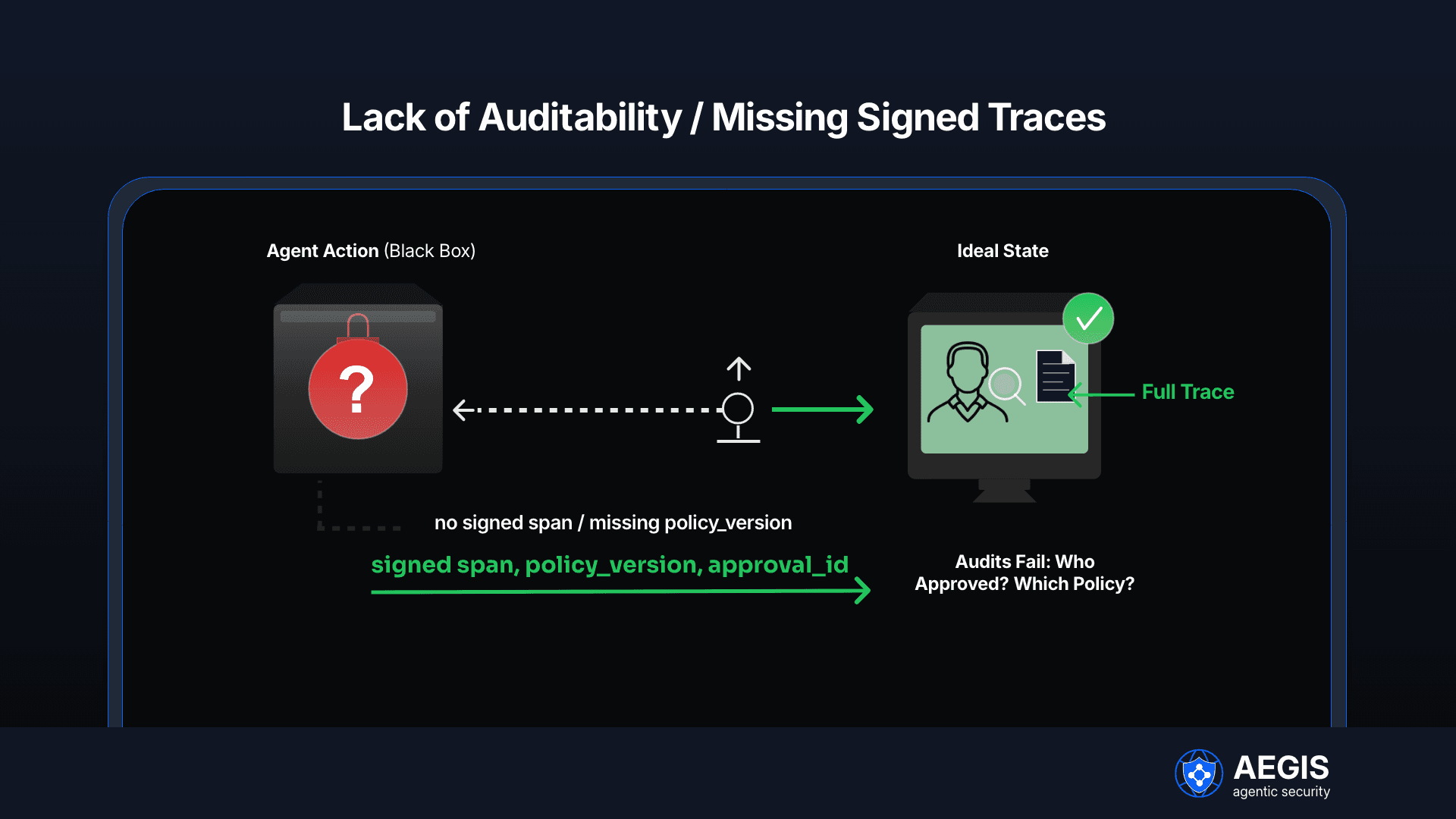
- Invisible audit trail: Auditors require structured, tamper-evident traces linking agent identity, policy version, decision reason and human approvals.
- Human-in-the-loop overload: Naive thresholding creates too many approval prompts, causing delays and fatigue.
Why legacy controls fail
- IAM and service meshes answer “who” and “where” but not “what parameters are allowed” or “when human approval is required.” Rules engines and manual triage do not scale with tens or hundreds of agent workflows.
Key industry context
Adoption of claims automation and intelligent OCR rose through 2024–2025; market analyses show continued investment in automation and RPA across insurance verticals (see Grand View Research). These trends justify stronger runtime governance to prevent loss leakage even as throughput grows. https://www.grandviewresearch.com/industry-analysis/robotic-process-automation-rpa-market
👉🏻 Speed up legal workflows with AI agents that draft and review with precision
Policy controls to reduce fraud and leakage
A simple taxonomy maps fraud rule → enforcement mode → expected outcome. Below is a practical table for common rules.
Fraud rule | Enforcement action (runtime) | Decision outcome | Example reason logged |
Payment amount > threshold | approval_needed (pause and request human) | blocked until approve | "amount_exceeds_threshold_v2" |
Duplicate claim ID within window | deny / idempotent block | denied | "duplicate_claim_id_detected" |
Suspicious PII pattern (SSN mismatch) | sanitize + approval_needed | sanitized payload & pause | "pii_mismatch_redaction" |
Per-agent daily payout ceiling exceeded | deny | denied | "agent_budget_exceeded" |
High fraud score from ML engine | approval_needed or deny per policy | approval_needed/deny | "fraud_score_0.92" |
Enforcement modes explained
- allow: pass the call unchanged.
- sanitize: redact or normalize parameters (e.g., mask SSNs) and continue.
- deny: block the action and return a consistent PolicyViolation response.
- approval_needed: emit a human-approval request and pause the action pending override.
Policy as code enables repeatable, auditable controls. Example condition in YAML:
agent: finance-agent
allowed_tools:
- name: payments
actions:
- create_payment
conditions:
max_amount: 5000
approval_if: "amount > 5000 || fraud_score > 0.8"
Implementation playbook and measurement
A practical rollout focuses on three phases: observe, enforce, optimize.
Phase 1 — Shadow & instrumentation
- Deploy a gateway in shadow mode to collect would-block events.
- Emit OpenTelemetry traces for each agent-tool call capturing agent_id, tool, decision, policy_version, latency.
- Tune regexes and thresholds using observed parameter distributions.
Phase 2 — Enforced runtime policies
- Flip high-confidence rules to enforceable modes (deny/sanitize).
- Start approval workflows for medium-risk rules; integrate with Slack/Teams for human approvals.
- Enforce per-agent budgets and rate limits to control cost and attack surface.
Phase 3 — Continuous improvement
- Use dashboards to measure cycle time, approve-latency, and paid-fraud rate.
- Maintain a policy versioning history; roll back problematic versions quickly.
Measurement KPIs
Metric | Target | How measured |
Claims cycle time (triage→settlement) | reduce by 30–50% | end-to-end traces |
Paid-fraud rate | reduce by >60% in first 90 days | reconciled payouts vs fraud labels |
Policy evaluation latency | <20 ms P99 | gateway spans |
Approval throughput | <5% of auto-flow | decision ratios |
Practical checks
- Ensure deterministic duplicate checking by integrating claim ID and secondary fingerprinting (document hash, payment reference).
- Log policy_version and decision_reason for every blocked/sanitized/approval_needed decision to support audits.
👉🏻 Reduce stock issues and improve efficiency with intelligent inventory agents
Aegis: the runtime gateway for agentic claims
Aegis is a policy & observability fabric purpose-built for multi-agent AI systems. It sits between agents and tools (payment API, OCR service, document stores) and enforces least-privilege, parameter validation, duplicate blocking, and human approvals in real time.
Core capabilities (operational summary)
- Agent identity & policy: Register agents with unique IDs and attach simple YAML/JSON policies that control which tools and parameters are allowed.
- Runtime enforcement: Sidecar/forward proxy intercepts calls, evaluates policies (OPA/Rego or compiled rules), and returns allow/deny/sanitize/approval_needed with structured reasons.
- Telemetry & SIEM readiness: Emits OpenTelemetry spans and structured logs (agent_id, policy_version, decision_reason) consumable by SIEM and SOC workflows.
- Approval workflows: Integrates with Slack/Teams to request approvals and mint one-time override tokens on approval.
How Aegis reduces claims risk (detailed)
- Enforce anti-fraud parameter checks: Fraud engines emit scores; policies map score bands to actions (deny vs. approval_needed). Aegis annotates the decision with the fraud model version and score for auditability.
- Block duplicate payouts: Before any create_payment call, Aegis performs a deterministic lookup of claim IDs and fingerprints. If the claim ID matches a recent settled claim, the call is denied with a clear reason.
- Per-agent controls: Define per-agent payout ceilings and daily budgets to prevent runaway spend or compromised agent activity.
- Audit-grade traces: Every decision includes policy_version, decision_reason, decision_timestamp and an attestation signature if required—making these traces SIEM-ready for auditors.
Example flow (runtime)
[IMAGE: Flowchart — Aegis agentic response — 4-step process: agent → Aegis Gateway (policy eval) → tool or approval queue → telemetry emitted. Include annotations: policy_version, decision_reason, OTel span id.]
Operational notes
- Shadow mode first: Customers can observe would-block events before enforcement; this reduces false positives.
- Hot-reload policies: Security teams can push policy updates without downtime and maintain version history for rollback.
- Fail-closed defaults for write operations: In production, writes fail closed; read-only fail-open can be configured.
Integration checklist for insurers
Technical prerequisites
- Orchestrator middleware (LangGraph/LangChain/AgentKit) support via SDKs.
- Sidecar or forward-proxy deployment (Envoy ext_authz recommended).
- Token service for short-lived JWTs per agent.
- Duplicate ID datastore (Redis/Postgres) for idempotency checks.
Policy examples to start with
- Payment ceilings per agent.
- Duplicate detection with claim ID + doc hash.
- Fraud-score gating and approval routing.
- PII redaction for outbound messages.
Two quick comparison tables
Table A — Enforcement modes vs operational effect
Mode | Immediate effect | Auditability |
allow | No interruption | trace only |
sanitize | Redacts sensitive fields, continues | trace + sanitized_payload |
deny | Blocked, error returned | trace + policy_version |
approval_needed | Pauses & notifies human | trace + approval_id |
Table B — Typical rules & recommended rollout
Rule | Start mode (shadow) | Rollout mode |
Duplicate claim id | Shadow 7 days | Enforce |
High-fraud score | Shadow | approval_needed or deny |
Amount thresholds | Shadow | approval_needed for mid-range; deny for extreme |
Per-agent budget | Shadow | Enforce with alerts |
Frequently Asked Questions
Q: How does Aegis integrate with existing orchestrators?
A: Via lightweight SDKs and middleware for common orchestrators. Aegis supports a proxy model (Envoy ext_authz) or direct SDK calls for non-HTTP tools.
Q: Will policy evaluation add latency to claims flows?
A: Properly tuned OPA prepared queries and in-memory caches target <20 ms P99 for decision calls. Critical write operations can be set to fail-closed if latency risk is unacceptable.
Q: How are human approvals handled?
A: Approval requests post to Slack/Teams with approval_id. On approval, Aegis mints a one-time override token allowing the client to retry the call.
Q: Can Aegis redact PII automatically?
A: Yes — deterministic DLP rules (regex-based masks) can sanitize payloads before they reach external tools, with the decision and sanitized fields logged.
Q: How do we measure effectiveness?
A: Track paid-fraud rate reduction, claims cycle time improvement, decision latency, and ratio of approval_needed vs auto-flow. Dashboards ingest OpenTelemetry spans for these metrics.
Q: Is Aegis multitenant for MSSPs?
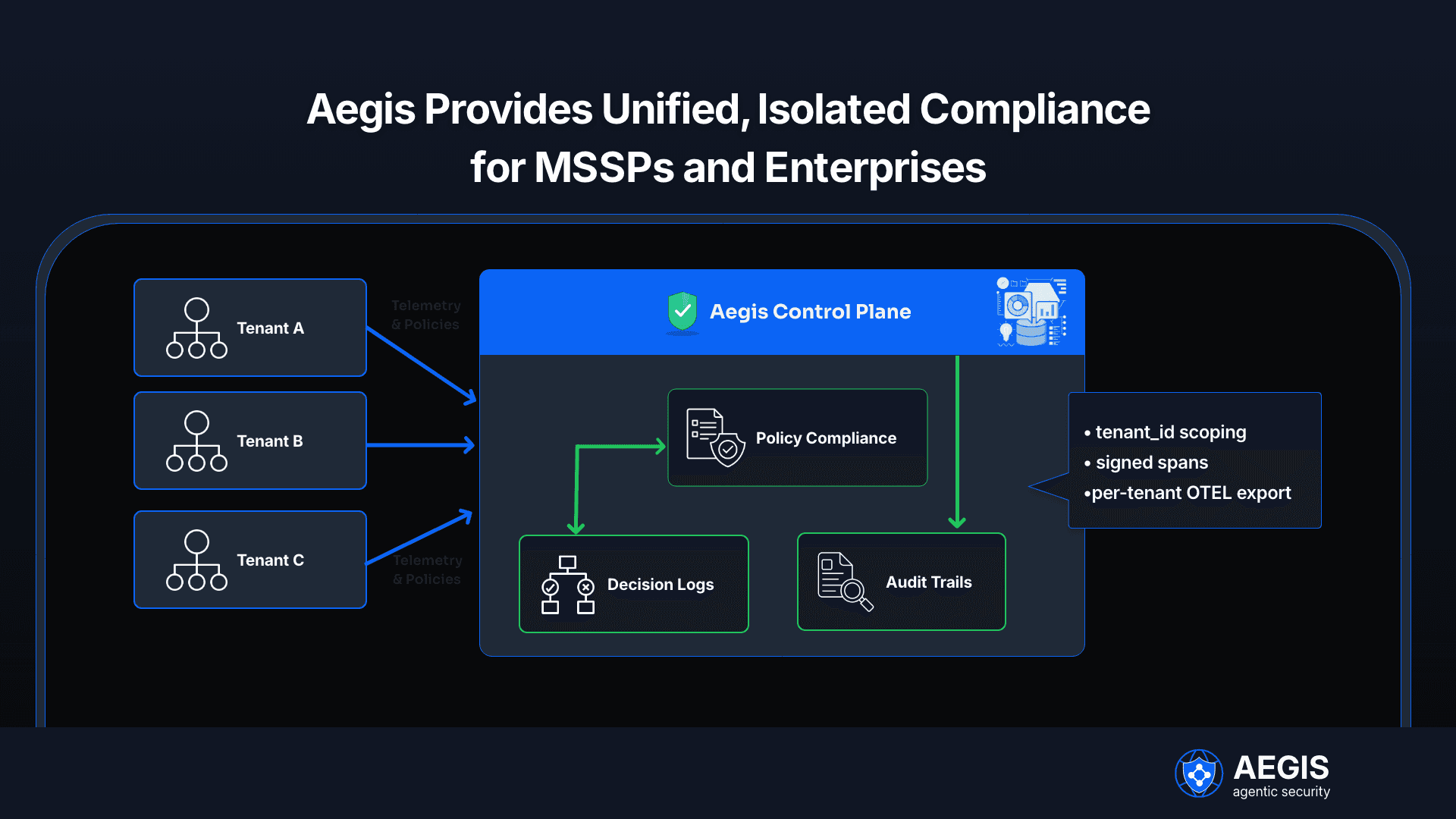
A: Yes — policies and bundles are tenant-scoped with versioning and region routing for data residency. SIEM-ready logs support tenant separation.
Practical next steps
- Start with a seven-day shadow deployment focusing on duplicate claim ID detection and payment ceilings.
- Collect OTel spans and tune parameter regexes to minimize false positives.
- Flip the highest-confidence rules to enforce and open approval workflows for medium-risk rules.
- Maintain policy version history and automate policy testing as part of CI for agent workflows.
👉🏻 Deliver faster public services with automated citizen support agents
Aegis provides a concise path from observation to enforcement, closing the operational gaps that appear when agentic AI handles payments and sensitive claims data