Microsoft Agent 365 Alternatives for Enterprise AI Agent Security
Compare Microsoft Agent 365 with leading AI agent security tools. Understand runtime coverage, MCP controls, identity gaps and complementary platforms.
Microsoft Agent 365 Alternatives: What It Covers, What It Does Not, and Tools That Fill the Gaps
Microsoft Agent 365 gives enterprises a centralized way to discover, manage, govern and secure AI agents across Microsoft and connected third-party environments. It is not, however, a universal runtime enforcement layer for every agent, framework and tool path. Its documented real-time protection currently depends on supported agent types and integrations, while some capabilities are tied to specific Microsoft 365 licensing. Source: Microsoft Agent 365 service description; Microsoft Defender real-time agent protection.
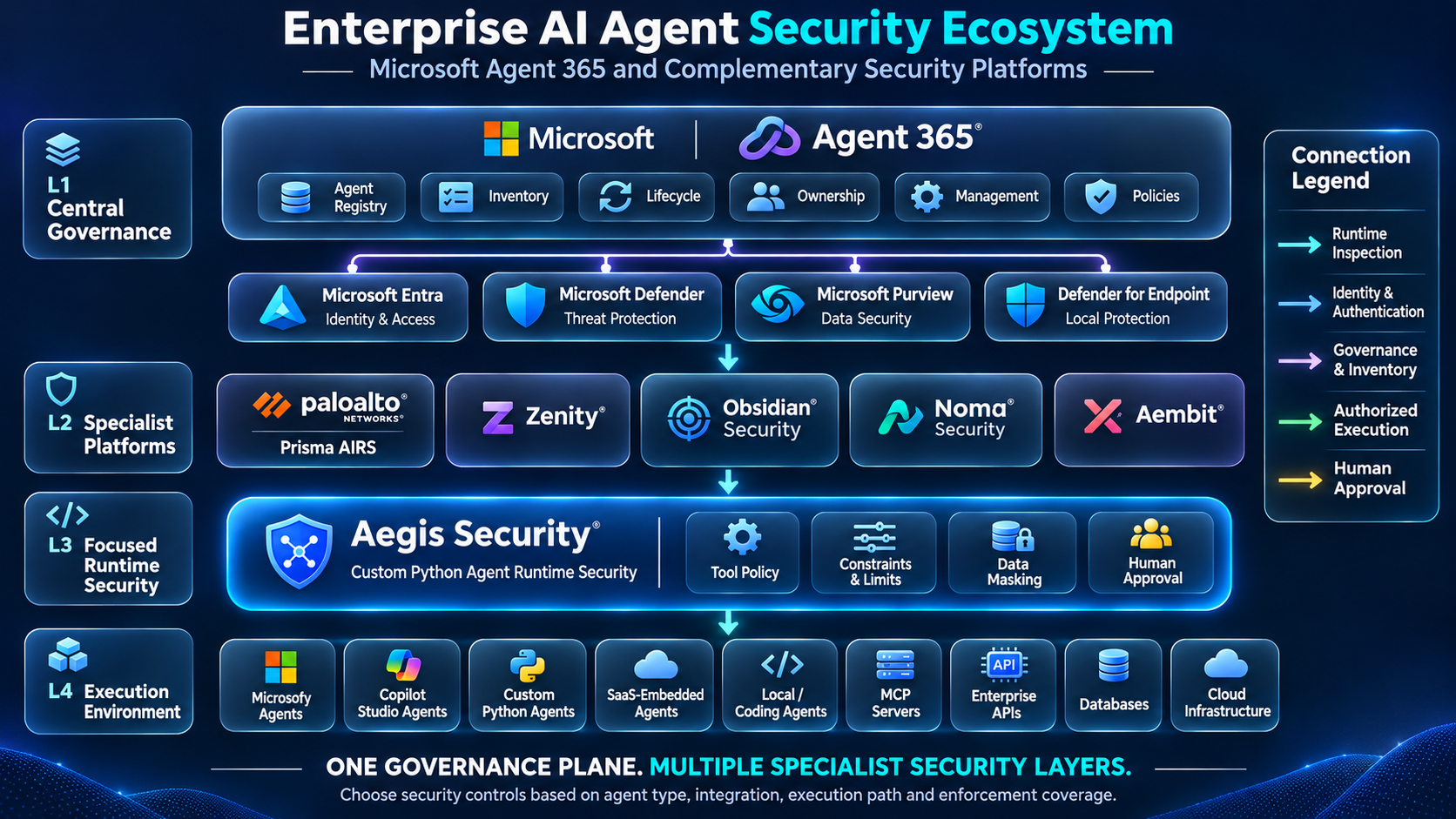
For organizations that need broader AI security or more specific controls, the tools worth evaluating include Palo Alto Networks Prisma AIRS, Zenity, Obsidian Security, Noma Security and Aembit. Aegis Security is a more focused option for policy enforcement on custom Python agents and their tool calls. These products address different layers of the problem; they should not be treated as interchangeable products or ranked without reference to an enterprise's architecture.
Microsoft Agent 365 is strongest as an enterprise agent control plane integrated with Microsoft administration, identity, security and compliance. Add a specialist product when you need capabilities that your deployment path does not provide natively—for example, wider agent runtime coverage, context-aware decisions across third-party applications, MCP access governance, workload identity or application-specific controls on custom agent tools. Verify the exact connector, agent type, enforcement point, licensing tier and GA status before selecting a product.
Microsoft Agent 365 alternatives at a glance
The right choice depends on the missing control. These are the most relevant products to shortlist, based on their current vendor-documented positioning as reviewed on 19 November 2026. “Alternative” here means an option to evaluate for a particular security function; it does not mean that each product replaces the complete Microsoft Agent 365 ecosystem.
Product | Primary security role | Why an enterprise would evaluate it |
Palo Alto Networks Prisma AIRS | Broad AI security platform | AI gateway, AI supply-chain security, red teaming, runtime security, posture management, agent identity and endpoint security. |
Zenity | AI agent security and governance across ecosystems | Agent visibility, governance and runtime-security capabilities across SaaS, cloud, endpoint and an expanding Microsoft ecosystem. |
Obsidian Security | Context-aware runtime decisions for agent actions | Central policy decisions using available user, identity, application and data context across supported coding-agent, Copilot Studio, MCP and gateway enforcement points. |
Noma Security | AI security posture management and runtime context | Discovery and risk analysis across endpoint, SaaS and cloud agents, including MCP servers, tools, models and skills; posture context can inform runtime governance. |
Aembit | Agent identity and access management | Blended agent/user identity, MCP access control, policy evaluation and short-lived credentials for agent-to-resource access. |
Aegis Security | Tool-level runtime policy enforcement for custom Python agents | Per-tool policy checks, parameter constraints, masking, rate limits, spend thresholds and approval holds, alongside agent discovery and risk visibility. |
What is Microsoft Agent 365?
Microsoft Agent 365 is a Microsoft 365 service that provides a centralized control plane for AI agents. Microsoft describes it as a way to discover, manage, govern and secure agents built on Microsoft platforms as well as agents built or acquired from third-party sources. It integrates with Microsoft 365 administration, identity, security and compliance capabilities. Source: Microsoft Agent 365 service description.
In practical terms, Agent 365 is intended to give administrators a shared place to understand which agents exist, who owns or uses them, how they are governed and how they relate to the wider Microsoft security stack. It should be understood as an enterprise management and governance layer—not simply an agent directory and not a single feature that replaces identity, data protection, endpoint controls or runtime threat detection.
The Microsoft security ecosystem around Agent 365
Microsoft component | Relevant responsibility | Question for the security team |
Agent 365 | Agent registry, lifecycle management, governance actions, supported observability and tenant-wide agent-tool controls. | Can we find, approve, assign, block and govern the agents in scope? |
Microsoft Entra | Identity and access capabilities integrated with the Microsoft agent ecosystem. | Can every agent and delegated action be attributed and restricted with the required identity context? |
Microsoft Defender | Security posture, threat detection, investigation and supported real-time protection policies for AI agents. | Which agent and tool paths are actually inspected or blocked before execution? |
Microsoft Purview | Data security, compliance and information-protection capabilities in the Microsoft environment. | Are sensitive data policies applied to the data and workflows these agents can access? |
Microsoft Defender for Endpoint | Separate onboarding path for local AI agent runtime protection on endpoints. | Are local agents covered on managed devices, and is endpoint protection in active mode? |
This is an ecosystem view rather than a claim that every capability is automatically enabled in every tenant. Microsoft documents separate setup requirements for AI agent security, including enabling the Microsoft 365 app connector; local agents are onboarded separately through Defender for Endpoint. Source: Microsoft Defender real-time agent protection; Microsoft Defender AI agent onboarding guide.
Agent 365 licensing: which capabilities require an eligible plan?
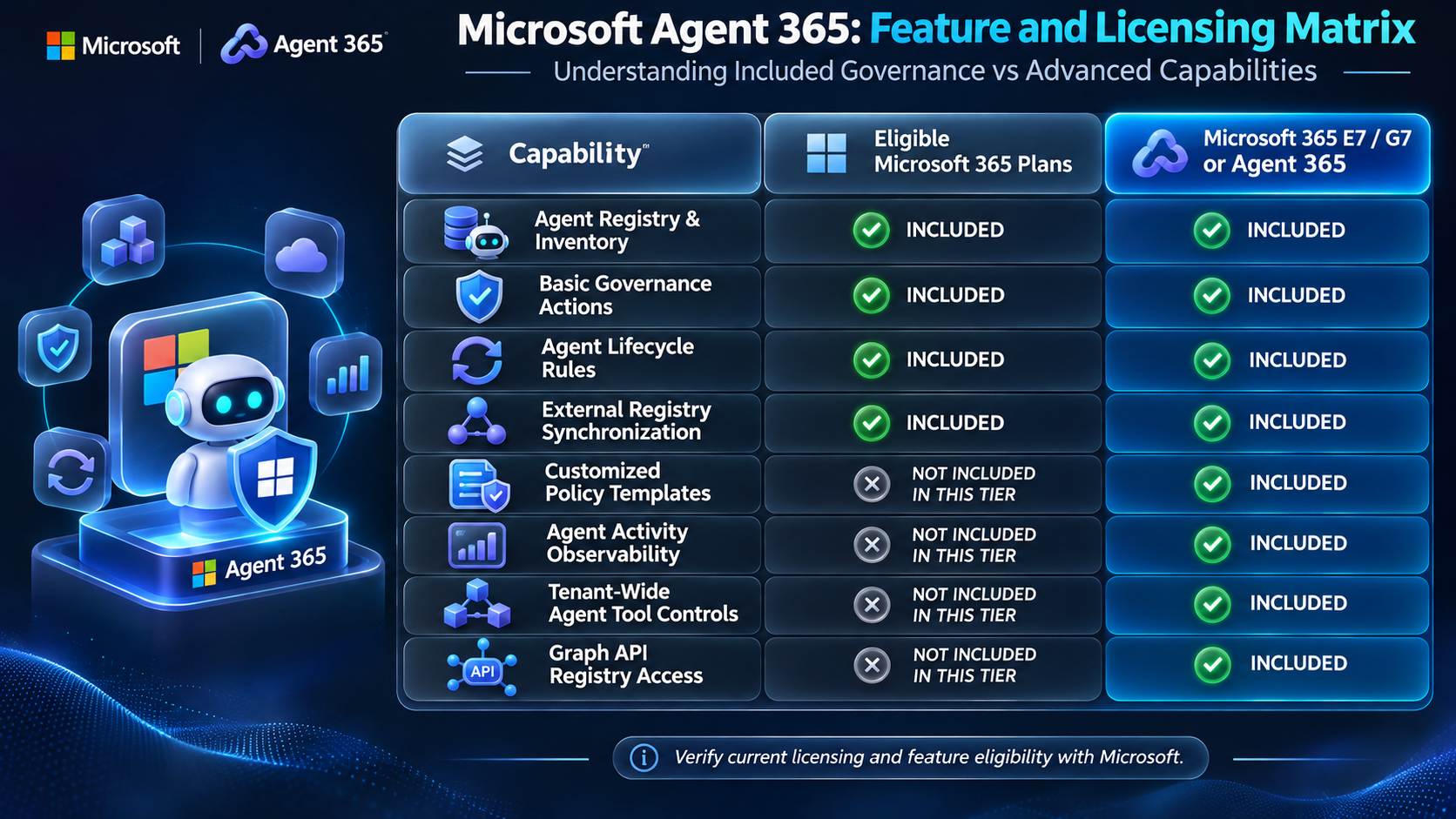
Microsoft's service description distinguishes basic registry and governance capabilities from more advanced policy, observability and tool-control features. It states that Agent 365 is available as a standalone subscription for use with eligible Microsoft 365 subscriptions and is also included with Microsoft 365 E7. The table below reflects the published feature-availability matrix reviewed on 19 November 2026. Confirm the applicable tenant, plan and regional availability directly with Microsoft before procurement. Source: Microsoft Agent 365 service description.
The practical implication is that “we have Microsoft 365” and “we have the full Agent 365 feature set” are not equivalent statements. A buyer should map each required governance, observability and tool-control function to the exact subscription and service entitlement before assuming it is available. Source: Microsoft Agent 365 service description.
Does Microsoft Agent 365 provide runtime security for AI agents?
Yes. Microsoft Defender provides real-time protection for supported AI agent paths. It can inspect agent activity during runtime and use policies to audit or block matching activity before an action executes. It would therefore be inaccurate to describe Agent 365 as having no runtime protection. The meaningful question is how much of an organization's actual agent estate is covered by the documented enforcement points. Source: Microsoft Defender real-time agent protection.
The documented runtime coverage boundary
Agent or execution path | Current documented status | What the documentation says |
Agent 365 Tooling Servers using Work IQ MCP and onboarded custom MCP tools | Generally available (GA) | Defender evaluates tool invocations and responses through Work IQ MCP. Custom MCP tools must be onboarded to Agent 365. |
Microsoft Foundry agents | Preview | Protection evaluates user requests, agent responses, tool invocations and tool responses. |
Microsoft Copilot Studio agents | Preview | The current real-time protection path evaluates tool invocations. |
Local AI agents on endpoints | Separate onboarding path | Local agents are protected through Microsoft Defender for Endpoint runtime protection; Defender for Endpoint must run in active mode. |
Other agent types or unsupported tool paths | Not covered by the current cloud real-time protection policy scope | Microsoft states that support for additional agent types is not yet available. Unsupported tools or paths not integrated with Work IQ MCP should not be assumed to be protected by that mechanism. |
The distinctions matter. Foundry and Copilot Studio do not have identical inspection scope in the current documentation. For Agent 365 Tooling Servers, the documented protection is tied to Work IQ MCP and onboarded custom MCP tools. An agent that uses a tool outside the supported path should not be counted as protected merely because it appears in an inventory. Source: Microsoft Defender real-time agent protection.
Microsoft also documents two operating modes for real-time rules. The default rule audits matching activity and records it as a behavior without stopping the action. Custom rules can block matching activity before it executes. Security teams therefore need to verify not just that a real-time rule exists, but whether it is in audit or block mode, which agents it covers and which detection types are selected. Source: Microsoft Defender real-time agent protection.
What types of activity can the current rules address?
Microsoft's current real-time protection documentation describes supported threat scenarios including malicious content propagation and unsafe email domains. The documentation explains that a matching event can be stopped at the relevant intervention point—for example, before a tool request executes or before suspicious content is passed along. This is different from assuming that every possible business rule can be expressed and enforced at every tool boundary. Source: Microsoft Defender real-time agent protection.
For a production deployment, test your own requirements explicitly: transaction thresholds, allowed parameter values, destination restrictions, call rates, approval conditions, data classification checks and multi-step business rules. The question is not whether a vendor calls its capability “runtime security”; it is whether your exact rule can be evaluated at the exact point where the action is still preventable.
Microsoft Copilot Studio configuration notice
Microsoft currently instructs tenants using the existing onboarding experience for Copilot Studio real-time protection to recreate and enable their blocking rules before 23 December 2026. The existing experience is scheduled to retire on that date, and the documentation warns that blocking settings will not migrate automatically. Administrators should check their tenant configuration and follow Microsoft's current migration instructions; this date and procedure should be rechecked immediately before publication. Source: Microsoft Defender real-time agent protection.
3. What Microsoft Agent 365 does not cover universally
The most useful way to discuss Agent 365 limitations is to describe the boundaries of the published capabilities—not to claim that the platform is incapable of securing agents. Microsoft has a substantial security ecosystem. The gaps appear when an enterprise assumes that inventory, identity, governance and runtime prevention automatically apply to every agent and every execution path.
1. Agent inventory is not the same as runtime enforcement
Agent 365 can synchronize agents and metadata from external platforms into its registry. That is valuable for central governance, but a registry entry is not proof that every action taken by that agent is inspected or blocked. A security team should separately document the discovery connector, telemetry source, runtime enforcement point and response action for each agent category. Source: Microsoft Agent 365 service description; Microsoft Defender real-time agent protection.
2. Runtime coverage is tied to supported agent types and integrations
The current Defender documentation lists a finite set of supported real-time protection paths. It also describes different inspection scopes for Foundry and Copilot Studio, and a Work IQ MCP dependency for Agent 365 Tooling Servers. Enterprises operating agents built on other frameworks, using other MCP clients or invoking APIs through custom execution paths should validate coverage rather than infer it from the registry. Source: Microsoft Defender real-time agent protection.
3. Local agents follow a separate endpoint-security path
Local developer agents and endpoint-based agents are not simply covered by enabling cloud-agent discovery. Microsoft documents a separate Defender for Endpoint setup for local runtime protection and requires Defender for Endpoint to be in active mode. This should be included in endpoint rollout and operational testing. Source: Microsoft Defender real-time agent protection; Microsoft Defender AI agent onboarding guide.
4. Audit mode and block mode produce different security outcomes
A rule that records a suspicious action without stopping it improves visibility, but it does not prevent the action. Teams should distinguish alerting, hunting, audit logging and inline prevention in their control matrix. For high-impact operations, verify that the relevant blocking rule is enabled and that the specific agent, tool and threat scenario fall within its scope. Source: Microsoft Defender real-time agent protection.
5. Feature availability depends on licensing
Advanced policy templates, agent activity observability and tenant-wide control over agent-accessible tools are listed in Microsoft's advanced licensing column rather than the baseline Microsoft 365 tier. An organisation may therefore have basic registry and governance actions but still need an eligible E7/G7 or standalone Agent 365 entitlement for the advanced features it expects. Source: Microsoft Agent 365 service description.
6. Broad governance does not remove the need to test application-specific rules
A business may need a refund agent to issue refunds below a threshold, require approval above it, cap the number of calls per second and mask customer identifiers before sending a tool request. Microsoft documents agent-tool governance and threat-focused runtime protection, but buyers should validate whether their precise parameter-level and workflow-specific requirements are implemented by the relevant Microsoft control or need another enforcement point. Avoid treating a product category label as proof that a specific policy can be enforced.
The best alternatives and complementary security tools to evaluate
There is no single universal replacement for Agent 365. Some products focus on broad AI security, some on agent discovery and posture, some on runtime decision-making, and others on identity and access. The following shortlist is organized by the problem each vendor says it addresses. Product descriptions are based on vendor documentation and announcements; they are not a substitute for a proof of concept or an independent feature test.
1. Palo Alto Networks Prisma AIRS: broad AI security across the lifecycle
Prisma AIRS is worth evaluating when the requirement extends beyond agent administration to a broader AI security program. Palo Alto Networks describes capabilities that include an AI gateway, AI supply-chain security, AI red teaming, AI runtime security, AI posture management, agent identity security and agentic endpoint security. That breadth makes it relevant when an enterprise wants to assess models, applications, data, agents and live interactions within a wider security platform. Source: Palo Alto Networks Prisma AIRS.
Best fit: organisations seeking a broad AI security platform that spans assessment, runtime protection and AI infrastructure. Evaluation question: which traffic paths, model providers, agent frameworks, deployment environments and data stores are covered by the specific Prisma AIRS components being purchased?
2. Zenity: agent security and governance across SaaS, cloud and endpoints
Zenity positions its platform around AI agent discovery, governance, runtime security and response across SaaS, cloud and endpoint environments. Its March 2026 announcement describes generally available inline runtime security for agents built on Microsoft Foundry. Source: Zenity's Microsoft Foundry runtime security announcement.
A particularly relevant update for this comparison was published on 17 November 2026. Zenity announced expanded visibility and governance across GitHub Copilot, Copilot Studio, Agent Builder in Microsoft 365 Copilot, Copilot Cowork, Microsoft Foundry and Claude Enterprise in Microsoft 365. It also said eligible findings from supported Copilot Studio and Foundry agents can be sent through Microsoft Sentinel to contribute runtime-security evidence to Microsoft-calculated dynamic agent risk. The announcement distinguishes these initial Sentinel integration paths from the broader visibility and governance coverage. Source: Zenity's Microsoft ecosystem coverage update (17 November 2026).
Best fit: enterprises that want a specialist agent-security platform across a varied application estate and are particularly interested in Microsoft ecosystem coverage. Evaluation question: for each named Microsoft surface, is the capability inventory, telemetry, posture assessment, inline prevention or runtime evidence—and is it GA, preview or limited to specific agent configurations?
3. Obsidian Security: context-aware runtime policy decisions
Obsidian announced its Runtime Policy Decision Engine on 10 November 2026. The company describes a centralized decision layer that evaluates agent actions using available context about the person behind the agent, the application and the data. Its stated enforcement points include sidecars for supported coding agents, a Copilot Studio webhook, an MCP Security Proxy and a Policy Decision API for customer-operated gateways. Depending on the supported enforcement point and policy, the engine can flag, require approval or block an action. Source: Obsidian's Runtime Policy Decision Engine announcement.
Best fit: enterprises whose agent activity spans third-party business applications and whose runtime decisions need context about users, application entitlements or data labels. Evaluation question: which enforcement points are available for the agents in your environment, and which decisions—especially human approval—are supported at each one?
4. Noma Security: AI security posture management and agent risk context
Noma describes AI-SPM capabilities for discovering agents, MCP servers, toolsets, skills and models across endpoint, SaaS and cloud environments. Its product material also describes evaluating combinations of tools, data access, channels, triggers, users and connected agents; inspecting MCP servers and AI supply-chain components; and feeding identity, ownership and blast-radius context into its Runtime Context Engine for runtime governance. Source: Noma Security AI Security Posture Management.
Best fit: security teams that need to build a risk-oriented inventory of agents and their dependencies, understand how agent capabilities combine, and use posture context to guide access and runtime controls. Evaluation question: what is discovered automatically in your actual platforms, how are unknown agents attributed, and which runtime controls are enforced at the point of action?
5. Aembit: agent identity, access policy and short-lived credentials
Aembit is relevant when the central problem is how an agent identifies itself and obtains access to enterprise resources. Its Agentic AI offering describes blended identity, combining agent and user context, an MCP Identity Gateway, policy-based access decisions and short-lived credentials rather than relying on long-lived secrets. Aembit also describes context-aware access decisions and audit visibility across agents and workloads. Source: Aembit IAM for Agentic AI.
Best fit: enterprises that need to govern agent-to-resource authentication, reduce standing credentials or control access to MCP servers. Evaluation question: does the identity model preserve the initiating user and agent identity through delegated workflows, and can credentials be scoped to the task, resource and required duration?
6. Aegis Security: policy enforcement on custom Python agent tool calls
Aegis is positioned most accurately as a focused runtime control and discovery platform for organisations building and operating custom agents. Its current developer documentation describes a Python SDK in which teams create a client and wrap each tool with a policy-check decorator. A policy is evaluated before the wrapped tool runs; unknown tools are denied, and a blocked call raises an error. The documented SDK decisions are allow, mask (sanitize), hold (approval needed) and block (deny). Source: Aegis Security platform; Aegis Security developer documentation.
Aegis documents per-tool parameter conditions, allowed values, calls-per-second limits, spend thresholds and approval requirements. Its platform documentation also describes cloud and SaaS discovery, risk scoring, right-sizing recommendations, in-process data masking for tool calls and evidence for runtime decisions. In a refund workflow, for example, an enterprise could bound the amount, cap call frequency and require multiple approvers above a configured threshold. Source: Aegis Security platform.
Aegis scope and product boundaries
Aegis currently documents runtime control for custom Python agents built by the customer. Agents embedded inside SaaS applications receive discovery and risk scoring, not Aegis runtime control. The published platform page says runtime control is Python-only today, with optional auto-instrumentations and MCP support. Approval decisions are handled in the Aegis console today; Slack, Teams and email delivery are listed as upcoming. Tool-call masking does not mean prompts sent to model providers are masked. These limits should be kept visible in any buyer comparison. Source: Aegis Security platform; Aegis Security developer documentation.
Best fit: teams that own custom Python agents and need explicit policies on the tools those agents call—for example, parameter bounds, rate limits, spend limits, masking or approval holds. Evaluation question: can the SDK wrap every consequential tool, is the policy decision point available in the required deployment model, and what happens when policy evaluation is unavailable?
For product details, see the Aegis platform and Aegis developer documentation.
Microsoft Agent 365 vs. Aegis Security: a scope-based comparison
Aegis should not be positioned as a one-for-one replacement for Microsoft Agent 365. Agent 365 provides a broad Microsoft control plane for agent inventory and governance. Aegis provides a more focused policy decision point for tool calls made by supported custom Python agents, alongside discovery and risk functions. An enterprise may use both when it needs Microsoft-wide agent administration and more specific tool-level rules for the Python agents it operates.
Evaluation dimension | Microsoft Agent 365 / Microsoft security stack | Aegis Security |
Primary role | Centralized agent registry, lifecycle governance and integration with Microsoft identity, security and compliance. | Agent discovery and focused runtime policy enforcement for custom Python agents and their tool calls. |
Agent discovery | Agent registry with external-platform metadata synchronization and Microsoft ecosystem integrations. | Documented discovery across AWS, Azure, Google Cloud, Salesforce, ServiceNow, Microsoft Copilot Studio, Workday and employee laptops; exact connector scope varies. |
Runtime enforcement | Defender real-time protection for documented supported agent types and execution paths. | Policy check before a wrapped tool runs in supported custom Python agents. |
Policy granularity | Agent governance, tenant-wide tool controls on eligible plans and threat-scenario-based real-time protection; validate exact business-rule requirements. | Per-tool parameter ranges and allowed values, rate limits, spend thresholds, masking and approval holds. |
Local and SaaS agents | Local protection uses a separate Defender for Endpoint path. Other coverage depends on supported Microsoft agent integrations. | SaaS agents receive discovery and risk scoring, not Aegis runtime control; local agent and employee AI capabilities are separately documented. |
Licensing / deployment | Microsoft 365 plan or standalone Agent 365 entitlement; advanced features require eligible licensing. | Python SDK and policy service, with SaaS or single-tenant appliance options described by Aegis. |
Best role in a combined architecture | Enterprise agent administration and Microsoft ecosystem governance. | Fine-grained action policy for custom Python agents whose tools can be wrapped and controlled. |
The key difference is not that one product is “secure” and the other is not. It is the enforcement surface. Microsoft Agent 365 governs an enterprise agent estate through Microsoft administration and integrated security services. Aegis is relevant when the engineering team needs an explicit policy decision before a custom Python tool executes. Source: Microsoft Agent 365 service description; Microsoft Defender real-time agent protection; Aegis Security platform; Aegis Security developer documentation.
6. How to choose the right combination for an enterprise
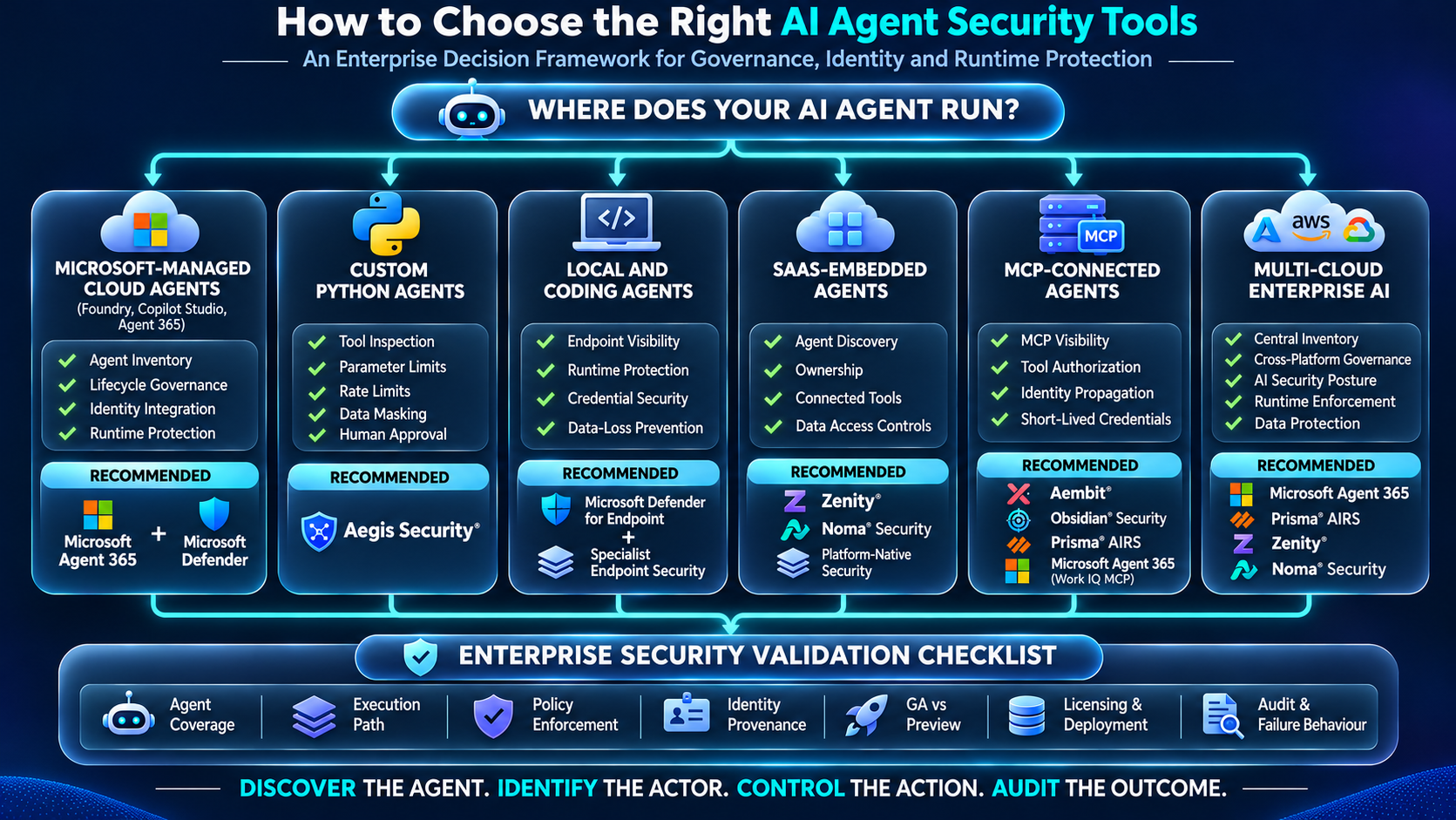
A practical architecture starts by identifying where agents run and what they can change. Choose controls based on the execution path, not merely on whether the product advertises agent governance, AI-SPM or runtime protection.
If the main requirement is… | Prioritize evaluating… | Proof-of-concept question |
A central inventory and lifecycle governance for Microsoft and connected agents | Microsoft Agent 365 | Can the registry identify the agents we operate, sync the required third-party metadata and enforce the governance actions we need? |
Broad protection across AI apps, models, data and agent interactions | Prisma AIRS | Which model, app, data and runtime paths are inspected inline, and how does prevention behave under load? |
Agent security coverage across SaaS, cloud, endpoints and the Microsoft ecosystem | Zenity | For each agent platform, is the capability discovery, telemetry, posture, runtime detection or inline blocking? |
Context-aware decisions for actions in third-party applications | Obsidian Security | Can a policy use the user, agent, application and data context needed for this action, and which enforcement point applies? |
Discovery, posture, agent dependency and MCP supply-chain risk | Noma Security | Can the platform discover our actual agent components and show how identity, tools, data and connected agents affect risk? |
Agent identity, MCP authorization and short-lived credentials | Aembit | Can the system issue task-scoped credentials while preserving both user and agent provenance? |
Parameter-level limits and approval on custom Python tools | Aegis Security | Can every consequential Python tool be wrapped, and can the exact rule be tested and enforced before execution? |
A practical reference architecture
A mature enterprise architecture may combine several controls, each placed where it can make a meaningful decision:
- Discover and register agents. Build an inventory across cloud services, SaaS platforms, endpoints, development tools and agent frameworks. Record owner, platform, connected tools, data sources and evidence of activity.
- Establish identity and delegation. Associate agent actions with the agent identity and, where applicable, the initiating user. Use short-lived, scoped credentials and remove broad shared secrets where possible.
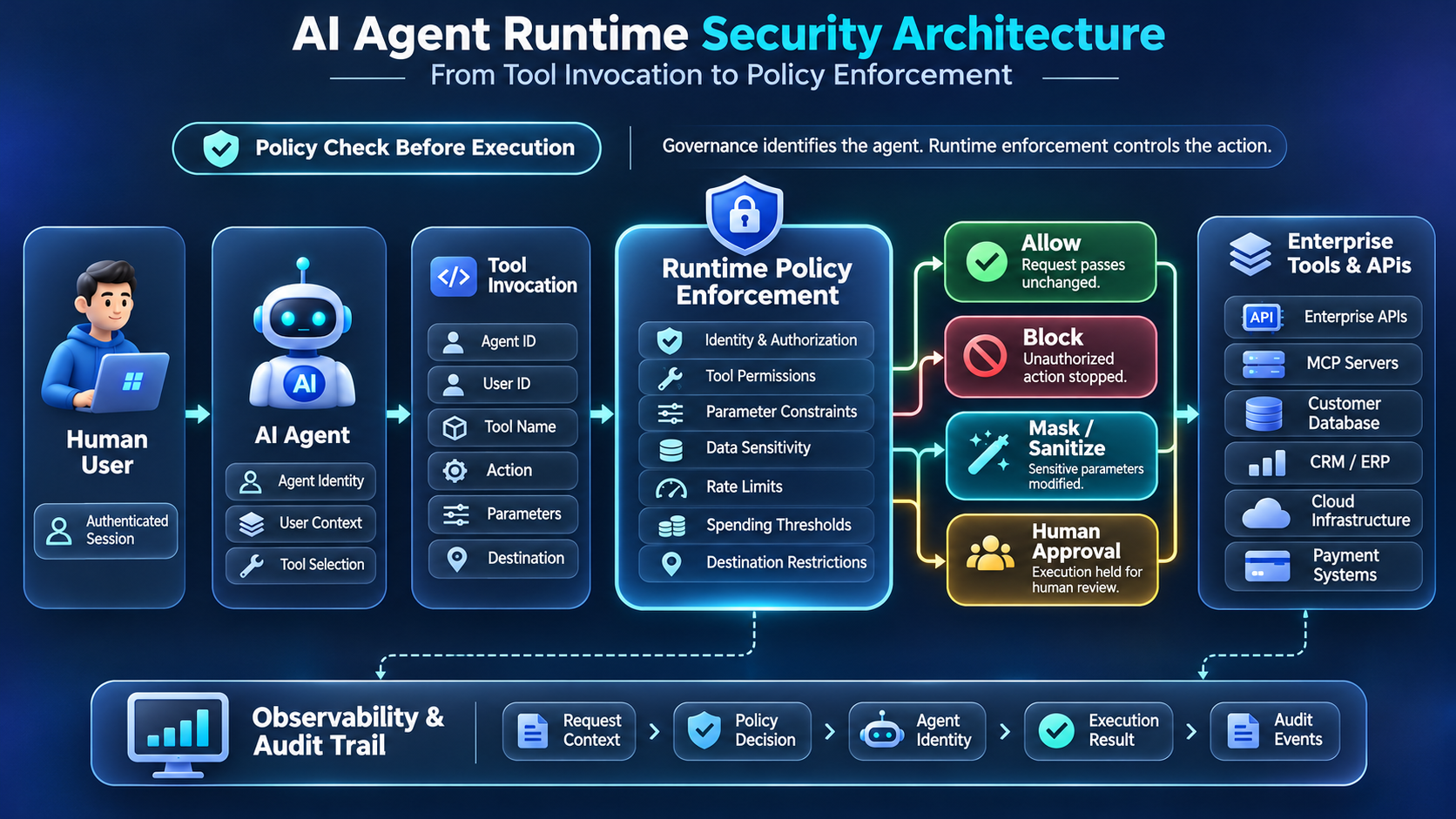
- Enforce policy at the execution point. Place a policy decision mechanism in the agent tool path, MCP gateway, supported platform hook or customer-operated gateway. Confirm that the control executes before the downstream action.
- Protect data and model interactions. Apply data classification, secret handling, egress controls and AI security inspection at the appropriate layer. Do not assume that tool-call masking automatically covers prompts sent to a model provider.
- Record evidence and test failures. Capture the actor, tool, parameters or safe metadata, policy version, decision, reason, timestamp and outcome. Test unavailable policy services, audit-only modes, approval timeouts and rollback behaviour.
The architectural principle is straightforward: discovery tells the security team what exists; identity tells it who or what is acting; runtime enforcement decides whether a specific action may proceed; data protection controls what sensitive information can move; and observability provides evidence. These layers can be delivered by one platform or by a combination of tools, provided their boundaries and handoffs are explicit.
Frequently asked questions
What are the best alternatives to Microsoft Agent 365?
The best alternative depends on the security function you need. Palo Alto Networks Prisma AIRS is a broad AI security platform; Zenity focuses on AI agent discovery, governance and runtime security across multiple environments; Obsidian Security offers context-aware runtime decisions for supported agent and application paths; Noma Security focuses on AI security posture and agent risk context; and Aembit focuses on agent identity and access. Aegis is worth evaluating for fine-grained tool-call policy enforcement on custom Python agents.
Does Microsoft Agent 365 provide runtime security?
Yes. Microsoft Defender provides real-time protection for supported agent paths. As documented on 19 November 2026, the listed cloud paths include Agent 365 Tooling Servers using Work IQ MCP and onboarded custom MCP tools (GA), Microsoft Foundry agents (Preview) and Microsoft Copilot Studio agents (Preview). Local agents use a separate Defender for Endpoint onboarding path. Source: Microsoft Defender real-time agent protection.
What does Microsoft Agent 365 not cover for AI agent security?
The main limitation is not a complete absence of security controls; it is that controls have defined coverage boundaries. The current real-time policy documentation lists supported agent types and integrations rather than universal support for every agent framework and tool. Local protection requires a separate endpoint setup, some capabilities depend on licensing, and the inspection scope differs between Foundry and Copilot Studio. Enterprises should verify coverage for each agent and execution path. Source: Microsoft Agent 365 service description; Microsoft Defender real-time agent protection; Microsoft Defender AI agent onboarding guide.
Can Microsoft Agent 365 protect custom MCP tools?
Microsoft documents real-time protection for Agent 365 Tooling Servers through Work IQ MCP, including customer MCP tools onboarded to Agent 365. That does not establish that every custom MCP server or every MCP client path is automatically covered. Confirm onboarding requirements, supported tool path, agent identity and whether the rule is auditing or blocking. Source: Microsoft Defender real-time agent protection.
Is Microsoft Agent 365 enough to secure custom Python or LangGraph agents?
It may provide important governance and supported security integrations, but the enterprise should validate the exact runtime execution path used by its custom Python or LangGraph agents. Check whether tool invocations are routed through a supported enforcement point and whether the required parameter-level policies can be enforced before execution. A specialist control such as Aegis may be relevant when custom Python tools need explicit per-tool policy checks.
What is the difference between AI agent governance and runtime enforcement?
AI agent governance covers ownership, inventory, approvals, lifecycle management, policy administration and oversight. Runtime enforcement evaluates an action as it is about to execute and allows, blocks, modifies or holds it according to policy. Governance can define the rules and identify the agent; runtime enforcement is the control that must act on the actual request before the downstream operation occurs.
Which tools are useful for AI agent identity and MCP access control?
Aembit is specifically positioned around agent identity, blended user-agent context, MCP access control and short-lived credentials. Microsoft Entra is part of the Microsoft identity stack around Agent 365. Other AI security platforms may provide identity-aware context or MCP governance, but buyers should compare the credential issuance, delegation, policy and audit behaviour required by their architecture.
Does an agent inventory prevent prompt injection or unauthorized tool calls?
No. An inventory helps discover agents, understand ownership and map exposure. It does not by itself stop a specific action. Prevention requires an enforcement point—such as a supported runtime policy, gateway, endpoint control or application authorization check—that can inspect and stop the request before it reaches the target tool or system.
How should an enterprise evaluate AI agent runtime security?
Start with a real workflow and a consequential tool call. Test malicious or unexpected input, invalid parameters, sensitive-data egress, rate-limit exhaustion and a high-impact action that should require approval. Confirm the exact enforcement point, available policy decisions, identity context, failure mode, telemetry and licensing. Do not accept a general product statement as proof that the specific workflow is protected.
Conclusion: choose controls by execution path, not by product label
Microsoft Agent 365 is an important enterprise control plane for managing and governing AI agents, and Microsoft Defender adds real-time protection for documented supported paths. The platform should not be dismissed as an inventory-only product. At the same time, enterprises should not assume that registry coverage automatically means every agent action is inspected or blocked.
The right architecture depends on the agents an organization actually runs. Broad AI security may point toward Prisma AIRS. Cross-environment agent visibility and governance may make Zenity or Noma relevant. Context-aware decisions across third-party applications may warrant evaluating Obsidian. Agent identity and short-lived credentials may point toward Aembit. Custom Python agents that need explicit policy checks on tool calls may be a fit for Aegis.
Before choosing, map agent types, execution paths, licensing and required controls. Then test whether each policy is enforced before the consequential action, whether the decision is attributable and whether the evidence is usable by security operations and auditors. That is a more reliable way to close AI agent security gaps than selecting a platform based on its category name alone.