AI Agent vs. Non-Human Identity: The Enterprise Security Guide
Discover the critical differences between non-human identities (NHIs) and AI agents. Learn how to secure enterprise workflows with Aegis.
Introduction: The New Frontier of Autonomous Risk
Enterprise technology is undergoing a foundational shift. For decades, infrastructure scaling was defined by static workloads, deterministic scripts, and predictable service accounts. Today, organizations are rapidly deploying Large Language Model (LLM)-driven autonomous systems—AI agents—that do not merely respond to prompts; they execute actions, query databases, orchestrate APIs, and modify production infrastructure in real time.
In boardrooms, developer standups, and architectural design sessions, two terms are increasingly used interchangeably: non-human identity (NHI) and AI agent. This conflation is more than a semantic error—it is an architectural vulnerability.
An NHI (such as an API key, an OAuth token, a Kubernetes service account, or a database credential) is static, deterministic, and bound to predefined, scripted routines. It executes precisely what it is programmed to do. Conversely, an AI agent is non-deterministic, reasoning independently, dynamically chaining tools, and adapting its execution path based on real-time environmental feedback.
Treating an autonomous AI agent as a standard service account strips security teams of the visibility and runtime controls required to prevent unauthorized actions. As enterprise architectures transition from human-centric operations to autonomous multi-agent execution, security leaders must recognize that the primary enterprise risk in AI is not model hallucination—it is uncontrolled, identity-blind action execution across trusted APIs, databases, and enterprise applications.
This comprehensive architectural guide deconstructs the differences between non-human identities and AI agents, examines the mechanics of agentic failure, and establishes a production-grade runtime enforcement model designed for Enterprise CTOs, CISOs, and Platform Engineering leaders.
Autonomous System Architecture & Challenges
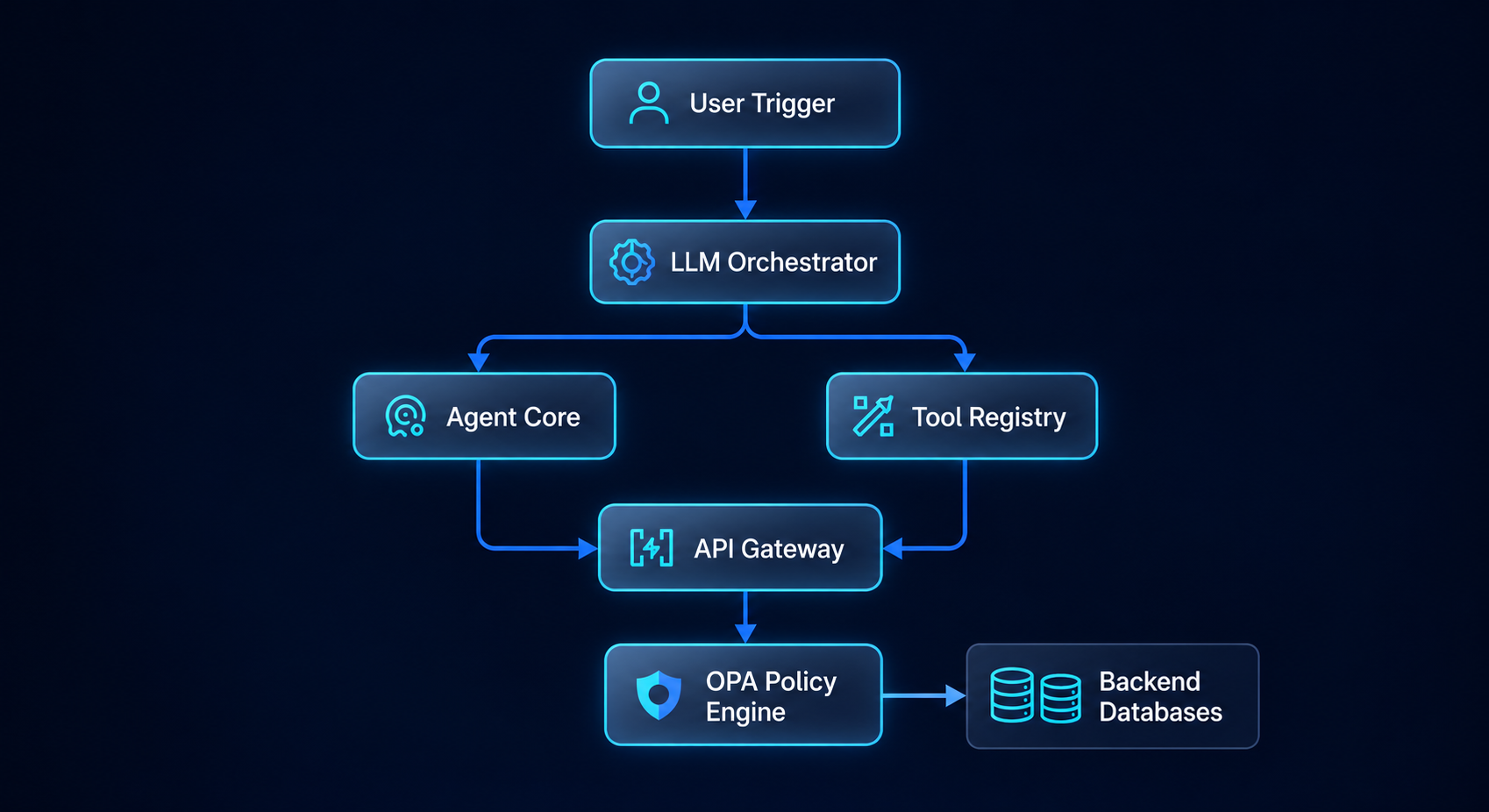
To secure agentic systems, security architects must understand their underlying execution topology. Unlike traditional monolithic applications or microservices, an autonomous agentic system is composed of several decoupled, highly dynamic layers.
Agents, Tools, and Orchestrators
At the heart of the architecture is the LLM Orchestrator, which acts as the reasoning engine. The orchestrator does not execute direct system calls; instead, it generates structured intents (often via JSON or function-calling syntax) that invoke registered Tools. These tools encapsulate enterprise capabilities, such as fetching customer records, initiating financial transactions, or modifying cloud configurations.
Multi-Agent Chaining and Propagation
Modern enterprise architectures rarely rely on a single isolated agent. Instead, they deploy multi-agent networks where Agent A delegates tasks to Agent B, which subsequently queries Agent C. In this cascading topology, identity propagation becomes notoriously difficult. If an initial user triggers a workflow, that user’s context, intent, and authorization boundaries must be cryptographically preserved across every downstream tool invocation and inter-agent handoff.
Without robust token issuance and validation frameworks leveraging JSON Web Tokens (JWT) and JSON Web Key Sets (JWKS), downstream services receive anonymous or over-privileged requests, destroying auditability and violating the principle of least privilege.
Runtime Execution vs. Orchestration Logic
A critical architectural flaw in current enterprise implementations is the reliance on orchestration frameworks (such as LangChain, Semantic Kernel, or custom agent runtimes) to enforce security logic. Orchestrators are designed for velocity and reasoning, not security governance. Embedding authorization checks inside the application code of an agent creates brittle, easily bypassed security boundaries.
Key Insight Highlight: "Most enterprises control models—but not execution paths."
Securing the prompt or fine-tuning the base model provides zero protection if the agent's execution path allows it to invoke a destructive database API or exfiltrate sensitive data via an unmonitored HTTP webhook. Security enforcement must be decoupled from the application logic and executed at the runtime networking layer.
Autonomous System Risks
When AI agents are granted access to enterprise tooling without rigorous runtime governance, they introduce a distinct matrix of operational and security risks that traditional Identity and Access Management (IAM) tools are fundamentally unequipped to handle.
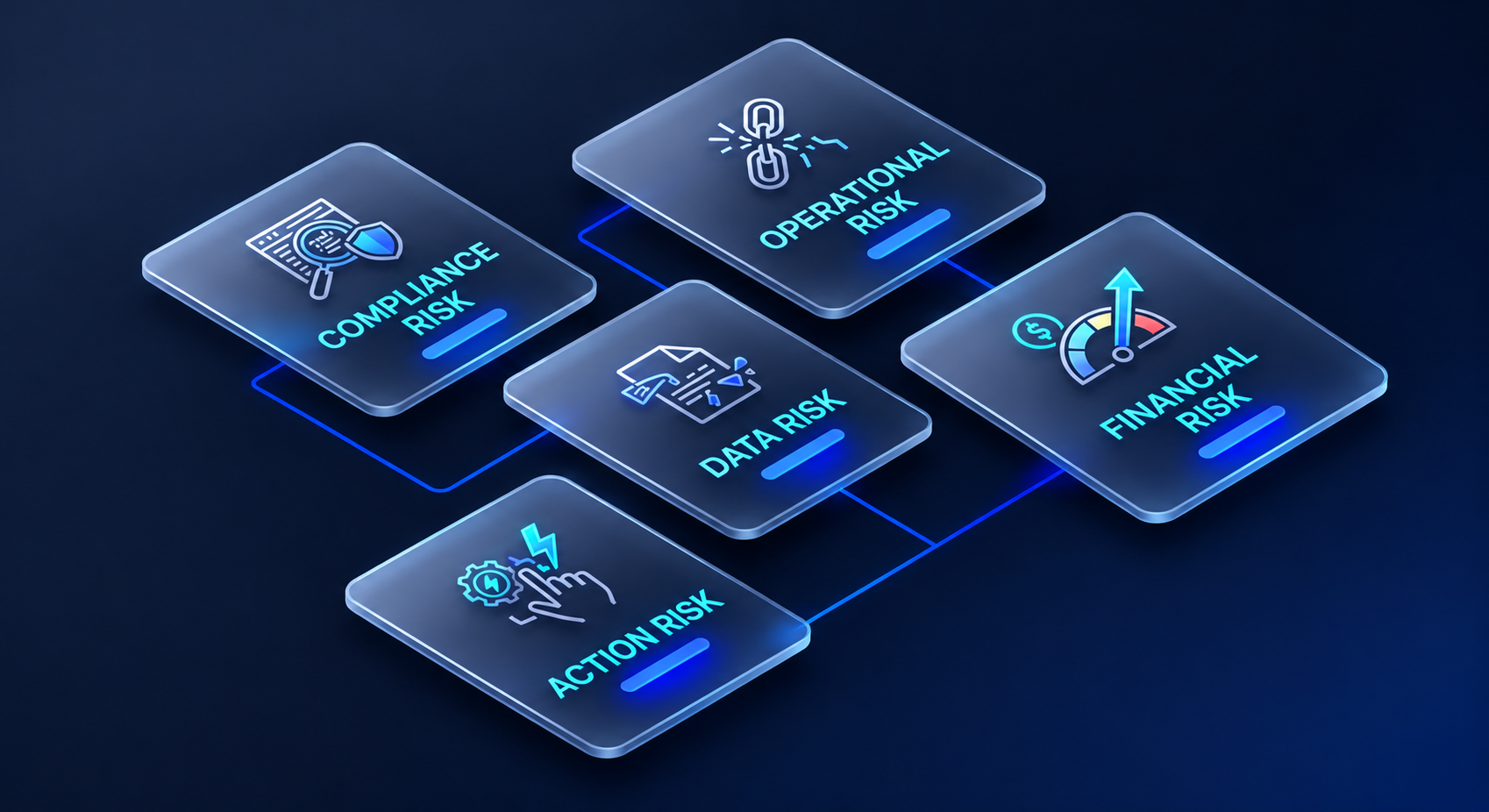
Action Risk: Unauthorized API Execution and Tool Misuse
Because AI agents operate non-deterministically, they can be manipulated into executing unintended tool sequences. Through prompt injection or complex multi-step reasoning loops, an agent might combine benign tools in novel ways to achieve malicious outcomes—such as chaining a file-reading tool with an external API-posting tool to exfiltrate proprietary source code.
Data Risk: Sensitive Data Leakage and RAG Exposure
Retrieval-Augmented Generation (RAG) pipelines connect LLMs to vast enterprise knowledge repositories. If an agent lacks fine-grained, context-aware data scoping, it can aggregate, synthesize, and leak Personally Identifiable Information (PII), intellectual property, or confidential financial metrics across tenant boundaries or unauthorized user sessions.
Financial Risk: Runaway Compute Costs and Transaction Abuse
Autonomous loops can easily malfunction, resulting in infinite tool-invocation cycles that exhaust API rate limits, inflate cloud compute bills, or execute unauthorized, high-value financial transactions (e.g., automated refund processing or programmatic procurement) at machine speed before human operators can intervene.
Operational Risk: Cascading Failures and System Instability
An unmonitored agent interacting directly with backend infrastructure can trigger cascading database locks, flood message queues, or issue destructive configuration changes (such as dropping database tables or altering firewall rules) in response to misinterpreted error codes or hallucinated system states.
Compliance Risk: Audit Trail Gaps and Telemetry Failure
Regulatory frameworks (such as GDPR, HIPAA, SOC 2, and the EU AI Act) mandate strict traceability for automated decision-making. When agents execute actions under shared service accounts or static API keys, compliance teams face insurmountable audit gaps, unable to prove who (or what prompt) authorized a specific system modification.
Interoperability & Lock-In Risks
As organizations race to adopt agentic workflows, many fall into the trap of proprietary vendor ecosystems. Current market dynamics encourage platform lock-in through closed-source SDKs, proprietary orchestration runtimes, and embedded security hooks that only function within a specific vendor's cloud or SaaS platform.
The Pitfalls of Closed Ecosystems
- Hardcoded Policy Logic: Security rules embedded directly into proprietary orchestrators make it impossible to migrate models or frameworks without rewriting core authorization code.
- Closed Telemetry Systems: Proprietary logging formats prevent security operations centers (SOCs) from centralizing agent audit trails into existing SIEM/SOEM infrastructure (e.g., Datadog, Splunk, Elastic).
- Non-Standard Token Formats: Custom credential issuance models create brittle integrations across multi-cloud and hybrid environments.
Protocols for Open Interoperability
To future-proof enterprise architectures, organizations must decouple agent development from security enforcement by adopting open standards:
- Protocol Standardization: Enforce communication via standard HTTP/gRPC interfaces with strict JSON schema validation for all tool inputs and outputs.
- Externalized Policy Engines: Utilize declarative policy languages (such as Rego via Open Policy Agent) to evaluate agent intent independently of the underlying LLM or orchestrator.
- Neutral Telemetry Fabrics: Instrument all agentic tool calls using OpenTelemetry (OTel) spans, capturing prompts, reasoning traces, and tool parameters in a vendor-neutral format.
Runtime Control Architecture
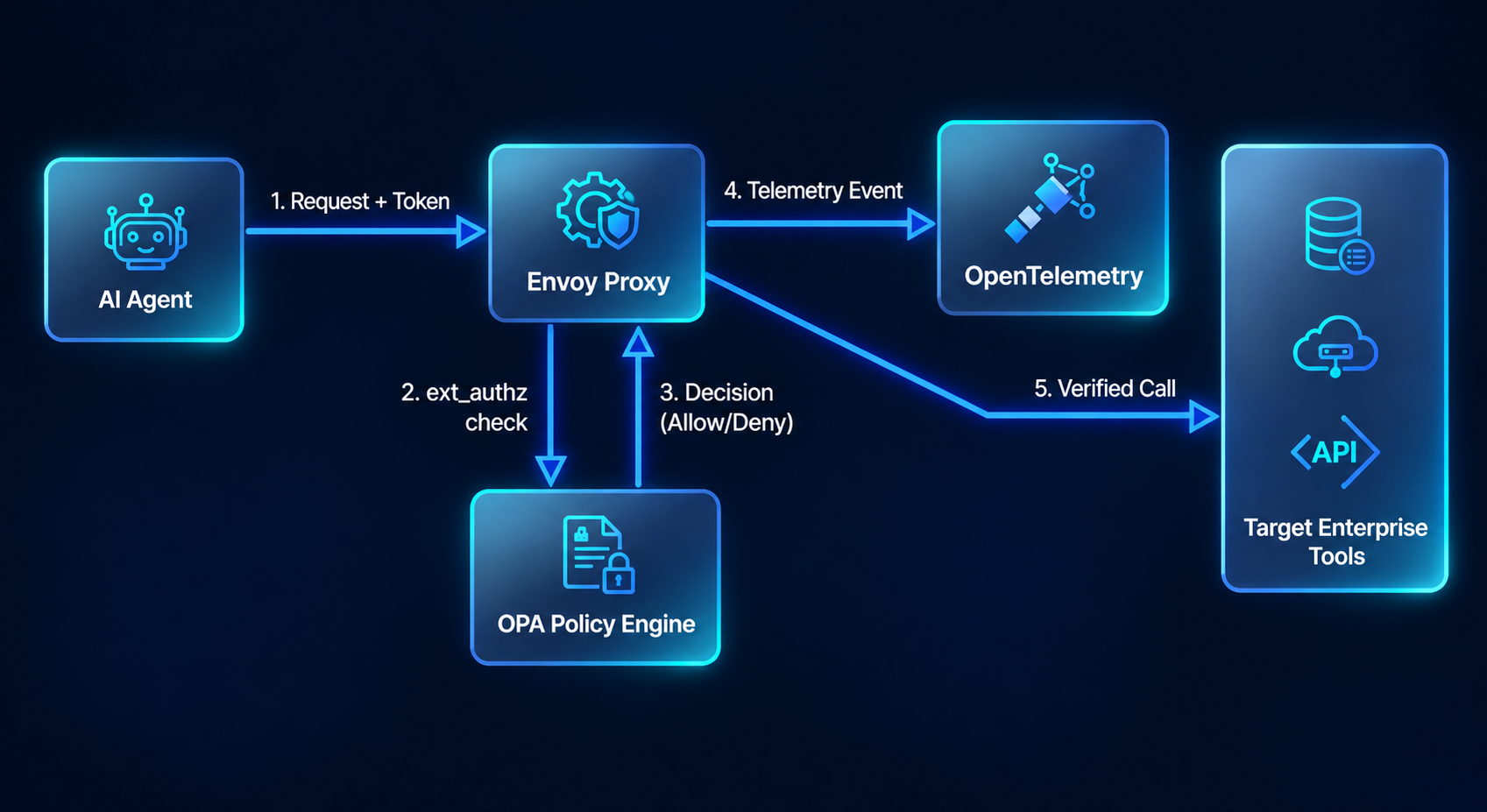
To eliminate the security blind spots inherent in autonomous systems, Aegis advocates for a decentralized, proxy-based Runtime Control Architecture. This model shifts security from application-level prompts to infrastructure-level enforcement.
Core Components
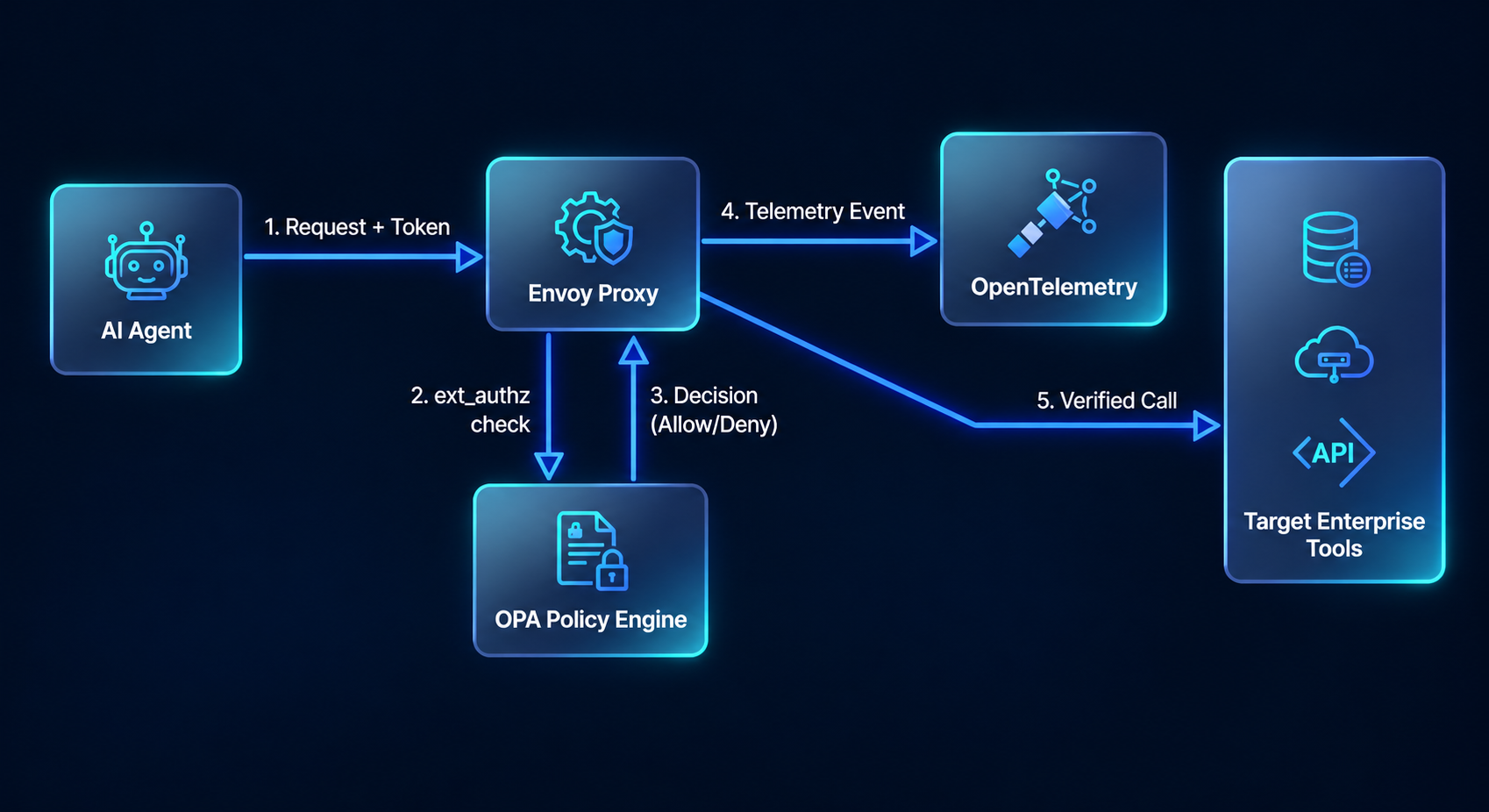
- API Gateway / Envoy Proxy: Acts as the network enforcement point (NEP) intercepting every tool invocation, API call, and database query initiated by an agent.
- External Authorization (ext_authz): A high-performance protocol extension that allows the gateway to query a policy decision point before forwarding traffic to backend systems.
- Policy Engine (OPA Bundles): Evaluates real-time contextual attributes—such as agent identity, user delegation scope, parameter thresholds, and time-of-day constraints—against declarative policies.
- Identity & Token Exchange: Validates incoming JWTs, extracts claims, and performs token exchange to mint short-lived, scoped workload credentials for downstream tool execution.
- Observability Layer: Emits standardized OpenTelemetry metrics and traces for every transaction, ensuring complete forensic visibility.
Step-by-Step Execution Flow
- Initiation: The AI agent generates a tool call (e.g., an API request to modify a user record).
- Interception: The Envoy gateway intercepts the HTTP request at the network edge.
- Authorization Check: The gateway triggers an ext_authz call to the policy engine, passing the request payload, headers, and agent identity context.
- Policy Evaluation: The policy engine evaluates the request against active security rules (e.g., "Does this agent have write permissions for this specific database table?").
- Enforcement: If authorized, the gateway injects a verified, short-lived token and forwards the request to the target tool. If denied, the gateway immediately terminates the request and logs an audit violation.
- Telemetry: OpenTelemetry records the complete request lifecycle, linking the user prompt, agent reasoning trace, tool parameters, and authorization outcome.
Enterprise Governance & Control Model
Implementing a robust governance framework requires aligning identity, policy, and observability into a cohesive operational model.
The Five Pillars of Agentic Governance
- Identity (Who/What is Acting): Every agent must possess a unique, cryptographic non-human identity. Shared API keys and generic service accounts are strictly prohibited.
- Policy (What Actions are Allowed): Access must be governed by dynamic, context-aware policies rather than static Role-Based Access Control (RBAC). Policies must inspect not just who is calling, but what parameters are being passed.
- Observability (Real-Time Insight): Security teams must maintain real-time visibility into agent behavior, tracking tool invocation frequencies, parameter distributions, and reasoning drift.
- Auditability (Cryptographic Proof): Every agentic transaction must generate an immutable audit trail linking the originating user, the agent instance, the governing policy, and the execution result.
- Human-in-the-Loop (HITL) Approvals: High-impact or destructive actions (such as financial transfers exceeding specified thresholds, database schema modifications, or mass data deletions) must automatically pause execution and trigger asynchronous human approval workflows via Slack, Microsoft Teams, or enterprise IAM portals.
Enterprise Failure Scenarios
To illustrate the critical importance of runtime enforcement, consider the following real-world failure scenarios driven by unmanaged agentic systems:
- Unauthorized Financial Transactions: A customer support agent, compromised via an indirect prompt injection embedded in an incoming support ticket, invokes a billing refund tool to transfer funds to an external account. Without runtime parameter validation, the system treats the call as valid because the agent possesses general billing access.
- Silent Data Exfiltration: A developer productivity agent tasked with code analysis is manipulated into reading sensitive environment variables from a production database and appending them to an outbound HTTP webhook. Without egress filtering and data-loss prevention (DLP) proxies, the exfiltration completes unnoticed.
- Unsanitized Configuration Changes: An infrastructure management agent misinterprets a natural-language prompt and executes a terraform script that deletes production security groups. Without least-privilege scoping and destructive-action gates, the blast radius encompasses the entire cloud environment.
Key Positioning Statement: "The real risk is not AI—it is uncontrolled actions inside trusted systems."
Business & Operational Value
Adopting an Aegis-aligned runtime enforcement architecture delivers immediate, quantifiable business value to enterprise organizations:
- Radically Reduced Blast Radius: Compartmentalizing agent permissions ensures that the compromise of a single agent cannot cascade across enterprise infrastructure.
- Immediate Audit Readiness: Automated OpenTelemetry logging and cryptographic audit trails eliminate the manual overhead associated with compliance preparation (SOC 2, ISO 27001, EU AI Act).
- Vendor Flexibility: Externalizing policy and decoupling security enforcement from proprietary orchestration frameworks allows engineering teams to upgrade models, switch LLM providers, and adopt new developer frameworks without refactoring security logic.
- Accelerated Innovation Velocity: Security teams can approve and deploy autonomous agents with confidence, replacing restrictive blanket bans on AI with dynamic, policy-driven guardrails.
Technical Definitions & Conceptual Explanations
To ensure technical clarity across engineering and security organizations, the following core concepts define the modern agentic security lexicon:
- Policy-as-Code: The practice of expressing security and access control policies in declarative, human-readable code files (e.g., Rego) that can be version-controlled, tested, and automatically enforced by machine engines.
- ext_authz (External Authorization): An architectural design pattern (commonly implemented in Envoy proxy) that offloads authorization decisions to an external microservice before permitting network traffic to reach backend workloads.
- OPA Bundles: Pre-compiled archives containing Open Policy Agent data and Rego policies, distributed dynamically to enforcement points for lightning-fast local evaluation.
- JWT & JWKS: JSON Web Tokens used for cryptographically signed identity assertions, validated via public keys published in a JSON Web Key Set endpoint.
- Token Exchange: An OAuth 2.0 extension (RFC 8693) that allows an entity (such as an AI agent) to exchange an incoming user token for a down-scoped, restricted token tailored for a specific downstream tool invocation.
- OpenTelemetry (OTel): An open-source observability framework providing vendor-neutral APIs and SDKs for collecting metrics, logs, and traces.
- Agent Identity: A unique, cryptographically verifiable digital credential assigned to an autonomous software entity, incorporating ownership metadata, behavioral baselines, and permission scopes.
- Runtime Enforcement: Security controls applied dynamically at the moment of system interaction (e.g., network calls, API requests, database queries) rather than statically at compile time or application startup.
- Shadow Mode (Dry-Run Deployment): A deployment strategy where security policies are evaluated in real-time and log violations without blocking traffic, allowing security teams to tune rules and measure false-positive rates before enforcing hard blocks.
Industry Research, Evidence & Architecture Patterns
Industry Risk Statistics
According to recent enterprise research by Gartner and industry security studies, over 70% of organizations adopting generative AI workflows have experienced at least one unauthorized data exposure or unintended tool execution incident stemming from over-privileged service accounts and lack of runtime visibility. Furthermore, NIST guidelines on AI risk management emphasize that autonomous agents operating without deterministic execution boundaries represent a critical vector for systemic operational failure.
Novel Architecture Pattern: The Policy-Enforced Agent Gateway
The following reference architecture details the implementation of a secure agent gateway utilizing an Envoy proxy sidecar paired with an Open Policy Agent evaluation engine:
- Proxy Interception: All outbound HTTP/gRPC traffic from the agent runtime is routed through a local Envoy sidecar proxy.
- Context Injection: The proxy extracts the agent's JWT identity and inspects the request body using WebAssembly (Wasm) filters to parse tool parameters (e.g., SQL queries, API arguments).
- Granular Evaluation: OPA evaluates the request against contextual policy bundles. For instance, a policy might dictate: Allow SQL_SELECT on table customer_profiles only if the WHERE clause includes the authenticated tenant ID, and strictly prohibit any SQL_DROP or SQL_ALTER operations.
- Audit & Log: Regardless of whether the request is allowed or denied, an immutable OTel span is emitted containing the raw prompt hash, decision rationale, and execution latency.
Enterprise Reference Tables
Table 1: Static Model Guardrails vs. Aegis Runtime Enforcement Architecture
Comparison Dimension | Static Model Guardrails (Prompt Shields / LMM Filters) | Aegis Runtime Enforcement Architecture |
Enforcement Layer | Application / Prompt level (Pre-execution) | Infrastructure / Network level (In-transit execution) |
Bypass Vulnerability | High (Vulnerable to prompt injection, jailbreaks, and multi-step tool chaining) | Zero (Relies on cryptographic identity, network proxies, and deterministic policy engines) |
Scope of Control | Restricts text generation and model output content | Restricts actual system actions, API calls, and database modifications |
Audit Granularity | Text logs of chat sessions and token counts | Cryptographic audit trails of exact tool parameters, identities, and policy decisions |
Vendor Lock-In | High (Tied to specific LLM providers or proprietary safety frameworks) | Low (Vendor-neutral, open-source protocols via Envoy, OPA, and OpenTelemetry) |
Table 2: Enterprise Risk Matrix: Agentic Risk Category vs. Technical Impact vs. Runtime Mitigation Strategy
Risk Category | Technical Impact | Root Cause | Aegis Runtime Mitigation Strategy |
Action Risk | Unauthorized API execution, privilege escalation | Over-permissioned service accounts, lack of input sanitization | Parameter-level policy enforcement via OPA, tool allow-listing, and short-lived token exchange |
Data Risk | PII leakage, cross-tenant data exposure | Unscoped RAG queries, broad database access | Context-aware data scoping, dynamic token down-scoping, and egress payload inspection |
Financial Risk | Runaway compute costs, fraudulent transactions | Infinite execution loops, unmonitored API calls | Rate limiting per agent identity, anomaly detection, and human-in-the-loop (HITL) approval gates |
Operational Risk | System instability, database corruption | Unrestricted write access, destructive tool calls | Destructive-action blocking, shadow mode validation, and strict least-privilege API design |
Compliance Risk | Audit failures, regulatory non-compliance | Shared API keys, anonymous execution traces | Immutable OpenTelemetry audit logging, cryptographic identity attribution, and policy provenance tracking |
Frequently Asked Questions (FAQs)
1. What is the fundamental difference between a non-human identity (NHI) and an AI agent?
A non-human identity (such as a service account, API key, or OAuth token) is static, deterministic, and executes predefined, scripted routines without independent reasoning. An AI agent is an autonomous, non-deterministic software system powered by an LLM that dynamically interprets intent, chains tools, and adapts its execution path in real time. Treating an AI agent as a standard NHI strips security teams of the behavioral monitoring and runtime parameter controls required to prevent autonomous overreach.
2. Why can't we rely on application-level guardrails or prompt filters to secure AI agents?
Application-level guardrails (such as input prompt sanitization or output content filters) operate entirely within the reasoning layer and can be easily bypassed via indirect prompt injection, multi-step tool chaining, or semantic jailbreaks. Once an attacker tricks an agent into generating a malicious plan, application filters are blind to the downstream system calls. True security requires infrastructure-level runtime enforcement—intercepting tool calls at the network layer via proxies and policy engines.
3. How does Aegis prevent vendor lock-in for enterprise agentic architectures?
Aegis decouples security enforcement from proprietary orchestration frameworks (like LangChain or vendor-specific agent platforms) by utilizing open, standards-based protocols. By standardizing on Envoy proxies, Open Policy Agent (OPA) for policy-as-code, JWT/JWKS for identity federation, and OpenTelemetry for observability, enterprises maintain total architectural flexibility, enabling them to swap LLM providers, cloud environments, or agent frameworks without rewriting security logic.
4. What is ext_authz and how does it secure agent tool invocations?
ext_authz (External Authorization) is a high-performance proxy extension pattern (native to Envoy) that enables an API gateway to intercept every tool call or API request initiated by an agent. Before the request reaches the target database or SaaS application, the gateway queries an external policy engine (like OPA) to evaluate real-time contextual attributes, user delegation scopes, and parameter constraints. If the policy check fails, the request is instantly terminated and logged as a security violation.
5. How does Aegis handle human-in-the-loop (HITL) approvals for high-risk agent actions?
When an agent attempts to execute a high-impact or destructive operation—such as transferring funds above a specific threshold, modifying database schemas, or deleting production resources—the runtime gateway intercepts the request and triggers an asynchronous pause. It dispatches an approval request via secure enterprise channels (such as Slack, Microsoft Teams, or an IAM portal) containing the complete agent reasoning trace and parameter payload. Execution resumes only upon cryptographic verification of human approval.