AI Agent Security for Banks: Platforms and Controls
Compare AI agent security platforms for banks and financial institutions. Learn how to govern agent identity, payments, customer data, runtime actions, approvals and audit evidence.
AI Agent Security for Banks: Platforms, Controls and Architecture
AI agents are moving from answering questions to carrying out work. In a bank, that can mean retrieving customer information, preparing a payment, investigating a suspicious transaction, updating a case, querying a lending system or changing an operational configuration. The security question is no longer limited to what an AI model says. It is whether the agent has the right identity, authority, data access and action limits when it touches a real banking system.
The strongest approach is layered: govern and inventory agents, give each agent a distinct identity, restrict data and credentials, enforce deterministic rules at the tool or API boundary, require meaningful human approval for consequential actions, and preserve evidence for audit and incident response. No single product should be assumed to provide every one of these controls across every agent type.
Quick answer: which platforms provide AI agent security for banks?
Banks can evaluate a combination of cloud-native controls and specialist AI-agent security platforms. Microsoft Agent 365 with Entra, Defender and Purview is relevant to Microsoft-centric estates; AWS Bedrock AgentCore Policy provides fine-grained policy enforcement for actions routed through AgentCore Gateway; Google Model Armor focuses on prompt, response and agent-interaction threats; Palo Alto Prisma AIRS, Zenity and Obsidian Security address broader agent visibility and runtime security; Noma Security focuses on AI security posture and agent-component discovery; and Aembit focuses on agent identity and access. Aegis is a focused option for policy enforcement on custom Python agents whose tools are wrapped with its SDK.
These platforms do different jobs. Discovery is not the same as prevention. Identity is not the same as transaction authorization. Prompt screening is not the same as validating a beneficiary, amount or currency. A bank should select controls by mapping them to the agent’s actual execution path and the business actions it can perform.
Why banking needs a different AI-agent security conversation
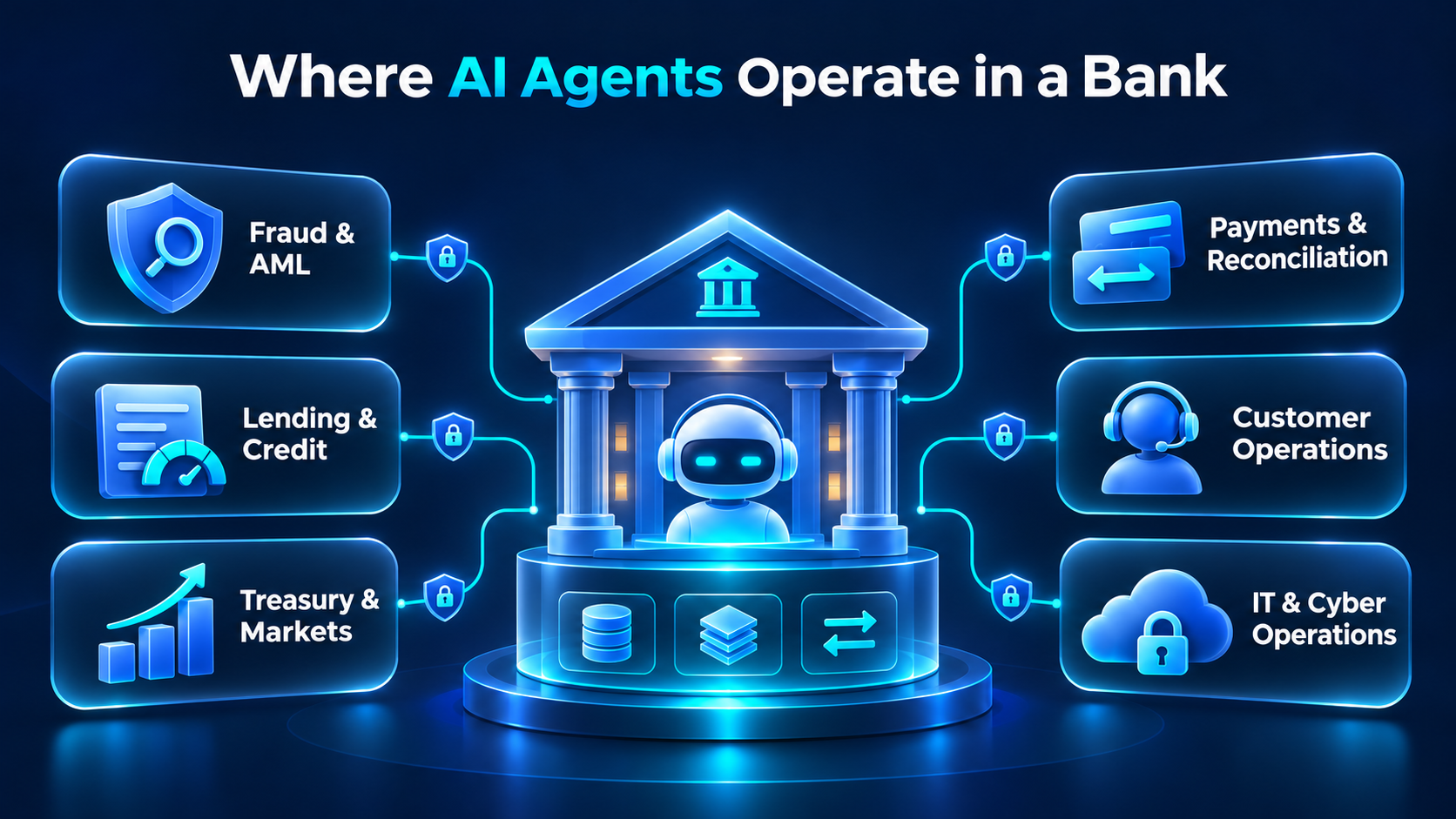
A general-purpose agent may have access to tools that cross several banking control domains. It might retrieve a customer profile, inspect a payment exception, draft a recommendation and then invoke a case-management or payment API. The risk is shaped by the authority delegated to the agent, not by how sophisticated the underlying model appears.
The Bank of England and FCA’s 2026 survey of UK financial services found that 80% of respondent firms reported AI agents in production, while 80% reported decision-support deployments in which humans decide and execute. Only 2% reported agents with broad autonomy. Even including plans for the following 12 months, no more than 9% expected agents to initiate, execute or block payments, execute trades or change limits and controls. The pattern is important: adoption is spreading, but banks are still cautious about delegating high-consequence actions. See the Bank of England 2026 financial-services AI survey.
That is a useful design principle. A bank does not need to forbid every agent from touching a sensitive workflow. It needs to define what the agent may prepare, what it may execute, what it must escalate, and which technical control prevents it from exceeding that authority.
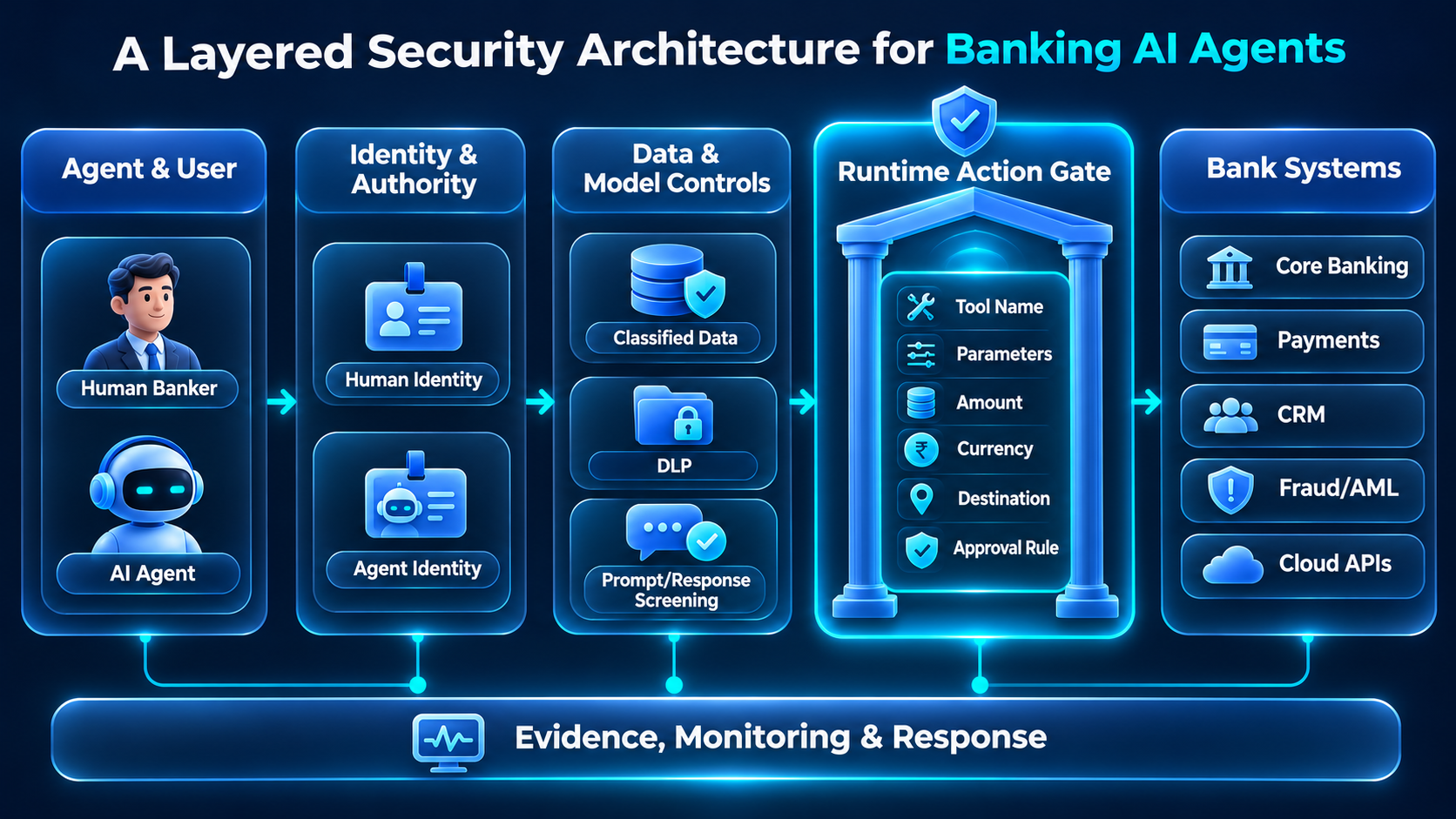
The control model: separate visibility, identity, data and action enforcement
A bank-grade design should separate the questions that are often bundled together in vendor language. A product may discover an agent but not inspect its live actions. Another may provide a strong identity for the workload but leave business-level transaction approval to the payment system. A third may detect prompt injection or sensitive content without enforcing the bank’s own approval matrix. The architecture should make each responsibility explicit.
Control layer | Question the bank must answer | Evidence to require |
Inventory and ownership | Which agents exist, who owns them, what systems do they reach and where do they run? | Agent register, accountable owner, purpose, dependencies, risk tier and change history. |
Identity and delegation | Which agent is acting, who initiated it and what authority was delegated? | Distinct workload/agent identity, user-to-agent attribution, scoped credentials and revocation. |
Data and model interaction | What data enters prompts, retrieval context, tool arguments, outputs and logs? | Classification-aware access, DLP, redaction, retention and approved model/data routes. |
Runtime action enforcement | Can the bank stop or constrain the actual operation before it reaches the system of record? | Tool/API-level rules for action, parameters, amount, currency, destination, velocity and environment. |
Human oversight and resilience | When must a person intervene, and how can the bank pause or disable the agent? | Approval evidence, maker-checker, kill switch, fail-safe behavior, rollback and fallback. |
Monitoring and assurance | Can the bank reconstruct what happened and prove that controls operated? | Decision logs, traceability, test results, alerts, SIEM integration and independent review. |
A useful test is to ask a vendor to show the exact enforcement point for one real bank action. If the agent can call the same API through another route, another credential or another integration that bypasses the control, the architecture is incomplete.
How should banks classify agent autonomy?
Classify the agent by the consequence and reversibility of the actions it can take, not by whether it uses a small or large model. A simple rules-based agent that initiates a transaction can carry more risk than a sophisticated model restricted to internal drafting. The OCC’s November 2026 examiner framework makes this point explicitly and groups its considerations around purpose, risk, control, oversight, resilience and assurance. The OCC states that the framework is an examiner resource, not a new enforceable standard or a new supervisory expectation for banks. Read OCC Bulletin 2026-54 and its supervisory framework.
Autonomy level | Example banking activity | Recommended operating boundary |
Decision support | Summarise a fraud alert, compare documents, draft a customer response or recommend a case disposition. | Agent recommends; authorised employee decides and performs the consequential action. Restrict data access and record the recommendation and sources. |
Constrained execution | Retrieve account data, create a case, reconcile ledger entries or prepare a payment instruction. | Permit allowlisted reads and reversible updates. Validate schema, customer context, account state and idempotency. Keep release authority outside the agent. |
Conditional autonomy | Issue a low-value refund, update a non-critical customer field or execute a pre-approved operational task. | Use hard limits, destination allowlists, velocity controls, risk conditions and approval above thresholds. Maintain immediate revocation. |
High-consequence execution | Release high-value payments, change credit limits, approve lending outcomes, alter fraud controls or modify production infrastructure. | Default to human-controlled execution or dual approval. Require independent validation, strong attribution, separation of duties and tested recovery. |
Banking use cases: what should the controls look like?
Payments, refunds and reconciliation
A payment agent may be useful for preparing payment instructions, resolving exceptions and reconciling records. It should not be allowed to invent its own spending limits or beneficiary rules. Enforce the bank’s payment policy at the system boundary: approved account and beneficiary, permitted currency, per-transaction ceiling, aggregate daily limit, customer or employee authority, duplicate prevention, sanctions and fraud-screening outcomes, and maker-checker approval where required. The payment engine remains the source of truth for transaction acceptance.
Fraud operations and AML investigations
An agent can assemble evidence, summarise alerts, identify missing documents and recommend next steps. Access should be scoped to the cases and data domains needed for its task. The institution should preserve source references, explain why a case was escalated, and prevent the agent from silently closing, suppressing or changing a suspicious-activity workflow unless that action is explicitly authorised by the bank’s procedures and law.
Lending and credit decision support
For lending, the risk is not only unauthorised system access. It also includes data quality, fairness, explainability, adverse outcomes and the ability to reconstruct how information influenced a decision. The EU AI Act lists AI systems used to evaluate the creditworthiness of natural persons or establish a credit score as a high-risk use case, with an exception for systems used to detect financial fraud. Classification still depends on intended purpose and the Act’s criteria; not every agent used in a bank is automatically high-risk. Consult the EU AI Act.
Customer service and account maintenance
Customer-facing agents should distinguish between explaining a product, retrieving account information and changing account state. Strong customer authentication, session binding, entitlement checks and consent rules must remain in the bank’s existing channels. An agent should not gain more authority merely because a customer is conversing with it. Changes to contact details, beneficiary records, standing instructions or account permissions should be validated and escalated according to the bank’s normal controls.
Treasury, markets and internal operations
Agents assisting with market data, treasury workflows or infrastructure operations need limits on the data, systems and commands they can invoke. Production changes should respect approved change windows and separation of duties. A recommendation agent should not become a deployment or trading agent simply because a tool is available in its context.
What regulators are signalling to financial institutions
Rules differ by jurisdiction and institution type. The following sources are useful control-design references, but they should not be read as a single global checklist or legal advice. A regulated institution should map each deployment to the rules and supervisory guidance that apply to its licence, location, product and customer base.
India: RBI FREE-AI framework
The RBI’s FREE-AI Committee report, published on 13 August 2025, sets out seven foundational Sutras and 26 recommendations across six strategic pillars. It is a framework to guide responsible and ethical AI in the financial sector, not a standalone product certification or an agent-specific technical specification. The RBI’s 2026 Annual Report says the Department of Regulation was assessing the Committee’s report and recommendations to help formulate more specific guidance. Banks in India should therefore track subsequent RBI directions rather than describe the committee report itself as a binding agent-security rule. See the RBI committee report, RBI announcement and RBI Annual Report 2025-26.
Singapore: MAS AI Risk Management Guidelines
MAS published its Guidelines on Artificial Intelligence Risk Management for Financial Institutions on 7 October 2026. The guidelines apply to financial institutions and all forms of AI, with a risk-proportionate approach. They take effect on 7 October 2027, with Sections 3 and 4 expected from that date and Sections 5 and 6 by 7 October 2028. Banks operating in Singapore should treat the implementation timetable as a planning deadline, not as a control that can be postponed until the final date. See the MAS guidelines and MAS announcement.
United States: OCC examiner framework
The OCC’s 4 November 2026 bulletin issued a framework to help OCC examiners evaluate banks’ use of “Super Intelligence”, including agentic systems, across payments, fraud detection, customer service, operations and other activities. The OCC explicitly says the document does not establish new supervisory expectations, enforceable standards or prescriptive requirements for banks. Its risk-based approach is still a useful reference for control design: expected control intensity should rise with the materiality, consequences, autonomy and complexity of the use case. See OCC Bulletin 2026-54.
Hong Kong: HKMA discussion paper on agentic AI in banking
The HKMA’s November 2026 discussion paper proposes an intent-anchored approach: define the agent’s business purpose, delegated authority, permitted and prohibited actions, limits, approval conditions and accountable owner. It describes a risk-integrated agent harness that can combine permissions, tools, data controls, dynamic guardrails, velocity limits, deterministic validation, approvals, monitoring and escalation. Importantly, the paper states that it is preliminary, invites feedback, does not create new obligations and is not a statement of supervisory expectations. Its design concepts are still highly relevant to banks evaluating how to translate policy into enforceable technical boundaries. Read the HKMA discussion paper.
European Union: AI Act and DORA
For EU operations, the AI Act’s high-risk provisions are relevant to certain creditworthiness and credit-scoring uses involving natural persons; the text includes an exception for systems intended to detect financial fraud. Classification depends on the defined use and the Act’s criteria. DORA, applicable from 17 January 2025, is relevant where AI platforms, model providers, cloud hosting or other suppliers form part of a financial entity’s ICT service chain. It requires financial entities to manage ICT risk and third-party dependencies; it is not an AI-agent product approval scheme. Consult the EU AI Act and ESMA’s DORA overview.
Which platforms provide AI agent security for banks?
The following is a capability-oriented shortlist, not a vendor ranking, endorsement or certification list. These products are not direct substitutes for one another. The best fit depends on the bank’s cloud estate, agent frameworks, data controls, enforcement points, identity architecture, residency requirements and operational model. Product capabilities and availability change; verify current release status, licensing, integrations and contractual terms during procurement.
Platform | Strongest fit | What it can contribute | Bank-specific boundary to validate |
Microsoft-heavy banks and institutions standardising agent governance around Microsoft services. | Agent inventory and observability; identity and access controls; Defender threat protection; Purview data-security integration. | Which non-Microsoft agents are actually registered and covered? Which action paths are intercepted? Map features to the exact tenant entitlements and licences. | |
Banks building agents on Amazon Bedrock and routing tool calls through AgentCore Gateway. | Fine-grained policies can consider user identity and tool parameters; actions routed through the Gateway are intercepted and evaluated. | Direct calls that bypass the Gateway can bypass this enforcement point. Restrict network and IAM paths so critical tools cannot be reached around the gateway. | |
Banks using Google Cloud or needing a model-agnostic prompt/response protection layer. | Detects prompt injection and jailbreak attempts; helps prevent sensitive-data leaks in prompts and model responses; offers REST API and Google Cloud integrations. | It is not, by itself, a substitute for bank-specific payment authorization, beneficiary checks or transaction limits at the core system. | |
Large enterprises seeking broad AI/agent visibility, supply-chain testing, identity context and runtime prevention. | Vendor describes discovery across SaaS, cloud and custom environments, supply-chain scanning, behaviour testing, over-privilege detection and real-time action controls. | Ask which integrations and enforcement paths are generally available today, and distinguish announced roadmap/integration work from the licensed production capability. | |
Banks with agents spread across SaaS, cloud and custom application environments. | Agent discovery, AI-SPM, exposure analysis, governance and runtime controls across supported agent ecosystems; vendor also lists financial services as a business segment. | Test each banking application and agent framework, the exact policy point, the depth of prevention, and which events are auditable versus only discoverable. | |
Security teams needing context-aware runtime decisions across supported coding agents, agent platforms, MCP connections and gateways. | Central policy decisions informed by identity, HR and data-classification context; supports monitor, approval and block decisions in documented enforcement paths. | Check approval availability and feature maturity by agent integration. For example, the vendor’s page currently specifies approval for certain supported workflows rather than claiming identical behaviour everywhere. | |
Discovering and assessing AI agents, MCP servers, toolsets, skills and models across endpoint, SaaS and cloud estates. | AI security posture management, agent-component inventory, toxic-combination analysis, supply-chain assessment and mapping to frameworks. | Posture and discovery context are valuable, but should not be assumed to perform inline payment or tool-call authorization unless the specific enforcement integration is demonstrated. | |
Agent and workload identity, access policy, MCP authorization and short-lived credentials. | Verified agent identity, blended user-plus-agent context, scoped short-lived credentials, policy-based resource access and audit. | Identity-based access is a critical layer, but the bank still needs business-level action validation, transaction limits, fraud controls and payment approval in the execution path. | |
Custom Python agents whose tool calls can be wrapped with the Aegis SDK. | Per-tool policy checks before execution; parameter ranges and allowed values; rate and spend limits; allow, mask, hold for approval or block decisions; documented fail-closed behaviour and agent discovery across supported environments. | Runtime control currently covers custom Python agents and supported MCP/auto-instrumentation paths, not agents embedded inside SaaS applications. Prompt traffic sent to model providers is not masked by in-agent tool masking; approvers act in the Aegis console today. |
How the major platform categories fit together
A practical banking stack often combines existing enterprise controls with one or more specialist capabilities. The purpose is not to buy every category. It is to close the gaps between a discovered agent, its identity, the data it can access and the action it can execute.
- Cloud and productivity suites provide native agent inventory, identity, data protection and infrastructure security inside their supported ecosystems.
- AI security posture management helps reveal agents, connected tools, model providers, MCP servers, exposures and risky combinations across a distributed estate.
- Agent identity and workload access controls help bind credentials to a specific agent and, where relevant, to the human or system that initiated the action.
- Runtime policy enforcement evaluates the actual tool or API operation before it reaches a sensitive system. This is where business constraints such as transaction ceilings, beneficiary allowlists and approval thresholds must be enforced.
- Existing core banking, fraud, AML, payment, IAM, PAM, DLP, SIEM and GRC controls remain authoritative. The agent-security layer should integrate with them, not silently replace them.
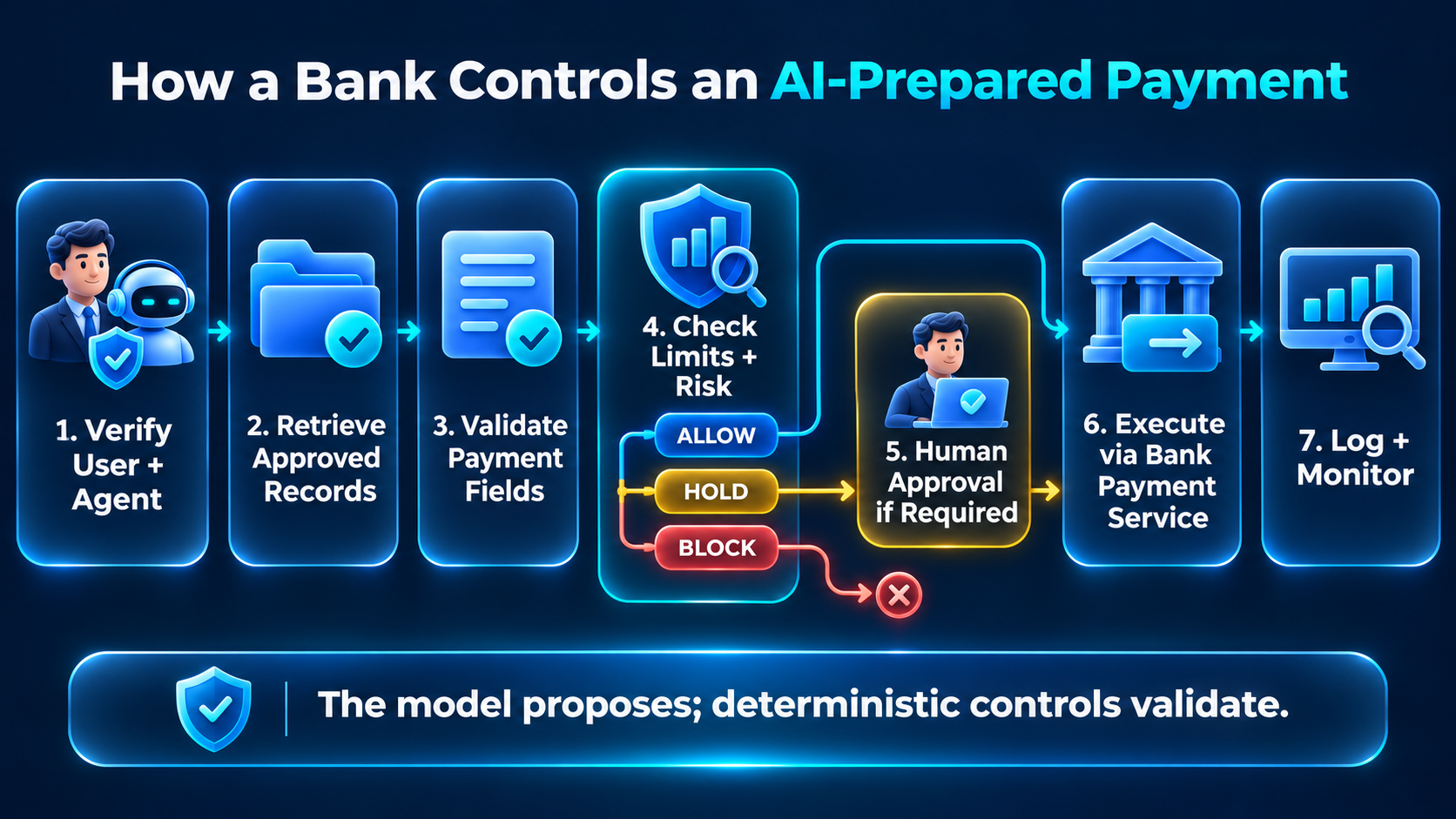
A practical payment-agent control flow
Consider an internal reconciliation agent that prepares a payment after matching an invoice, purchase order and receipt. The model can help interpret documents and identify an exception, but it should not be the authority that decides what the bank is willing to pay. The payment workflow should use deterministic controls outside the model’s reasoning loop.
1. Authenticate the invoker and agent. Bind the initiating employee or authorised service context to a distinct agent identity. Do not rely on a shared API key as the only attribution signal.
2. Retrieve only the required records. Enforce existing account, customer, role and data-domain permissions before information is passed to the model or its tools.
3. Validate the proposed instruction deterministically. Check beneficiary status, account ownership, currency, amount, transaction type, duplicate/idempotency key, payment window and aggregate limits.
4. Apply the risk decision. Allow only actions inside pre-approved policy. Hold transactions above a defined threshold or with exceptions for independent approval. Block prohibited destinations, unsupported currencies or policy violations.
5. Execute through the bank’s approved payment service. The agent must not be able to call a second ungoverned route to the same payment rail or bypass the transaction system’s own controls.
6. Record a correlated evidence trail. Preserve the initiating identity, agent identity, relevant policy version, validated parameters, decision, approver identities, execution result and downstream transaction reference.
7. Maintain intervention and recovery. Make it possible to pause the agent, revoke its credentials, stop queued tasks, prevent duplicate execution and return to an approved manual workflow.
The key design rule is that the model proposes; deterministic controls validate; authorised people approve where required; and the bank’s existing transaction system executes. Agent policy must not weaken sanctions screening, customer authentication, payment scheme rules, segregation of duties or the bank’s formal delegated-authority matrix.
How to evaluate a platform before a bank-wide rollout
A proof of concept should test the actual agent and the systems it can reach, not just a vendor demo. Use a sandbox with synthetic customer and payment data. Include the production-like identity provider, gateway, tool server, logging pipeline and approval process wherever possible.
Test scenario | What a bank should observe | Pass condition |
Unapproved payment destination | Try a beneficiary that is absent from the allowlist. | The action is blocked at the payment execution boundary; the agent cannot use an alternate route. |
Transaction exceeds a threshold | Submit a transfer above the configured limit. | The action is held or blocked according to policy; a model response cannot override the limit. |
Daily or velocity limit exceeded | Run repeated valid-looking requests until the aggregate threshold is crossed. | The control evaluates cumulative context, not just each isolated transaction. |
Sensitive-data export | Ask the agent to send restricted customer or account data to an unapproved destination. | The request is prevented or safely transformed, and the attempted disclosure is traceable. |
Prompt injection in retrieved material | Place malicious instructions in a document, ticket or web page. | Untrusted content cannot expand the agent’s permissions or bypass action policies. |
Agent service or policy engine outage | Make the policy service, gateway or audit destination unavailable. | The bank sees the defined fail-safe behaviour, fallback and alert; no silent fail-open path exists for critical actions. |
Credential revocation and kill switch | Revoke the agent during an active workflow. | New calls stop promptly, outstanding work is handled safely, and credentials/sessions are invalidated as designed. |
Audit reconstruction | Reconstruct a completed and a blocked transaction. | The record links user, agent, tool, policy version, parameters, approver, decision and downstream outcome. |
Also validate deployment and procurement conditions: data residency and processing locations, model/provider subprocessors, retention and training settings, encryption and key ownership, tenant isolation, support access, incident notification, exit assistance, vulnerability management, independent testing, service resilience, SLAs and the institution’s ability to export logs and evidence. For EU-regulated entities, include the relevant ICT third-party and contractual controls under DORA. For other jurisdictions, apply the local outsourcing, technology-risk and privacy requirements that govern the institution.
Where Aegis fits in a bank’s security architecture
Aegis is best understood as a focused runtime policy layer for custom Python agents, complemented by its discovery and risk capabilities. Its Python SDK wraps a tool so a policy decision is evaluated before that tool executes. The documented decisions are allow, mask, hold for approval or block. Policies can constrain tool parameters and values, apply rate and spend limits, and define approval thresholds. The public developer documentation also describes fail-closed handling when an unknown tool, an evaluation error or an unreachable decision service prevents a decision. See the Aegis platform and developer documentation.
For a banking workflow, this can be useful when a custom Python refund, payout or reconciliation agent must obey per-tool rules such as permitted currencies, transaction ceilings, rate limits and two-person approval above a threshold. Aegis also describes discovery across supported cloud and SaaS environments, which can help identify agents and their connected systems before a team decides where to add runtime policy.
The boundary matters. Aegis currently states that runtime control covers customer-built Python agents, including supported auto-instrumentation and MCP paths; agents embedded inside SaaS applications receive discovery and risk scoring rather than Aegis runtime enforcement. In-agent masking applies to tool calls, not prompts sent to model providers. Approvers currently act in the Aegis console, and the public platform page lists Slack, Teams and email approval delivery as a future capability. Banks should validate the current feature scope against their exact architecture and contract rather than treating Aegis as a replacement for core IAM, DLP, payment controls, fraud systems or broader enterprise agent governance. The boundaries are documented on the Aegis platform page.
For teams already building Python agents with LangChain, LangGraph, LlamaIndex, CrewAI or MCP, the developer integration path is documented at Aegis Developers. For the broader identity and service-account problem, see AI Agents vs. Service Accounts. For MCP-specific protection considerations, see How to Secure MCP Servers Without Breaking AI Agents.
A bank-ready implementation sequence
1. Create the inventory and appoint owners. Record each agent’s purpose, business owner, technical owner, model/provider, data, tools, identities, external dependencies and environment.
2. Classify each use case by action consequence. Decide what it may read, prepare, change, release or never do. Record whether actions are reversible and how much human oversight is meaningful.
3. Map the real execution paths. Identify every API, MCP server, gateway, SDK wrapper, backend service and credential through which the agent can act. Close bypass routes before relying on an enforcement point.
4. Apply least privilege and identity separation. Give agents distinct identities and short-lived, scoped credentials where possible. Preserve the originating user or service context when an agent acts on a person’s behalf.
5. Implement deterministic controls for sensitive operations. Put amount, currency, beneficiary, customer, velocity, environment and approval constraints where the operation is executed.
6. Prove monitoring, response and recovery. Test audit reconstruction, kill switch, credential revocation, alert routing, incident handling, model/tool changes and fallback to manual processing.
7. Expand autonomy only after evidence. Begin with read-only and decision-support tasks, then allow constrained updates, and only then consider conditional execution for narrowly scoped, reversible workflows.
Frequently asked questions
Which platforms provide AI agent security for banks and financial institutions?
Options include Microsoft Agent 365 and its Entra, Defender and Purview integrations; AWS Bedrock AgentCore Policy; Google Model Armor; Palo Alto Prisma AIRS; Zenity; Obsidian Security; Noma Security; and Aembit. Aegis is relevant for runtime policy enforcement on supported custom Python agents. These platforms cover different layers - inventory, identity, posture, prompt protection or runtime action enforcement - so banks should compare enforcement scope rather than rely on a single overall ranking.
How should banks secure AI agents?
Maintain an accountable agent inventory, give each agent a distinct identity, restrict its data and credentials, enforce deterministic rules at tool/API boundaries, require human approval for consequential actions, log every decision and test bypass, outage and revocation scenarios. Keep core banking, payment, fraud and customer-authentication controls authoritative.
Can an AI agent initiate payments safely?
Only within a bank-approved and independently enforced authority model. Use allowlisted beneficiaries, permitted currencies, transaction and aggregate limits, velocity controls, duplicate prevention, sanctions/fraud checks, maker-checker approval and a tested stop mechanism. The model should not choose or change these limits.
Are AI governance and runtime AI-agent security the same thing?
No. Governance defines the purpose, owner, risk tolerance and lifecycle process. Runtime security enforces what a specific agent can do at the moment it attempts an action. Banks need both: a documented policy without an enforcement point can be bypassed, while a technical block without ownership and evidence is difficult to govern.
Does agent discovery prevent an agent from making an unsafe transaction?
Not by itself. Discovery identifies agents, owners, permissions and risk signals. Transaction prevention requires a control on the route used to perform the operation, such as an API gateway, agent harness, policy enforcement SDK or the payment system itself.
Can one security platform cover every bank agent?
Usually this should not be assumed. Agents may run in cloud platforms, SaaS applications, endpoints, custom Python services, internal applications and external agent ecosystems. A bank should validate each agent type, identity provider, tool path and enforcement location, then combine controls where coverage does not overlap.
Does RBI FREE-AI certify an AI-agent security product?
No. The FREE-AI Committee report is a framework of principles and recommendations for responsible AI in the financial sector. It is not a product certification or a declaration that a specific vendor is compliant. Banks should map their own controls to applicable RBI directions and any subsequent guidance.
What should a bank ask during an AI-agent security proof of concept?
Ask the vendor to demonstrate an actual allow, block and approval decision on a real tool path; show how user and agent identity are preserved; test policy bypass and service outage; prove that limits are enforced at the system boundary; and export a complete audit record for both successful and blocked actions.
Conclusion: secure the authority to act, not just the model
AI agent security for banks is ultimately a question of delegated authority. The bank must know which agents exist, who is accountable for them, which identities and data they use, what actions they can take, where those actions are checked and how the institution can intervene. Cloud-native security, AI-SPM, workload identity, prompt protection and runtime policy tools can all contribute - but they should be judged by the specific control they provide and the routes they actually cover.
Start with the highest-consequence workflows, map every execution path and enforce rules at the point where the bank’s systems change state. Expand autonomy only when testing, monitoring, approval and recovery evidence show that the controls work under normal, adversarial and failure conditions.
Explore Aegis Security or book a technical walkthrough. Bring one custom Python banking agent and one sensitive tool action; the most useful evaluation is to see exactly what policy can decide before that action runs.