AI Agent Policy Enforcement: Real-Time Action Control
Master AI agent policy enforcement with real-time allow, deny, and human-in-the-loop approval controls using Envoy, OPA, and Zero Trust architecture.
How to Allow, Deny, or Approve AI Agent Actions in Real Time: An Enterprise Architecture Guide to AI Agent Policy Enforcement
Enterprise AI adoption has crossed a decisive architectural threshold. Organizations are no longer merely deploying stateless chat interfaces that summarize documents or draft emails; they are embedding autonomous, tool-calling AI agents directly into production ERP systems, cloud data warehouses, CI/CD pipelines, payment gateways, and customer relationship management (CRM) platforms.
Yet most enterprise security architectures remain anchored in the previous era of generative AI. Security teams invest heavily in prompt-level guardrails, model alignment, and input/output content filters while leaving the actual execution layer wide open. The primary enterprise risk in autonomous AI is not model hallucination—it is uncontrolled, identity-blind action execution across trusted APIs, databases, and enterprise applications.
When an agent holds a static, high-privilege API key or inherits an unsegmented service account, a single indirect prompt injection, ambiguous reasoning step, or miscalibrated tool parameter can trigger irreversible production changes in milliseconds. Written acceptable-use policies and system prompt instructions ("never delete production tables" or "do not issue refunds above $500") are probabilistic suggestions, not security boundaries.
Effective AI agent policy enforcement requires moving security out of the model's reasoning loop and into a deterministic, runtime control plane. By intercepting every tool invocation at the network and API boundary, evaluating it against externalized policy-as-code, binding every call to verified user and agent identities, and routing high-blast-radius operations through real-time human-in-the-loop (HITL) approval workflows, enterprises can safely scale autonomous systems. Control enables scale—not the opposite.
Autonomous System Architecture & Challenges
To enforce policies on autonomous agents in real time, platform engineering and security teams must first deconstruct how modern agentic systems actually execute work. Unlike traditional microservices—where code paths are deterministic, statically compiled, and mapped to predictable API contracts—agentic systems generate execution graphs dynamically at runtime based on natural-language inputs and environmental observations.
Agents, Tools, and Orchestrators
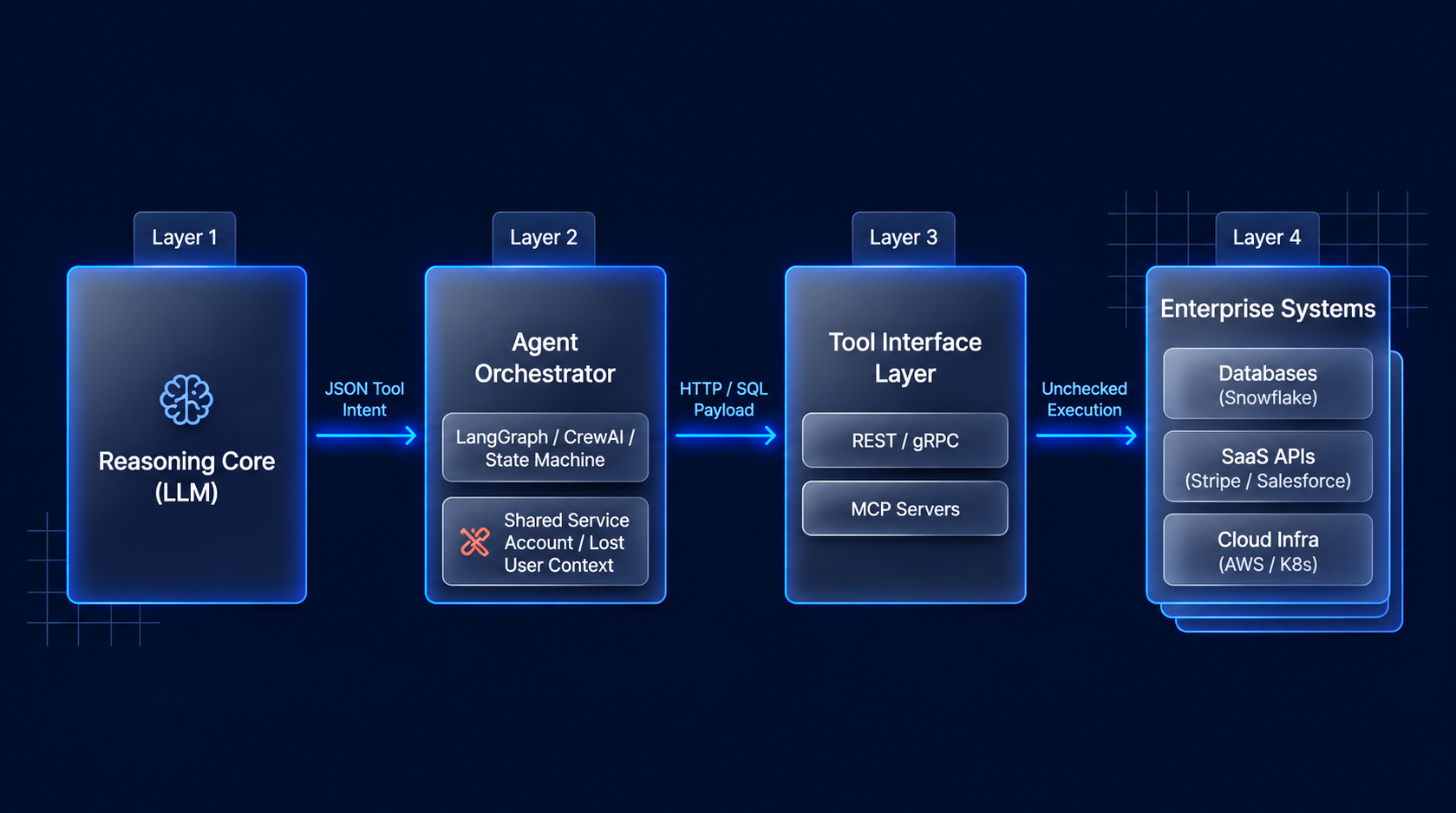
A production agentic stack typically consists of four interacting layers:
- The Reasoning Core (LLM): Receives context (system prompt, user prompt, memory, retrieved documents, and tool schemas) and outputs structured tool-call intents (e.g., JSON payloads specifying a function name and arguments).
- The Orchestrator / Agent Runtime: Frameworks such as LangGraph, CrewAI, AutoGen, or custom enterprise state machines that manage the ReAct (Reason + Act) loop, maintain conversation state, parse model outputs, and dispatch tool invocations.
- The Tool Interface Layer: Connectors, REST/gRPC wrappers, database drivers, or Model Context Protocol (MCP) servers that translate structured tool calls into concrete network requests against internal and external systems.
- Target Enterprise Systems: Downstream databases (Snowflake, PostgreSQL), SaaS applications (Salesforce, Stripe, Jira, Workday), and infrastructure APIs (AWS, Kubernetes) where state changes actually occur.
Multi-Agent Workflows and Chaining
Enterprise automation rarely relies on a single monolithic agent. Instead, organizations deploy multi-agent topologies—hierarchical supervisor-worker graphs, peer-to-peer handoffs, or event-driven swarms over message brokers like Kafka. A finance supervisor agent may delegate invoice retrieval to a Document Extraction Agent, pass structured line items to a Reconciliation Agent, and hand off approved payouts to a Treasury Execution Agent.
Each hop in a multi-agent chain introduces a privilege boundary. Without strict delegation controls, downstream sub-agents frequently inherit the union of all upstream permissions, creating an implicit privilege escalation vector. If a low-trust Research Agent reading untrusted external web pages can trigger a high-trust Operations Agent with production write access, the entire workflow inherits the vulnerability surface of its weakest input channel.
Tool Invocation Mechanics Across APIs, Databases, and SaaS
When an agent invokes a tool—whether through native function calling or an MCP server—the orchestrator serializes the model-generated parameters into an HTTP request, gRPC call, or SQL query. From the perspective of the downstream target system (such as a Stripe API endpoint or a Snowflake warehouse), that request looks indistinguishable from a legitimate application call.
Because the target system only validates whether the caller possesses a valid credential and whether the payload conforms to the API schema, it has zero visibility into why the call is happening, which human user initiated the upstream workflow, or whether the arguments were influenced by untrusted data retrieved three steps earlier.
Identity Propagation and Token Issuance (JWT/JWKS)
In traditional enterprise architectures, user identity propagates cleanly through OAuth 2.0 and OpenID Connect (OIDC) flows. An edge gateway validates a user's JSON Web Token (JWT) against the identity provider's JSON Web Key Set (JWKS) endpoint and forwards scoped claims to backend services.
In most early-stage agentic deployments, this identity chain breaks completely at the orchestrator boundary:
- Shared Service Accounts: The orchestrator authenticates to downstream tools using a single static API key or broad OAuth client credential. Every user's agent runs with identical administrative privileges.
- Lost Delegation Context: Even when user tokens are passed into the orchestrator, they are rarely exchanged for narrowly scoped, task-bound tokens. Downstream APIs cannot distinguish between "Alice directly deleting a customer record" and "an autonomous agent acting on Alice's behalf attempting to delete a customer record after reading an external support ticket."
- Long-Lived Credentials: Static bearer tokens stored in environment variables or secrets managers do not expire when a specific agent task completes, violating least-privilege principles and complicating post-incident revocation.
Runtime Execution vs. Orchestration Logic
A fundamental architectural flaw in modern agent deployments is the conflation of orchestration logic (how an agent decides what to do next) with runtime enforcement (whether an action is permitted to execute). Developers frequently embed if/else authorization checks inside Python orchestrator callbacks or instruct the LLM via system prompts to "verify the user's role before calling issue_refund."
This coupling fails for two reasons. First, orchestration logic is mutable, distributed across dozens of repositories and frameworks, and subject to rapid iteration by product teams—not security engineers. Second, placing security checks inside the same process space as the untrusted reasoning loop violates basic defense-in-depth principles.
Lack of Centralized Enforcement
As enterprises scale from five pilot agents to five hundred production agents across business units, decentralized controls collapse into ungovernable sprawl. Each team implements ad-hoc logging, inconsistent approval Slack bots, and divergent permission checks. Security teams lose the ability to answer basic governance questions: Which agents can write to production finance tables? Who approved yesterday's schema migration? What is the organization's real-time exposure if a critical MCP server is compromised?
Key Architectural Insight: Most enterprises control models—but not execution paths. Securing the prompt while leaving the tool execution layer unguarded is equivalent to installing a biometric lock on a bank's brochure rack while leaving the vault door propped open.
Autonomous System Risks (Core Section)
The OWASP Top 10 for LLM Applications (LLM06:2025) formally identifies Excessive Agency as one of the most critical vulnerabilities in production AI systems—defined as the risk that an LLM-based system performs damaging actions in response to unexpected, ambiguous, or manipulated output. According to Gartner's research on agentic AI adoption, over 40% of agentic AI projects are projected to be canceled by the end of 2027 due to escalating costs, unclear business value, or inadequate risk controls.
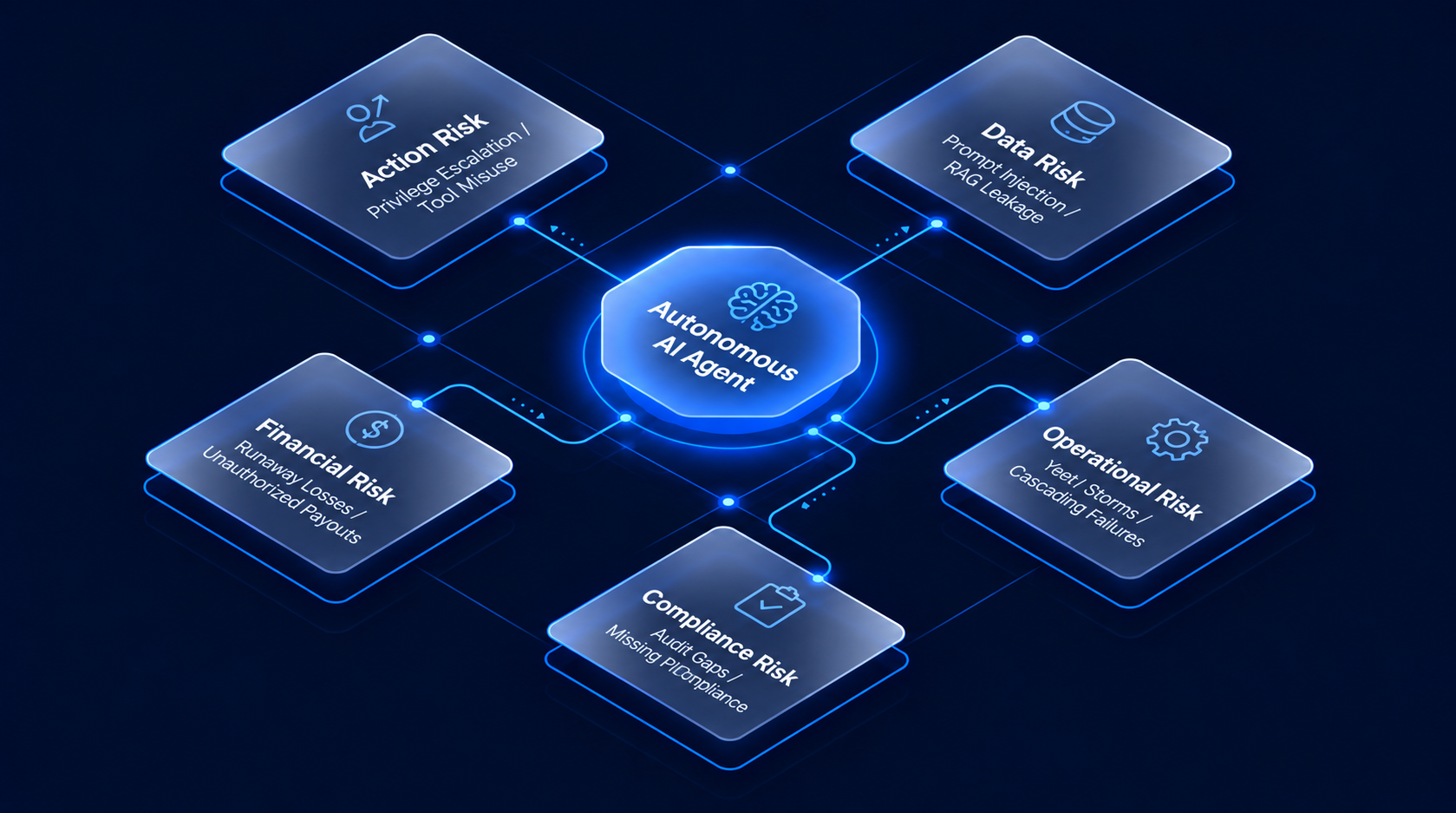
To design effective AI agent policy enforcement, security architects must categorize agentic risks by their technical failure modes across five distinct domains.
Action Risk: Unauthorized Execution, Tool Misuse, and Privilege Escalation
Action risk occurs when an agent executes a state-changing operation that violates business policy, exceeds the initiating user's authority, or repurposes a legitimate tool for an unintended effect.
- Unauthorized API Execution: An agent granted broad REST access to a billing service invokes DELETE /v1/subscriptions/{id} instead of GET /v1/subscriptions/{id} due to parameter confusion or prompt manipulation.
- Tool Misuse: General-purpose tools—such as a bash shell executor, raw SQL runner, or unrestricted HTTP client—allow an agent to bypass narrow business workflows. Even a syntactically valid SQL query can drop a production column that forty downstream analytics models depend on.
- Privilege Escalation (Confused Deputy): A low-privilege user interacts with a customer-facing or internal support agent whose backend service account holds elevated privileges. By crafting inputs that steer the agent's reasoning, the user coerces the agent into executing administrative operations the user could never perform directly.
Data Risk: Sensitive Data Leakage, RAG Exposure, and Cross-Tenant Access
Agents routinely aggregate data from disparate repositories—vector databases, data warehouses, email threads, and ticketing systems—to synthesize answers or populate tool arguments.
- RAG Access Control Bypass: Retrieval-Augmented Generation (RAG) pipelines frequently index documents without preserving granular document-level Access Control Lists (ACLs). An agent querying a shared vector index may retrieve confidential executive compensation or M&A documents and inject them into a response for an unauthorized employee.
- Cross-Tenant Data Exposure: In multi-tenant SaaS environments, an agent missing strict tenant-ID scoping in its tool parameters or database queries can leak Customer A's records into Customer B's context window or outbound webhook payload.
- Indirect Prompt Injection Exfiltration: When an agent ingests untrusted external content (such as a customer email, webpage, or PDF attachment) containing hidden instructions, it can be tricked into reading sensitive internal data via one tool and exfiltrating it via another—for example, by embedding secrets in an outbound URL query string or sending an email to an external recipient.
Financial Risk: Runaway Compute, Uncontrolled Transactions, and API Abuse
Autonomous agents operate at machine speed without natural fatigue or intuitive cost awareness.
- Runaway Token and Compute Costs: Long-running agent loops that repeatedly re-inject large context windows, spawn recursive sub-agents, or retry failing reasoning chains can burn thousands of dollars in LLM inference and cloud warehouse compute credits in hours.
- Uncontrolled Financial Transactions: Agents integrated with Stripe, ERP procurement modules, or banking APIs can issue duplicate refunds, approve fraudulent vendor invoices, or alter payment routing details if transaction amounts, velocity limits, and destination accounts are not enforced deterministically outside the model.
- Third-Party API Abuse: Unthrottled tool execution can exhaust rate limits on metered third-party APIs (e.g., enrichment providers, SMS gateways, cloud provisioning APIs), causing both financial overages and service degradation for core business applications.
Operational Risk: Cascading Failures, Infinite Retry Loops, and System Instability
When agents interact with production infrastructure and data pipelines, localized errors propagate rapidly.
- Infinite Retry Loops: An agent encountering a transient HTTP 500 or schema validation error may enter an unbounded self-correction loop, hammering downstream microservices with thousands of malformed requests and triggering self-inflicted Denial-of-Service (DoS) conditions.
- Cascading Downstream Breakage: Altering a shared dimension table, modifying a Kubernetes ConfigMap, or revoking an IAM role in response to a misdiagnosed incident alert can cascade across dozens of dependent production services.
- State Drift: Multi-step workflows that partially succeed before failing leave enterprise systems in inconsistent states—such as charging a customer's card while failing to provision the corresponding license—without transactional rollback handles.
Compliance Risk: Audit Trail Gaps, Missing Telemetry, and Regulatory Exposure
Regulatory frameworks—including SOC 2, ISO 27001, HIPAA, GDPR, PCI-DSS, the EU AI Act, and India's Digital Personal Data Protection (DPDP) Act—require verifiable accountability for automated decisions and data access.
- Incomplete Audit Trails: Logging raw chat transcripts or basic tool invocation names ("updated schema") is insufficient for forensic investigations or compliance audits. Auditors require cryptographic proof of who initiated the request, which policy version authorized it, what exact payload executed, and who approved any high-risk override.
- Separation of Duties Violations: Allowing the same individual (or an agent acting solely on their prompt) to both request and approve a sensitive production change or PII access grant violates foundational change-management controls.
Table 2: Enterprise Risk Matrix — Agentic Risk Category vs. Technical Impact vs. Runtime Mitigation Strategy
Agentic Risk Category | Specific Failure Mode | Technical & Business Impact | Deterministic Runtime Mitigation Strategy |
Action Risk | Confused deputy privilege escalation; unauthorized DELETE/UPDATE tool calls; destructive schema drops | Irreversible data loss, unauthorized state mutations, broken downstream pipelines, compromised production integrity | Intercept calls at an Envoy-based Agent Gateway; enforce OAuth 2.0 Token Exchange (RFC 8693) to bind actions to user + agent identity; evaluate exact tool arguments via OPA policy-as-code before execution |
Data Risk | Indirect prompt injection exfiltration; RAG ACL bypass; cross-tenant data leakage via external webhooks or emails | Regulatory breach notifications (GDPR/HIPAA/DPDP), intellectual property theft, customer churn, legal liability | Enforce egress destination allowlists and payload DLP inspection at the runtime proxy; inject mandatory tenant_id and ACL filters into database/RAG queries at the enforcement point, never trusting model-supplied filters |
Financial Risk | Runaway multi-agent loops; unauthorized high-value refunds or payouts; metered third-party API exhaustion | Direct monetary loss, unexpected cloud/LLM billing spikes, API quota exhaustion blocking core business operations | Enforce per-session token/cost budgets, sliding-window rate limits, and monetary threshold rules in the policy engine; require real-time, single-action human approval for financial mutations exceeding defined tiers |
Operational Risk | Unbounded retry storms; unsanitized production config changes; partial multi-step execution without rollback | Self-inflicted DoS on internal microservices, cascading production outages, corrupted transactional state | Implement circuit breakers, max-hop/max-iteration caps, and deterministic blast-radius checks at the gateway; require dry-run diff previews and pre-registered rollback handles for Tier 2+ infrastructure mutations |
Compliance Risk | Unlogged autonomous actions; editable logs; missing approver provenance; violation of separation of duties | Failed SOC 2 / ISO 27001 / PCI-DSS audits, inability to perform incident root-cause analysis, regulatory fines | Emit structured OpenTelemetry spans with trace correlation across agent hops; write tamper-evident, append-only hash-chained audit logs recording request, evidence, policy version, approver identity, exact diff, and outcome |
Interoperability & Lock-In Risks
As enterprises rush to operationalize AI agents, many inadvertently lock their governance, identity, and integration layers into a single LLM vendor or agent framework. This architectural coupling creates severe long-term risk: when model capabilities shift or regulatory mandates tighten, enterprises cannot migrate workloads without rebuilding their entire security stack from scratch.
How Current Agentic Deployments Create Vendor Lock-In
- Proprietary Connectors and SDKs: Embedding tool definitions, authentication logic, and retry wrappers directly inside vendor-specific SDKs (e.g., proprietary Assistants APIs or closed SaaS agent builders) forces teams to rewrite integrations whenever they adopt a new foundational model or orchestration engine.
- Hardcoded Policy Logic in Orchestrators: Writing authorization rules as Python decorators inside LangGraph nodes or TypeScript middleware inside a specific agent framework ties security posture to application code. If one business unit uses CrewAI, another uses Claude Code via MCP, and a third uses custom Go microservices, security policies fragment immediately and drift out of sync.
- Non-Standard Token Formats: Custom session cookies, opaque vendor API keys, and proprietary context headers prevent enterprise identity providers (Okta, Entra ID, Ping Identity) from exercising centralized visibility and revocation over agentic workloads.
- Closed Telemetry Systems: Relying exclusively on vendor-hosted observability portals traps audit logs and execution traces in proprietary schemas, making it difficult to correlate agent actions with existing enterprise SIEM/SOAR platforms (Splunk, Datadog, Microsoft Sentinel) or retain tamper-evident compliance archives inside corporate infrastructure.
Architectural Solutions and Countermeasures
Avoiding lock-in requires treating the AI agent policy enforcement layer as an open, protocol-driven infrastructure plane—decoupled from both the upstream reasoning model and the downstream enterprise applications.
- Protocol Standardization (HTTP/gRPC, MCP, and JWT): Standardize all agent-to-tool communication over ubiquitous transport protocols (HTTP/1.1, HTTP/2, gRPC) and open tool-invocation standards like the Model Context Protocol (MCP). Enforce standard OAuth 2.0 / OIDC JWTs validated via JWKS endpoints so any compliant identity provider can issue and verify agent and user credentials.
- Adapter-Based Tool Architecture: Isolate downstream SaaS and database integrations behind lightweight, stateless protocol adapters (or standardized MCP servers). Orchestrators invoke a uniform interface through the runtime gateway rather than importing vendor-specific client libraries directly.
- Externalized Policy Bundles (OPA): Decouple authorization logic from application code entirely by authoring rules in Rego and distributing them as version-controlled Open Policy Agent (OPA) bundles. The exact same policy bundle enforces rules whether the request originates from an internal Python agent, a developer's IDE (Cursor, Windsurf, VS Code), or a third-party SaaS copilot.
- Vendor-Neutral Telemetry (OpenTelemetry): Instrument every gateway interception, policy decision, approval event, and tool execution using OpenTelemetry (OTel) traces, metrics, and logs. Neutral OTel pipelines stream directly to any enterprise SIEM, data lake, or observability backend without proprietary schema translation.
Runtime Control Architecture (Aegis-Aligned)
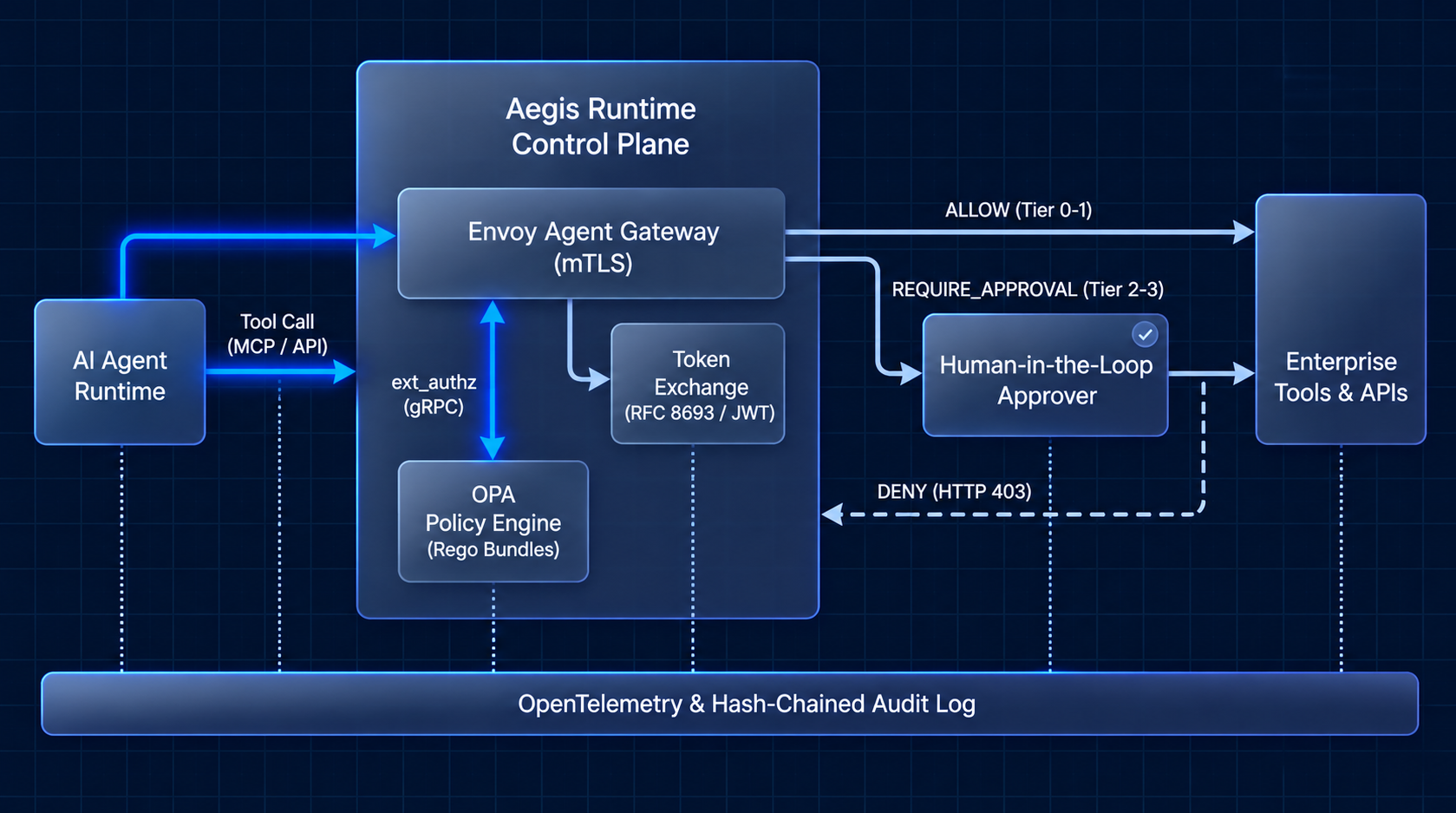
To allow, deny, or approve AI agent actions in real time without introducing unacceptable latency or vendor lock-in, enterprises must deploy a dedicated runtime control plane between agents and protected resources. The Aegis Agent Gateway Pattern applies proven cloud-native zero-trust infrastructure—specifically the Envoy proxy and external authorization architecture—to the unique dynamics of autonomous tool execution.
Core Architectural Components
1. Agent Gateway / Proxy (Envoy Pattern)
Every outbound tool invocation—whether an HTTP REST call, gRPC request, SQL-over-HTTP query, or MCP JSON-RPC payload—must traverse a hardened reverse/egress proxy built on the Envoy pattern. Network policies (Kubernetes NetworkPolicies, AWS Security Groups, or service mesh mTLS) ensure that agent runtimes have zero direct network path to downstream enterprise databases or SaaS APIs. The agent cannot bypass the enforcement point.
2. External Authorization (ext_authz)
When the gateway intercepts a tool call, it pauses execution and invokes an External Authorization (ext_authz) filter over low-latency gRPC. Unlike coarse-grained API gateways that only inspect URL paths and HTTP verbs, an agent-aware ext_authz service parses the full structured payload—including the MCP method name, target resource identifier, SQL AST or JSON arguments, monetary values, and egress destinations—before issuing a deterministic verdict: ALLOW, DENY, or REQUIRE_APPROVAL.
3. Policy Engine (OPA Bundles)
The ext_authz service delegates rule evaluation to an embedded or co-located Open Policy Agent (OPA) engine. Policies are authored as declarative Rego policy-as-code, stored in Git, validated through CI/CD unit tests, cryptographically signed, and distributed dynamically as OPA bundles. Because OPA evaluates policies in-memory in single-digit milliseconds, real-time enforcement adds negligible overhead to agent workflows.
4. Identity & Token Exchange Service
Before a tool call reaches the downstream system, the gateway verifies the incoming identity context (validating JWT signatures against the enterprise JWKS endpoint) and performs OAuth 2.0 Token Exchange (RFC 8693). The gateway exchanges the broad incoming session credential for a short-lived, narrowly scoped downstream token that encodes both the initiating human principal (sub) and the acting autonomous agent (act). Downstream services receive only the exact permissions required for that single operation.
5. Real-Time Approval Orchestrator
When the policy engine returns a REQUIRE_APPROVAL decision, the gateway does not fail open. It holds the execution request in a suspended state (or returns an asynchronous pending challenge with a correlation token), computes a cryptographic hash of the exact proposed payload, and dispatches a structured approval card to the designated domain owner (via Slack, Microsoft Teams, IDE plugin, or mobile authenticator). Upon cryptographic sign-off, the gateway verifies that the payload hash has not mutated and releases the action for execution.
6. Observability & Tamper-Evident Audit Layer (OpenTelemetry)
Every stage of the pipeline emits OpenTelemetry spans carrying standardized semantic attributes (agent.id, user.sub, tool.name, policy.bundle_version, policy.decision, approval.id, blast_radius.tier). Simultaneously, decision records are committed to an append-only, hash-chained audit store for forensic integrity.
Step-by-Step Real-Time Execution Flow
The end-to-end runtime lifecycle operates deterministically across five stages:
- Agent Intent Generation (Agent): The LLM reasons over a task and emits a structured tool call—for example, stripe.create_refund(charge_id="ch_9821", amount_cents=250000, reason="duplicate").
- Network Interception (Gateway): The agent runtime routes the request to the Aegis Agent Gateway over mTLS. The gateway validates the agent's workload identity (SPIFFE/SVID or signed JWT) and extracts the delegated human user token.
- Real-Time Policy Evaluation (Policy Decision): The gateway invokes ext_authz, passing identity claims, tool metadata, parsed arguments, and environmental context (e.g., data sensitivity tags from the enterprise catalog, cumulative session spend) to the OPA engine.
- Tier 0 / Tier 1 (ALLOW): Policy passes immediately. The gateway exchanges the token for a scoped downstream credential and forwards the call.
- Policy Violation (DENY): Policy fails (e.g., unauthorized PII export or prohibited DROP TABLE statement). The gateway immediately returns an HTTP 403 / JSON-RPC error with a sanitized policy reason code back to the agent so it can gracefully halt or replan—without leaking internal security rules.
- High-Impact Action (REQUIRE_APPROVAL): The refund exceeds the $500 autonomous threshold. The gateway suspends execution, locks the payload hash, and routes an approval request to the Finance Operations owner. If approved before expiry, execution proceeds; if denied or timed out, the gateway aborts the call.
- Scoped Downstream Execution (Tool): The authorized request hits the target API or MCP server using the short-lived, least-privilege token. The response flows back through the gateway, where response-side DLP filters can optionally redact unexpected sensitive fields before returning data to the LLM context window.
- Immutable Telemetry & Audit Commit (Telemetry): The gateway finalizes the OpenTelemetry trace and writes the complete decision record—request, evidence references, policy version, approver identity, executed payload, outcome, and rollback handle—to the immutable audit log.
Example: Declarative Policy-as-Code (Rego) for Real-Time Action Control
Below is a simplified Rego policy illustrating how an OPA bundle evaluates real-time allow, deny, and approval decisions based on action reversibility, data classification, and monetary thresholds:
Shadow Mode Validation Pattern
Deploying strict deny-by-default rules into live agentic workflows without prior calibration risks breaking legitimate automation. The Shadow Mode (Dry-Run) Pattern solves this operational friction. In shadow mode, the Aegis Agent Gateway intercepts 100% of live tool traffic and evaluates every request against candidate OPA bundles in real time, logging what the policy would have denied or routed for approval without blocking execution. Platform and security teams review shadow-mode telemetry over a 7-to-14-day window to tune false positives, verify identity claim mappings, and measure authorization latency before flipping individual domains to active enforcement.
Table 1: Static Model Guardrails vs. Aegis Runtime Enforcement Architecture
Architectural Dimension | Static Model Guardrails (Prompt Filters & System Prompts) | Aegis Runtime Enforcement Architecture (Gateway + OPA + ext_authz) |
Enforcement Boundary | Inside or immediately adjacent to the LLM prompt/completion layer (probabilistic) | At the network, API, and MCP tool execution boundary outside the model (deterministic) |
Resilience to Prompt Injection | Vulnerable; indirect prompt injections in retrieved documents can override system instructions | Immune to reasoning manipulation; even a compromised LLM cannot bypass backend ext_authz checks |
Identity & Authorization | Identity-blind; relies on shared orchestrator service accounts or static API keys | Identity-aware; validates JWT/JWKS and executes RFC 8693 Token Exchange binding user + agent + task |
Granularity of Control | Coarse text classification (toxicity, keywords, regex patterns on natural language) | Payload-level inspection of structured JSON arguments, SQL ASTs, monetary thresholds, and resource tags |
Real-Time Approval Support | None natively; requires custom, brittle application code inside each agent framework | Native REQUIRE_APPROVAL verdict with cryptographic payload binding, strict TTL expiry, and routing by data owner |
Multi-Framework Portability | Tightly coupled to specific LLM providers or orchestration SDKs | Protocol-agnostic; enforces identical OPA bundles across LangGraph, CrewAI, Claude Code, Cursor, and custom agents |
Auditability & Compliance | Logs unstructured chat history; lacks policy provenance and proof of execution | Emits OpenTelemetry traces and tamper-evident, hash-chained audit logs linking request, policy version, approver, and diff |
Rollout Safety | Binary; prompt edits cause unpredictable regressions across unrelated tasks | Supports Shadow Mode (dry-run) evaluation and version-controlled Rego unit testing in CI/CD |
Governance & Control Model
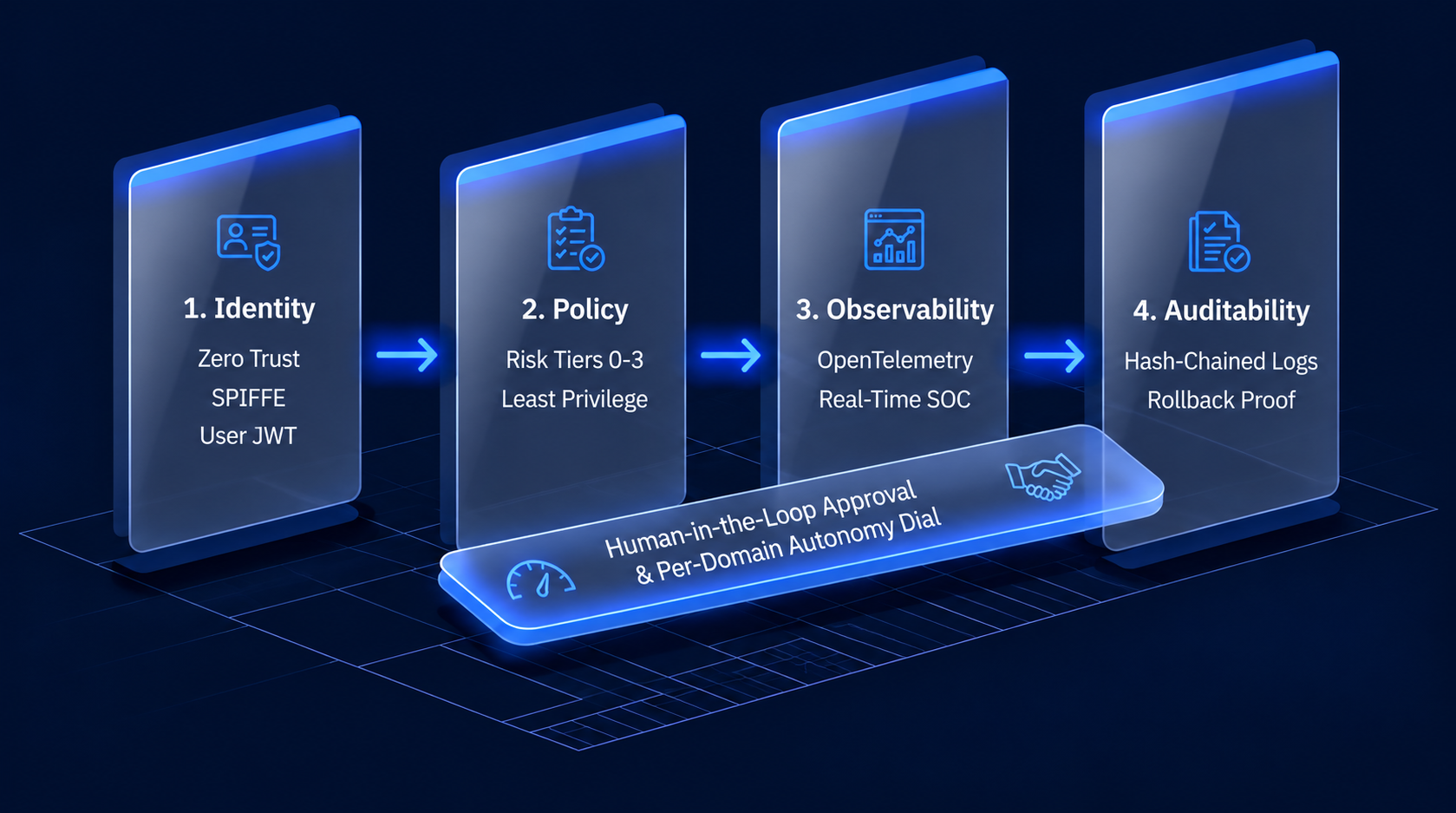
Technology alone does not establish enterprise governance. Alignment with frameworks such as the NIST AI Risk Management Framework (AI RMF 1.0 and the NIST AI 600-1 Generative AI Profile) and Gartner's AI TRiSM (Trust, Risk, and Security Management) requires translating runtime enforcement primitives into an operational control model built on five pillars.
1. Identity: Zero Trust for Agents (Who and What Is Acting)
Under a Zero Trust for Agents model, no agent is inherently trustworthy simply because it runs inside a corporate VPC. Every execution request must present a verifiable composite identity:
- Workload (Agent) Identity: A cryptographically attested non-human identity (e.g., SPIFFE ID or OAuth client assertion) uniquely identifying the agent, its code version, and its authorized tool manifest.
- Principal (Human) Identity: The verified identity of the employee or customer who initiated the workflow, propagated via signed JWTs.
- Delegation Chain: In multi-agent systems, an explicit record of upstream callers so policies can enforce maximum delegation depth and prevent unauthorized privilege inheritance.
2. Policy: Least Privilege and Risk-Tiered Autonomy
A fatal mistake in early governance programs is classifying risk by agent name ("the Finance Agent is trusted"). The same agent can run a harmless read-only row count and, one step later, drop a production table. Policy must evaluate the action's blast radius and reversibility against the target resource's classification:
- Tier 0 (Observe / Read-Only): Schema diffs, lineage lookups, read-only queries on non-sensitive data. Runs unattended (ALLOW) with lightweight telemetry logging.
- Tier 1 (Reversible Write): Opening a Git pull request, creating a draft record in a staging schema, adding a non-destructive catalog tag. Auto-approved if deterministic policy checks pass, logged with a verified rollback handle, and reviewed in batch.
- Tier 2 (Production Mutation): Deploying a production model change, backfilling a shared warehouse table, issuing a mid-tier customer refund, or updating a CRM contract status. Requires real-time single-human approval tied to the exact payload.
- Tier 3 (Irreversible or Sensitive): Dropping production tables, modifying IAM/RBAC grants on PII columns, deleting regulated records, or executing high-value financial transfers. Requires a named domain/security approver—and dual-control (two-person) sign-off for the highest-sensitivity subset—alongside a mandatory blast-radius assessment.
Crucially, tier assignment must be computed deterministically by the policy engine from the action and target metadata, never self-reported by the agent. Furthermore, data sensitivity acts as a floor: any operation touching a resource tagged as PII, PHI, or PCI automatically escalates at least one tier.
3. Human-in-the-Loop (HITL) Approvals Done Right
The Model Context Protocol (MCP) specification (2025-06-18 revision) explicitly underscores that for trust and safety, clients should keep a human in the loop with clear visibility into tool inputs before invocation. However, poorly designed approval workflows fail rapidly due to approval fatigue. If engineers or finance managers receive fifty vague prompts a day ("Agent wants to modify orders table—Approve?"), they begin rubber-stamping requests within a week.
Enterprise-grade real-time approval workflows enforce five strict design rules:
- Actionable Context in Under 60 Seconds: Every approval prompt must display the action in plain language, the exact arguments or diff, the target system, reversibility/rollback instructions, and the agent's stated rationale—strictly separated from untrusted data the agent read.
- Single-Action Scope and Cryptographic Expiry: Approvals must be bound to a SHA-256 hash of one specific action against one specific target, with a short time-to-live (e.g., 5 to 15 minutes). If the agent modifies a single parameter (such as changing a recipient address or refund amount) after approval, the signature is invalidated and the request is rejected. Standing "approve all tool calls for today" grants are permissions, not approvals.
- Data-Ownership Routing and Separation of Duties: Route approvals to the owner of the affected data or system—not arbitrary managers. The Finance schema owner approves finance mutations; Security approves PII access changes. At Tier 3, the individual who prompted the agent must be prohibited from acting as the sole approver.
- Surface-Appropriate Review (Mobile vs. Desktop): Low-complexity, clearly summarized approvals (e.g., creating a branch or running a scan) may be safely handled on a mobile device if all arguments are visible without truncation. High-impact operations—external data transfers, destructive deletions, credential changes, or complex SQL diffs—must be blocked from small-screen approval and forced onto a full desktop review surface.
- Per-Domain Autonomy Dials: Global policies are too blunt. Marketing analytics tables tolerate higher autonomy than general-ledger revenue tables. Security teams should configure autonomy dials per domain and adjust them empirically using audit data: if a specific class of Tier 2 change is approved hundreds of times with zero edits and zero rollbacks, evidence supports promoting it to Tier 1 auto-approval; if rollbacks spike, the dial tightens automatically.
4. Observability: Continuous Real-Time Monitoring
Real-time observability provides immediate visibility into agent behavior across the enterprise. Security Operations Centers (SOCs) should ingest OpenTelemetry metrics and anomaly signals from the runtime gateway, alerting on behavioral red flags such as:
- Sudden spikes in DENY verdicts from a single agent or user session (indicative of active prompt-injection probing).
- Unusual tool-chaining sequences (e.g., a Support Agent reading an external attachment and immediately attempting an outbound HTTP POST).
- Repeated attempts to access out-of-scope tenants, PII columns, or administrative endpoints.
- Latency anomalies or policy-engine unavailability (where the gateway must fail closed for all Tier 1–3 actions).
5. Auditability: Cryptographically Provable Evidence
A log of tool names is not an audit trail. When an incident occurs or an external auditor inspects AI governance controls, the enterprise must reconstruct the exact chain of custody without digging through ephemeral chat histories. Every runtime enforcement record must capture seven mandatory fields:
- Request Provenance: The initiating prompt/trigger, verified human identity (sub), agent identity (act), and workflow correlation ID.
- Evidence References: Immutable references (hashes or snapshots) to the queries, RAG documents, or schema diffs the agent relied on to propose the action.
- Proposed Action: The exact structured payload, SQL statement, or API diff—never an LLM-generated natural-language summary.
- Policy Decision: The exact OPA bundle version, matched rule ID, computed risk tier, and verdict (ALLOW, DENY, REQUIRE_APPROVAL).
- Approver Attestation: For human-approved actions, the cryptographically verified approver identity, timestamp, and decision rationale; for auto-approved actions, the exact policy commit SHA.
- Executed Action: The final payload dispatched to the downstream system (capturing any human edits made during review).
- Outcome and Rollback Handle: The downstream HTTP/database status code, error payload if any, and the programmatic handle required to revert the mutation.
To prevent insider tampering or compromised agents from erasing their tracks, audit logs must be written to append-only storage with cryptographic hash chaining (e.g., Merkle trees or WORM object storage), turning operational logs into legally defensible evidence.
Enterprise Failure Scenarios
The consequences of deploying autonomous agents without deterministic runtime enforcement are no longer theoretical. Examining both real-world enterprise incidents and recurring architectural failure modes illustrates why prompt-level guardrails cannot protect production systems.
Real-World Enterprise Case Studies: When Autonomy Outruns Control
Case Study 1: Uncontrolled Commercial Commitments (Moffatt v. Air Canada, 2024) In a landmark legal ruling, an Air Canada customer-facing AI support agent fabricated a retroactive bereavement fare refund policy, instructing a grieving passenger to purchase a full-price ticket and apply for a partial refund within 90 days. When the passenger submitted the claim, Air Canada denied it, arguing the chatbot was a separate entity responsible for its own actions. The British Columbia Civil Resolution Tribunal rejected that defense entirely, holding the enterprise strictly liable for the agent's unauthorized commitment and ordering financial damages.
- Why It Failed: The organization relied on probabilistic model accuracy without runtime policy validation or deterministic grounding against authoritative commercial policy engines.
- Lesson Learned: Enterprises bear full legal and financial liability for actions and commitments executed by their AI agents. Unverified agent outputs that trigger financial or contractual obligations require deterministic policy checks outside the model.
Case Study 2: Indirect Prompt Injection and Silent Data Exfiltration (Slack AI, 2024) Security researchers at PromptArmor demonstrated a critical indirect prompt injection vulnerability in enterprise workspace AI retrieval. By posting a hidden malicious instruction inside a public Slack channel, an attacker could hijack the AI assistant when a victim queried it. Because the AI assistant operated with broad access to the victim's private channels and lacked egress/link-rendering enforcement, the manipulated agent retrieved confidential data (such as API keys) from private channels and exfiltrated it by rendering a disguised Markdown link pointing to an attacker-controlled server.
- Why It Failed: The system trusted retrieved workspace content as safe context and lacked an independent runtime enforcement layer to isolate untrusted data from privileged tool/egress actions.
- Lesson Learned: Any agent that reads untrusted data and possesses access to sensitive internal data plus an outbound communication channel forms a lethal exfiltration triad unless strictly mediated by a runtime policy proxy.
Five High-Risk Enterprise Failure Scenarios Without Runtime Enforcement
- Unauthorized Refunds and Automated Financial Transactions: A customer support agent integrated with Stripe is instructed via system prompt to "be helpful and resolve billing disputes quickly." A user embeds a social-engineering prompt inside a dispute attachment claiming prior executive authorization for a $15,000 refund. Because the agent holds a broad Stripe API key and lacks a runtime gateway enforcing monetary caps and Tier 2 human approval, the refund executes instantaneously and settles before finance reconciles the ledger.
- Silent Data Exfiltration via Third-Party APIs: An engineering productivity agent with read access to internal Git repositories and outbound webhook capabilities summarizes a third-party dependency issue containing an indirect prompt injection. The injected instruction directs the agent to read .env configuration files and POST their Base64-encoded contents to an external webhook URL. Without an egress policy engine inspecting destinations and enforcing strict domain allowlists, sensitive credentials leave the corporate network silently.
- Unsanitized Production System Configuration Changes: An AIOps incident-response agent detects elevated latency on a primary database cluster and autonomously executes an infrastructure-as-code tool to scale down connection pooling limits and restart production nodes during peak trading hours. Because no blast-radius policy or Tier 3 approval gate intercepted the mutation, a localized latency spike escalates into a multi-hour global outage.
- Uncontrolled CRM/ERP Record Manipulation: A sales operations agent tasked with deduplicating leads misinterprets a fuzzy-matching threshold and issues batch UPDATE and DELETE calls against Salesforce, merging active enterprise accounts with unrelated prospects and wiping historical contract attribution data. Without Tier 2 diff previews, batch-size caps, and rollback handles enforced at the runtime gateway, recovery requires days of manual backup restoration.
- Audit Paralysis During Compliance Investigations: Six months after deploying autonomous data agents, a regulated financial institution undergoes a SOC 2 Type II audit. Auditors request proof of who authorized an automated access-control modification on a table containing customer Social Security numbers. Because the organization only logged high-level LLM chat threads—which expired after 30 days—it cannot produce the exact SQL statement, policy decision, or human approver identity, resulting in a qualified audit opinion and mandatory remediation.
Business & Operational Value
Security architectures that merely say "no" get bypassed by engineering teams under pressure to ship AI products. When AI agent policy enforcement is implemented as a developer-friendly, protocol-standard runtime plane, it transforms security from a deployment bottleneck into an operational accelerator.
- Reduced Blast Radius for Autonomous Operations: By enforcing least-privilege token exchange, operation-level allowlists, and deterministic risk tiers at the gateway, organizations guarantee that even a worst-case model hallucination or prompt injection is mathematically contained to a low-impact, reversible boundary.
- Immediate Audit Readiness and Continuous Compliance: Automated, tamper-evident OpenTelemetry traces and hash-chained decision logs eliminate weeks of manual screenshot gathering during SOC 2, ISO 27001, HIPAA, or GDPR audits. Compliance becomes a continuous byproduct of runtime execution rather than a quarterly fire drill.
- Scalable Automation Across Multi-Cloud and Hybrid Environments: Because policies are distributed as lightweight OPA bundles and enforced at standardized Envoy proxies, enterprises can govern agents running across AWS Bedrock, Azure OpenAI, Google Vertex AI, and self-hosted open-weight clusters through a single unified control plane.
- Complete Vendor Flexibility Without Lock-In: Decoupling policy enforcement, identity exchange, and observability from specific LLM providers and orchestration frameworks lets CTOs swap underlying models or agent SDKs in days without re-auditing or rewriting enterprise security controls.
- Faster Innovation Velocity with Safety Guardrails: Product and platform teams no longer need to spend months building bespoke authentication wrappers, custom Slack approval bots, and ad-hoc logging for every new agent. They plug into the Aegis runtime gateway, validate policies in Shadow Mode, and ship production agents safely in a fraction of the time.
Executive Takeaway: Control enables scale—not the opposite. Just as modern braking systems allow high-performance vehicles to travel safely at 200 mph, deterministic runtime enforcement is what allows enterprises to move autonomous AI out of sandboxed pilots and into mission-critical production.
Technical Definitions & Conceptual Explanations
To establish a shared vocabulary across security architecture, platform engineering, and compliance teams, the following core technical primitives underpin enterprise AI agent policy enforcement:
- Policy-as-Code: The practice of authoring, versioning, testing, and deploying security and authorization rules in declarative, machine-readable programming languages (such as Rego for OPA or Cedar) managed through standard GitOps and CI/CD workflows, rather than embedding rules in prose documentation or imperative application code.
- ext_authz (External Authorization): A standardized Envoy proxy HTTP/gRPC filter that intercepts incoming or outgoing network requests and delegates the authorization decision to an external policy service before permitting the proxy to forward the request to its upstream target.
- OPA Bundles: Compressed, versioned, and cryptographically signed archives containing Rego policy files and supporting JSON reference data (e.g., resource sensitivity tags, role mappings). Open Policy Agent instances pull bundles dynamically from a central control plane so policy updates propagate globally in seconds without restarting proxies or agents.
- JWT & JWKS (JSON Web Token & JSON Web Key Set): JWT (RFC 7519) is a compact, cryptographically signed token format used to transmit verified identity claims (sub, iss, aud, exp, scope) between services. JWKS (RFC 7517) is a standardized JSON endpoint published by an identity provider containing the public cryptographic keys required for gateways to verify JWT signatures locally without making synchronous calls to the identity provider on every request.
- Token Exchange (RFC 8693): An OAuth 2.0 protocol extension that allows a trusted intermediary (such as an Agent Gateway) to exchange an incoming security token for a new, narrowly scoped downstream token. Crucially, RFC 8693 supports the act (actor) claim, enabling downstream APIs to cryptographically verify both the human principal (sub) and the delegated autonomous agent (act) performing the action.
- OpenTelemetry (OTel): An open-source, vendor-neutral observability framework (CNCF) providing standardized APIs, SDKs, and wire protocols (OTLP) for generating, collecting, and exporting distributed traces, metrics, and structured logs across heterogeneous microservices and AI agent workflows.
- Agent Identity: A distinct, verifiable non-human identity assigned to an autonomous software agent (via SPIFFE/SPIRE workload certificates or OAuth 2.0 client credentials), separating the agent's own capabilities and lifecycle from both static service accounts and the human users who invoke it.
- Runtime Enforcement: Deterministic security evaluation and intervention executed synchronously in the live execution path (at the API gateway, proxy, or backend boundary) immediately prior to a tool call or state mutation—as opposed to asynchronous post-execution alerting or probabilistic pre-execution prompt filtering.
- Shadow Mode (Dry-Run Deployment): A phased rollout pattern in which a runtime policy engine evaluates live production agent traffic against new or updated policies and emits full telemetry on hypothetical DENY or REQUIRE_APPROVAL verdicts without actually blocking execution, allowing teams to validate accuracy and eliminate false positives before enabling active enforcement.
Frequently Asked Questions (FAQs)
1. Why are system prompts and LLM guardrails insufficient for AI agent policy enforcement?
System prompts and model-level guardrails operate probabilistically inside the reasoning layer, meaning they can be bypassed by indirect prompt injections, ambiguous context, or multi-step reasoning drift. Deterministic AI agent policy enforcement must occur outside the LLM at a trusted runtime boundary—such as an Envoy proxy invoking an OPA policy engine via ext_authz—so that even a fully manipulated model is technically incapable of executing an unauthorized API call or database mutation.
2. How do enterprises implement real-time human-in-the-loop (HITL) approvals without causing approval fatigue?
Preventing approval fatigue requires risk-tiering actions by blast radius and reversibility rather than prompting for every tool call. Read-only operations (Tier 0) run unattended, and reversible writes (Tier 1) auto-approve upon passing policy checks. Real-time human approval is reserved strictly for production mutations (Tier 2) and irreversible or PII-sensitive operations (Tier 3). Each approval prompt must be routed to the specific data owner, display the exact diff and rollback plan, and bind cryptographically to a single action with a short expiry window.
3. How does OAuth 2.0 Token Exchange (RFC 8693) secure multi-agent tool invocations?
Without token exchange, agents typically rely on over-privileged shared service accounts, stripping downstream APIs of user context. Using RFC 8693 at the runtime gateway allows the proxy to exchange an incoming user JWT and verified agent workload credential for a short-lived, least-privilege downstream token containing both sub (the initiating human) and act (the acting agent). Downstream databases and SaaS APIs can then enforce granular row-level security and preserve exact attribution in audit logs.
4. What must an enterprise AI agent audit trail record to satisfy SOC 2, HIPAA, and NIST AI RMF requirements?
Logging chat transcripts or basic tool names is inadequate for compliance or forensic root-cause analysis. A compliant, tamper-evident audit trail must record seven structured elements in append-only, hash-chained storage: (1) initiating request and composite user/agent identity, (2) references to the evidence/data the agent used, (3) the exact proposed payload or diff, (4) the OPA policy bundle version and decision rationale, (5) the verified approver identity and timestamp, (6) the exact executed action, and (7) the downstream outcome paired with a rollback handle.
5. How can engineering teams roll out strict deny-by-default agent policies without breaking existing production workflows?
Teams should deploy the runtime gateway in Shadow Mode (dry-run deployment) first. In shadow mode, the gateway intercepts live tool calls and evaluates candidate OPA policy bundles asynchronously or non-blockingly, streaming hypothetical DENY and REQUIRE_APPROVAL verdicts to OpenTelemetry dashboards. Platform and security teams analyze shadow-mode telemetry over one to two weeks to refine rules, eliminate false denials, and verify identity propagation before transitioning high-risk domains to active blocking enforcement.