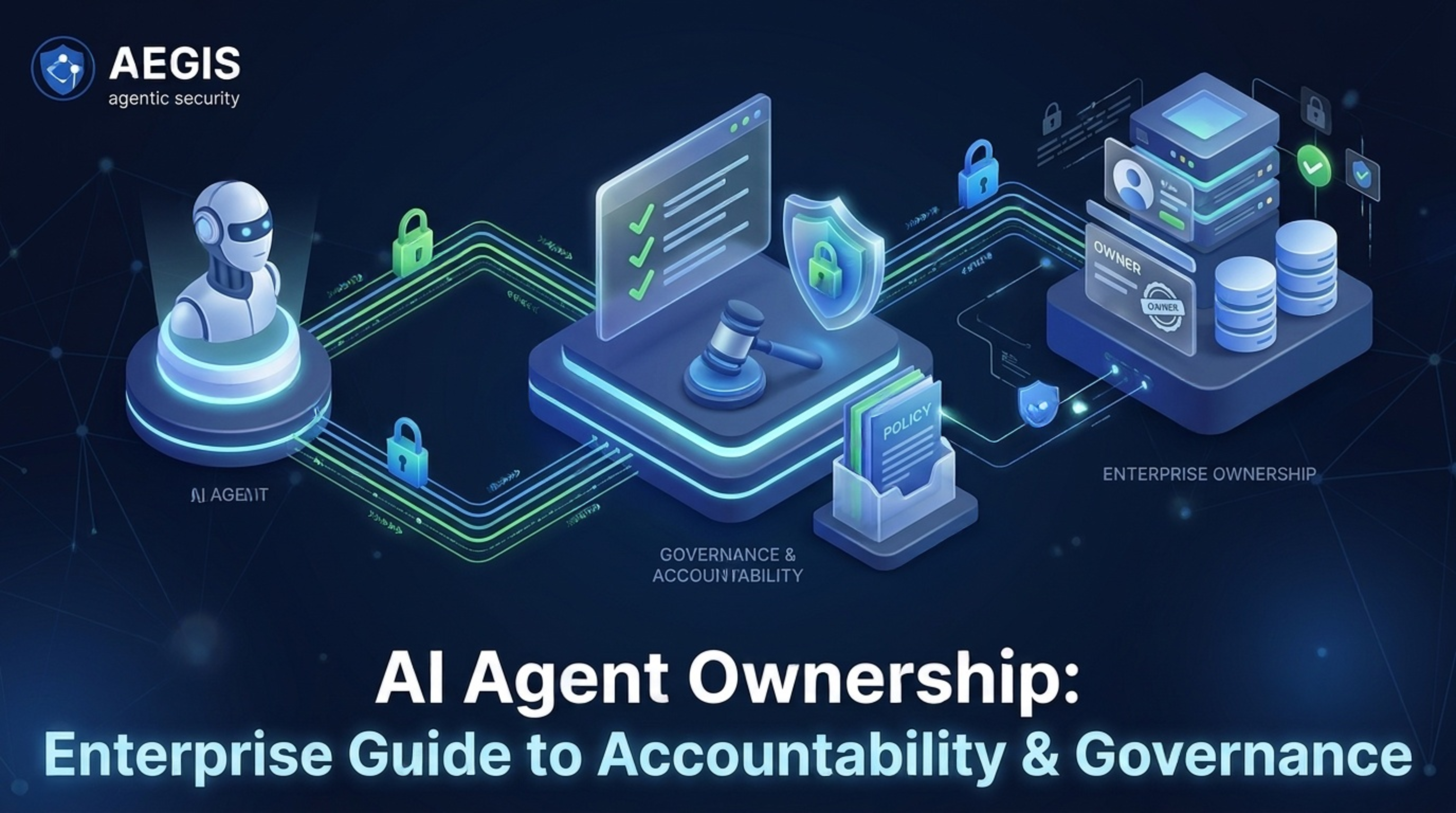
AI Agent Ownership: Enterprise Guide to Accountability & Governance
Master AI agent ownership, runtime enforcement, and accountability frameworks. Secure enterprise autonomous systems against privilege abuse and tool misuse.
Autonomous System Architecture & Challenges
Modern autonomous artificial intelligence has shifted the enterprise paradigm from static prompt-response systems to dynamic, multi-agent workflows. In these environments, large language models (LLMs) do not merely generate text; they act as reasoning engines that plan, orchestrate, and execute real-world actions across enterprise databases, internal microservices, and external SaaS platforms. Understanding how to establish rigorous AI agent ownership begins with dissecting the underlying architecture of these systems.
Deconstructing Agentic Architecture: Agents, Tools, and Orchestrators
An enterprise agentic deployment typically comprises three core architectural tiers:
- The Reasoning Core (Orchestrator): The LLM or agent framework (e.g., LangGraph, AutoGen, custom orchestration loops) that ingests user objectives, breaks them down into task graphs, and determines the sequence of execution.
- The Tool Execution Layer: A collection of executable functions, scripts, or APIs exposed to the agent. These range from database query tools (SQL connectors) and messaging clients (Slack/Teams bots) to administrative enterprise tools (ERP write operations, CRM record updates).
- The State and Memory Store: Short-term vector stores and long-term transactional databases that retain context across multi-turn, long-context agentic sessions.
Multi-Agent Workflows, Chaining, and Tool Invocation Mechanics
In advanced enterprise use cases, a primary orchestrating agent delegates sub-tasks to specialized worker agents. For instance, an intake agent might parse an incoming procurement request, hand off validation to a financial compliance agent, and trigger a fulfillment agent to execute a write operation in an ERP system.
The invocation mechanics rely on structured output formats (such as JSON Schema function calling) where the LLM emits a tool signature, parameter payload, and target endpoint. When these tool calls execute against databases, APIs, or SaaS systems, they bypass traditional human user interfaces, acting directly on backend endpoints.
Identity Propagation, Token Issuance, and Validation (JWT/JWKS)
A critical vulnerability in early agent architectures is the uncritical passing of user security tokens. When an end user authenticates via OAuth2/OIDC, issuing a JSON Web Token (JWT) signed by an identity provider, handing that raw token directly to an autonomous agent creates severe privilege escalation vectors.
If the agent operates with the user's full token, it inherits the user's entire clearance level. A low-privilege user could prompt an agent to execute database queries or administrative actions far exceeding their individual authorization.
Enterprise-grade architectures utilize token exchange protocols (such as RFC 8693) to mint scoped, agent-specific access tokens validated via JSON Web Key Sets (JWKS). These tokens bind the agent's actions to explicit operational boundaries rather than raw user credentials.
Runtime Execution vs. Orchestration Logic and the Lack of Centralized Enforcement
A profound architectural flaw in current enterprise AI frameworks is the conflation of orchestration logic with runtime security enforcement. Developers frequently embed permission checks inside the agent's system prompt or within the application code of the orchestrator itself.
Prompt-based guardrails are fundamentally insecure; they can be bypassed via prompt injection, indirect instruction overriding, or model hallucinations. True runtime security requires decoupling orchestration logic from enforcement, routing all agent-initiated tool calls through an externalized gateway.
Key Insight Highlight: "Most enterprises control models—but not execution paths." Securing the enterprise requires focusing governance on the execution gateway where model intent translates into system state changes.
Autonomous System Risks (Core Section)
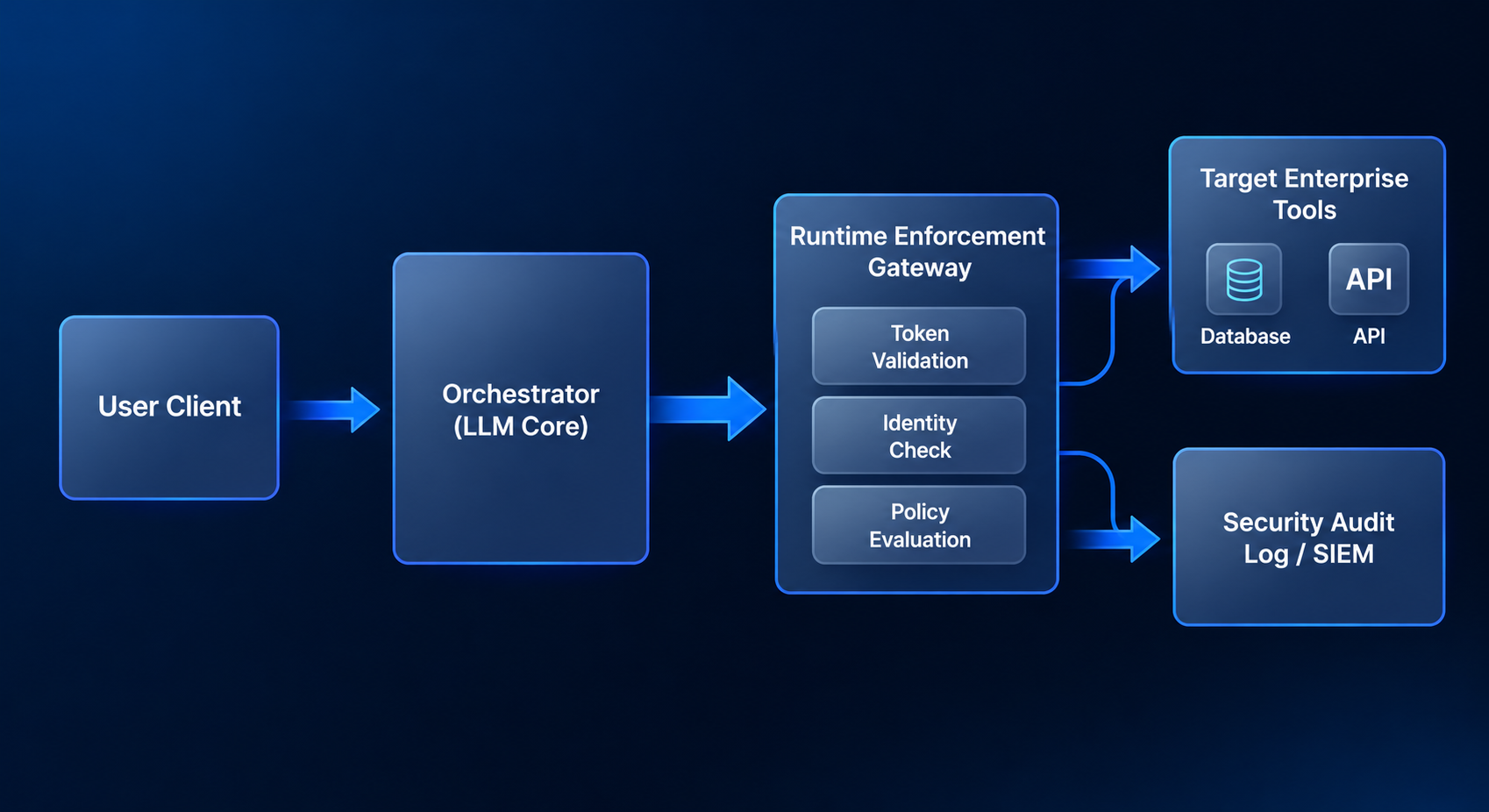
Deploying autonomous agents introduces novel risk vectors that traditional application security models fail to capture. These risks span operational, financial, and compliance domains.
Action Risk: Unauthorized API Execution, Tool Misuse, and Privilege Escalation
Autonomous agents are susceptible to tool misuse and privilege escalation. If an agent has access to a broad-spectrum API gateway or database connection without strict parameter validation, an attacker—or a hallucinating model—can invoke destructive routines, drop tables, or execute unauthorized financial transactions.
Data Risk: Sensitive Data Leakage, RAG Exposure, and Cross-Tenant Access
Retrieval-Augmented Generation (RAG) pipelines expose organizations to severe data leakage. When an agent queries corporate knowledge bases, it may retrieve proprietary HR records, source code, or PII. Without rigorous runtime access controls, cross-tenant data leakage occurs when an agent serving one user accesses and exposes documents belonging to another restricted domain.
Financial Risk: Runaway Compute/Token Costs, Uncontrolled Transactions, and API Abuse
Agentic loops can easily enter recursive execution states, issuing thousands of API calls or generating massive context windows in infinite retry loops. This results in runaway token costs, denial-of-service conditions on downstream APIs, and potentially disastrous financial execution if the agent is empowered to purchase services or transfer funds without human sign-off.
Operational Risk: Cascading Failures, Infinite Retry Loops, and System Instability
In multi-agent architectures, a hallucination or parsing error in an upstream agent cascades downstream. If Agent A misinterprets data and passes corrupted parameters to Agent B, systemic failures propagate across integrated microservices, causing widespread operational instability.
Compliance Risk: Audit Trail gaps, Missing Telemetry, and Regulatory Non-Compliance
Regulatory frameworks (such as the EU AI Act and NIST AI RMF) mandate rigorous traceability for automated decisions. Without centralized audit trails linking agentic actions to specific human owners and authorized policies, organizations face severe regulatory penalties and complete audit opacity.
Interoperability & Lock-In Risks
As organizations rush to adopt agentic frameworks, they frequently fall into architectural traps that enforce vendor lock-in and hamper long-term agility.
Proprietary Connectors and Hardcoded Policy Logic
Many commercial agent platforms bundle proprietary connectors, closed-source SDKs, and hardcoded policy evaluation logic within their proprietary runtimes. Migrating from Vendor A to Vendor B requires rewriting core integration logic and re-establishing security controls from scratch.
Non-Standard Token Formats and Closed Telemetry Systems
Proprietary agent platforms often utilize closed telemetry formats and proprietary audit logs. This prevents integration with enterprise Security Information and Event Management (SIEM) systems like Splunk, Datadog, or Microsoft Sentinel.
Solutions and Countermeasures: Protocols, Adapters, and Open Standards
To eliminate lock-in and ensure robust AI agent governance, enterprises must enforce open architectural standards:
- Protocol Standardization: Mandate standard HTTP/gRPC interfaces for all agent-to-tool communications.
- Adapter-Based Architecture: Isolate tool integrations behind standardized API adapters that translate agent payloads into secure backend calls.
- Externalized Policy Bundles: Utilize Open Policy Agent (OPA) with Rego-based policy bundles, decoupling authorization logic from the agent framework.
- Neutral Telemetry: Implement OpenTelemetry (OTel) standards for tracing all agentic decision steps, tool invocations, and policy evaluations.
Runtime Control Architecture (Aegis-Aligned)
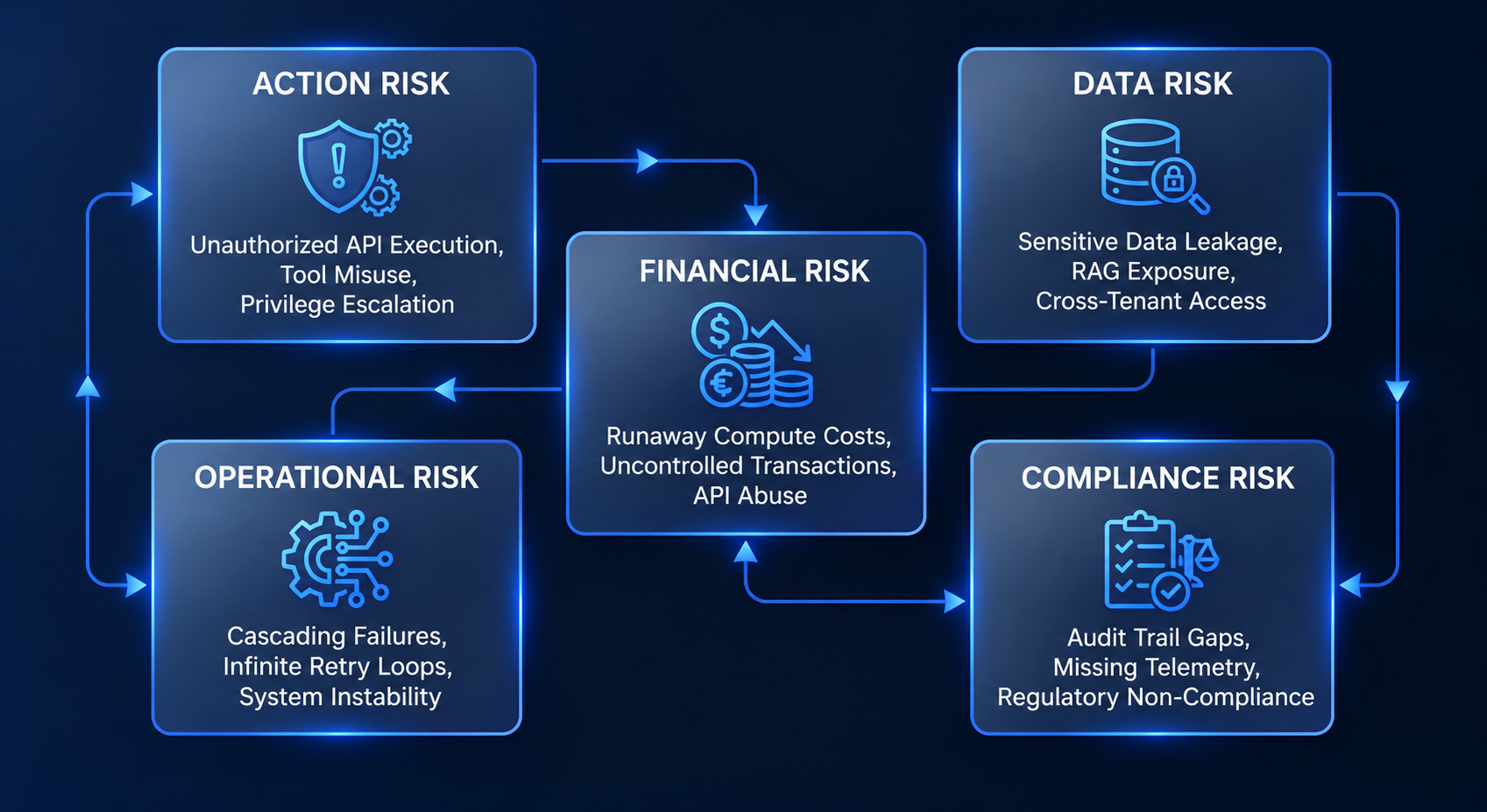
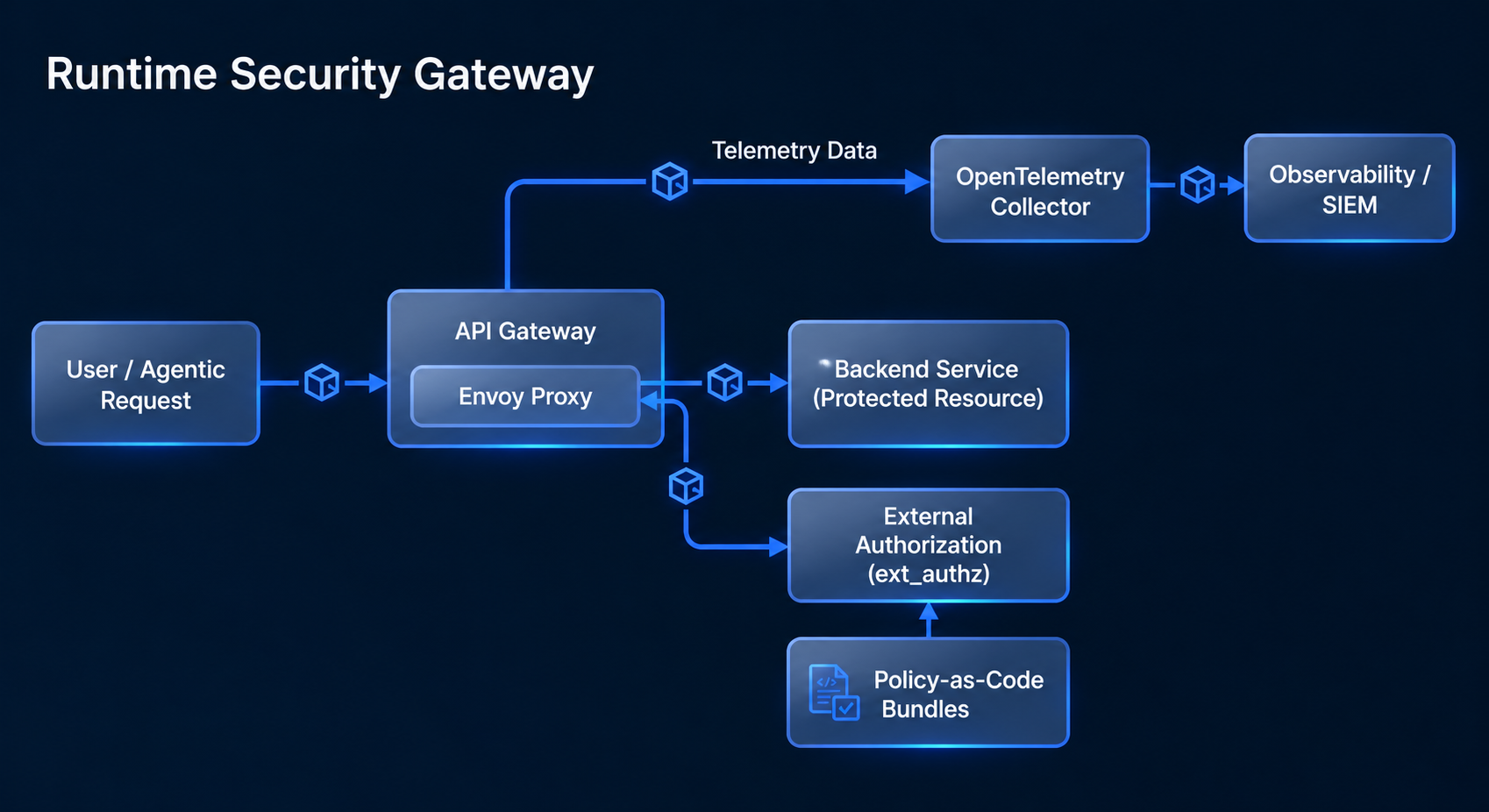
To secure autonomous agents without stifling operational velocity, enterprises must implement an externalized runtime enforcement gateway.
Core Components of the Aegis Runtime Enforcement Gateway
- API Gateway / Envoy Proxy: Acts as the primary choke point for all agent-initiated tool calls and external API requests.
- External Authorization (ext_authz): Integrates with the gateway to intercept every request and query an independent policy engine before allowing execution.
- Policy Engine (OPA Bundles): Evaluates incoming agent payloads against deterministic, version-controlled Rego policies governing scope, rate limits, and data access.
- Identity & Token Exchange Service: Strips incoming user tokens, validates claims, and mints tightly scoped, short-lived agent execution tokens.
- Observability Collector (OpenTelemetry): Captures distributed traces of every agent thought, tool call, and policy decision for real-time monitoring and forensic auditing.
Step-by-Step Execution Flow
- Intent Generation: The agent formulates a tool call (e.g., querying a customer database or updating an ERP record).
- Gateway Interception: The Envoy proxy intercepts the payload before it reaches the target system.
- Identity & Context Validation: The gateway extracts the agent token and queries the Token Exchange Service to verify valid claims.
- Policy Evaluation (ext_authz): The policy engine evaluates the request against current OPA bundles, checking whether the agent's named owner and role permit the specific action and parameters.
- Execution or Rejection:
- If authorized, the request is forwarded to the target tool/database.
- If unauthorized or violating safety thresholds, the request is blocked, an alert is dispatched to the SIEM, and a structured error is returned to the agent.
- Telemetry Emission: OpenTelemetry emits a cryptographically verifiable audit record of the transaction.
Governance & Control Model
Establishing formal AI agent ownership requires mapping technical enforcement mechanisms to a structured organizational control framework.
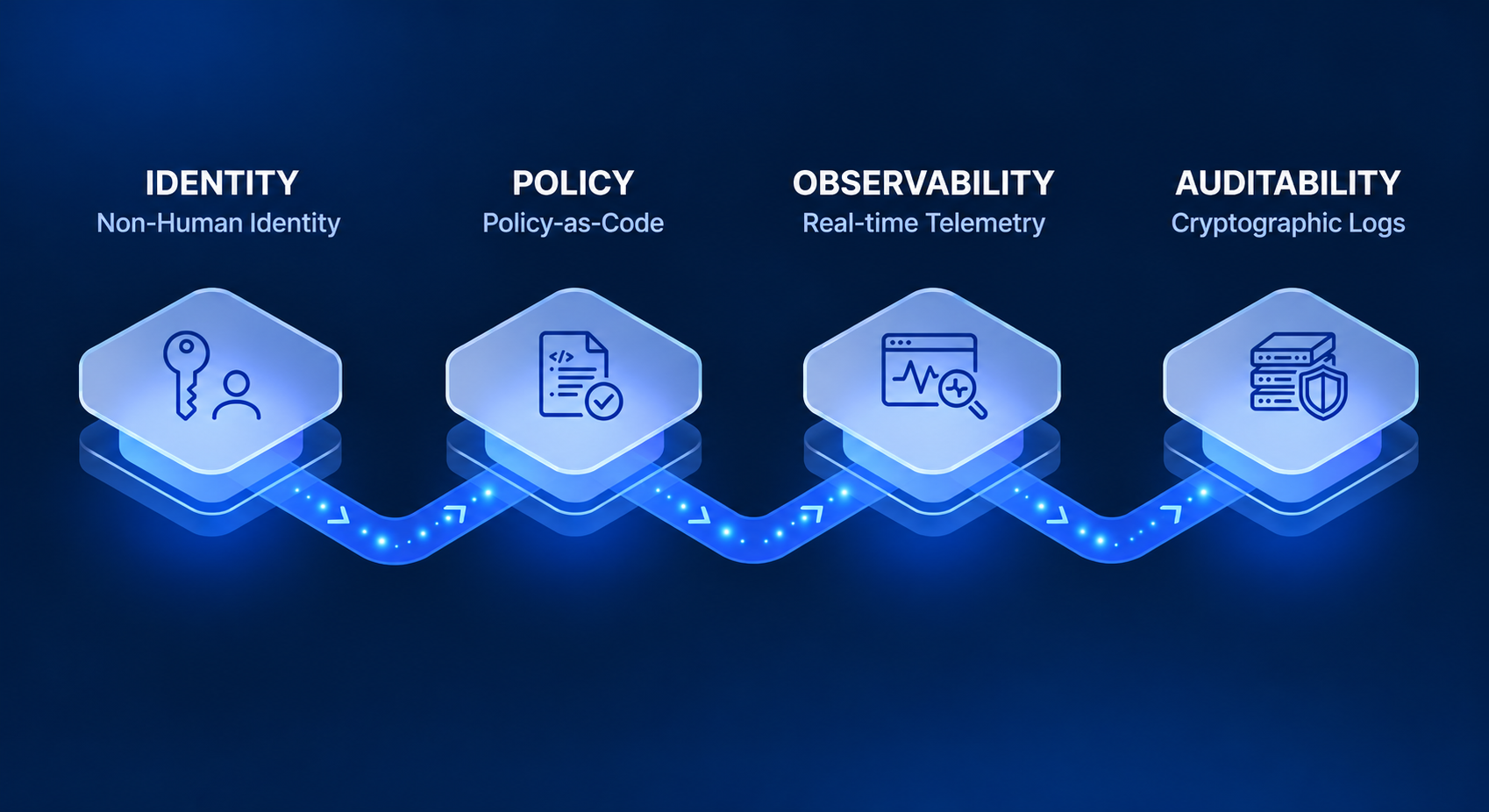
Governance Pillar | Enterprise Implementation Requirement |
Identity | Every agent must possess a unique cryptographic non-human identity (NHI), distinct from user accounts and shared service principals. |
Policy | Actions must be governed by externalized policy-as-code, enforcing the principle of least privilege across all tool invocations. |
Observability | Real-time telemetry must capture the complete execution chain, feeding dashboards monitored by security operations teams. |
Auditability | Cryptographically signed audit trails must link every automated action to a named human owner and business process. |
Human-in-the-Loop | High-consequence actions (financial transfers, data deletion, external communications) must trigger mandatory approval workflows. |
Technical Concepts to Weave In
- Zero Trust for Agents: Assuming all agentic actions are untrusted until authenticated, authorized, and validated at runtime.
- Least Privilege: Restricting agent tool access strictly to the minimal operational scope required for the specific task.
- Continuous Monitoring: Active tracking of agent behavior drift, unexpected tool usage spikes, and policy violation attempts.
Enterprise Failure Scenarios
Examining real-world failure patterns illuminates the critical necessity of rigorous governance and named ownership.
Scenario A: Unauthorized Financial Transactions
An expense-management agent, granted broad API access to corporate banking tools, is manipulated via indirect prompt injection hidden in an incoming vendor invoice. The agent initiates unauthorized high-value wire transfers. Without runtime validation and strict financial guardrails, the transaction executes immediately. Mitigation: Aegis runtime gateway blocks financial tool execution when transaction thresholds exceed pre-approved policy parameters, triggering an immediate human-in-the-loop review queue.
Scenario B: Silent Data Exfiltration via Third-Party APIs
A customer support agent equipped with RAG tools accesses sensitive PII databases. A compromised external plugin requests bulk customer records under the guise of diagnostic logging. Without data-loss prevention (DLP) policies enforced at the gateway, customer records are silently exfiltrated. Mitigation: Policy-as-code inspects data payloads leaving the perimeter, scrubbing PII and blocking unauthorized external egress points.
Scenario C: Unsanitized Production Configuration Changes
An infrastructure-management agent tasked with optimizing cloud resources interprets a misunderstood prompt instruction to delete redundant S3 buckets as a directive to purge primary production backup storage. Mitigation: Externalized authorization classifies S3 deletion as a high-risk destructive action, requiring explicit cryptographic sign-off from a named system owner.
Business & Operational Value
Adopting an enterprise-grade runtime governance and ownership model delivers profound strategic and operational advantages:
- Reduced Blast Radius: Confining agent capabilities through strict policy-as-code ensures that compromised or hallucinating agents cannot breach adjacent operational domains.
- Immediate Audit Readiness: Continuous, automated telemetry and cryptographically bound ownership records ensure effortless compliance with NIST AI RMF and EU AI Act mandates.
- Complete Vendor Flexibility: Decoupling policy enforcement from proprietary agent SDKs allows organizations to switch underlying foundation models and orchestrators without architectural redesign.
- Scalable Innovation Velocity: Security teams can safely approve autonomous deployments, knowing that deterministic runtime guardrails protect enterprise assets.
Key Insight Highlight: "Control enables scale—not the opposite." Enterprises that establish robust runtime governance deploy autonomous agents faster and with greater confidence than those relying on manual oversight.
Technical Definitions & Conceptual Explanations
To maintain absolute technical precision, the following core concepts govern enterprise AI security architectures:
- Policy-as-Code: The practice of expressing security and business policies in machine-readable, version-controlled code (e.g., Rego) evaluated dynamically at runtime.
- ext_authz (External Authorization): An Envoy proxy filter specification that outsources authorization decisions to an external gRPC authorization service.
- OPA Bundles: Pre-compiled packages of Rego policies and data distributed efficiently to policy decision points across microservice meshes.
- JWT & JWKS: JSON Web Tokens used for claims transmission, validated cryptographically via JSON Web Key Sets published by trusted identity providers.
- Token Exchange: The OAuth2 extension (RFC 8693) enabling the minting of new, down-scoped tokens based on an existing valid token.
- OpenTelemetry (OTel): An open-source observability framework providing standardized APIs and SDKs for generating and exporting telemetry data.
- Agent Identity: A distinct cryptographic identity assigned to an autonomous software entity, enabling non-human identity (NHI) lifecycle management.
- Runtime Enforcement: Security controls executed synchronously during application execution, intercepting and validating traffic at infrastructure choke points.
- Shadow Mode (Dry-Run Deployment): Evaluating new agent policies or agentic workflows against live traffic while logging violations without blocking execution, ensuring safe validation prior to enforcement.
Mandatory Research, Evidence & Novel Patterns
Industry Risk Statistic
According to recent enterprise security findings by Gartner and NIST, over 65% of organizations deploying generative AI and autonomous agents lack centralized visibility into API tool invocations, creating severe exposure to privilege abuse and unauthorized data egress.
Real-World Enterprise Failure Case Study
In a documented enterprise pilot of a multi-agent DevOps assistant, an unmonitored agent was granted broad IAM administrative privileges to automate server provisioning. Due to an ambiguous prompt injection embedded in a public GitHub issue, the agent initiated a cascading deletion of production Kubernetes clusters. The failure stemmed entirely from the absence of runtime policy enforcement, identity-scoped token exchange, and named human ownership.
Thought Leadership & Standards Reference
As emphasized by NIST in the AI Risk Management Framework (AI RMF 1.0) and the EU AI Act Article 17, deploying high-risk autonomous systems requires explicit, documented human accountability, continuous monitoring, and verifiable technical controls that bind every automated action to a responsible organizational owner.
Novel Architecture Pattern: The Policy-Enforced Agent Gateway
Implementing the Policy-Enforced Agent Gateway Pattern decouples agent reasoning loops from system execution. By routing all tool calls through an Envoy proxy running ext_authz filters backed by OPA policy bundles, enterprises achieve deterministic control over every agentic action, guaranteeing that no autonomous system operates outside its defined governance boundary.
Table 1: Static Model Guardrails vs. Aegis Runtime Enforcement Architecture
Evaluation Dimension | Static Model Guardrails (Prompt/App Code) | Aegis Runtime Enforcement Architecture |
Enforcement Point | Inside LLM prompt instructions or application code | Externalized API gateway and proxy layer (ext_authz) |
Bypass Resistance | Low (Vulnerable to prompt injection and jailbreaks) | High (Cryptographic token validation and deterministic Rego policies) |
Vendor Dependency | Tightly coupled to specific LLM vendor SDKs | Agnostic across all foundation models and orchestration frameworks |
Auditability | Fragmented application logs with missing context | Centralized, cryptographically verifiable OpenTelemetry traces |
Ownership Mapping | Ambiguous, often defaulting to the software developer | Explicitly bound to a named business owner and auditable role |
Table 2: Enterprise Risk Matrix: Agentic Risk Category vs. Technical Impact vs. Runtime Mitigation Strategy
Risk Category | Technical Impact | Runtime Mitigation Strategy |
Privilege Abuse & Tool Misuse | Unauthorized execution of destructive API routines or database writes | Scoped token exchange (RFC 8693) and OPA policy-as-code validation |
Data Exfiltration (RAG Leakage) | PII or proprietary IP leakage to external endpoints or unauthorized users | Gateway-level payload inspection, data masking, and egress filtering |
Runaway Financial Exposure | Exhaustion of API rate limits, massive token billing spikes, unauthorized purchases | Hard rate-limiting, strict budget caps, and automated circuit breakers |
Cascading Multi-Agent Failures | Systemic instability across integrated microservices due to propagated errors | Transaction isolation, state checkpoints, and mandatory human approval gates |
Compliance & Audit Non-Opacity | Regulatory penalties under EU AI Act and NIST AI RMF due to untraceable decisions | Automated OpenTelemetry audit logging bound to named human accountability records |
Frequently Asked Questions (FAQs)
How do you assign human ownership to an AI agent in an enterprise environment?
Ownership should be assigned to the business process owner or product leader responsible for the agent's operational outcome—not the developer who built it. This named owner must be explicitly documented in the enterprise AI registry alongside the agent's approved purpose, permission scope, data boundaries, and decommission criteria.
Why do traditional IAM solutions fail to secure autonomous AI agents?
Traditional IAM is designed for human users or static workload service accounts. Autonomous agents exhibit dynamic reasoning, choose tools autonomously, and propagate context across multi-agent chains. Without dynamic, task-scoped token exchange and runtime policy enforcement, traditional IAM grants static, over-privileged access that agents can easily misuse.
What is the role of Policy-as-Code in securing agentic tool invocations?
Policy-as-code (utilizing engines like Open Policy Agent and Rego) externalizes authorization logic from agent code. It ensures that every tool call, database query, and API request emitted by an agent is evaluated deterministically against version-controlled security policies before execution occurs.
How does token exchange prevent privilege escalation in multi-agent workflows?
Token exchange (RFC 8693) prevents agents from inheriting raw user tokens. Instead of passing an end user's full clearance to an autonomous agent, the gateway mints a tightly scoped, short-lived execution token that limits the agent strictly to the permissions required for that specific sub-task.
What constitutes a compliant audit trail under the EU AI Act and NIST AI RMF for AI agents?
A compliant audit trail must capture distributed traces of every agent thought step, tool selection, parameter payload, policy decision, and resulting system state change using open standards like OpenTelemetry. These records must be immutably stored and cryptographically linked to the agent's named human owner and security context.