
Using Agents to Monitor Social Media for Brand Insights
How Aegis enforces egress, PII redaction, rate limits and auditability for agentic social media monitoring.
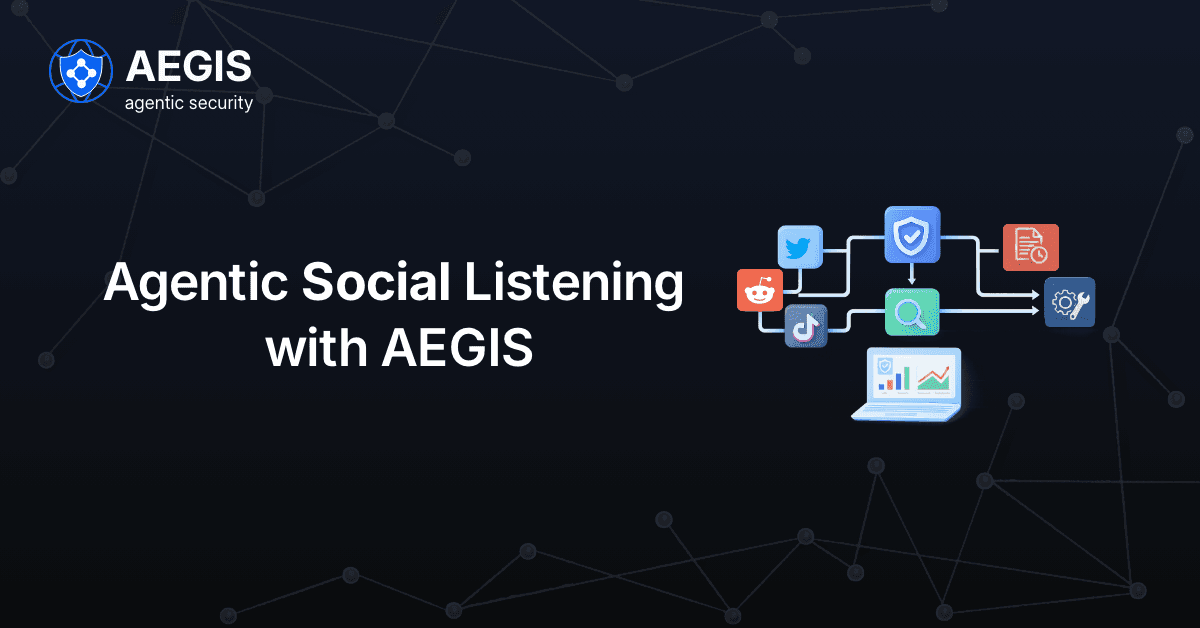
Agentic Social Listening: How to Run Social Media Monitoring Agents Securely with Aegis
Social listening at scale is attractive and dangerous. Autonomous agents can synthesize streams from Twitter/X, Reddit, TikTok and forums into crisp brand insights — but they also increase the surface for data leaks, misclassifications, and noncompliant egress. This article unpacks the problem, shows a production pipeline for agentic monitoring, and explains how Aegis — Aegissecurity runtime policy and observability gateway — enforces egress policy, PII redaction, rate limits, and auditable traces so teams can gain brand signal without adding regulatory or reputational risk.
The Problem: Volume, Noise, and Sensitive Data
Social listening generates high throughput and much noise:
- Vast volume: millions of posts per day for mid-size brands.
- Noisy signals: sarcasm, slang, and domain-specific terms cause mislabelled sentiment.
- Sensitive content: DMs, personal handles, phone numbers, images with PHI/PII.
- Egress risk: agents may forward raw text to third-party LLMs or public channels.
Traditional approach — human analysts plus keyword alerts — scales poorly and introduces latency. Naïve agentic pipelines amplify risk: agents ingest raw streams, call external LLM APIs for summarization, and post outputs to public dashboards or Slack without deterministic redaction. The result is accidental PII exposure or sending regulated data to uncontrolled destinations.
Business impact (examples):
- Brand crisis escalates when an agent posts unredacted customer handles into a public feed.
- Regulatory exposure when PHI is included in an external LLM prompt.
- Cost overruns from runaway LLM calls initiated by unconstrained agents.
A Production Pipeline for Agentic Social Media Monitoring
A resilient pipeline separates ingestion, enrichment, classification, and action — and places Aegis at the agent↔tool boundary to enforce controls.
- Ingestion layer
- Stream connectors (pub/sub, webhooks, platform APIs) collect raw posts and metadata.
- Minimal pre-filtering (language, geo, hashtag) to reduce noise.
- Normalization & PII detection
- Deterministic regex + ML recognizers locate handles, emails, phone numbers, IDs, and named entities.
- Masking occurs early (hash/replace) per policy before further processing.
- Agentic enrichment
- Lightweight agents perform sentiment scoring, topic clustering, and entity linking.
- Agents call internal LLMs or analytics microservices for summarization.
- Decision & routing
- Alerts are raised for threshold breaches (sentiment drop, volume spike, brand-entity coupling).
- High-risk alerts trigger human escalation for validation.
- Action channel
- Sanitized highlights are posted to dashboards, tickets, or approved Slack channels.
- All actions pass through Aegis for enforcement and telemetry.
Policies: Preventing Leakage and Misclassification
Robust policies are the core control. Policies should be written as code (YAML/JSON) and include:
Egress and allowed APIs
- Define an allowlist of external domains (e.g., internal LLM endpoints, approved analytics APIs).
- Deny unknown domains by default; require approval for exceptions.
PII redaction and field-level rules
- Per-field masking rules (handles → hashed_handle, phone → REDACTED).
- Deterministic DLP (regex) for quick inline redaction plus ML-based detectors for images and handwritten text.
Rate limits and budgets
- Per-agent RPS limits for third-party LLM calls.
- Daily budgets for high-cost APIs; block calls that would exceed budget.
Approval and human-in-the-loop rules
- High-risk conditions (mass negative sentiment, legal mentions) set approval_needed.
- Approval channels integrate with Slack/Teams; an override token allows one retry after approval.
Why Aegis Matters
Aegis is designed to be the runtime policy and observability fabric for multi-agent pipelines. When inserted as a gateway (sidecar or proxy) between orchestrators and tools, Aegis enforces per-agent identity, parameter inspection, and auditable decisioning.
Key capabilities that directly apply to social listening agents:
- Egress control: Only approved domains (internal summarizers, analytics endpoints) are reachable; agent attempts to call public LLMs are blocked or forced through a scrubber. This prevents sensitive content from leaving controlled boundaries.
- PII sanitization: Aegis applies deterministic redaction or sanitize decisions at the parameter level — for example, replacing user handles with anonymized tokens before any summarization or external API call.
- Rate limits & budgets: Set per-agent RPS and spend budgets to avoid runaway LLM costs when spikes occur during a viral event.
- Approval workflows: For crisis-level alerts or suspected legal exposures, Aegis can pause the flow and route an approval request to a human reviewer via Slack/MS Teams; once approved, the agent receives a one-time override.
- Auditability & tamper-resistant traces: Every decision (allow/deny/sanitize/approval_needed) is emitted as structured OpenTelemetry spans with policy_version and decision_reason. These traces feed SIEM for audits and incident investigations.
- Shadow mode: Run policies in shadow to collect "would-block" telemetry — useful for tuning rules before enforcement.
Practical example: A crisis-detection agent triggers when sentiment drops 25% in 15 minutes. The agent prepares a summary and attempts to post to the public brand channel. Aegis enforces policy: it redacts personal handles, checks the destination channel is approved for crisis posts, and requires approval if the content references legal terms or PHI. If blocked, a structured alert with trace IDs is stored for compliance. This prevents accidental exposure and creates an audit trail for legal and SOC teams.
Case Study - Crisis Detection with Aegis (Operational Narrative)
Scenario: sudden coordinated negative posts about a product from multiple accounts.
Flow:
- Topic clustering agent aggregates candidate posts and computes cluster sentiment.
- Crisis threshold crossed → agent composes a draft summary, including sample posts.
- Aegis intercepts the outgoing call: it redacts handles, strips URLs to external payment pages, checks egress allowlist, and evaluates approval_needed because the cluster contains legal keywords.
- Approval request posted to incident Slack channel; human review validates and approves.
- Agent posts sanitized summary with reference ID; all steps logged with policy_version, approval_id, and OpenTelemetry spans.
Outcome: rapid detection with safety net. No PII posted to public channels, and all decisions are auditable.
Table 1 — Comparative risk controls (agentic social listening)
Control area | Traditional (human + alerts) | Agentic pipeline without Aegis | Agentic + Aegis |
PII exposure | low-rate, manual risk | high (raw posts forwarded) | low (deterministic redaction enforced) |
Egress control | manual process | often uncontrolled | strict allowlist + proxy enforcement |
Audit trail | partial (emails, notes) | limited | full OpenTelemetry spans + signed logs |
Cost control | manual reviews | unpredictable LLM spend | per-agent budgets & throttles |
Table 2 — Example policy snippets & effect
Policy intent | Example rule (summary) | Runtime effect |
Redact handles | redact: fields: [user.handle,email] | Replaces handles with anonymized tokens before external calls |
Disallow external LLMs | egress.allow: ["internal-llm.myorg"] | Blocks calls to api.openai.com unless approved |
Approval on legal keywords | if contains(mentions, ["lawsuit","regulatory"]) -> approval_needed | Pauses call and sends approval request to Slack |
Budget enforcement | daily_budget_usd: 100 | Returns PolicyViolation: BudgetExceeded when limit reached |
Operational Checklist (Practical Steps)
- Define approved endpoints and internal LLMs; update allowlist regularly.
- Write per-agent policies: egress rules, field redaction, rate limits, approval thresholds.
- Deploy Aegis in shadow mode for 7–14 days; collect would-block telemetry.
- Tune regex/ML DLP rules and sentiment thresholds; validate false positives/negatives.
- Enable approve flows for high-risk conditions; train on response SLAs.
- Ensure logs/OTel traces flow to SIEM and legal archives (signing optional).
- Run tabletop exercises simulating a viral event and confirm traceability.
Frequently Asked Questions
Q1: Will redaction reduce the quality of sentiment analysis?
A: Minimal impact when using tokenized or hashed handles; classifiers trained on sanitized inputs perform comparably while preserving privacy.
Q2: Can Aegis integrate with our existing orchestrator?
A: Yes — Aegis is orchestrator-agnostic and supports middleware/adapters for common agent frameworks.
Q3: How do we avoid approval fatigue?
A: Use thresholds, sampling, and aggregated approvals (batch approval for low-risk events) and tune policies in shadow mode.
Q4: Is the system auditable for regulators?
A: Aegis emits structured spans and signed logs suitable for SOC and legal evidence collection.
Q5: What about images and videos containing PII?
A: Use integrated ML image detectors at the normalization stage; Aegis can block egress of raw media and require human review.
Q6: How to control costs for high-volume LLM calls?
A: Enforce per-agent budgets, RPS limits and route high-volume summarization to cheaper batch analyzers.
Closing (Operationally Focused)
Agentic social listening can deliver continuous, near-real-time brand insight — but only when runtime safeguards are built into the pipeline. Place enforcement at the agent↔tool boundary, apply deterministic redaction, throttle and budget LLM calls, and require approvals for high-risk events. Aegis provides these controls while delivering auditability and low-latency policy evaluation suited for regulated enterprises and MSSPs.