Responding to Agent Security Incidents: Playbook and Tools
Practical playbook for detecting, containing, and remediating agent incidents in multi-tenant systems using Aegis runtime policies and observability.
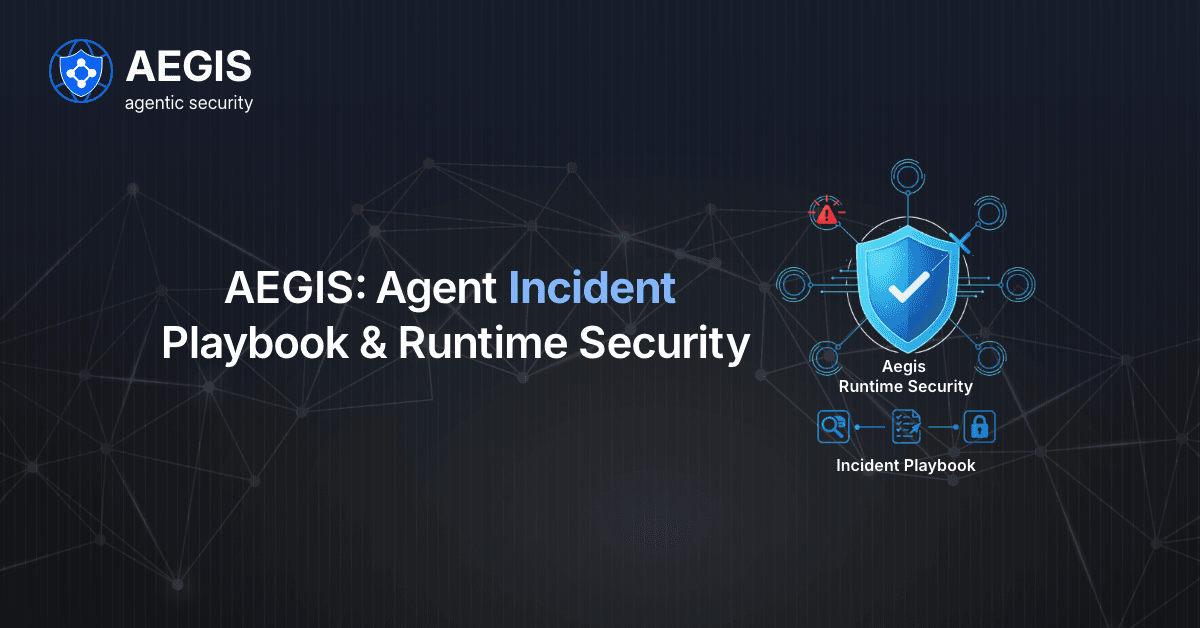
Aegis: Agent Incident Playbook & Runtime Security
Autonomous agents accelerate workflows but escalate risk: compromised agents can exfiltrate data, perform unauthorized payments, or trigger cascading automation across tenants. This post gives a concise, operational playbook for detection, containment, forensics and remediation tailored to multi-agent production systems and describes how Aegis — a runtime policy and observability gateway — addresses each stage. It’s written for security engineers, platform leads, and MSSPs who need concrete steps, automation levers, and measurable KPIs.
Detection signals
What to watch for (high-fidelity signals)
- Unusual tool invocation patterns: spike in calls from one agent, repeated denied actions, or bursty parameter distributions.
- Egress anomalies: outbound connections to unknown domains, unusual TLS fingerprints, or sudden use of new endpoints.
- Approval flood or throttle events: a sudden rise in approval_needed requests can indicate a rogue workflow trying to bypass human approvals.
- Cost & budget alerts: rapid budget exhaustion or spike in high-cost API calls from a single agent.
- Telemetry contradictions: traces where parent_agent_id or call chain mismatches the expected orchestration graph.
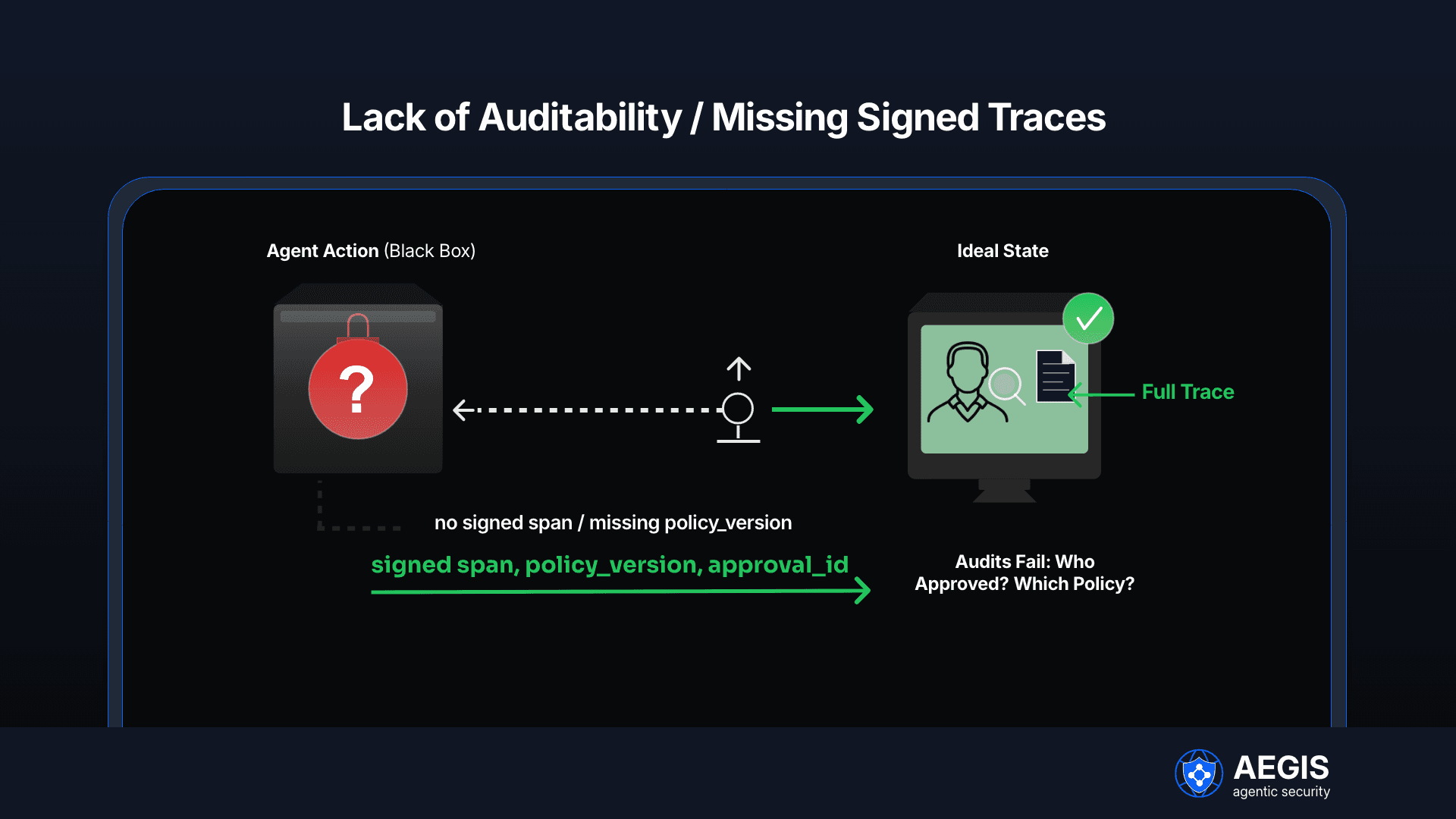
Operational note: emit OpenTelemetry spans per agent-tool call (decision, reason, policy_version). OpenTelemetry adoption continues to grow in production, with collector deployments and stabilization efforts documented by the OpenTelemetry project. (OpenTelemetry)
Signal quality and correlation
Correlate OTel spans with signed audit logs and SIEM alerts. Prioritize signals that match multiple dimensions (agent identity + unusual egress + budget breach). Use a severity score to drive automatic containment thresholds.
Containment playbook (step-by-step)
Immediate triage (first 5–15 minutes)
- Triage alert and snapshot context: agent_id, tenant_id, policy_version, approval_id, recent spans.
- Scope kill decision: choose scoped kill (revoke tokens for a single agent ID or session) rather than mass revocation to avoid multi-tenant collateral.
- Apply gateway block: set gateway rule to block egress for the agent_id and for the implicated destination(s).
- Open incident ticket, assign roles (SOC analyst, policy owner, platform engineer, legal/compliance).
Scoped kill vs mass revocation
Scoped kills revoke only the agent identity, session tokens, or override tokens. Mass revocation is Dangerous in multi-tenant systems and should be used only with explicit playbook approval because it can disrupt many tenants.
Containment automation levers
- Automated kill switch for agent ID (with audit trail).
- Budget exhaustion enforcement that automatically throttles or denies calls beyond set budgets.
- Auto-rollback of the latest policy version if a misconfiguration is suspected.
Example — real-time prevention: an agent attempts to exfiltrate PII to an unknown domain; gateway blocks the egress, SOC sees the trace, revokes the agent token, and initiates sandbox replay for forensic analysis.
Forensics & remediation
Forensics workflow
- Preserve signed audit logs and OTel traces; persist a sanitized payload snapshot (remove secrets). Signed logs maintain chain of custody for compliance.
- Replay traces in an isolated sandbox to reproduce the sequence without risking production (replay must use sanitized inputs).
- Capture payload snapshots, approval queue snapshots, and any external HTTP responses to reconstruct cause.
- Produce an incident report mapped to compliance fields: affected agents, policy_version, approvals, mitigation steps.
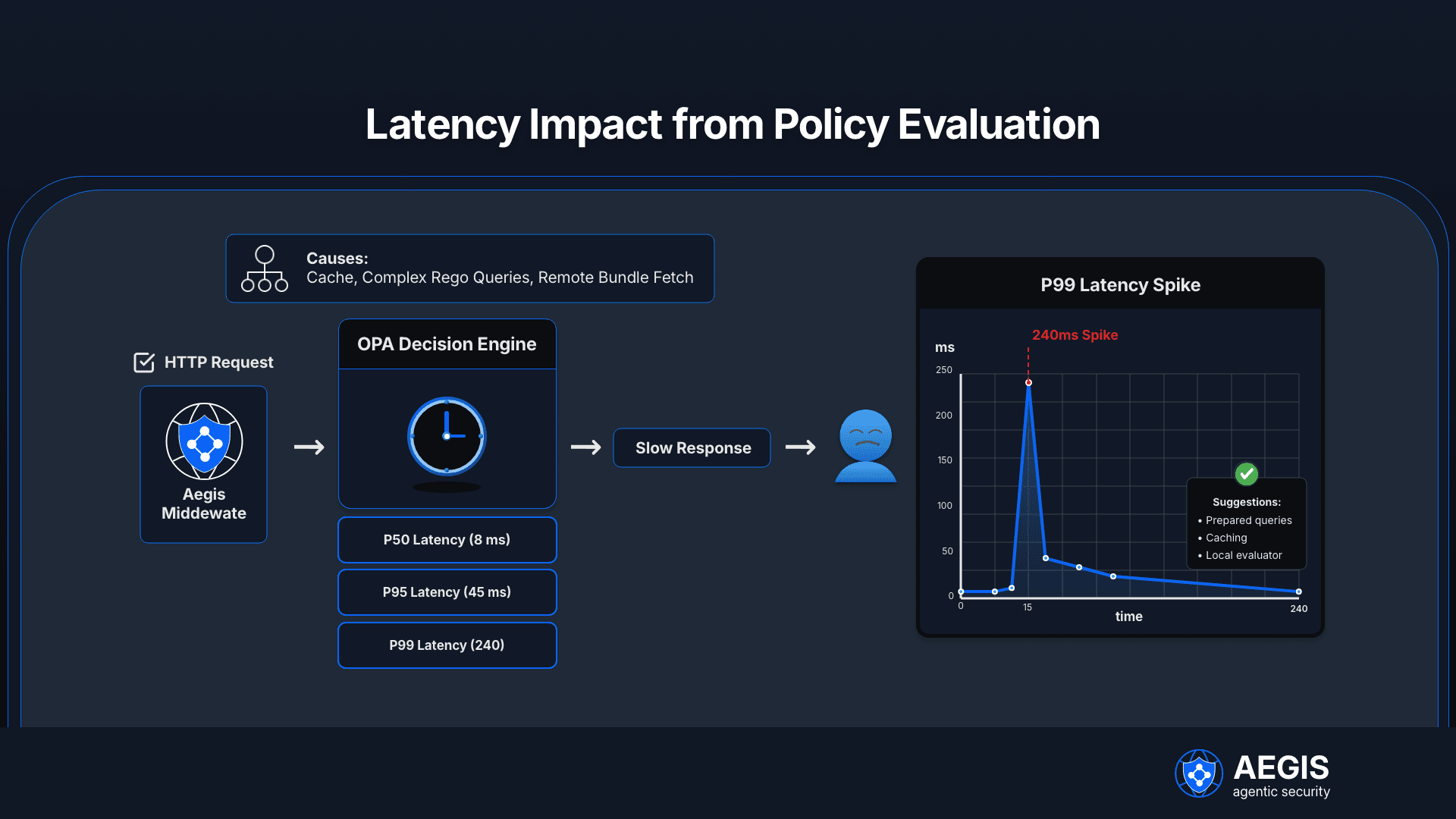
Tools to integrate: SIEM for correlation, OTel traces for timelines, and signed logs for chain-of-custody. Open Policy Agent (OPA) remains the de facto policy engine for such policy-as-code approaches and is commonly used where low-latency, auditable decisions are required. (CNCF)
Remediation steps
- Revoke credentials (agent tokens, override tokens).
- Apply policy rollback if recent policy change led to an unintended allowance.
- Patch agent code or orchestrator workflows if exploitation originated from prompt injection or parameter handling.
- Incrementally re-enable agent with monitoring and a canary policy (shadow → enforce).
Table: Incident type → containment action → evidence to collect
Incident type | Containment action | Evidence to collect |
Data exfiltration to unknown domain | Gateway block + revoke agent token | OTel spans, egress request logs, payload snapshot (sanitized) |
Unauthorized high-value payment | Pause call, require approval, revoke tokens | Payment request payload, approval_id, policy_version |
Rogue agent spawning | Scoped kill for spawned agents, throttle creation | Agent registry events, creation call traces, parent_agent_id |
Approval-flood (automation abuse) | Throttle approvals, add rate limit | Approval queue snapshot, timestamps, requester agent_id |
Aegis Gateway as a Solution
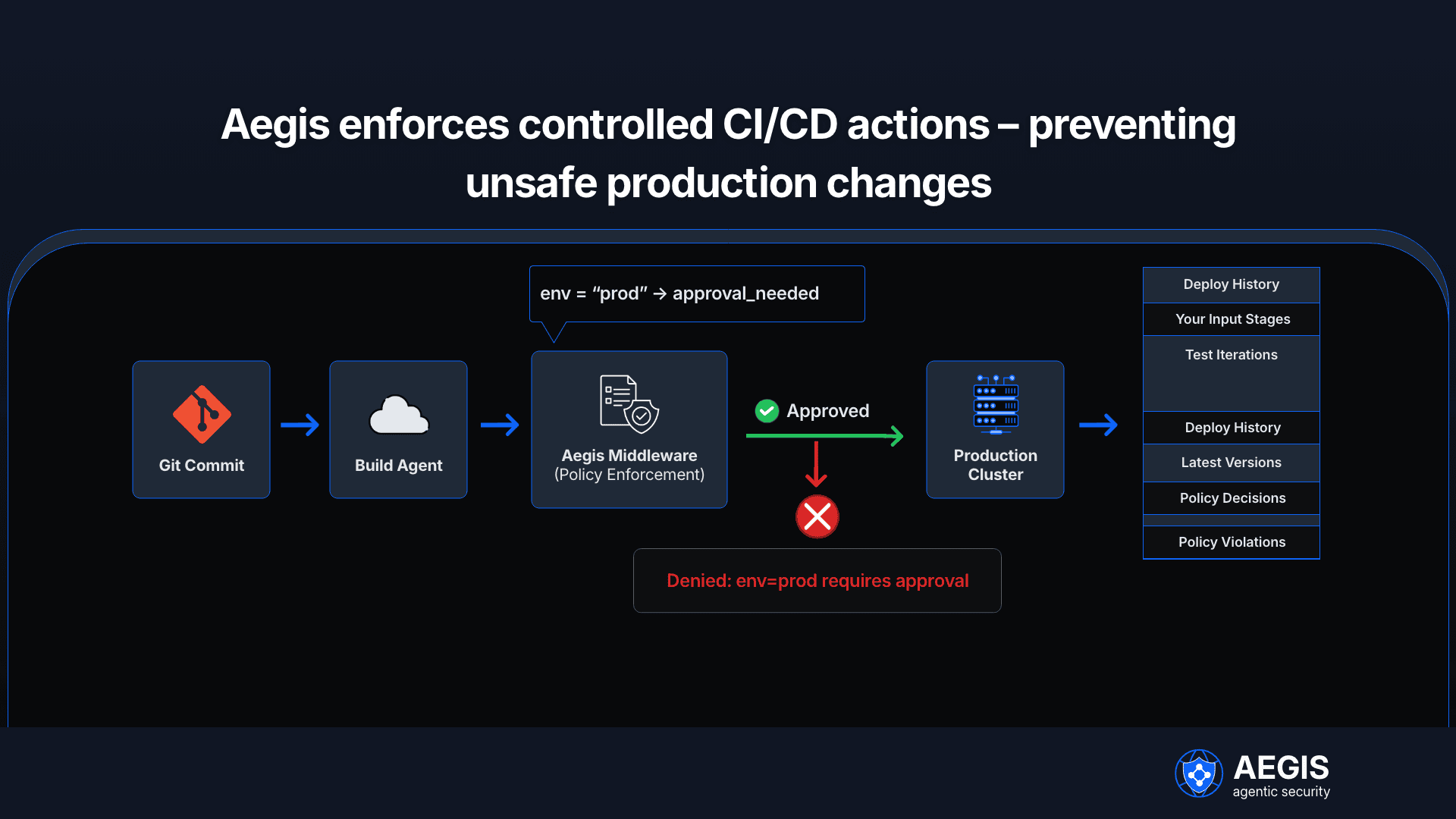
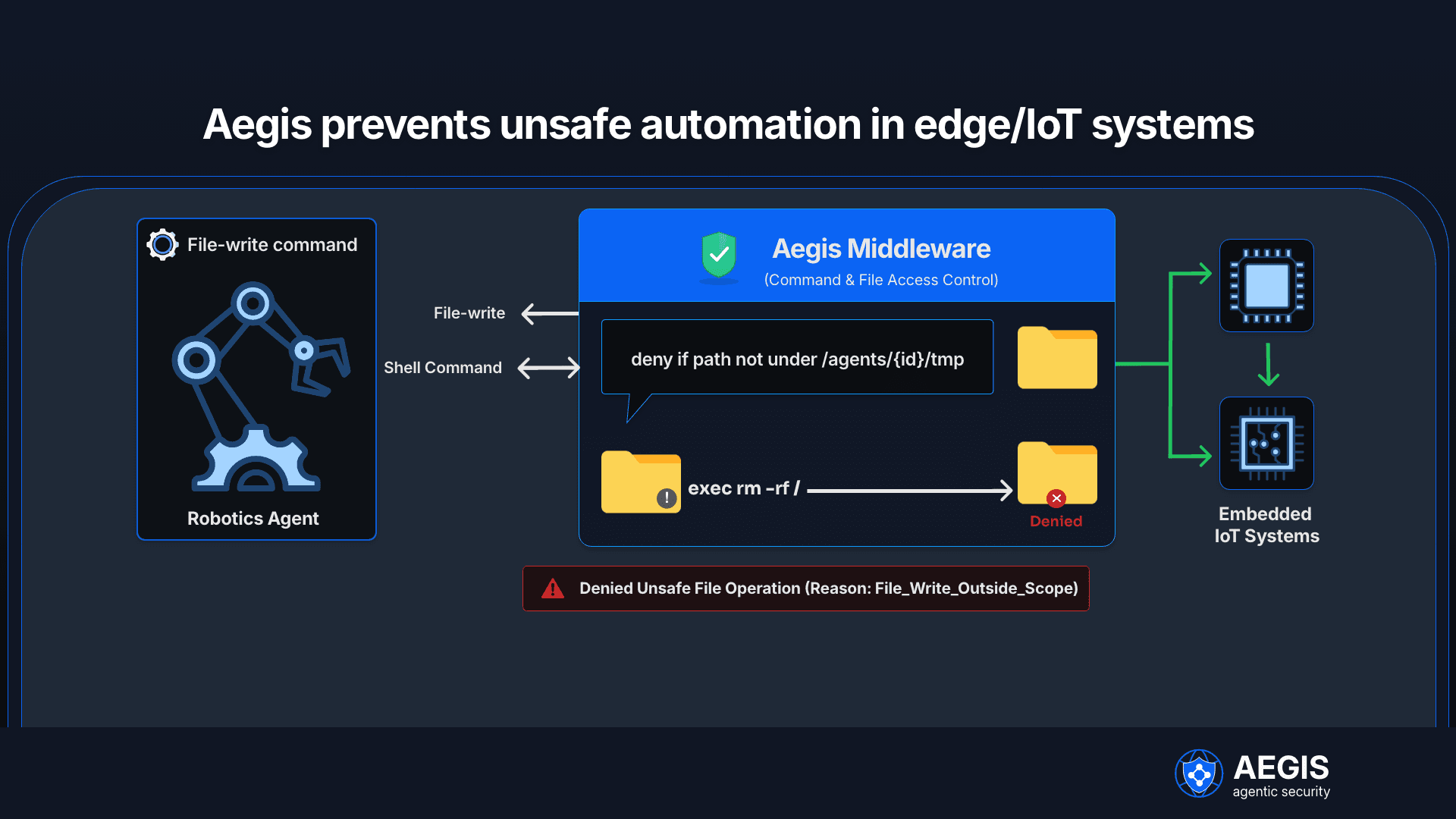
Aegis is a runtime policy and observability gateway that enforces least privilege at the agent↔tool boundary. It functions as a sidecar or forward proxy (Envoy ext_authz pattern) and integrates OPA-style policy bundles with OpenTelemetry spans, short-lived signing tokens, and an approvals service.
How Aegis enforces and responds
- Identity & tokens: agents register with Aegis and receive short-lived JWTs with agent_id, tenant, and scopes. Tokens can be revoked instantly by the control plane to execute a scoped kill.
- Runtime policy evaluation: policies are authored as YAML/JSON, compiled into bundles and evaluated with prepared OPA queries for sub-20ms decision latency at P99. Decisions include allow, deny, sanitize, and approval_needed.
- Observability & audit: every decision emits an OTel span with decision metadata (policy_version, reason, approval_id), and audit logs can be signed to preserve chain of custody.
- Automation & approvals: for approval_needed outcomes, Aegis posts interactive approvals to Slack/MS Teams and mints an override token on manual approval. It also supports shadow mode for tuning policies before enforcement.
- Incident automation: Aegis supports automated kill switches, budget exhaustion enforcement, and policy auto-rollback to remediate incidents rapidly.
Operational benefits for MSSPs and platform teams include tenant-scoped enforcement, multi-tenant isolation, FinOps visibility (per-agent budgets), and the ability to run tabletop exercises or live drills with shadow agents to validate responses.
Table: Aegis capability comparison (conceptual)
Capability | Traditional gateway | Aegis (agent mesh) |
Per-agent parameter inspection | No | Yes |
Approval workflow integration | Partial | Native (Slack/Teams) |
Signed audit chain | Rare | Yes |
Per-agent budgets & throttles | No | Yes |
Shadow mode for policies | Limited | Native |
Playbook templates (high-risk examples)
- High-risk payment: require approval_needed for amount > threshold and log approval_id.
- Data exfiltration: egress allowlist + DLP sanitization for outbound payloads.
- Rogue agent spawning: rate limits + parent_agent_id validation.
- Approval-flood: per-agent approval caps and throttles.
KPIs to track: mean time to isolate (MTTI), time to revoke credentials, incidents per quarter, number of would-block events in shadow mode, and percentage of incidents resolved by automated actions.
.png&w=3840&q=75)
Testing regimen and governance
- Table-top exercises: walk through scenarios with SOC, policy owners, platform engineers, and legal.
- Live drills: shadow agents that simulate exfiltration or payment attempts.
- Purple-team prompt injection exercises: validate DLP, parameter sanitizers, and approval flows.
- CI integration: encode lessons learned as policy tests added to CI for automatic regression checks.
Automation caveats & role mapping
Automation caveat: avoid reflexive mass revocation in multi-tenant systems. Use scoped kills, tenant scoping, and verification gates. Map roles clearly: SOC analyst (triage & initial kill), policy owner (evaluate and change policy), platform engineer (apply rollout & rollback), legal/compliance (preserve chain of custody).
Compliance & legal notes
Preserve signed logs and audit manifests for evidentiary trails. Maintain sanitized payloads for forensic reproduction without exposing secrets. Map incident report fields to regulatory requirements: affected agents, policy_version, approvals, mitigation steps.
Recommended integrations & links
- Integrate OTel spans into your SIEM and dashboards for traceable timelines (OpenTelemetry resources). (OpenTelemetry)
- Leverage OPA bundles for prepared queries and low latency decisions (see OPA project pages). (CNCF)
Frequently Asked Questions
- What is a scoped kill?
A scoped kill targets a single agent identity or session token, revoking its credentials and blocking further actions without impacting other tenants. - How do you preserve chain of custody?
Sign audit logs (hash chain or signature) at write time and store signed manifests alongside OTel trace IDs and policy_version metadata. - When should we use shadow mode?
Use shadow mode for at least one release cycle to collect would-deny metrics and tune policies before flipping enforcement on. - Can approvals scale?
Yes — use thresholds and rate limits to reduce low-value approvals; batch low-risk approvals or use human-in-the-loop only for high-risk actions. - How do you avoid denial of service from an automated kill switch?
Implement verification guards, scoped kills, and manual override workflows; avoid global token revocations unless absolutely necessary. - What KPIs should an MSSP report?
MTTI, time to revoke credentials, incidents per tenant per quarter, percent automated remediation, and policy false positive rate.