
It’s Not What AI Knows—It’s What AI Does: Securing AI Actions
Shift your security focus from model outputs to runtime actions. Learn how to secure the AI execution layer using the Aegis runtime defense framework.
It’s Not What AI Knows—It’s What AI Does: Securing AI Actions
Enterprise artificial intelligence has officially moved past the conversational era. The early wave of deployment focused almost entirely on passive assistants—chatbots optimized to summarize documentation, synthesize text, and answer user queries. Consequently, security frameworks emerged to protect the conversational edges: filtering prompts, sanitizing model inputs, and inspecting static outputs for data leakage.
But when an enterprise transitions from an AI assistant to an autonomous Agentic AI system, the security perimeter shifts completely. Modern agents do not just generate responses; they execute actions. They interface directly with corporate systems of record: querying internal databases, triggering multi-cloud production workflows, mutating CRM indices, calling external SaaS APIs, and consuming budgets dynamically.
At this scale, the primary risk surface is no longer what the system says (Prompt Risk), but what the system does (Execution Risk). Securing this environment requires an architectural shift: we must move from conversational guardrails to runtime action interception.
1. Dual Dimensions of the AI Attack Surface
A robust enterprise security posture must balance two deeply interconnected but distinct dimensions of artificial intelligence architecture: leveraging AI as a defensive asset while simultaneously establishing an infrastructure matrix to secure AI models from targeted exploitation.
1.1. AI in Cybersecurity: Automating the Defense
By automating threat detection, prevention, and remediation, machine learning and deep learning algorithms process massive telemetry arrays—such as network traffic trends, application usage metrics, browsing habits, and cross-cloud login logs—to establish a baseline of normal host and entity behavior.
Any activity that shifts outside this baseline is instantly flagged as an anomaly, allowing Security Operations Centers (SOCs) to contain zero-day or fileless Living-off-the-Land (LOTL) attacks before they escalate.
1.2. Securing AI Deployments: Protecting the Processor
As models handle highly consequential corporate decisions, they become primary targets for adversarial manipulation. Because AI models operate in probabilistic, stochastic environments, they are vulnerable to unique attack vectors that standard network firewalls cannot detect.
- Adversarial Attacks: Intentionally manipulated input data designed to exploit vulnerabilities in machine learning algorithms, causing models to produce incorrect, biased, or harmful outputs.
- Prompt Injection: Explating large language models (LLMs) by injecting malicious instructions into the context window, tricking the agent into executing unauthorized actions like deleting files or exposing internal system paths.
- Data Poisoning: Deliberately tampering with training data or vector database retrieval sources during the development or fine-tuning phase to degrade performance or create hidden backdoors.
2. Why Actions Break Traditional Perimeters
Traditional enterprise security controls are built on a fundamental assumption: an authenticated identity is tied to a human user or a highly deterministic piece of software following a fixed code path. Firewalls trust the connection, and IAM directories grant the permission because the session has been validated at the edge.
Agents break this model completely. An agent acts on its own initiative, chaining together multi-step plans and calling tools over extended time horizons. When a model encounters a prompt injection or a poisoned RAG (Retrieval-Augmented Generation) source, it remains a fully authenticated, valid identity. It uses legitimate credentials and authorized APIs to perform actions that collectively violate corporate policy or compliance mandates.
This architecture proves why traditional user-centric IAM cannot govern autonomous behavior. If an agent is granted broad, standing access to tools, it can execute an irreversible real-world state change—such as triggering an unauthorized $10,000 transaction refund or leaking patient medical history to an unvetted third-party caterer—at machine speed long before a human analyst can review the log.
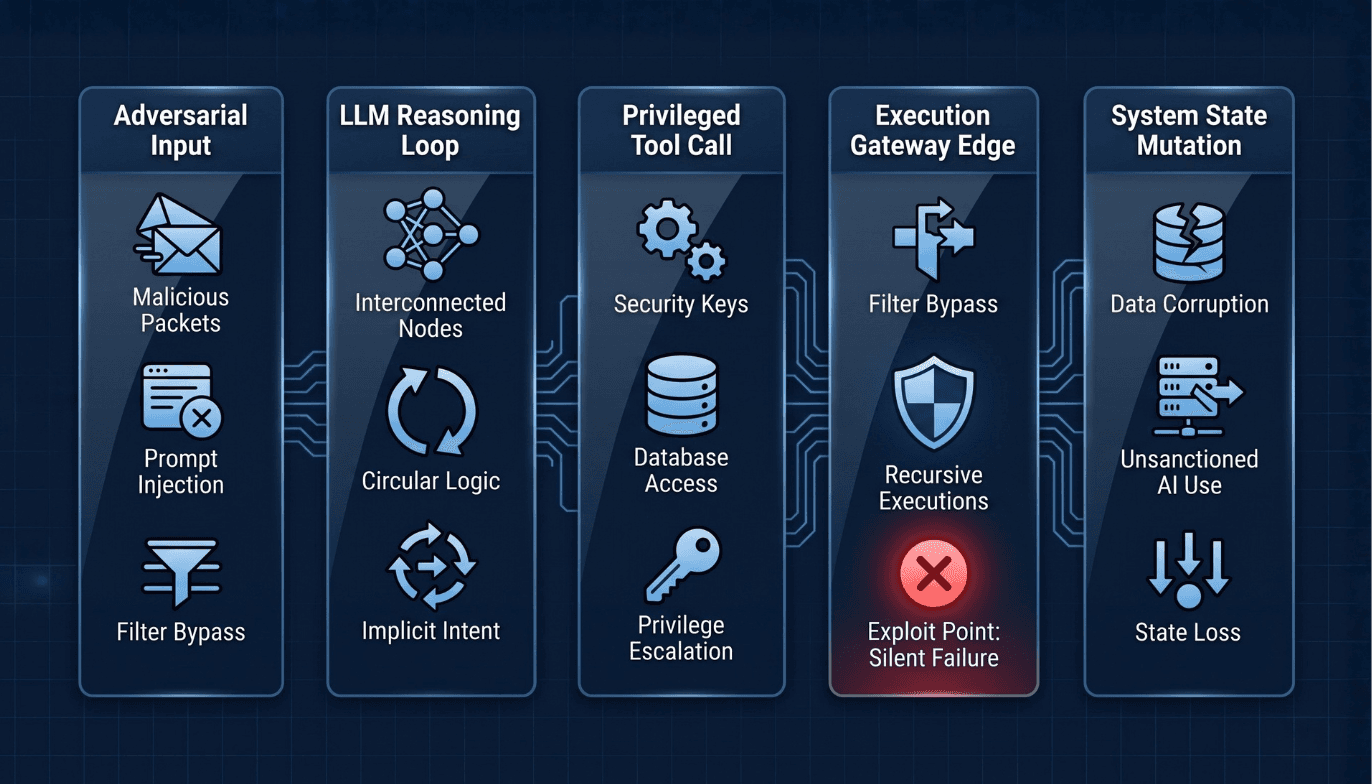
3. The Aegis Blueprint: Runtime Interception Layer
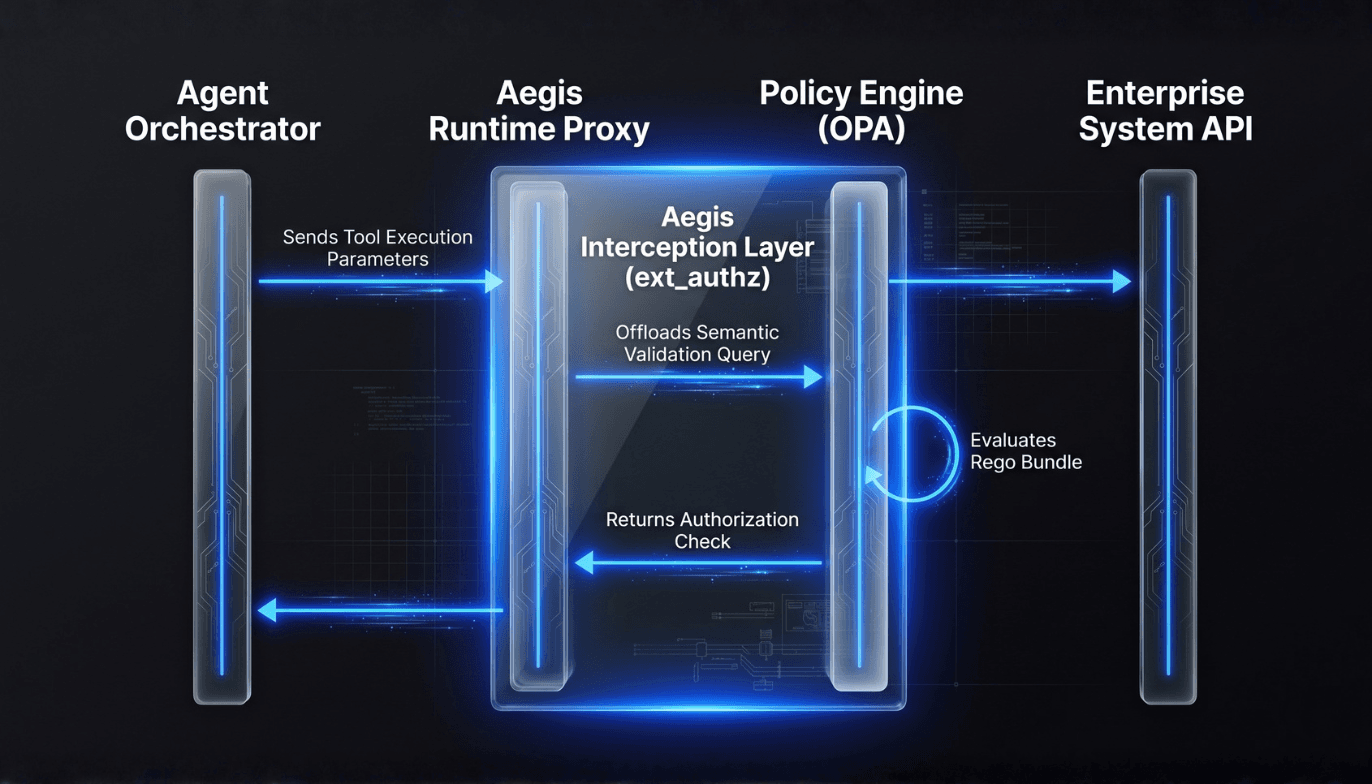
Mitigating action-level risk requires a decoupled control plane that completely separates the model's reasoning engine (the brain) from the execution of capabilities within your corporate network (the hands). Security teams must implement a Runtime AI Gateway pattern that intercepts every outbound tool call before any side effects can hit production resources.
Operating at the infrastructure boundary, the Aegis Runtime Interception Layer evaluates every proposed transaction against centralized, versioned rules using an external authorization (ext_authz) pattern:
- Enforce Policy Outside the Model: LLMs cannot self-regulate. Prompts, system instructions, and reinforcement learning weights are bypassable. Policies must execute in an independent proxy layer (such as an Envoy gateway configuration) that inspects payloads out-of-band.
- Shift to Semantic Evaluation: Traditional regex patterns and keyword matching fail against paraphrasing or synthesis. The policy engine must evaluate the semantic meaning and context of the payload (e.g., verifying parameter ranges, data classification tiers, and transactional limits).
- Treat Outputs as Untrusted: Models can leak internal configuration tokens or combine data domains across permission boundaries even when inputs appear completely clean. Post-generation output filtering—including redaction, summarization, or response truncation—is applied continuously.
4. The Multi-Layered Safety Architecture
Implementing comprehensive AI risk management requires structuring security into four distinct, automated operational layers across the entire system lifecycle:
- Layer 1: Threat Detection and Anomaly Scoring: The system continuously monitors network events, data movement, and tool call velocities to build a mathematical baseline of normal system behavior. Any out-of-place activity—such as a sudden surge in traffic or unfamiliar API command sequences—is instantly scored and flagged.
- Layer 2: Automation and Response (Agentic Triage): When an anomaly crosses defined risk thresholds, the system fires automated containment runbooks. Rather than waiting hours for manual triage, an automated script can immediately rotate compromised credentials, isolate affected computing nodes, or revoke short-lived access tokens.
- Layer 3: In-Path Runtime Protections: Employs dedicated LLM firewalls and semantic content inspection blocks directly within the streaming data pipeline to prevent prompt injections, inspect data sensitivity tags, and neutralize data poisoning attempts before the data touches production schemas.
- Layer 4: Regular Audits and Drift Tracking: Algorithms evolve over time due to shifts in input distributions or underlying model updates. This layer tracks Model Drift and Decay using metrics like the Population Stability Index (PSI), executing scheduled revalidation fire drills and adversarial red-teaming to ensure controls remain hardened.
5. Operational Framework for Enterprise AI Risk
To turn high-level data governance policies into machine-enforceable controls, organizations must operationalize five core deployment pillars:
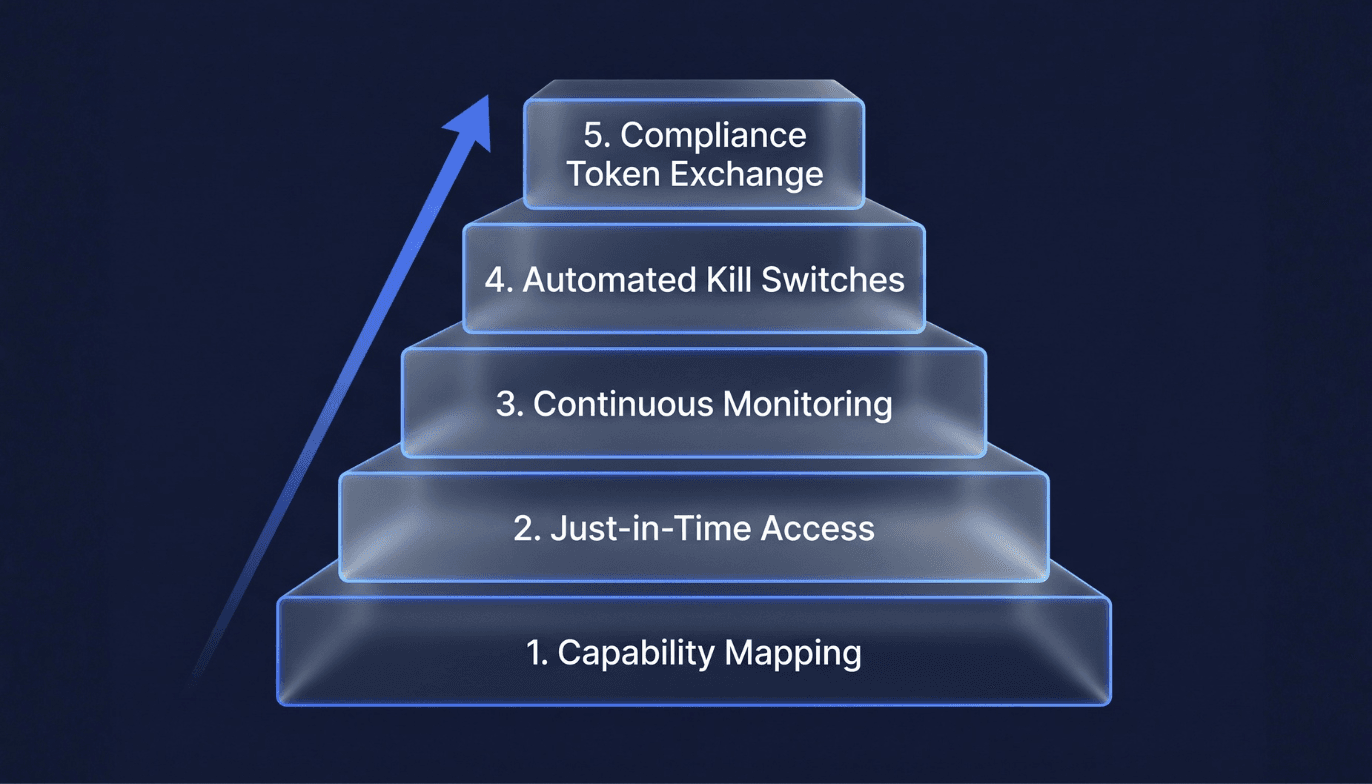
- Pillar 1: Capability Mapping & Risk Assessment: Document every deployed agent, its underlying system dependencies, available tool APIs, and data access paths. Classify each use case not by its technology type, but by its Business Consequence (e.g., an internal summarizer vs. an autonomous pricing engine).
- Pillar 2: Just-in-Time Access Control: Eliminate permanent, broad standing roles for machine identities. Implement Intent-Based Access Control, provisioning fine-grained, short-lived credentials via secure token exchange vaults that expire automatically the millisecond a discrete task completes.
- Pillar 3: Continuous Monitoring & Telemetry Tracing: Migrate from flat request logs to deep execution traces. Using standards like OpenTelemetry, the system captures the end-to-end trace of why an action was proposed, what contextual data preceded it, and which policy engine rules were triggered.
- Pillar 4: Automated Kill Switches: Build tiered infrastructure circuit breakers that give security leaders the ability to execute an immediate multi-workflow termination. If an autonomous fleet exhibits erratic behavioral drift, the kill switch freezes connected APIs and quarantines workloads simultaneously without taking down adjacent business applications.
- Pillar 5: Compliance and Verification Ledger: Translate real-time security checking into unchangeable documentation required by international standards (NIST AI RMF, ISO/IEC 42001, and the EU AI Act). The platform compiles runtime traces into cryptographically signed snapshot artifacts, saving them to write-once-read-many (WORM) storage to serve as verified evidence loops for external auditors.
6. The Agentic SOC: Deploying AI to Monitor AI
The structural latency inherent in traditional, human-dependent Security Operations Centers represents a critical failure vector when defending against compromised machine identities. If an agent hijacked by a prompt injection attack can execute an unauthorized data extraction, modify access rules, and clear its own local logs in under ninety seconds, a human triage loop measured in hours is no longer an active security control; it is merely a post-mortem reporting mechanism.
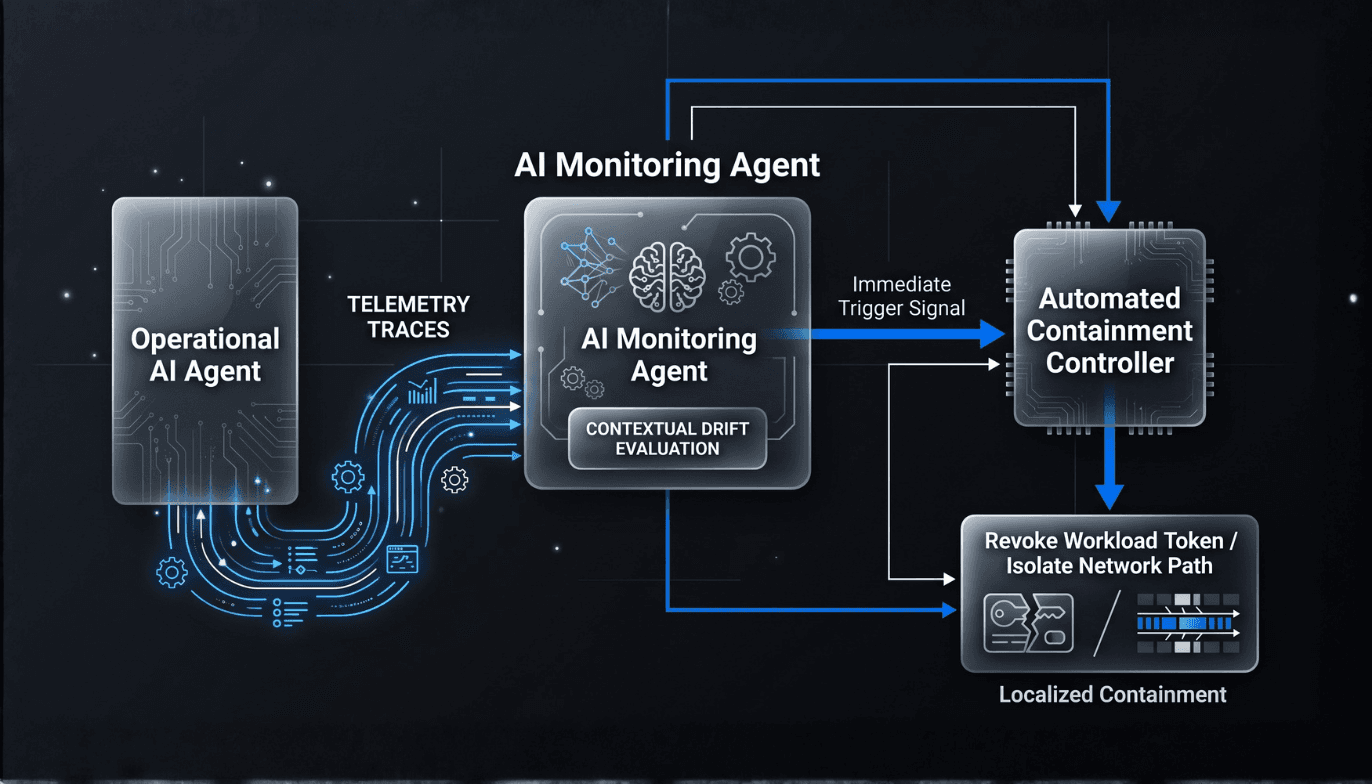
The only architecturally coherent defense against a threat moving at machine speed is the implementation of an Agentic SOC: an operational environment where specialized AI monitoring agents continuously govern operational AI agents.
In this architecture, autonomous monitoring agents run out-of-band alongside primary enterprise workflows, streaming thin execution traces via real-time telemetry loops. These monitoring nodes apply localized reinforcement learning to refine their behavioral baselines.
The moment an operational agent's path drifts past defined risk thresholds, the monitoring agent executes an instant containment protocol: it signals the identity vault to revoke the target workload's active token, modifies gateway routing tables to isolate the container at the network edge, and flags the trace logs for human engineering teams. Human operators move away from manual first response, stepping up to serve as systemic commanders who set policy bounds and optimize risk parameters, while the machine-speed runtime layer handles the volume that human attention cannot sustain.
Conclusion: Control Enables Scale
Enterprise operations frequently lose control of artificial intelligence because their policies exist strictly on paper, disconnected from the actual systems running inside the business. A written principle cannot govern a non-deterministic model that acts, adapts, and scales at machine speed.
Securing the agentic workforce is not a theoretical compliance challenge—it is an infrastructure control challenge. By decoupling global policy-as-code management from underlying application logic, implementing automated real-time interception via runtime gateways, and anchoring response speeds with an Agentic SOC architecture, organizations can confidently mitigate risk while accelerating innovation. Stop asking exclusively if your model is capable; ask if your infrastructure is ready to govern its execution. Secure the action layer, and your enterprise can scale autonomous intelligence with absolute confidence.
Frequently Asked Questions (FAQ)
Q1: Why are traditional input-filtering guardrails insufficient for securing AI agents?
A: Conversational guardrails and input filters are "soft controls" that evaluate syntax and vocabulary. They operate inside the probabilistic environment of the LLM and can be systematically bypassed via prompt injection or context manipulation. True action-level protection requires "hard controls"—Runtime Enforcement—that reside completely outside the model's environment, evaluating the semantic intent and parameter payload of tool calls at the infrastructure layer before state changes occur.
Q2: How does a Runtime AI Gateway impact core system latency?
A: When implementing a high-performance proxy layer (such as Envoy) alongside localized Open Policy Agent (OPA) sidecar engines, the infrastructure latency overhead is sub-millisecond. Because typical enterprise agentic workflows already incur large LLM inference wait times ranging from 500ms to 2 seconds, this sub-millisecond gateway tax is mathematically negligible and represents a necessary trade-off for real-time protection.
Q3: Can we manage agent risk using existing Role-Based Access Control (RBAC)?
A: No. Standard RBAC is too coarse-grained to regulate stochastic agent behaviors. While an IAM role can decide whether an account has permission to interface with a target CRM database, a Policy-as-Code engine (like OPA) inspects the deep runtime payload of the call, enforcing fine-grained, context-based constraints such as: "Allow this agent to write record updates, but only if the customer profile is designated 'Tier 1' and the transaction value is under $5,000."
Q4: What is the benefit of deploying security policies in "Shadow Mode"?
A: Shadow mode allows security architecture teams to test new Policy-as-Code configurations in a non-blocking "dry-run" state. The runtime gateway intercepts live agent workflows, evaluates the proposed payloads against the OPA definitions, and logs whether an action would have been blocked without actually dropping the network packet. This allows platform teams to eliminate false positives and fine-tune rules without breaking live production systems.
Q5: What is "Model Drift" and how does it compromise enterprise compliance?
A: Model drift is the gradual decay of an algorithm's performance that occurs when real-world production data shifts away from the datasets used during initial training. A model that passed a rigorous safety or bias audit during deployment can drift silently over time, generating non-compliant, inaccurate, or discriminatory outcomes without crashing the underlying software application.
Q6: How does OpenTelemetry support forensic auditing in an agentic ecosystem?
A: OpenTelemetry acts as the definitive "flight recorder" for autonomous agents. Instead of generating flat, text-based log files, it logs an end-to-end, trace-linked record tracking exactly why a tool was called, what contextual data preceded it, which specific policy engine filters fired, and how costs or retries accumulated along that execution path—essential for root-cause forensic analysis and regulatory audit validation.
Q7: Who should ultimately own AI risk within a large organization?
A: AI governance fails when it lacks clear, distributed ownership. Mature governance models mandate a clear allocation of responsibility: the line-of-business team owns the use case and the final business outcome; platform engineering owns the architecture and integration discipline; risk and compliance teams define the policy thresholds; and security infrastructure owns the model interfaces, non-human identities, and runtime interception layers.
Q8: How do international frameworks like the EU AI Act impact post-deployment architecture?
A: The EU AI Act and emerging regional legislations move compliance away from design-time documentation toward demonstrable runtime enforcement. Organizations must be able to prove that high-risk AI workflows are subject to continuous post-deployment monitoring, automated logging of automated choices, human-on-the-loop oversight mechanisms, and active safeguards capable of terminating an interaction the moment an anomaly is detected.