How to Build an AI Agent Inventory: Enterprise Guide
Step-by-step technical blueprint to construct a real-time AI agent inventory. Learn how to execute multi-plane correlation to find shadow AI agents.
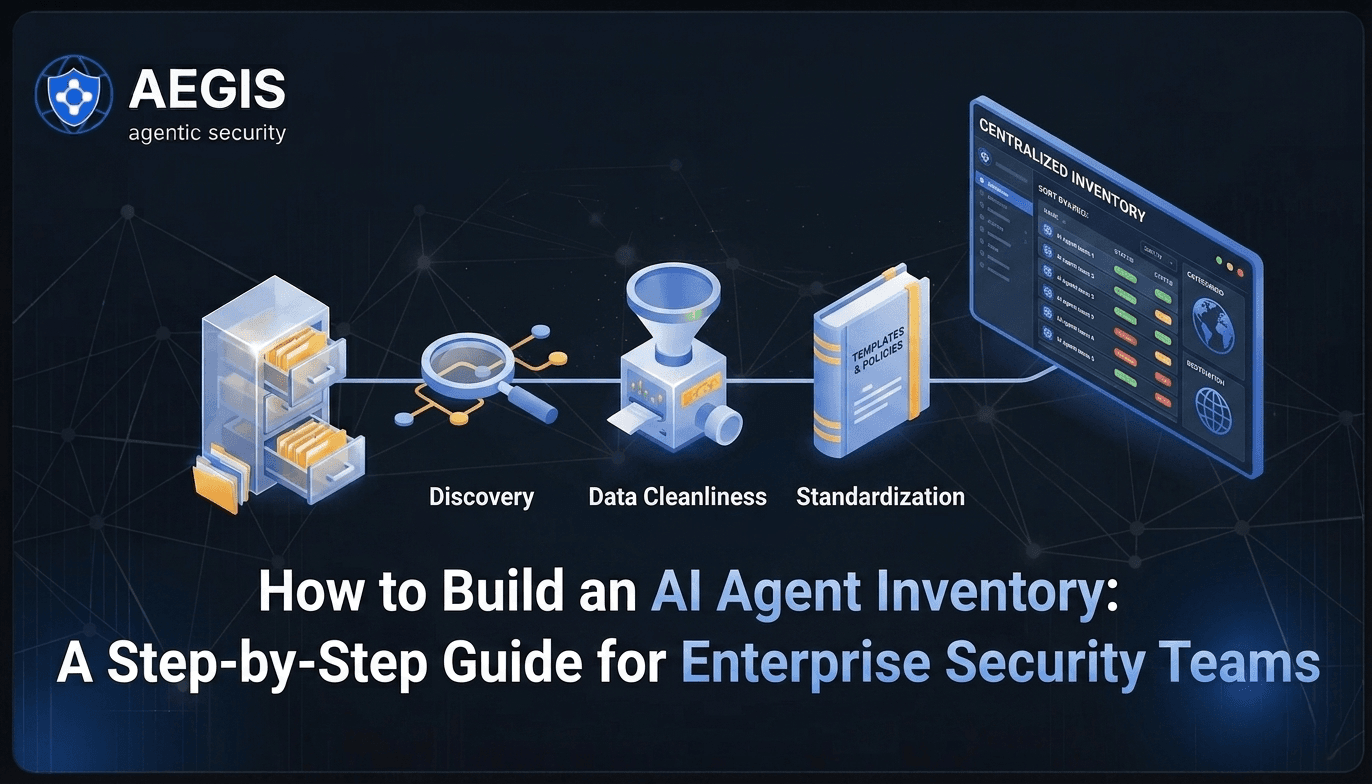
How to Build an AI Agent Inventory: A Step-by-Step Guide for Enterprise Security Teams
When security teams perform initial, manual assessments of their generative AI footprint, the internal estimate routinely lands between 20 and 30 active deployments—usually confined to a few sanctioned chatbot pilots. However, the moment an automated multi-plane discovery scan is executed, the true data plane emerges: large organizations routinely discover between 200 and 400+ unmanaged, autonomous AI agent instances running across their networks.
This massive governance gap does not occur because of malicious internal actors. It occurs because capability vendors are silently embedding autonomous features, Model Context Protocol (MCP) servers, and agentic workflows directly into the software-as-a-service (SaaS) products teams already use. Every routine application update introduces untracked non-human identities (NHIs) that can reason, chain tools, extract data from databases, and execute system modifications out-of-band from human oversight.
Relying on developers to manually register these assets in a static spreadsheet is an operational failure. In an environment where an unmanaged agent can execute a catastrophic data exfiltration or a non-compliant transaction loop in under ninety seconds, security teams require an actionable blueprint to regain control.
This guide outlines the technical sequence to build an automated, real-time AI Agent Inventory using the Aegis Multi-Plane Correlation Engine.
The Core Philosophy: The Rule of Multi-Plane Corroboration
A basic chatbot interaction involves a single turn: a user inputs text, and the model returns a passive response. An autonomous agent, conversely, operates stochastically across an extended time horizon. It interprets high-level goals, evaluates its environment, selects tools, passes arguments to internal APIs, and executes multi-step plans.
Because an agent is a highly integrated, fluid pipeline—spanning foundation model routing, prompt books, vector database connections, and downstream API endpoints—a single point security solution will miss it. If you only monitor network traffic, an agent appears as standard, encrypted HTTPS queries routing to a trusted domain. If you only look at identity directories, it looks like a standard, authenticated service account.
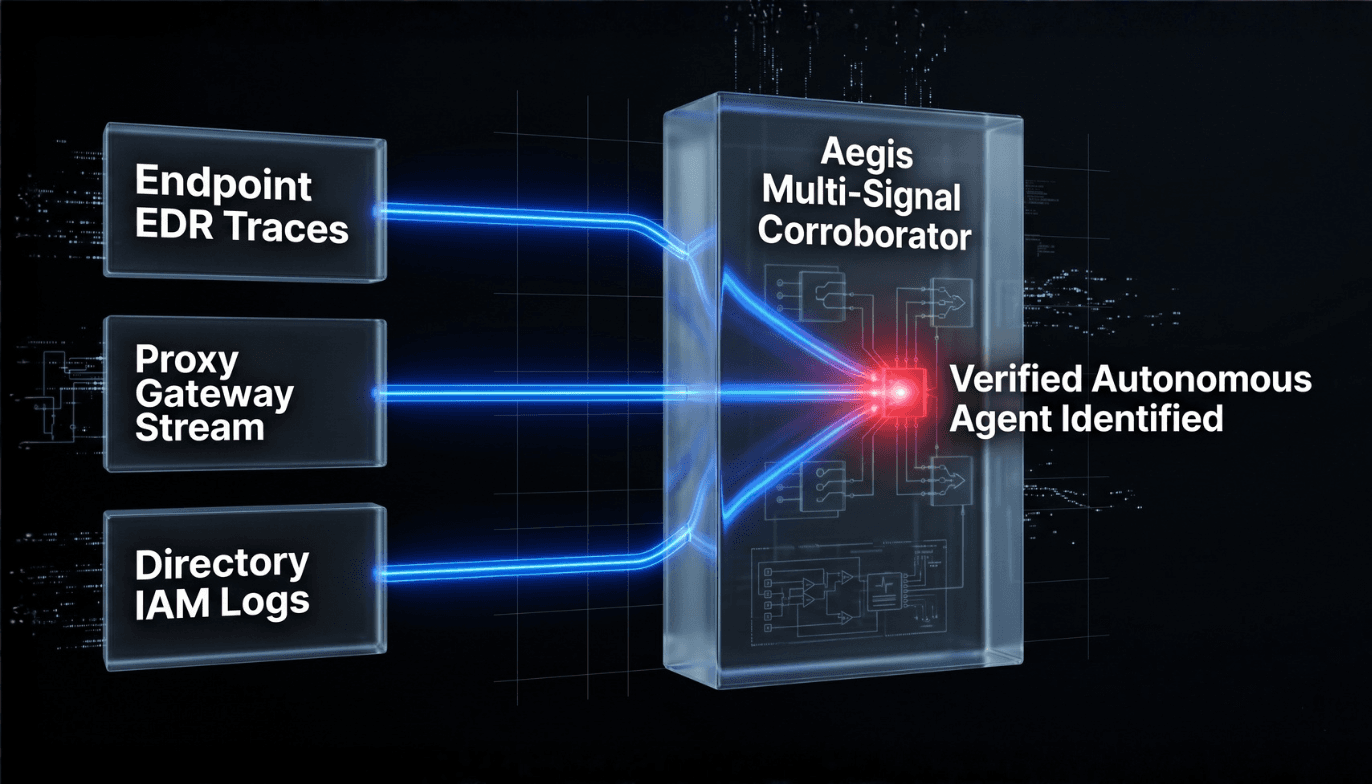
To eliminate this structural blindness, the Aegis architecture enforces the Rule of Multi-Plane Corroboration. The control plane rejects vendor self-attestation or single-signal alerts. An asset is officially cataloged and registered as an active autonomous agent only when anomalous signals correlate concurrently across at least two independent telemetry planes. This multi-plane alignment is what separates raw asset discovery from an actionable, enterprise-grade control inventory.
Architectural Breakdown: The 5 Planes of Telemetry Collection
To build a continuous, real-time inventory, enterprise security teams must tap into five distinct infrastructure planes, routing unstructured signals down into a centralized correlation hub.
The Endpoint Event Loop (EDR)
Monitors low-level system events on local developer and analyst machines. It captures process instantiation paths, command-line arguments, local agent framework activations (e.g., LangChain, CrewAI processes running locally), and high-volume copy-paste telemetry patterns where internal source code or confidential text blocks move from secure files into browser-based windows.
The Identity Provider Surface (IDP)
Monitors the enterprise authentication directory (e.g., Okta, Entra ID, Ping) to catch when an employee signs up for an external model portal using a corporate email address, or when an application creates a new, unmanaged OAuth/JWT token specifically to link a business tool to an external large language model.
The Cloud Infrastructure Log Plane (CSPM & Kubernetes Audit)
Parses active orchestration tracks across AWS, Azure, GCP, and internal Kubernetes environments. It looks for runtime configuration drift, unexpected pod instantiations referencing unvetted model containers, and the sudden deployment of Model Context Protocol (MCP) server endpoints requesting read/write access to production datastores.
The Browser Web Edge Layer
Monitors unmanaged, embedded browser extensions designed for grammar correction, instant summarization, or code completion. Because these plugins quietly bundle hidden machine-learning runtimes that process corporate data externally via background API calls, tracking them at the browser edge is vital to closing data exfiltration channels.
The Transport Layer Decryption Gateway (SSL Intercept)
Executes in-path, out-of-band streaming packet inspection at the network gateway proxy edge. By performing selective SSL decryption on outbound traffic routing to known model domains, it opens up the deep JSON payloads of queries, allowing the policy engine to parse raw arguments, parameter fields, and tool instructions before they can cross the perimeter.
Step-by-Step Guide: Executing the AI Agent Inventory Blueprint
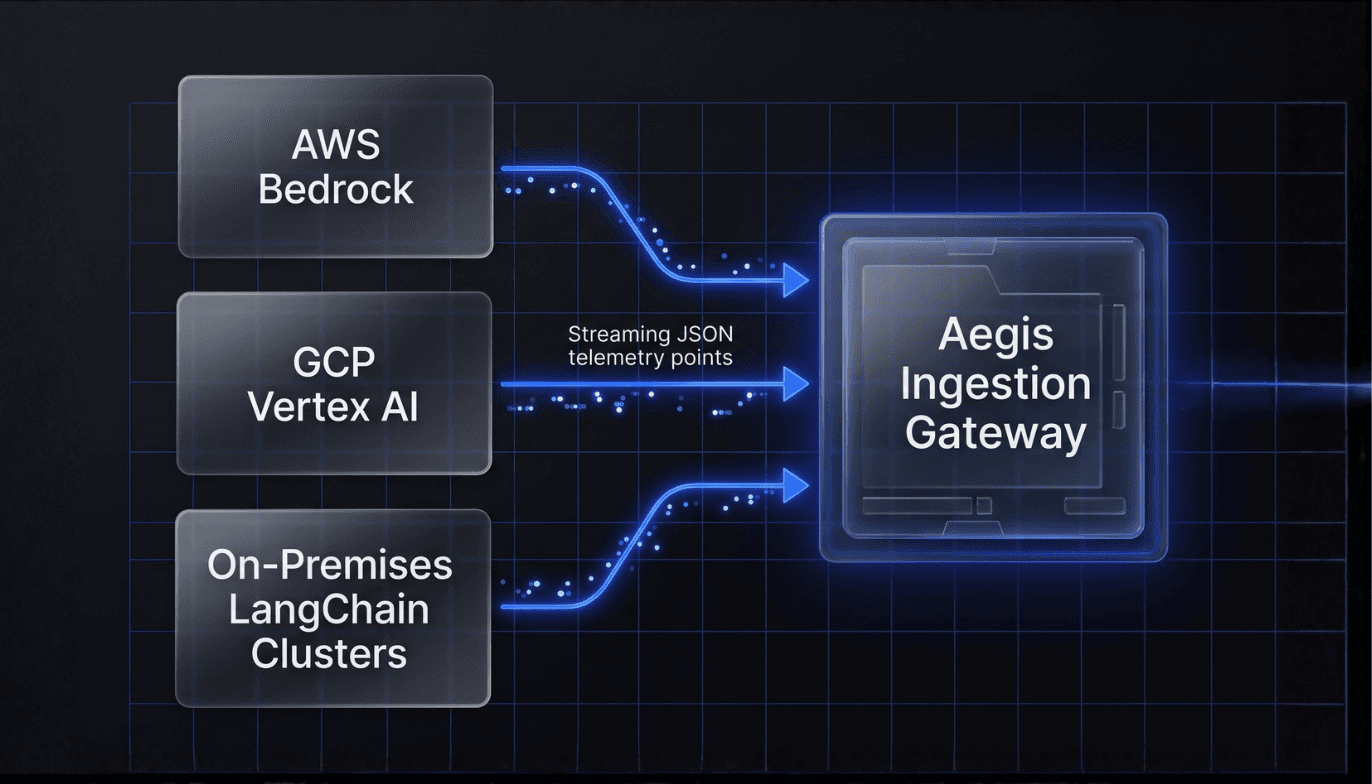
Step 1: Establish Continuous Telemetry Ingestion Across Cloud and API Planes
What to Look For:
Configure your cloud posture managers and log routers to look specifically for outbound API calls to known model hosting endpoints alongside rapid Kubernetes pod creations that mount machine-learning library dependencies. Ensure that all incoming telemetry is enriched with an immutable cryptographic metadata header.
What You'll Miss Without This:
Without continuous ingestion across infrastructure boundaries, you are entirely blind to Ecosystem Sprawl. When an enterprise application silently enables a built-in agent feature via an automated cloud software update, it bypasses traditional procurement gates and runs completely unmonitored.
Step 2: Implement Endpoint Behavior Fingerprinting for Copy-Paste and Process Loops
What to Look For:
Configure your Endpoint Detection and Response (EDR) policy controls to flag patterns of large text blocks being copied from core systems of record (such as code repositories, CRM databases, or internal financial applications) and pasted immediately into browser-based tabs connected to unmapped domains.
What You'll Miss Without This:
Without endpoint event loop tracking, you miss the earliest stages of unmanaged Shadow AI development. Engineers and analysts frequently use public, public-facing chatbots to troubleshoot proprietary algorithms or refine confidential board decks late at night, leaking critical intellectual property into public neural networks where it can never be recalled or deleted.
Step 3: Run the Multi-Plane Correlation Engine to Verify Autonomous Intent
What to Look For:
The correlation engine must evaluate incoming telemetry streams looking for concurrent, intersecting events. If the EDR loop logs a major copy-paste event to a browser tab, and the network proxy detects streaming HTTPS queries to an unmapped model domain at the exact same millisecond, the platform flag matches the signals, identifying an active, unregistered autonomous workflow.
What You'll Miss Without This:
Without cross-plane correlation, you will fall into the trap of false positives and severe Alert Fatigue. Isolated network visibility tools see standard, valid web browsing traffic; traditional DLP engines see unstructured natural language without regex matches. You will remain blind to the machine-speed execution chain weaving the actions together.
Step 4: Construct the Live Canonical AI Agent Registry
What to Look For:
Every corroborated agent must automatically populate a dynamic, write-once-read-many (WORM) central repository. The entry profile cannot be a static text configuration sheet. The database must record seven critical operational metadata fields:
What You'll Miss Without This:
Without a dynamic, dynamic registry, your governance program slips into Spreadsheet Fatigue. Manual asset sheets become obsolete the hour they are compiled because agents spin up, modify code pipelines, and shut down within brief runtime windows. You lose the definitive audit trail needed for regulatory compliance.
Step 5: Embed Real-Time Policy-as-Code Execution Controls
What to Look For:
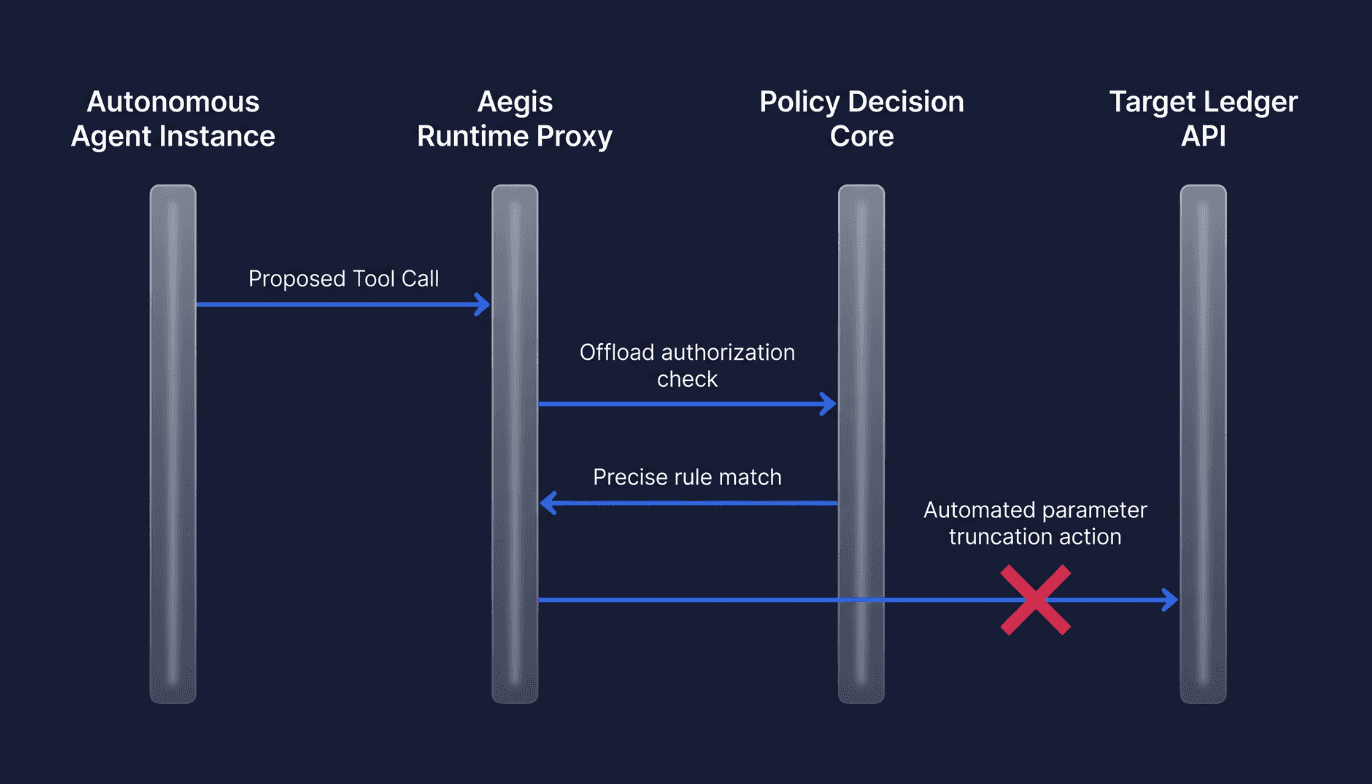
Decouple policy management from the underlying models by deploying a Runtime AI Gateway (using an Envoy proxy configuration running an ext_authz filter primitive). The gateway inspects every outbound tool parameter out-of-band against Open Policy Agent (OPA) policy-as-code bundles before application logic can process the input.
What You'll Miss Without This:
Without in-path runtime execution gating, your security guidelines remain purely aspirational—you are stuck in Policy Theater. Seeing a machine-speed agent drift or violate a compliance rule inside an observability dashboard after the action has executed does not stop the transaction. You must possess the infrastructure capability to block it mid-flight.
Step 6: Deploy the Agentic SOC for Machine-Speed Containment
What to Look For:
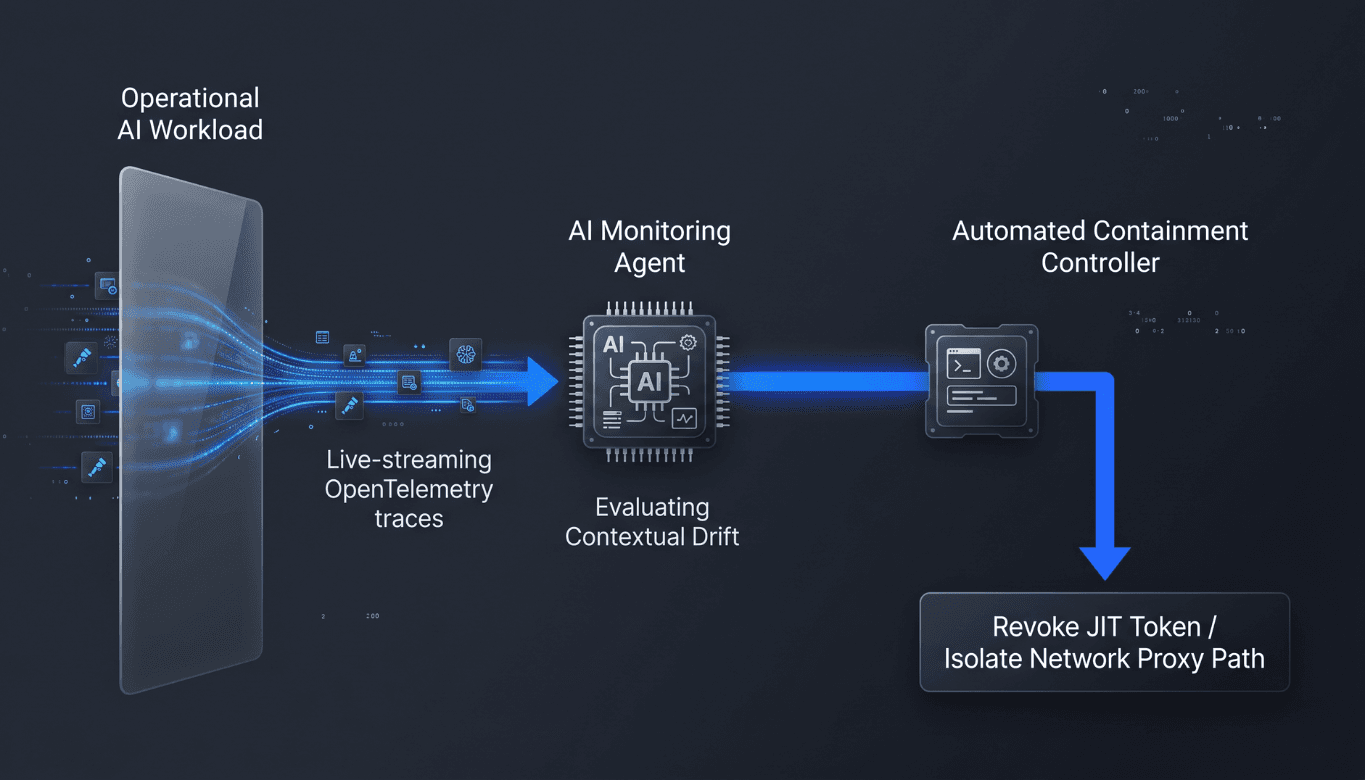
Deploy specialized AI monitoring agents tasked exclusively with overseeing, auditing, and validating the performance traces of your operational business agents. When an operational agent's trajectory strays past pre-defined risk boundaries, the monitoring engine must execute automated containment runbooks instantly without waiting for manual human validation.
What You'll Miss Without This:
Without an Agentic SOC framework, your incident response speed is bounded by Human Latency Constraints. When an autonomous system can execute an entire data breach or alter privileged access keys in under ninety seconds, a human triage loop measured in hours is not a security control; it is merely a post-mortem report documenting a completed disaster.
Technical Terms Glossary
- AI Agent Inventory: An automated, continuously updated canonical repository tracking the identity, ownership, purpose, tool access, and deployment compliance state of all AI agents across the enterprise fabric.
- Model Context Protocol (MCP): An open-source connection architecture standard that enables reasoning engines to securely discover, call, and interface with external developer tools and datastores.
- ext_authz (External Authorization): A native filter premium within network proxies (like Envoy) that intercepts a live request stream to execute an out-of-band authorization call against a policy service before allowing execution.
- Stochastic Profile: Systems whose state transitions rely on probabilistic variations, making their internal operational pathways fundamentally non-deterministic compared to classic legacy code.
- Workload Attestation: Programmatically validating the unique cryptographic hash, code baseline, namespace metadata, and cgroup values of a running application container at the operating system kernel layer.
- Agentic SOC: An advanced security operations center architecture where autonomous AI monitoring nodes continuously analyze the OpenTelemetry execution traces of operational AI agents to detect and contain threats at machine speed.
Conclusion: Control Follows Visibility
Building an enterprise AI agent inventory is not a checkbox compliance exercise; it is an foundational engineering discipline. Organizations cannot govern what they cannot see, and they cannot trust what they cannot measure. Attempting to manage agent proliferation by implementing blanket perimeter bans or requiring manual registration templates simply forces adoption underground, accelerating shadow AI risks and increasing your overall attack surface.
By operationalizing a continuous, 5-plane collection pipeline backed by the Aegis Multi-Plane Correlation Engine, security leadership can systematically eliminate agent sprawl, enforce fine-grained intent boundaries at the runtime proxy edge, and deploy automated containment runbooks. Transitioning to a data-driven, trace-native inventory changes security operations from a structural bottleneck into a scalable capability. Protect the execution path, replace policy theater with real-time controls, and confidently scale the benefits of an automated workforce.
Frequently Asked Questions (FAQ)
Q1: Why do traditional IT asset discovery scanners fail to identify AI agent sprawl?
A: Traditional scanners look for known software installations, fixed ports, or discrete network traffic files. AI agents operate stochastically over standard, encrypted HTTPS browser connections using natural language queries, allowing them to appear as valid, normal web browsing traffic to traditional point-in-time discovery systems.
Q2: What is the benefit of using "Multi-Plane Corroboration" over single-signal alerts?
A: Single-signal alerts generate massive false positives and alert fatigue because point tools only see isolated fragments of normal activity. Multi-plane corroboration requires a signal to cross-reference concurrently across at least two independent layers (such as matching an endpoint copy-paste event to an outbound proxy stream) before registering an asset as an agent, ensuring high-fidelity tracking.
Q3: How does a Runtime Gateway impact overall system latency during tool execution?
A: When implementing a high-performance proxy network (such as Envoy) alongside localized Open Policy Agent (OPA) sidecar engines, the infrastructure latency overhead is typically sub-millisecond. For most agentic workflows that already encounter large LLM inference turnaround times ranging from 500ms to 2 seconds, this tiny tax is mathematically negligible and represents a necessary trade-off for operational protection.
Q4: What specific metadata fields must a production-grade agent registry track?
A: A production-grade registry must track the agent’s unique cryptographic UUID, a named human owner accountable for its behavior, its precise autonomy classification tier, its kernel-level workload identity token (SPIFFE/OIDC), its active model routing path, its approved tool/API surfaces, and its real-time compliance validation state.
Q5: What is "Policy Theater" and how does intent-based authorization eliminate it?
A: Policy theater occurs when an organization writes security guidelines on paper but lacks the infrastructure controls to enforce them at runtime. Intent-based authorization eliminates this by deploying a proxy gateway that inspects the deep payload parameters of tool calls at request time, programmatically blocking or truncating a transaction the millisecond a security boundary is breached.
Q6: Why can't we manage agent risk using traditional cloud IAM roles?
A: Traditional IAM roles are too coarse-grained to regulate non-deterministic systems. While an IAM rule can control whether an account has permission to call a database interface, a policy-as-code engine (like OPA) inspects the specific runtime arguments of the transaction, enforcing rules such as: "Allow this agent to update a CRM record, but only if the target row matches Tier-1 status and the amount stays under $5,000."
Q7: How does an Agentic SOC protect production systems faster than a human analyst team?
A: A traditional SOC relies on manual triage queues that introduce hours of operational latency—a window that allows a compromised machine identity to complete an entire data exfiltration cycle. An Agentic SOC deploys out-of-band AI monitoring agents that continuously verify operational workloads and execute machine-speed containment runbooks, revoking tokens and isolating proxy paths the moment an anomaly manifests.
Q8: What is "Model Drift" and how does it create a hidden governance exposure?
A: Model drift is the gradual performance degradation that occurs when live production data shifts away from the conditions used during initial training. A model that passed a rigorous safety or bias audit during deployment can shift over time, generating non-compliant, inaccurate, or discriminatory outcomes silently without crashing the underlying software application.