
Hidden Risks of Autonomous Systems: A Guide to Agentic AI
Explore the architectural risks of agentic AI. Learn how runtime enforcement and policy-as-code secure autonomous API and tool execution in the enterprise.
Hidden Risks of Autonomous Systems: The Architecture of Agentic Security
The enterprise AI conversation is shifting. While 2023 was the year of "Shadow AI" (employees using web-based LLMs), 2025/2026 is the year of Agentic Shadow AI. We are moving from passive text generation to autonomous systems that possess "agency"—the ability to use tools, invoke APIs, and modify enterprise data without direct human intervention.
Gartner predicts that by 2027, 50% of business decisions will be augmented or automated by AI agents. However, McKinsey notes that many organizations are unprepared for the "execution-layer" risks these agents introduce. The challenge isn't just what the AI says; it's what the AI does.
Autonomous System Architecture & Challenges
Modern agentic systems are complex distributed systems. A standard architecture consists of:
- The Orchestrator: The "brain" (e.g., LangGraph, AutoGPT) that manages state and planning.
- Tools/Functions: APIs, databases, or SaaS platforms that the agent can invoke.
- Identity Propagation: The mechanism by which an agent carries the authority of a user or a service account.
The primary architectural challenge is the lack of centralized enforcement. In traditional applications, the logic is hardcoded. In agentic systems, the execution path is generated at runtime. This creates a "black box" between the intent (the prompt) and the action (the API call). Without a dedicated enforcement layer, the enterprise has no way to validate a JWT or check a policy before a destructive tool is invoked.
Autonomous System Risks
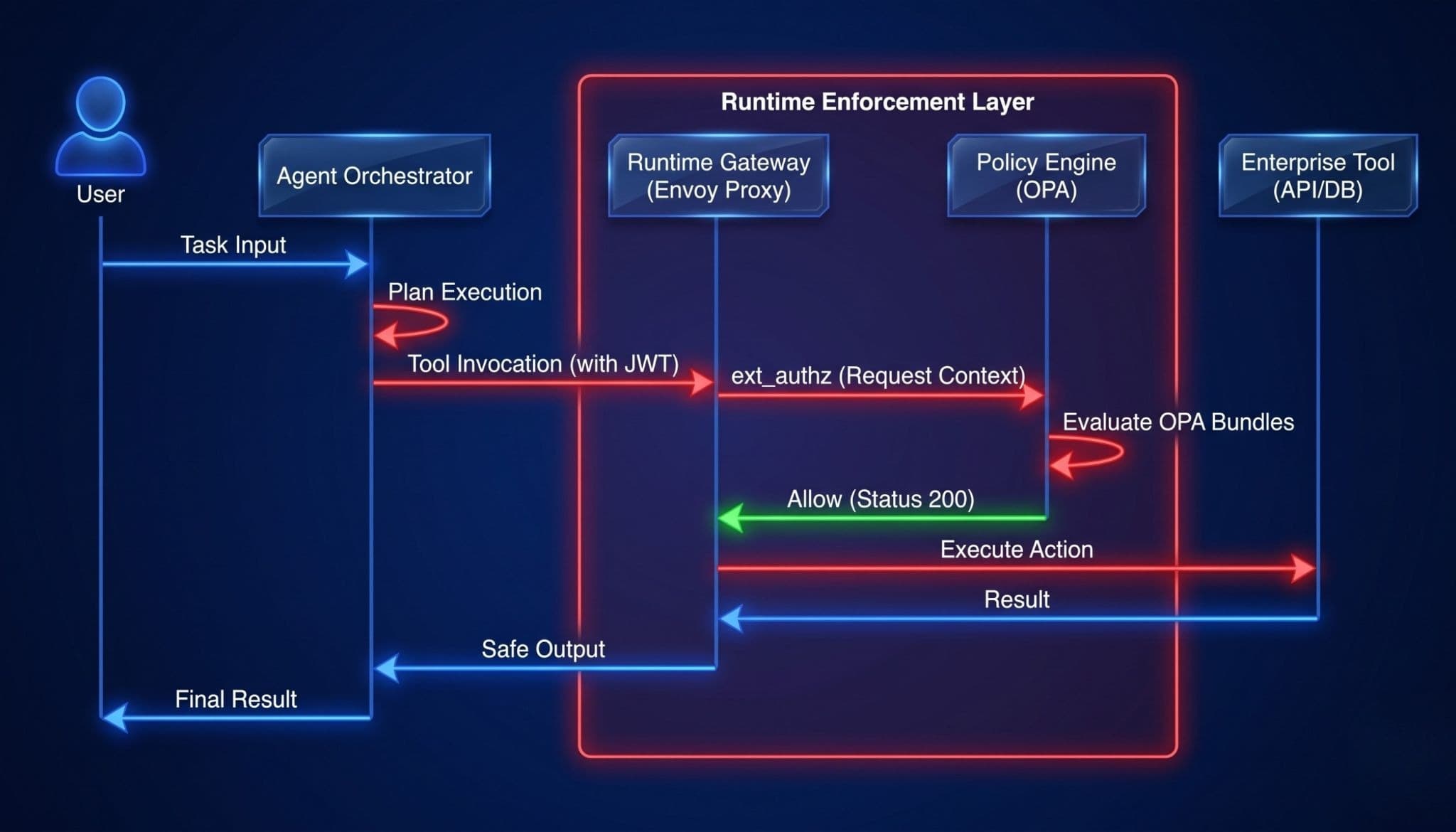
The risks of autonomous systems are best categorized by their impact on the operational backbone of the enterprise:
Table 1: Autonomous System Risks vs. Business Impact
Risk Category | Technical Trigger | Business Impact |
Action Risk | Unauthorized API execution; privilege escalation via tool access. | Financial loss, unauthorized transactions, system downtime. |
Data Risk | RAG over-fetching; cross-tenant data leakage in multi-tenant agents. | Regulatory fines (GDPR/CCPA), loss of IP, breach of privacy. |
Financial Risk | Agentic "retry loops" or infinite recursive calls to expensive APIs. | Unexpected "bill shocks," resource exhaustion. |
Operational Risk | Cascading failures in multi-agent chains; system instability. | Interruption of critical business processes. |
Compliance Risk | Missing audit trails for agent-initiated changes. | Failed audits, loss of "Board-ready" compliance status. |
Interoperability & Lock-in Risks
A significant, often overlooked risk is vendor lock-in through proprietary agent frameworks. Many "AI Governance" platforms embed their security logic directly into the orchestrator or use non-standard token formats.
- The Problem: If your security policy is hardcoded into a specific vendor's SDK, moving to a more efficient model or framework requires a total rewrite of your governance stack.
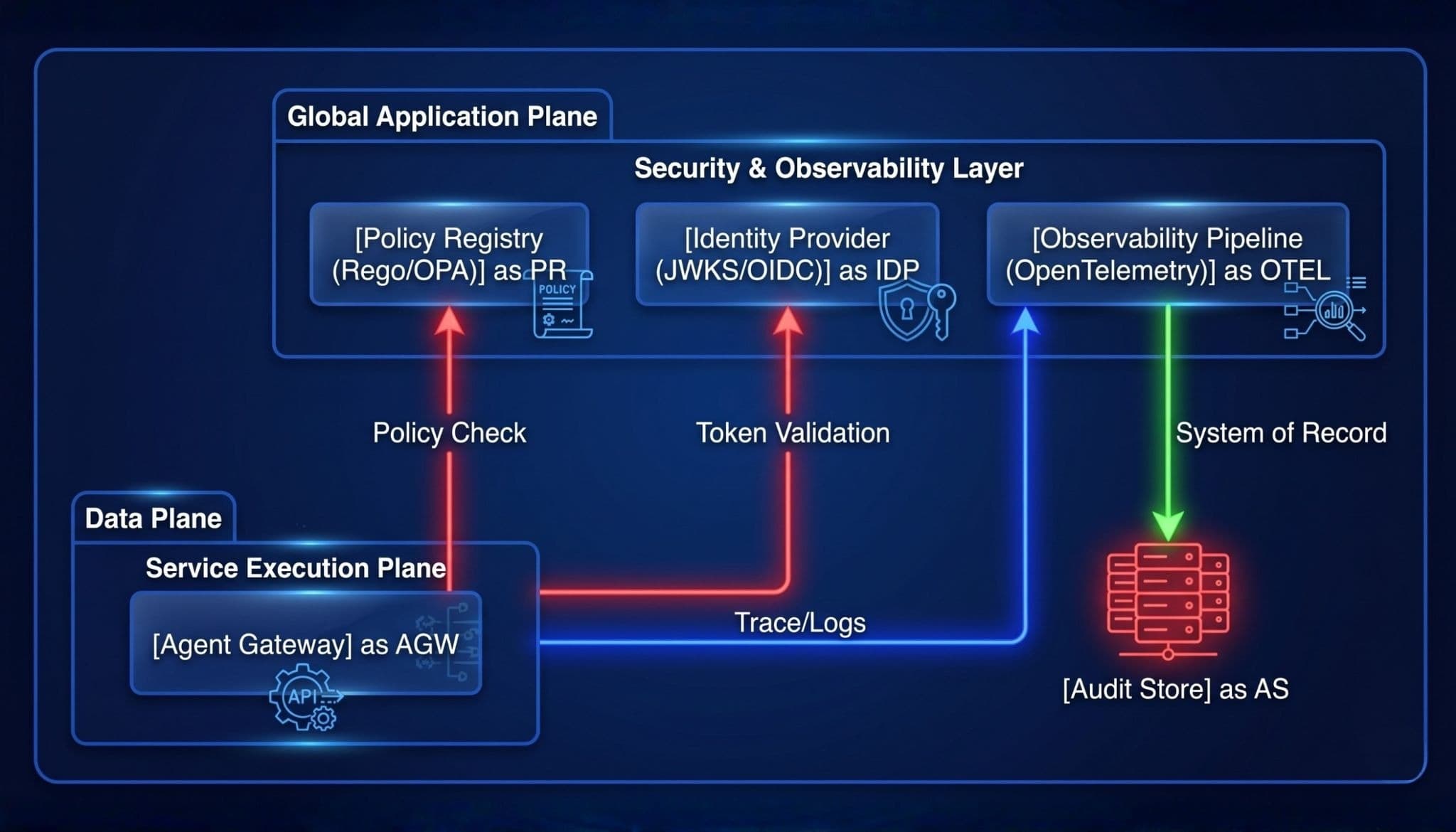
- The Solution: Decouple policy from execution. Use Policy-as-Code (OPA) and standardized protocols like gRPC or HTTP with JWKS for identity verification. Adopting a neutral telemetry standard like OpenTelemetry ensures your audit trails remain portable.
Runtime Control Architecture
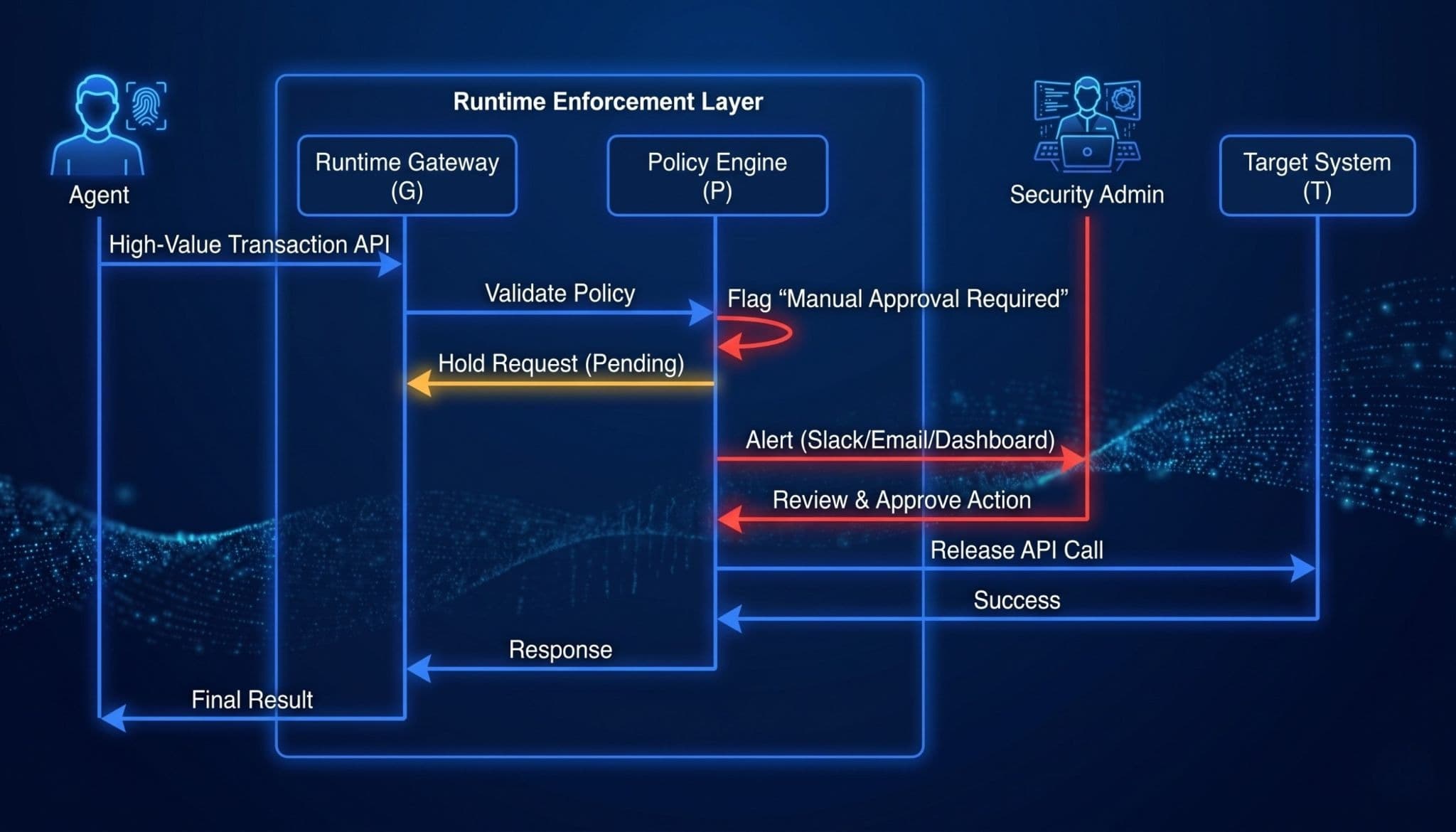
To secure agentic workflows, enterprises must move toward a Runtime Enforcement Layer. This pattern borrows from the Service Mesh (Envoy) model to intercept actions before they hit the target system.
Core Components:
- Gateway/Proxy: Acts as the "chokepoint" for all agent tool invocations.
- External Authorization (ext_authz): The gateway offloads the decision to a specialized policy engine.
- Policy Engine: Evaluates OPA bundles to determine if the agent (Identity A) can use Tool B on Resource C.
- Identity & Token Exchange: Ensures the agent’s short-lived token is valid and carries the correct context.
Execution Flow: Agent → Gateway → Policy Decision (Allow/Deny) → Tool Execution → Telemetry Export.
Governance & Control Model: The "System of Action"
Governance must be an operational reality, not just a PDF document. A robust model focuses on:
- Zero Trust for Agents: Never trust, always verify every tool call, regardless of the agent's origin.
- Least Privilege: Agents should only have access to the specific API endpoints required for their current task.
- Shadow Mode: Before enforcing "Deny" policies, run governance in a "dry-run" mode to observe agent behavior without breaking workflows.
- Human-in-the-Loop (HITL): For high-stakes actions (e.g., transactions > $10k), the runtime layer must trigger an asynchronous approval workflow.
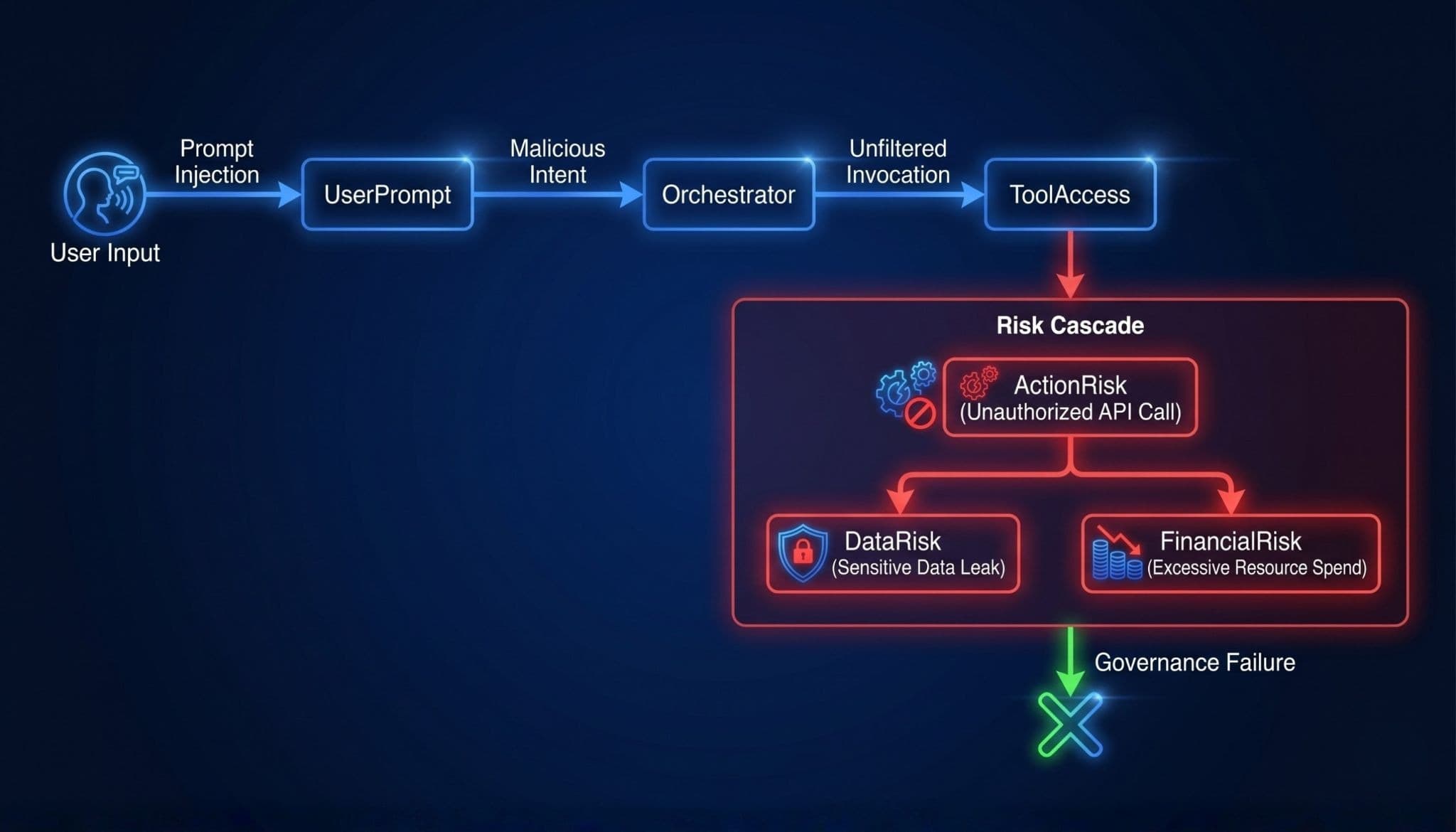
Table 2: Control Mechanisms vs. Risk Mitigation
Control Mechanism | Description | Risk Mitigated |
Runtime Enforcement | Real-time interception of API/Tool calls. | Action Risk, Privilege Escalation. |
Policy-as-Code | Centralized, version-controlled security rules. | Compliance Risk, Governance Gaps. |
Identity-Aware Tooling | Token-based validation of agent identity. | Unauthorized access, Identity theft. |
OpenTelemetry Audit | Granular logging of agent decision/action pairs. | Audit Gaps, Forensic failure. |
Enterprise Failure Scenarios
What does a lack of control look like in practice?
- The Runaway Refund: A customer service agent, given access to a Stripe API tool to "help customers," is manipulated via prompt injection to issue a series of unauthorized refunds to a malicious actor's account. Root Cause: Lack of runtime value-limit checks on the API tool.
- The CRM Data Exfiltration: A sales-enablement agent is tasked with summarizing leads but is tricked into "exporting" the entire CRM database to an external webhook under the guise of a "formatting task." Root Cause: Missing egress controls at the agent gateway.
The real risk is not the AI model being "evil"—it is uncontrolled actions inside trusted systems.
Business & Operational Value
Implementing a specialized governance layer for autonomous systems provides more than just security; it provides the operational backbone for scaling AI.
- Reduced Blast Radius: Runtime controls ensure that even if an agent is compromised, its ability to do damage is strictly limited.
- Audit Readiness: Automated logs provide "audit evidence" that is board-ready, showing exactly who (or what) did what and why.
- Innovation Velocity: When guardrails are automated, business units can deploy agents faster without waiting for manual security reviews for every new prompt or tool.
Technical Appendix: Core Terminology
- Policy-as-Code: Managing security rules using high-level languages (like Rego) that can be versioned and tested like software.
- ext_authz: A gRPC/HTTP interface used by proxies like Envoy to check with an external service if a request is authorized.
- OPA Bundles: Policy files packaged for distribution to distributed policy engines.
- JWT & JWKS: JSON Web Tokens and the Key Sets used to cryptographically verify them, essential for agent identity.
- Token Exchange: The process of swapping a user’s identity token for an agent-specific token with scoped permissions.
- Runtime Enforcement: The act of stopping a process or network call at the moment of execution based on active security policies.
Conclusion: Control Enables Scale
In the age of five trillion agents, traditional security tools are "blind" to the behavior-driven risks of autonomous systems. By adopting a runtime-first, vendor-neutral approach to governance, enterprises can move from fear-based restriction to confident, agentic automation.
FAQ: Agentic Security Essentials
Q: Why don't my current security tools (CASB/WAF) stop agentic risks? A: Traditional tools monitor "User-to-App" traffic. Agents perform "Machine-to-Machine" API calls. Since these calls often use legitimate credentials, traditional tools view them as authorized behavior, even if the agent is performing a destructive action like mass data deletion.
Q: Model Governance vs. Runtime Governance: What's the difference? A: Model Governance manages output (preventing bias/toxic text). Runtime Governance manages action (preventing unauthorized API calls). A "safe" model can still trigger a "dangerous" transaction if its execution path isn't restricted.
Q: What is the benefit of Policy-as-Code (PaC)? A: PaC (using tools like OPA) decouples security from the AI’s logic. You can update "guardrails"—like transaction limits—across all enterprise agents instantly without changing the underlying model or application code.
Q: How does "Shadow Mode" help deployment? A: It allows you to monitor agent behavior against security policies in a "dry-run" state. You gain visibility into potential policy violations without breaking live workflows, ensuring your governance layers are tuned before enforcement begins.
Q: Can I automate security for high-risk actions? A: Yes, through Risk-Based Orchestration. Low-risk tasks run autonomously, while high-risk triggers (e.g., changing system permissions) automatically pause the agent and request a Human-in-the-Loop approval via the runtime gateway.