
Designing Robust Data Pipelines for Autonomous Agents
Design fault-tolerant, observable pipelines for autonomous agents with policy controls, schema versioning, and Aegis enforcement.
.png&w=3840&q=75)
Designing Robust Data Pipelines for Autonomous Agents
Autonomous agents rely on continuous, correct, and well-formed data: memory vectors, telemetry, contextual documents, and ephemeral state. When pipelines fail—due to schema drift, malformed inputs, burst traffic, or silent data corruption—agents make worse decisions, workflows break, and compliance gaps appear. This article explains the failure modes, practical ingestion patterns (idempotency, retries, backpressure), observability and SLOs, schema versioning strategies, and where a runtime policy + telemetry fabric like Aegis fits into production deployments.
Failure Modes for Agentic AI Systems
Pipeline failures manifest in several predictable ways. Understanding the failure taxonomy lets you design targeted mitigations.
Key failure modes
- Schema drift — upstream change modifies field types or names, producing corrupted embeddings or missing fields.
- Silent corruption — badly encoded payloads, truncation, or encoding mismatches create invalid vectors or partial records.
- Backpressure collapse — sudden telemetry or event bursts overwhelm ingestion, causing timeouts and partial writes (a “memory storm”).
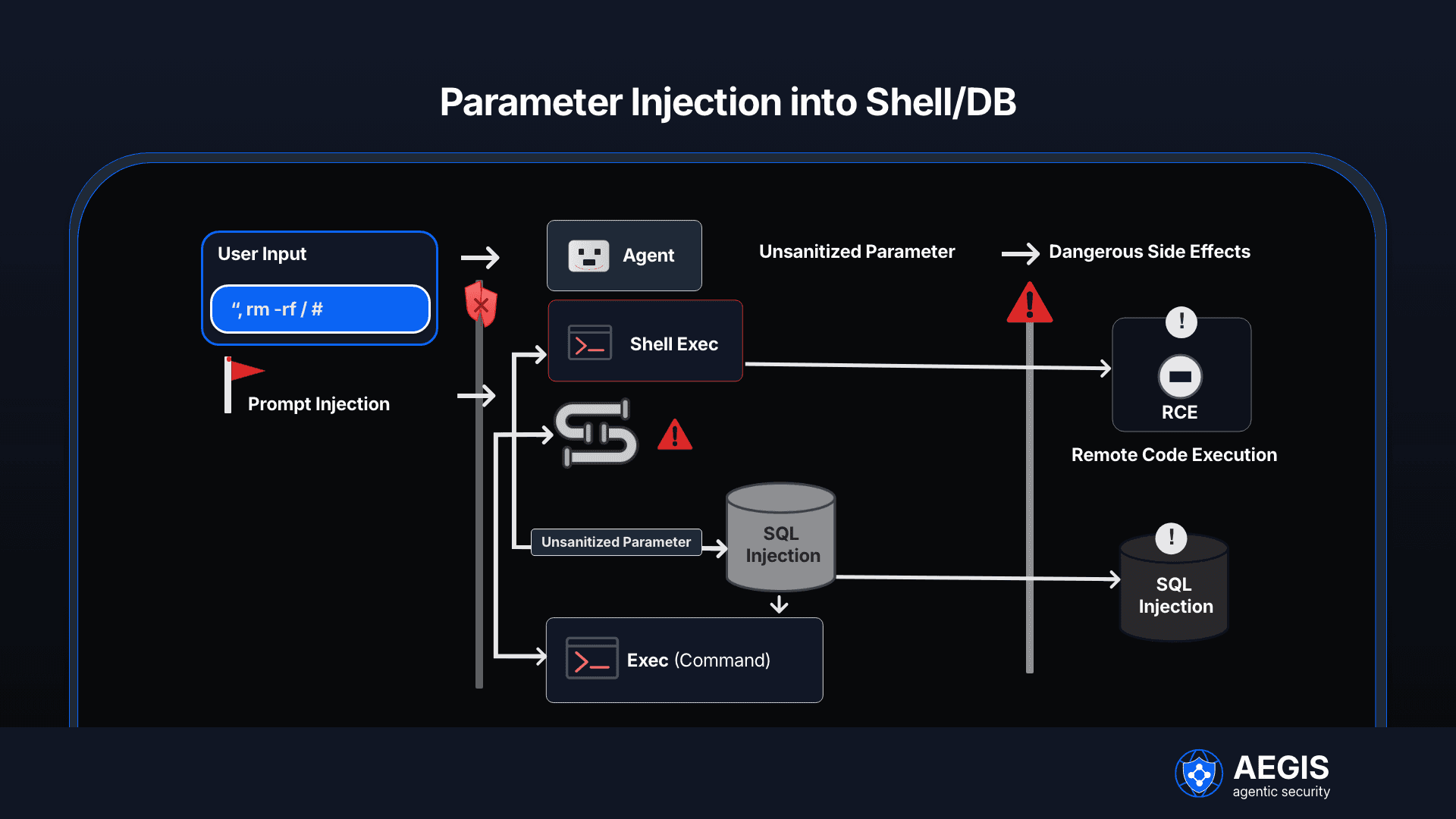
- Parameter injection — unvalidated user text reaches tool parameters (e.g., CLI, shell or DB) and triggers unsafe execution.
- Observability blind spots — missing traces or sampled logs prevent root cause analysis.
Table 1 — Failure modes and mitigations
Failure mode | Impact on agents | Practical mitigations |
Schema drift | Corrupted embeddings, wrong fields | Schema contracts, versioned transforms, canary/ shadowing |
Silent corruption | Wrong state, model hallucination | Input validation, checksums, deterministic transforms |
Backpressure collapse | Timeouts, queue growth, lost events | Reservoir shaping, rate limits, reservoir/burst controls |
Parameter injection | Unsafe actions, data exfiltration | Per-field validation, regex DLP, policy sanitization |
Observability blind spots | Slow RCA, missed incidents | End-to-end tracing (OpenTelemetry), structured logs, sample all deny events |
(Important stat) Cloud-native deployment is now mainstream: the CNCF 2024 survey reports cloud-native technique adoption at ~89% among respondents, underscoring that production scale systems must consider robust pipelines and multi-region resilience. https://www.cncf.io/reports/cncf-annual-survey-2024/ (CNCF)
Reliable ingestion patterns (idempotency, retries)
Design decisions for ingestion shape how resilient your agent memory and context store will be.
Core principles
- Make every transform idempotent. A transform step should produce the same canonical output for the same input (use content hashing + versioned transforms).
- Use event-driven ingestion with immutable event IDs and deduplication. Critical when orchestrators or retry systems resend events.
- Implement exponential backoff + jitter for retries. Avoid thundering-herd retries by coordinating retry windows and using circuit breakers for persistent downstream failures.
- Limit writer concurrency against memory or embedding stores to prevent hot partitions. Reservoir/burst shaping helps smooth sudden spikes.
Implementation pattern (recommended)
source → ingest queue (with event ID) → transform (idempotent, versioned) → validation (schema + value checks) → versioned store (immutable snapshots) → agent read (with read-through cache)
Table 2 — Ingestion pattern elements and operational controls
Element | Purpose | SRE Controls |
Event queue (e.g., Kafka-like) | Buffer & ordering | Retention, partitioning, compacted topics |
Transform service | Normalize, embed | Version tags, canary rollout |
Validator | Schema & field checks | Reject/ quarantine malformed messages |
Rate limiter | Prevent storms | Token bucket, reservoir shaping |
Observability | Trace every step | OTel spans, structured logs |
Schema versioning strategy (H3)
- Use explicit schema contracts with major/minor versioning. Embed schema version IDs in every event.
- Support graceful evolution: consumers declare compatible versions and use adaptors for older formats.
- Canary and shadow transforms: route a small % of traffic through a new transform and compare outputs before global rollout. This prevents accidental model poisoning from a schema change.
Observability and SLOs for pipeline health
Observability is not optional. For agentic systems, you need end-to-end traces that tie agent identity, event ID, transform version, and decision outcomes together.
Minimum observability requirements
- Emit OpenTelemetry spans at each pipeline boundary (ingest, transform, validate, store read). Evidence shows OpenTelemetry adoption is rising and collectors are deployed at scale across organizations; published surveys and project reporting confirm robust uptake and Collector deployment patterns. https://opentelemetry.io/blog/2024/ (OpenTelemetry)
- Track SLOs that matter for agent correctness: schema validation pass rate, embedding integrity checks, end-to-end latency percentiles (P50/P99), and “would-block” rates from policy evaluation.
- Export structured logs and include decision metadata (policy_version, agent_id, decision_reason) so SOC and compliance teams can audit actions.
Operational SLO examples
- Validation pass rate ≥ 99.9% over 30 days.
- End-to-end embedding write latency P99 < 500ms for low-latency agents (adjust per use case).
- Trace capture for 100% of deny/block events; sampled traces for allow events.
(Stat) Observability surveys indicate organizations increasingly investigate or deploy OpenTelemetry collectors at scale—useful evidence that instrumenting pipelines with OTel is realistic and sustainable. (Grafana Labs)
Policy enforcement at pipeline boundaries (Aegis example)
At least one-third of production readiness for agent pipelines is about runtime control: who/what can call which pipeline endpoints, with what parameters, and under what conditions. That’s where Aegis fits.
What Aegis provides (architectural summary)
Aegis is a runtime policy and telemetry fabric that sits as a lightweight gateway between orchestrators and pipeline endpoints. It enforces least-privilege policies, validates parameters, and emits structured OpenTelemetry spans for every pipeline access. In practice, Aegis acts like an “Istio + policy engine” tuned for agent semantics: agent identities, tool scopes, parameter conditions, budgets, and approval workflows.
Key responsibilities of Aegis
- Identity & token service: short-lived JWTs per agent that include tenant and scope claims.
- Policy-as-code: YAML/JSON policy bundles compiled to a fast evaluator (e.g., OPA prepared queries/WASM) for low latency.
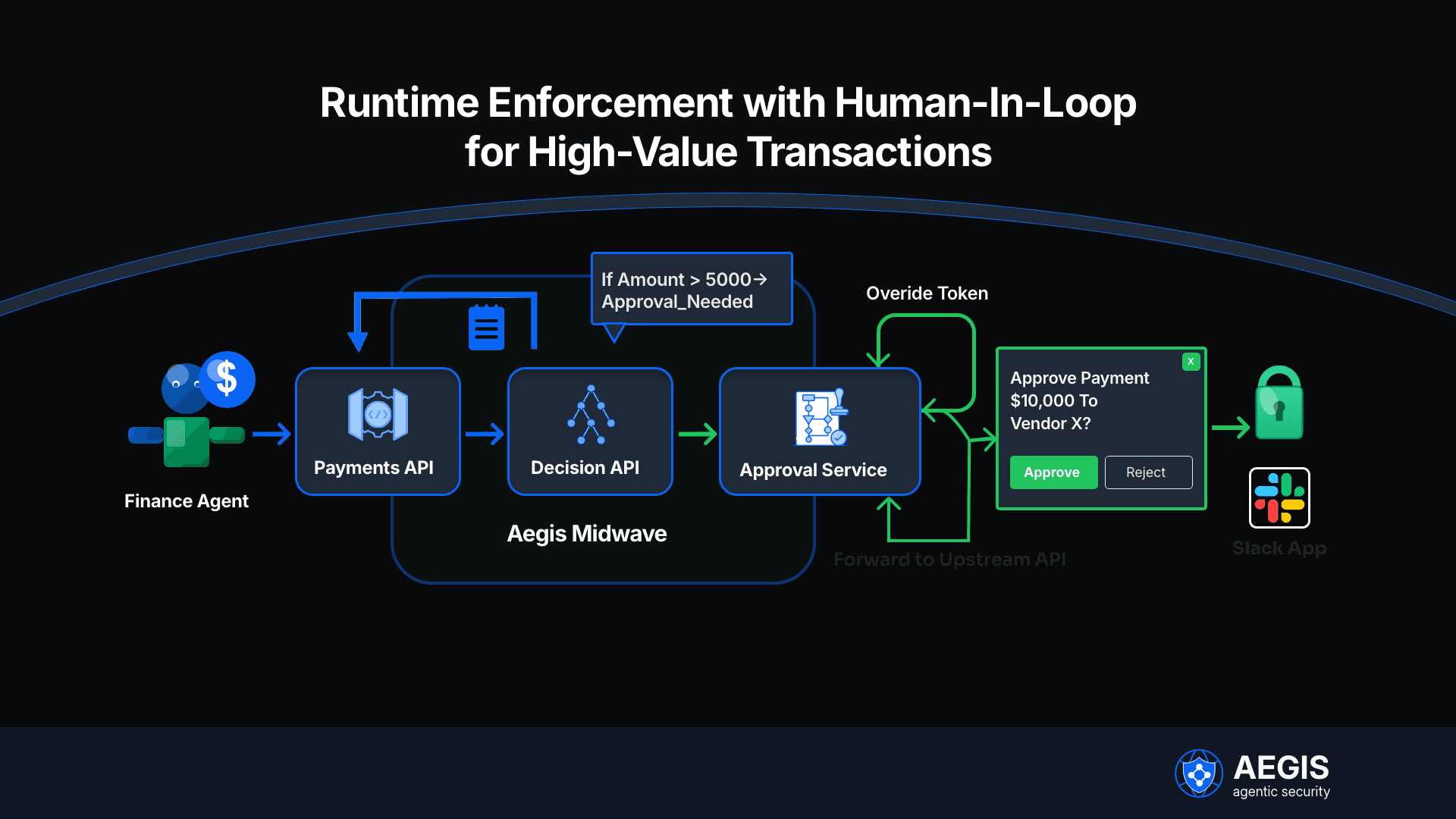
- Runtime enforcement: intercepts every pipeline access, inspects the payload, and returns decisions: allow, deny, sanitize (field redaction), or approval_needed.
- Telemetry & audit: emits spans containing agent_id, policy_version, decision, latency, and approval_id when applicable.
How Aegis prevents common failure scenarios
- Schema drift & malformed payloads: Aegis validates parameters and blocks malformed calls before they reach embedding or memory stores; it logs the trace so engineering teams can roll back a transform version quickly. Example: when an upstream schema change injected a renamed field into embeddings, Aegis blocked the malformed call, emitted a deny span with the offending event ID, and triggered an automated rollback workflow.
- Memory storms / backpressure: Aegis enforces per-agent rate limits, budgets, and reservoir shaping at the gateway; when thresholds are hit it returns throttled responses and emits metrics for the dashboard.
- Parameter injection & unsafe calls: Aegis can sanitize or redact fields, enforce regex constraints, and require human approval for high-risk parameter ranges (e.g., transfer amounts beyond thresholds). Approval workflows integrate with collaboration channels and mint override tokens post-approval, ensuring traceability.
Operational pattern for rollout
- Shadow mode: deploy Aegis in shadow to collect would-block metrics and tune rules.
- Canary enforcement: enable enforcement for a subset of agents or environments.
- Full rollout: enable production enforcement once policy coverage and false-positive rates are acceptable. The tools for policy dry-run and rollback reduce the risk of accidental outages.
Agentic AI adoption is accelerating but governance remains a top barrier; analyst coverage warns many early agentic projects will be abandoned without strong integration and governance controls—underscoring why runtime enforcement like Aegis is critical for enterprise pilots. https://www.reuters.com/business/over-40-agentic-ai-projects-will-be-scrapped-by-2027-gartner-says-2025-06-25/ (Reuters)
Operational examples & runbooks
Example: Versioned embeddings pipeline
- Ingest text → transform v1 (embedding) → validate vector dimensions, checksum → store versioned in object store → agent read referencing transform_version.
- When deploying v2, route 5% of traffic; compare downstream accuracy and anomaly rates; if accept, increase rollout; otherwise rollback and capture traces for RCA.
Example: Clinical EHR ingestion (compliance)
- Validate schema and purpose field; enforce field-level deterministic DLP; block exports to non-approved domains; log signed audit spans for regulators.
.png&w=3840&q=75)
Conclusion
Robust data pipelines are a precondition for safe, auditable, and reliable agentic AI in production. Implement idempotent transforms, schema contracts, backpressure controls, and end-to-end observability (OpenTelemetry). Add runtime policy enforcement at pipeline boundaries to block malformed or unsafe calls, rate-limit agents, and emit the audit trails SOC and compliance teams require. Aegis provides a practical, production-grade enforcement and telemetry fabric that integrates with existing orchestrators, enforces per-agent policies, and gives teams the visibility and control necessary to move from experiment to sustainable production.
Frequently Asked Questions
Q: What is the single most effective mitigation against schema drift?
A: Enforce schema contracts at ingress with versioned transforms and use canary/shadow rollouts for new transform versions.
Q: How does idempotency protect agents?
A: Idempotent transforms prevent duplicate events from changing state or producing duplicate embeddings; combined with event IDs and deduplication, they keep memory stable.
Q: Does Aegis add meaningful latency?
A: Aegis is designed for low overhead using prepared policy evaluations and caching; typical target latencies are ≤20ms for decision calls in MVP designs.
Q: How should I roll out policies without breaking production?
A: Start in shadow mode, tune using would-block metrics, perform canary enforcement, and keep rollback paths with versioned policy bundles.
Q: What observability primitives are essential?
A: End-to-end trace propagation (OTel spans with agent_id, event_id, policy_version), structured logs for deny events, and metrics for validation pass rates and budgets.