
Can CrowdStrike, Palo Alto, or Okta Find Your AI Agents?
Policy dashboards fail when applied to stochastic agents. Discover the structural blind spots inside your existing security stack (EDR, Firewall, IAM)
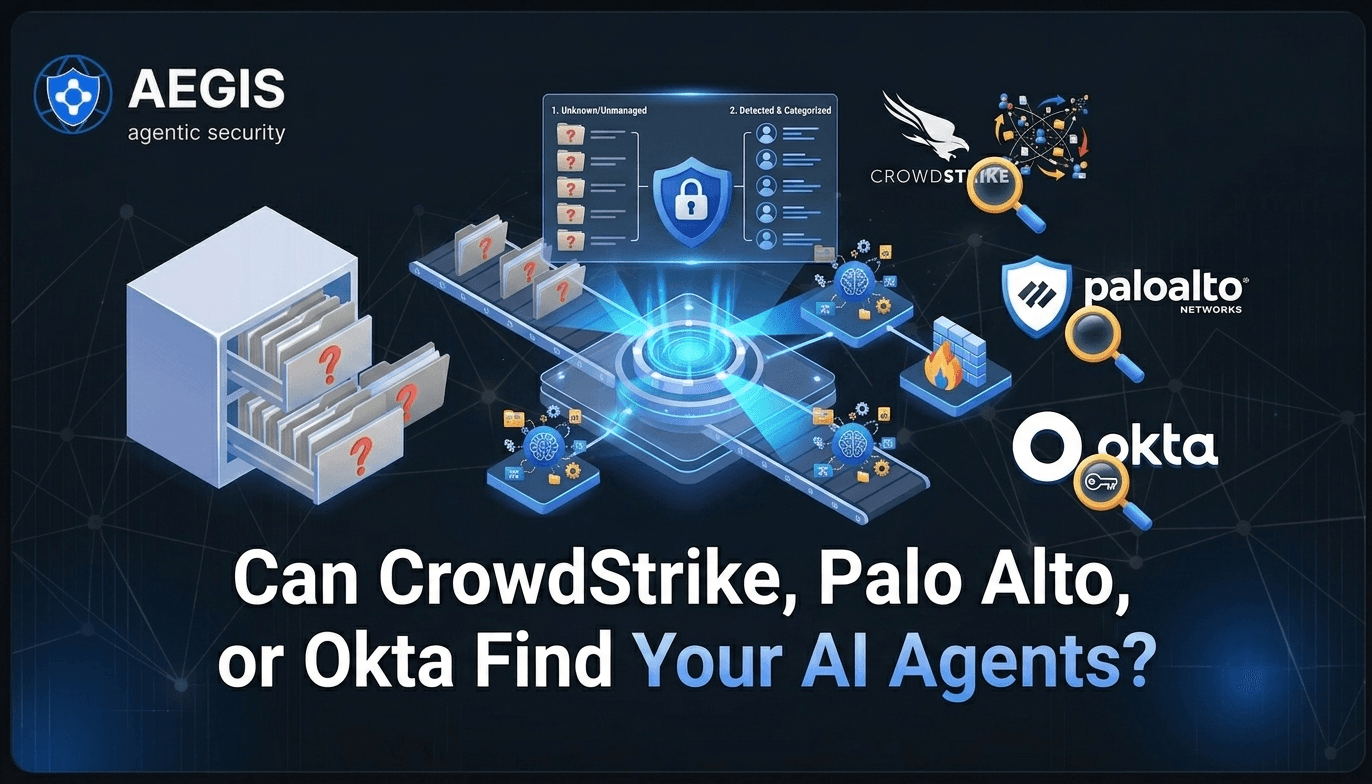
Can CrowdStrike, Palo Alto, or Okta Find Your AI Agents? Here's What Each Tool Actually Sees
The modern enterprise security perimeter has officially moved past the conversational era. Organizations are no longer merely drafting acceptable-use policies for employee copilots or monitoring simple chat prompts. Instead, engineering and business units are aggressively deploying active autonomous AI Agents to execute production workflows—granting them direct system authority to process financial transactions, parse customer databases, modify multi-cloud infrastructure, and make real-time decisions that affect revenue.
This macro structural migration changes the baseline security question. Security teams can no longer protect their networks by asking exclusively, "Who authenticated this session, and what did the model say?" They must answer a fundamentally harder runtime question: "What did the AI agent actually do, and was that specific action authorized within this precise context?"
To solve this visibility and control gap, enterprise buyers instinctively turn to the industry-leading vendors they already own: their Endpoint Detection and Response (EDR) agents, their Next-Generation Firewalls (NGFW), and their Identity and Access Management (IAM) directories.
But a critical classification failure is occurring across enterprise IT: Traditional security stacks are treating stochastic, non-deterministic software actors like static, linear services. The financial consequences are immense—data breaches involving unmanaged shadow AI cost organizations an average of $670,000 more than standard security incidents.
Here is an objective, architectural analysis of what CrowdStrike, Palo Alto Networks, and Okta actually see when an agent runs on your network—and why your existing stack remains structurally blind to the execution chain.
CrowdStrike Falcon AI Security: The Endpoint Lens
For organizations heavily standardized on the Falcon platform, CrowdStrike provides exceptionally deep endpoint threat intelligence, real-time behavioral monitoring, and cloud workload protection.
What It Sees
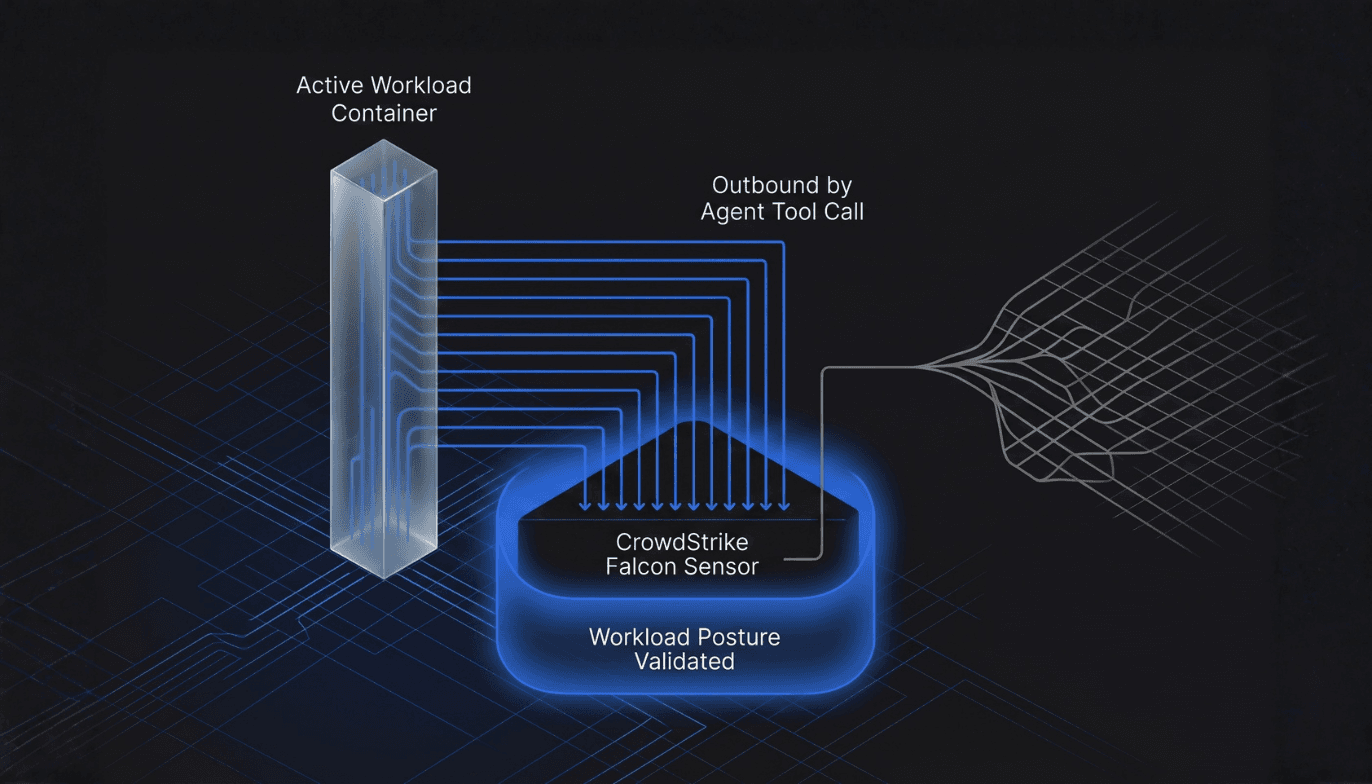
CrowdStrike Falcon AI Security views the artificial intelligence landscape through host-level and endpoint workload monitoring. It excels at runtime threat detection within the container or pod, identifying prompt injection strings that look like classic shellcode exploits, spotting fileless malware attacks, and mapping unauthorized local agent process loops (such as unapproved LangChain or CrewAI frameworks executing on an engineer's machine). If an adversary attempts to poison an active ML workload container or execute a known denial-of-service vector against an LLM inference endpoint, CrowdStrike catches it.
What It Misses
CrowdStrike is fundamentally built to detect technical system compromise, not to analyze business logic intent across stochastic applications. An autonomous agent does not follow rigid line-by-line syntax; it reasons toward abstract goals via dynamic tool selection.
If an agent gets hijacked via an indirect prompt injection and decides to use valid, legal API calls to bulk-download confidential CRM projections, CrowdStrike's Threat Graph processes the activity as a safe, authorized process execution. The endpoint agent cannot determine why the model made that specific call, whether the parameters violate corporate compliance, or if the resulting output breaches data privacy sovereignty.
Palo Alto Networks Prisma AIRS: The Network Perimeter
Palo Alto Networks approaches the artificial intelligence lifecycle through inline network filtering, Cloud Security Posture Management (AI-SPM), and traffic-layer anomaly detection.
What It Sees
Prisma AIRS analyzes the network transport plane and the cloud infrastructure posture. It continuously sweeps the cloud fabric to discover active model deployments, map unmanaged Model Context Protocol (MCP) servers, identify exposed AI service APIs, and spot sensitive training datasets sitting in misconfigured object storage buckets. At the transport edge, it flags unusual surges in outbound network traffic routing to external model domains (such as api.openai.com or claude.ai), providing a necessary layer of shadow AI tool discovery.
What It Misses
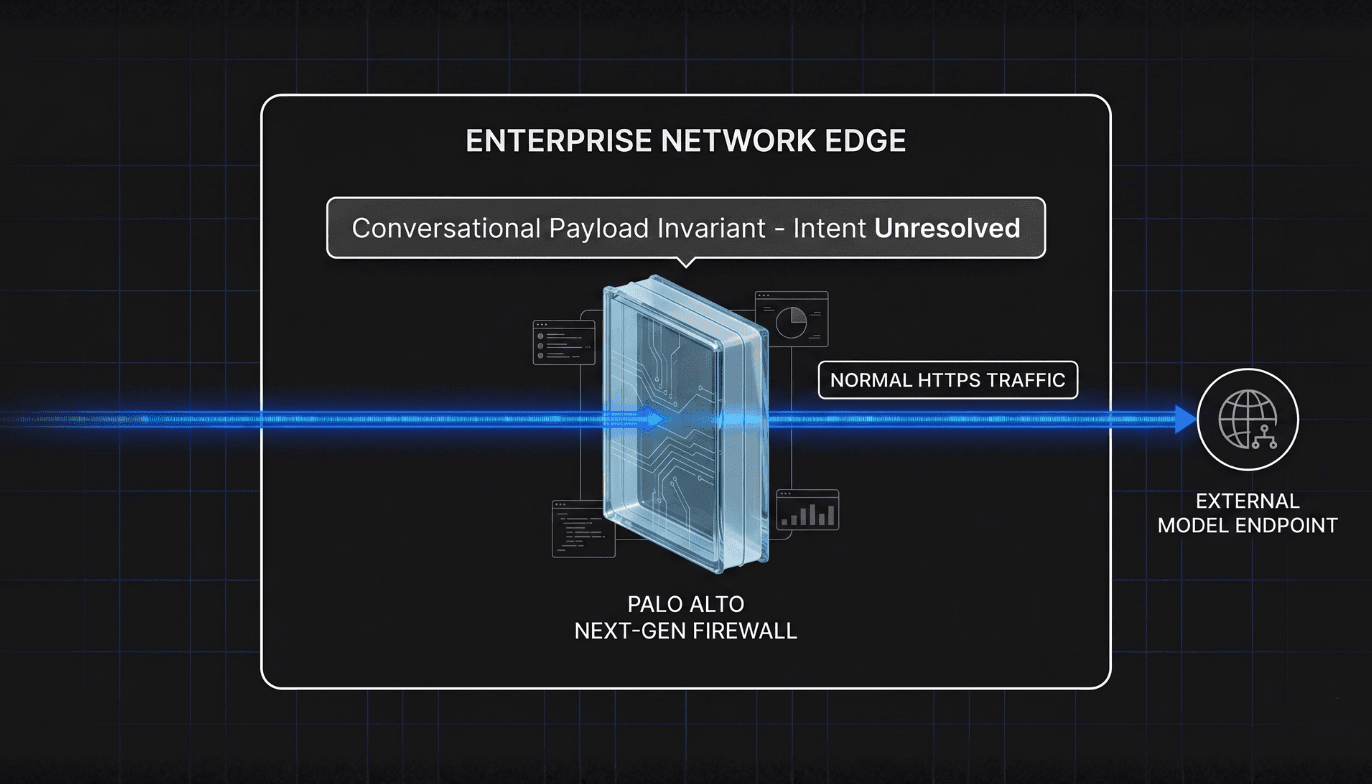
Palo Alto Networks was engineered to intercept discrete, pattern-based data payloads—such as scanning for explicit database drops, credit card sequences, or malware signatures passing across a gateway. Shadow AI agents transmit data via conversational natural language without structured file formats.
If a business analyst asks an unsanctioned chatbot to summarize an unreleased product strategy document, the firewall processes the streaming request as safe web traffic. The proxy cannot piece together the multi-turn conversational context, cannot audit the data lineage of the prompt, and cannot prevent the model from absorbing corporate trade secrets into its public training parameters.
Okta Identity Cloud: The Authentication Border
Okta operates as the centralized identity orchestration layer, validating user authentication, enforcing Multi-Factor Authentication (MFA), and lifecycle-managing enterprise application roles.
What It Sees
Okta manages the perimeter authentication boundary. It ensures that only verified enterprise users or authorized service accounts can establish a session with your sanctioned cloud AI platforms. During routine credential monitoring, Okta catches when an individual attempts to register a corporate email address on an unapproved external AI service, helping identify shadow identity sprawl before an account can turn into an unmonitored security exposure point.
What It Misses
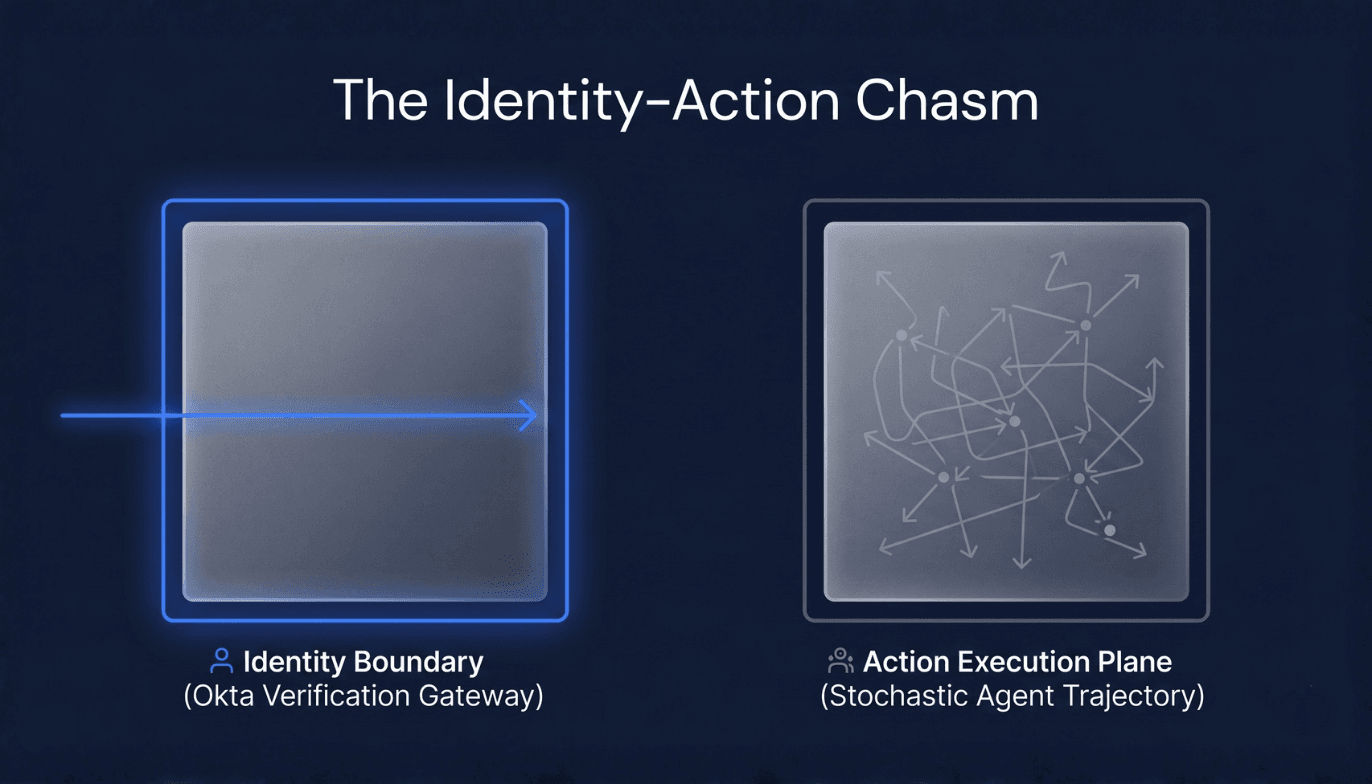
Okta answers exclusively: "Who is this entity, and is their credential valid?" It cannot answer: "What is this entity executing right now?" Once Okta authenticates a machine session and issues a federated JSON Web Token (JWT), it steps completely out of the data path. Because traditional directory controls assume stable boundaries, they cannot monitor the stochastic behavior of a goal-driven agent that begins chaining tools across separate cloud microservices. Okta remains entirely blind to the execution chain, unable to detect if an authenticated identity has had its intent overridden by an adversarial prompt injection.
The Aegis Framework: Connecting the Disjointed Stack
The critical vulnerability inside modern enterprise infrastructure is not that your existing tools are failing at their respective jobs; it is that none of them correlate telemetry across each other for the purpose of agentic governance. CrowdStrike validates the host driver, Palo Alto scans the network packet, and Okta verifies the login token—yet each operates inside an isolated silo.
Aegis Security does not replace your existing stack; it connects it. Aegis functions as an in-path, trace-native AgenticOps control plane that unifies disjointed infrastructure perimeters into a cohesive runtime defense layer.
The Power of Multi-Signal Correlation
Aegis intercepts the live data path by deploying lightweight sidecars and proxy filters natively within your application cluster (utilizing an ext_authz external authorization primitive). It executes the Rule of Multi-Signal Corroboration: an asset is verified and governed only when telemetry indicators match concurrently across your entire environment.
Operational Security Vector | Legacy Security Stack (EDR / Firewall / IAM) | Aegis AgenticOps Control Plane |
Data Payload Visibility | Limited to syntax pattern-matching; blind to natural language intent. | Executes continuous semantic analysis over unstructured streaming queries and context. |
In-Process Tracking | Fragmented; tools see isolated snapshots at the network or host boundary. | Captures full execution tracing—mapping every prompt, tool call, API mutation, and outcome. |
Authorization Model | Static RBAC; permissions are granted permanently at onboarding time. | Intent-Based Authorization; provisions ephemeral, short-lived tokens via secure vaults. |
Mitigation Speed | Human-in-the-loop dependencies that introduce hours of operational latency. | Agentic SOC framework; monitoring agents isolate out-of-bounds workloads at machine velocity. |
Implementing Intent-Based Action Security
To transition from passive visibility alerts to active runtime containment, security leaders must deploy a multi-layered framework built around the three core engineering variables of the 3As Framework.
The Agent (Cryptographic Attestation)
The platform moves completely away from untracked non-human identities. Every running agentic runtime is cataloged inside a live canonical registry, mapped to an explicit human owner, and verified at the kernel layer using cryptographic workload attestation standards like SPIFFE/SPIRE or OIDC token exchange.
The Access (Just-in-Time Entitlements)
Eliminate permanent, broad standing roles across cloud databases and target systems. The gateway proxy implements Intent-Based Access Control, interfacing with credential vaults to generate fine-grained, task-scoped secrets that automatically expire the millisecond a specific sub-task completes.
The Action (Runtime Payload Gating)
Before an agent call can hit an internal corporate API, the proxy gates the request out-of-band, evaluating the parameters and arguments against declarative policy-as-code bundles (such as Rego definitions via Open Policy Agent). If the payload crosses financial limits, exposes unredacted PII, or violates compliance matrices, the proxy blocks or truncates the transaction instantly at the transport edge.
The Agentic SOC: Regaining Command at Machine Velocity
The underlying reality of agent sprawl is that human response networks cannot scale to protect machine-speed risks. In a standard enterprise SOC framework, a threat alert is ingested, aggregated into a data lake, prioritized by a SIEM, and placed into a manual investigation queue—introducing an inherent operational latency measured in hours.
When an autonomous system is hijacked via an execution-layer prompt injection, it can parse sensitive code manifests, alter cloud access tokens, and delete its own local logging histories in less than ninety seconds. Waiting for a human security analyst to triage a ticket is a failure vector; it merely serves as an after-the-fact report documenting a completed data breach.
The Agentic SOC Model
The only architecturally coherent defense against an autonomous threat is the deployment of an Agentic SOC: a security operational environment where specialized AI monitoring agents continuously govern operational AI agents.
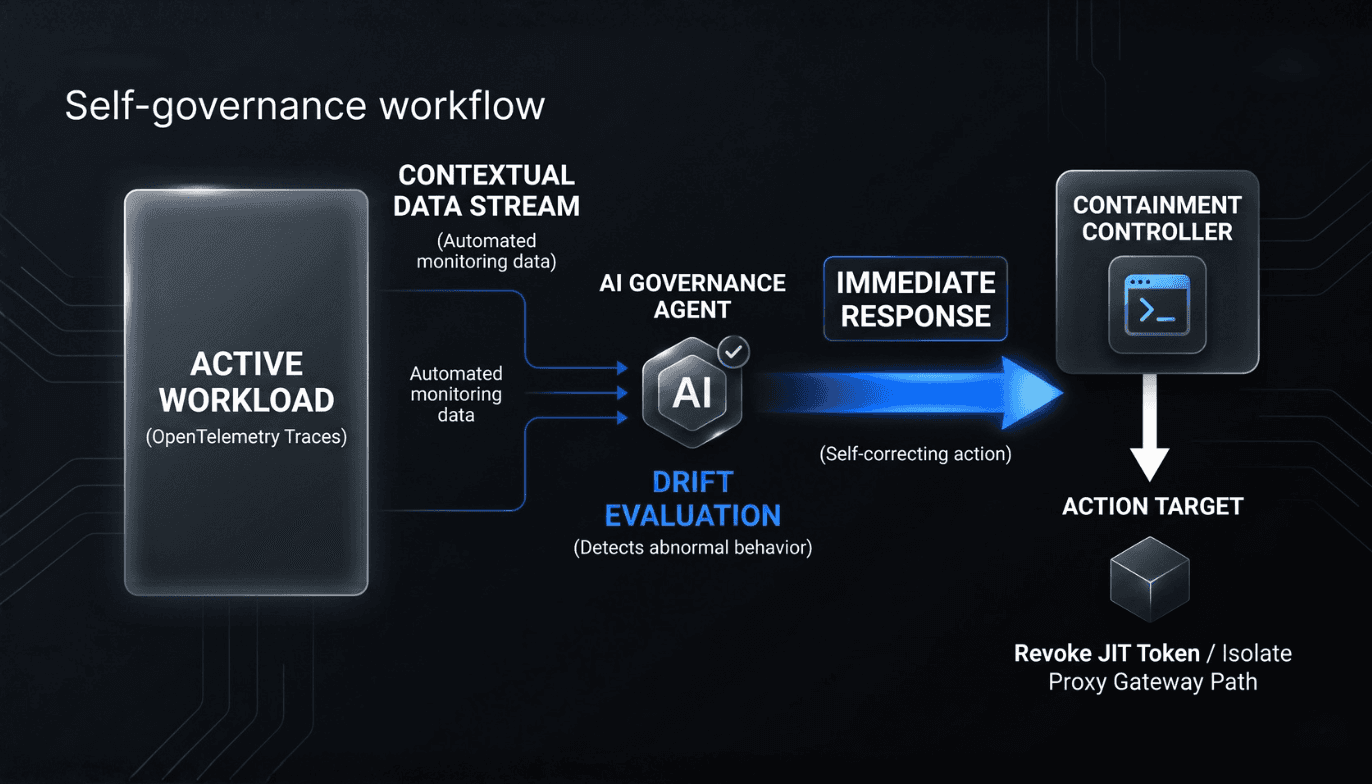
In this architecture, automated monitoring agents run natively within the data plane, consuming thin execution traces via continuous OpenTelemetry loops. These specialized nodes apply localized reinforcement learning to construct real-time profiles of normal software intent.
The exact millisecond an operational agent's call trajectory drifts outside its authorized baseline parameters, the monitoring layer steps completely outside human manual latencies: it signals the identity layer to instantly revoke the target workload's short-lived JWT token, modifies proxy gateway settings to isolate the network path at the transport edge, and packages the complete trace record for forensic analysis.
Human security operators move away from chasing individual event logs, stepping up to serve as systemic commanders who configure risk tolerances and dictate baseline rules, while the automated runtime architecture handles the massive transaction volume that human oversight cannot sustain.
Conclusion: Control Follows Interception
The promise of Agentic AI lies in its capacity to execute actions autonomously, but in a regulated enterprise infrastructure, autonomy without absolute command is an existential liability. Written guidelines and static policy dashboards represent a soft control layer that cannot protect a non-deterministic platform moving at machine velocity.
The organizations that achieve true operational maturity will not be the ones that attempt to achieve safety through manual check-box audits or blanket perimeter bans, but those that establish an executable runtime control plane from day one. By connecting your disjointed endpoint, network, and identity perimeters through an integrated multi-signal correlation engine, you can structurally containerize your blast radius, neutralize injection exploits mid-flight, and generate immutable compliance logs automatically. Stop relying on tools that only validate who entered the network; secure the execution path, protect the action layer, and scale autonomous enterprise intelligence with absolute confidence.
Frequently Asked Questions (FAQ)
Q1: Can my existing endpoint detection (EDR) agents identify a hijacked AI agent workflow?
A: Traditional EDR sensors are engineered to look for binary threat signatures, kernel exploits, or unauthorized process changes at the host layer. If a hijacked AI agent uses legitimate, unvetted API calls to copy data or alter repository files, the EDR tool views the transaction as a safe and valid process execution, leaving it completely blind to the underlying policy breach.
Q2: Why do pattern-based network firewalls fail to catch shadow AI data leakage?
A: Network firewalls scan for structured, syntax-based patterns (like credit card strings or specific file format headers). Shadow AI tools transmit data via unstructured natural language conversations over authenticated HTTPS streams. Because the payload contains no explicit syntax violations, it passes across the gateway completely unhindered.
Q3: What is the main structural limitation of relying on IAM directories like Okta to secure agents?
A: Okta operates exclusively as an authentication boundary—verifying who is requesting access and issuing a valid session token. Once that credential is authenticated, Okta steps completely out of the active data path, meaning it cannot monitor or restrict the stochastic tool-chaining and machine-speed mutations the agent executes later.
Q4: How does Aegis implement "Intent-Based Access Control" across legacy applications?
A: Legacy platforms often contain standing secrets embedded directly inside scripts, making them incapable of revoking tokens cleanly. Aegis routes transactions through an in-path proxy that gates tool arguments out-of-band at request time, checking payloads against centralized policy-as-code bundles before backend databases can parse the transaction.
Q5: What is the technical value of OpenTelemetry within an agentic security architecture?
A: OpenTelemetry functions as a complete "flight recorder" for non-human workloads. Instead of generating flat, text-based log entries, it captures a trace-linked record of the entire execution chain—mapping the original goal prompt, model routing logic, context data injections, and proxy filter adjustments to ensure complete forensic auditability.
Q6: How does "Model Drift" impact enterprise compliance metrics under the EU AI Act?
A: Model drift is the slow behavioral decay that occurs when real-world production data distributions stray from the datasets used during validation testing. A model can pass initial bias tests during procurement but drift silently over time, generating non-compliant or discriminatory outcomes without crashing the application infrastructure.
Q7: Why do human-in-the-loop gates fail to protect networks against machine-speed attacks?
A: A human response network (such as a tier-1 analyst queue) introduces hours of operational latency. When an autonomous agent can complete an entire data exfiltration cycle or rewrite infrastructure permission keys in under ninety seconds, manual gates fail to function as an active security control.
Q8: What is "Shadow AI" and how do blanket perimeter blocks accelerate its adoption?
A: Shadow AI is the unauthorized use of public models and tools by employees without IT visibility. When a security team attempts to mitigate risk by executing blanket perimeter blocks without supplying secure, corporate-vetted alternatives, workers are tempted to move underground—launching unapproved tools via personal devices and mobile networks.
Do you know exactly what your active AI workloads are executing right now? Connect your disjointed endpoint, network, and identity perimeters with the Aegis AgenticOps Control Plane Core. Secure the execution path.