
Building a Secure Proxy Layer for Agent Egress (Sidecar)
Practical guide to Envoy sidecars, ext_authz integration, attestation and Aegis runtime enforcement for secure agent egress.
.png&w=3840&q=75)
Building a Secure Proxy Layer for Agent Egress (Sidecar)
Autonomous agents running in production require a small, reliable enforcement plane for outbound calls. Centralized egress gateways add latency and single points of failure; unproxed agents create risk. This post explains tradeoffs, a practical Envoy ext_authz integration pattern, failure-mode and SLO guidance, and how Aegis implements signing/attestation and runtime controls to secure agent egress at scale.
Sidecar vs centralized gateway tradeoffs
Sidecar (local) and centralized gateway patterns each solve egress control but with different operational characteristics.
Advantages of sidecars
- Low latency for local decisions and retries; avoids hairpinning traffic across regions.
- Failure isolation: a per-host sidecar can be tuned per cluster/tenant.
- Localized re-origination: the proxy can re-open connections and perform deep inspection with minimal cross-network hops.
Costs/complexity of sidecars
- Operational footprint: fleets of sidecars require orchestration (DaemonSet, Helm hooks) and lifecycle handling.
- Multi-tenancy must be enforced at the sidecar level to prevent misrouting across tenants.
Centralized gateways — pros and cons
- Easier central policy distribution and single place for telemetry.
- Risk: network latency, single point of failure, and potential for traffic concentration attacks.
When to choose which
- Use sidecars where low latency and tenant isolation are required (e.g., finance payments, healthcare EHR writes).
- Consider a hybrid: local sidecars for enforcement + central control plane for policy distribution and aggregated telemetry.
Practical pattern: deploy Envoy-style sidecars as a DaemonSet on nodes that host agents. Sidecars intercept outbound HTTP(S) calls, call ext_authz to Aegis, and can perform parameter sanitization and re-origination when required.
Envoy ext_authz integration (code + config)
Envoy’s external authorization filter (ext_authz) is well suited for low-latency policy checks. The common flow:
- Envoy intercepts an outbound request.
- ext_authz issues a synchronous gRPC/HTTP call to Aegis decision service.
- Aegis evaluates policy (agent identity, tool, parameters, context) and returns a decision.
- Envoy enforces the action: forward, block, sanitize (mutate), or pause for approval.
Example Envoy ext_authz snippet (conceptual):
http_filters:
- name: envoy.filters.http.ext_authz
typed_config:
"@type": type.googleapis.com/envoy.extensions.filters.http.ext_authz.v3.ExtAuthz
http_service:
server_uri:
uri: http://aegis-external-authz.default.svc.cluster.local:8080
cluster: aegis_authz
timeout: 5s
path_prefix: "/v1/authorize"
include_peer_certificate: true
allowed_headers:
patterns:
- exact: "x-agent-id"
- exact: "x-parent-agent-id"
Decision API (JSON) — example response shapes:
{ "decision":"allow", "attestation":"<signed-jwt-or-blob>", "metadata": { "policy_version":"v12" } }
{ "decision":"sanitize", "redacted_body":"{...}", "attestation":"<sig>" }
{ "decision":"approval_needed", "approval_id":"abc123", "message":"Requires human approval" }
{ "decision":"deny", "reason":"PolicyViolation:OutOfBudget" }
Configuration notes
- Use HTTP/2 gRPC for ext_authz where possible to keep P99 under budget.
- Keep ext_authz timeouts tight (e.g., 50–200 ms). Cache allowlist decisions at the proxy for low-risk reads.
Performance considerations and OPA
Aegis compiles policy-as-code into OPA bundles and uses prepared queries + in-memory caches to achieve low latencies (target P99 ≤ 20 ms for decision eval). See OPA performance guidance for techniques (prepared queries, WASM compilation) that reduce runtime overhead. (Open Policy Agent)
Failure modes and SLOs
- Fail-closed (recommended) for write operations. If the ext_authz call times out or returns error, Envoy should block writes to prevent destructive actions.
- Fail-open (optional) for low-risk reads to maintain user experience, but only after explicit risk acceptance.
- Circuit breaker: on repeated ext_authz failures, fall back to a cached allowlist or a degraded mode that only permits whitelisted domains.
- SLO guidance:
- Decision latency (end-to-end): target P50 < 5 ms, P99 < 20 ms for cached/optimized paths.
- Availability: data plane (sidecars + ext_authz) 99.9% target; control plane can be lower.
- Observability: every decision should emit an OpenTelemetry span with agent_id, tool, decision, policy_version and decision_latency—this is essential for troubleshooting and audits.
Table 1 — Typical SLOs for ext_authz decision path
Metric | Target |
Decision latency (P50) | < 5 ms |
Decision latency (P99) | < 20 ms |
Data plane availability | 99.9% |
Control plane availability | 99.0% |
Signing and attestation for audits
Attestations are vital: they bind a decision to a verifiable signature that auditors and SOCs can rely on.
Envoy ext_authz integration (code + config)
Envoy’s external authorization filter (ext_authz) is well suited for low-latency policy checks. The common flow:
- Envoy intercepts an outbound request.
- ext_authz issues a synchronous gRPC/HTTP call to Aegis decision service.
- Aegis evaluates policy (agent identity, tool, parameters, context) and returns a decision.
- Envoy enforces the action: forward, block, sanitize (mutate), or pause for approval.
Example Envoy ext_authz snippet (conceptual):
http_filters:
- name: envoy.filters.http.ext_authz
typed_config:
"@type": type.googleapis.com/envoy.extensions.filters.http.ext_authz.v3.ExtAuthz
http_service:
server_uri:
uri: http://aegis-external-authz.default.svc.cluster.local:8080
cluster: aegis_authz
timeout: 5s
path_prefix: "/v1/authorize"
include_peer_certificate: true
allowed_headers:
patterns:
- exact: "x-agent-id"
- exact: "x-parent-agent-id"
Decision API (JSON) — example response shapes:
{ "decision":"allow", "attestation":"<signed-jwt-or-blob>", "metadata": { "policy_version":"v12" } }
{ "decision":"sanitize", "redacted_body":"{...}", "attestation":"<sig>" }
{ "decision":"approval_needed", "approval_id":"abc123", "message":"Requires human approval" }
{ "decision":"deny", "reason":"PolicyViolation:OutOfBudget" }
Configuration notes
- Use HTTP/2 gRPC for ext_authz where possible to keep P99 under budget.
- Keep ext_authz timeouts tight (e.g., 50–200 ms). Cache allowlist decisions at the proxy for low-risk reads.
Performance considerations and OPA
Aegis compiles policy-as-code into OPA bundles and uses prepared queries + in-memory caches to achieve low latencies (target P99 ≤ 20 ms for decision eval). See OPA performance guidance for techniques (prepared queries, WASM compilation) that reduce runtime overhead. (Open Policy Agent)
Failure modes and SLOs
- Fail-closed (recommended) for write operations. If the ext_authz call times out or returns error, Envoy should block writes to prevent destructive actions.
- Fail-open (optional) for low-risk reads to maintain user experience, but only after explicit risk acceptance.
- Circuit breaker: on repeated ext_authz failures, fall back to a cached allowlist or a degraded mode that only permits whitelisted domains.
- SLO guidance:
- Decision latency (end-to-end): target P50 < 5 ms, P99 < 20 ms for cached/optimized paths.
- Availability: data plane (sidecars + ext_authz) 99.9% target; control plane can be lower.
- Observability: every decision should emit an OpenTelemetry span with agent_id, tool, decision, policy_version and decision_latency—this is essential for troubleshooting and audits.
Table 1 — Typical SLOs for ext_authz decision path
Metric | Target |
Decision latency (P50) | < 5 ms |
Decision latency (P99) | < 20 ms |
Data plane availability | 99.9% |
Control plane availability | 99.0% |
Signing and attestation for audits
Attestations are vital: they bind a decision to a verifiable signature that auditors and SOCs can rely on.
How Aegis implements this in practice
Aegis is architected as a policy and telemetry fabric that integrates directly with Envoy ext_authz and OPA-based policy bundles. It provides a runtime decision API that returns rich decisions (allow/deny/sanitize/approval_needed) and produces cryptographic attestations for every allowed call. The control plane compiles policy-as-code into tenant-scoped OPA bundles and serves them with strong caching and ETag integrity.
Operationally, Aegis supports:
- Agent registration and identity issuance (short-lived JWTs with tenant and agent claims) to prevent agent identity spoofing.
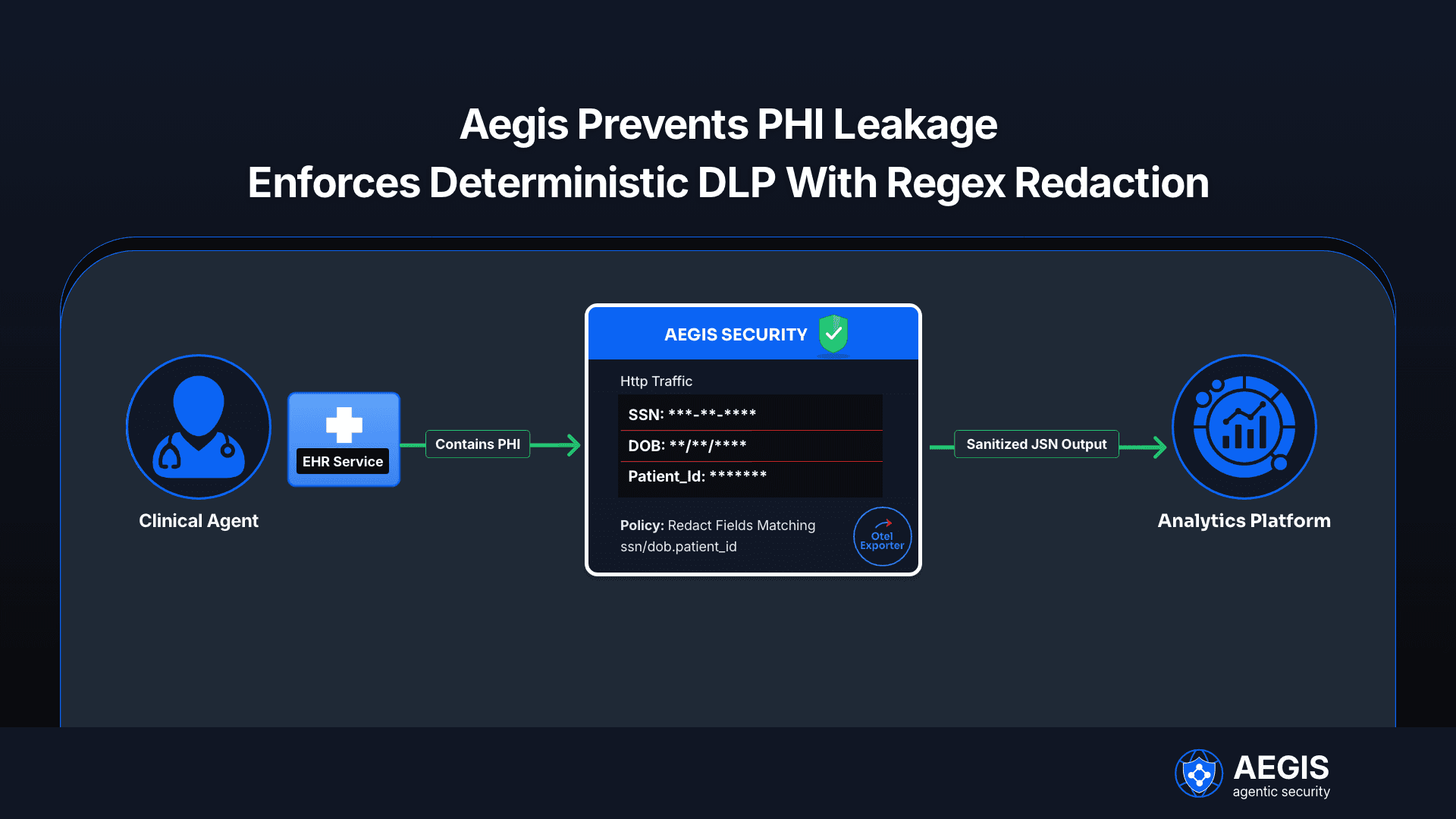
- Deterministic DLP (regex-based redaction) for PII/PHI use cases (healthcare, EHR access).
- Approval workflows integrated with chat platforms for human-in-the-loop authorization when policies return approval_needed.
- OpenTelemetry-first telemetry so every decision becomes a span that feeds dashboards and SIEM: calls per agent, blocked events, top offending parameter patterns.
Deployment patterns
- Helm chart (DaemonSet) to deploy sidecars with automatic mTLS to the local Aegis authz endpoint; sample chart snippets live in the Aegis repo (see deployment examples in developer docs).
- Fail-closed on write endpoints; optional fail-open for read-only endpoints after risk review.
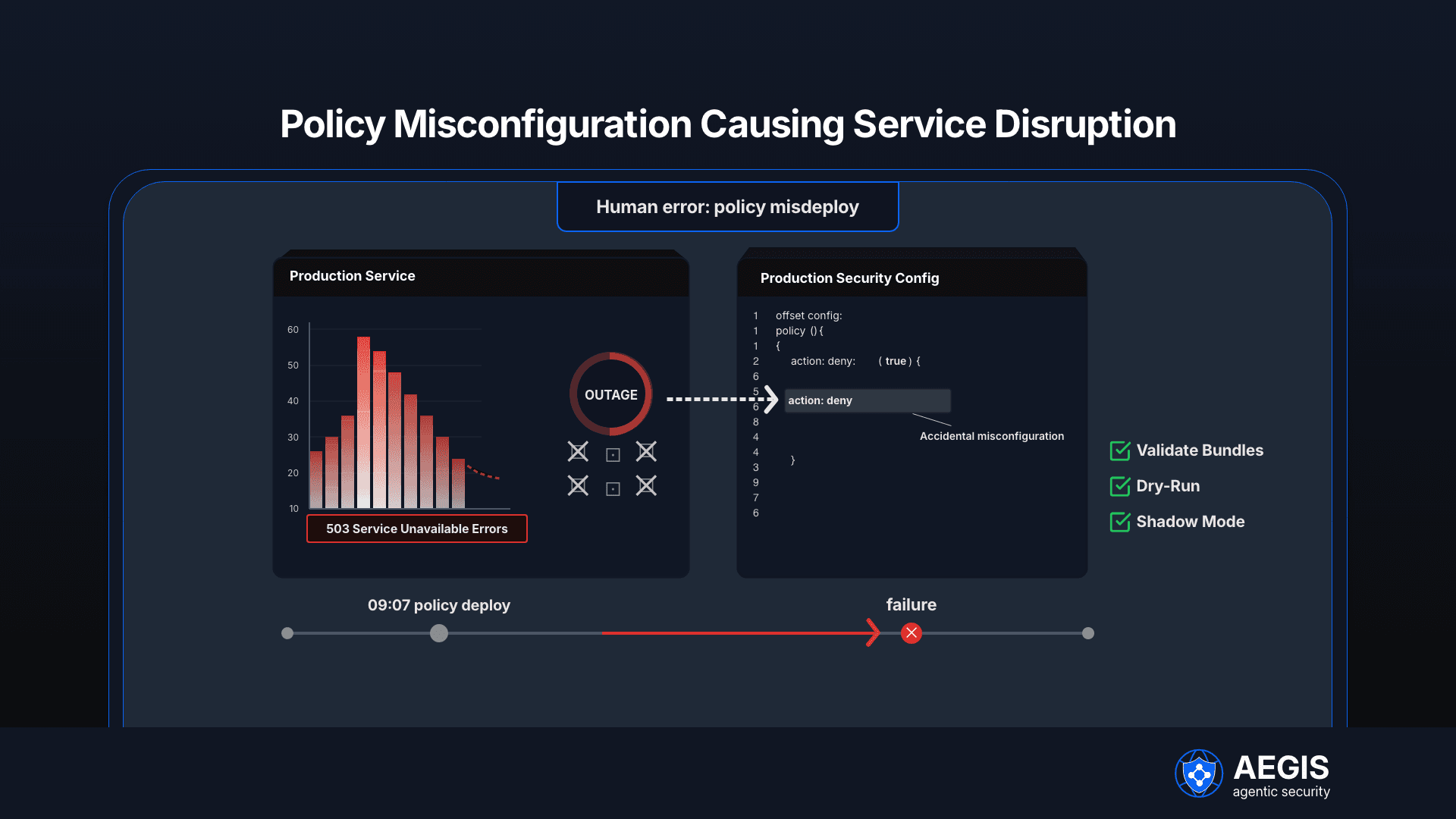
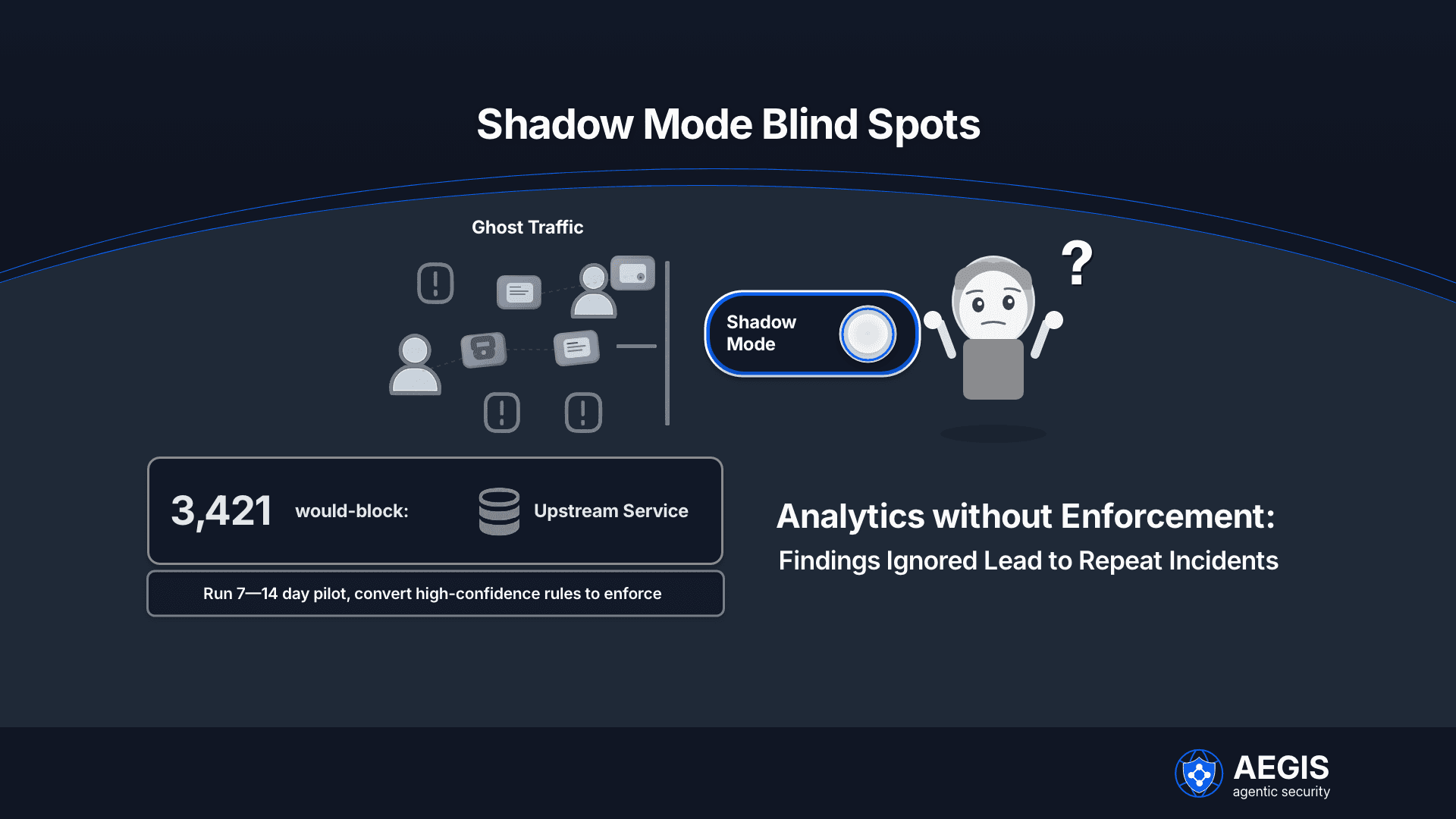
- Shadow mode: run policies in passive mode for 7–14 days to collect would-deny metrics before enforcing, reducing false positives.
Use-case alignment
- FinTech: enforce per-agent payment ceilings and require approval for high-value transfers.
- Healthcare: DLP on EHR payloads, regionally routed endpoints for data residency.
- MSSPs: multi-tenant policy scoping with signed attestations for SOC audits.
Why this matters now
Agentic AI adoption is growing — organizations report active scaling and experimentation of agent systems, and security/regulatory risks are rising alongside. Recent industry surveys show meaningful adoption of agentic systems while security concerns remain a top barrier; protecting outbound calls and enforcing runtime least-privilege are critical mitigation controls. (McKinsey & Company)
External evidence and risk
The average cost of a data breach remains material (e.g., IBM’s 2024 report shows global average breach costs near $4.88M), reinforcing the need for runtime enforcement and tamper-proof audit trails where agents interact with sensitive systems. (IBM)
Implementation checklist & quick patterns
- Identity: short-lived JWTs per agent; Ed25519 signing, JWKS for verification.
- Proxy: Envoy sidecars with ext_authz calling Aegis decision API.
- Policy: YAML → compiler → OPA bundle; hot reload.
- Observability: OTel spans for each decision; dashboards for policy tuning.
- Approvals: Slack / Teams interactive approvals with override tokens.
- Deploy: Helm DaemonSet for sidecars, Deployment for control plane, S3 bundle store for policies.
.png&w=3840&q=75)
Frequently Asked Questions
Q: Should I fail-open or fail-closed by default?
A: Fail-closed for writes; fail-open for low-risk reads only after informed risk acceptance.
Q: How do I reduce latency for policy decisions?
A: Use prepared OPA queries, in-memory caches, and edge caching of allowlist decisions; consider compiling hot paths to WASM. (Open Policy Agent)
Q: Can Aegis integrate with existing orchestrators?
A: Yes — Aegis provides SDKs and middleware for LangChain/LangGraph/AgentKit and deploys as a drop-in sidecar.
Q: How are attestations verified?
A: Attestations are Ed25519-signed tokens referencing policy_version and params_hash; verify via Aegis JWKS endpoints and record in SIEM.
Q: How long should I run shadow mode?
A: Typically 7–14 days depending on traffic and policy complexity.