
AI Governance vs. AI Visibility: The Inventory Mistake
Policy dashboards assume you know what you are governing. Discover why enterprise AI governance fails without programmatic workload visibility and asset inventory.
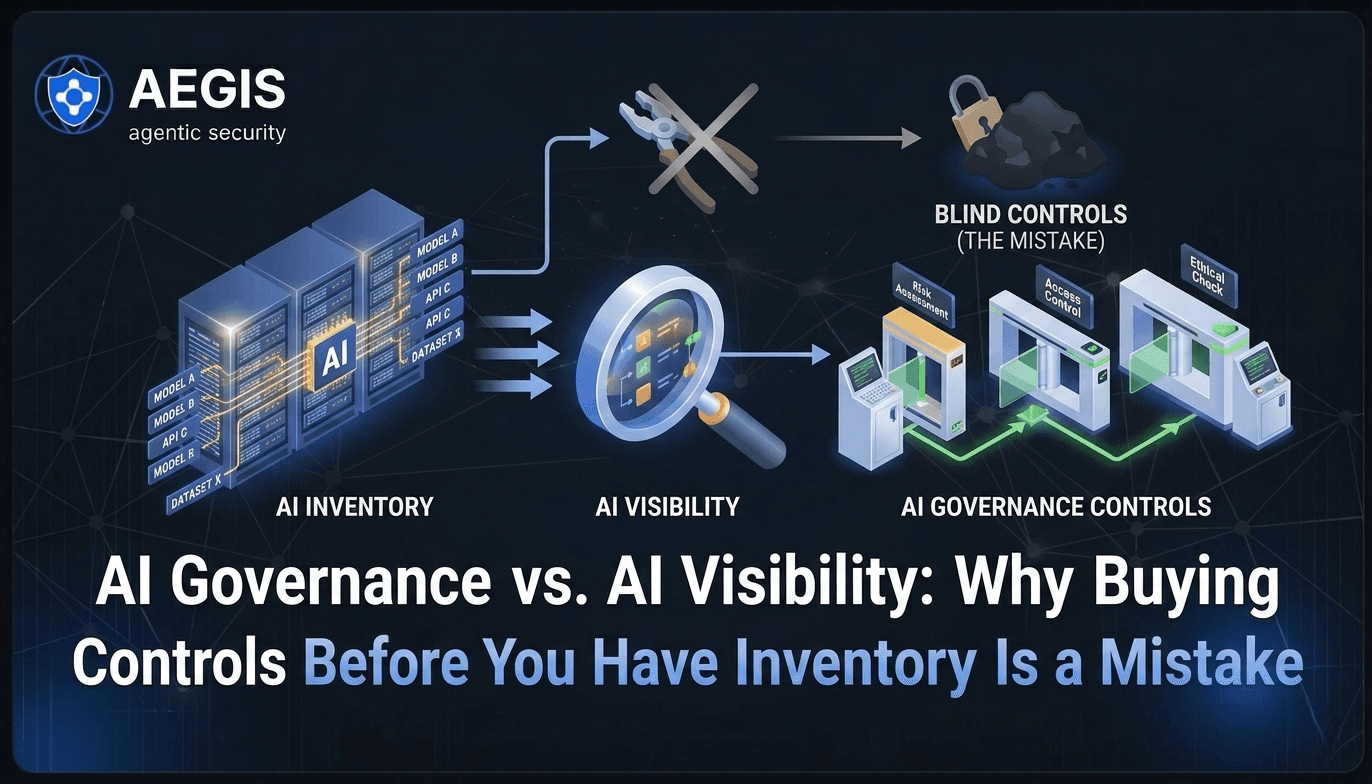
AI Governance vs. AI Visibility: Why Buying Controls Before You Have Inventory Is a Mistake
Enterprise AI governance has become the premium placeholder name for what organizations think they are implementing to achieve security. C-suites are racing to invest in high-level enterprise AI governance tools, deploying extensive policy dashboards, establishing ethics committees, and archiving compliance definitions to satisfy strict internal and external parameters. On paper, the control loop looks airtight.
But here is where the operational model breaks: policy dashboards assume you know exactly what you are governing.
The industry is currently suffering from a foundational sequence failure. Organizations are attempting to write acceptable-use constraints, data classification limits, and human-on-the-loop escalation paths for non-human workloads they haven't actually found. Industry research reveals that 86% of organizations report zero technical visibility into internal AI data flows, while agent sprawl continues to grow organically across browser extensions, shadow developer pipelines, and unvetted third-party integrations.
Buying a governance framework before establishing a programmatic, live asset inventory is not a security control—it is an empty dashboard. True security demands a contrarian execution track: you must establish visibility before you can enforce governance.
Why Visibility Stops at Discovery and Governance Starts at Control
To build a resilient enterprise architecture, security leaders must decouple simple network observation from continuous runtime governance. The two concepts serve entirely separate operational goals:
- AI Visibility is a discovery function: It operates as an asset index layer. It answers whether a machine-learning workload exists, where its orchestration engine runs, what external endpoints it queries, and what data blocks it touches.
- AI Governance is a control function: It translates raw visibility signals into actionable, real-time constraints. It defines who owns the operational outcome, what explicit policy engine bounds regulate the workflow, how access is dynamically provisioned, and how an asset is programmatically decommissioned when its context changes.
This structural variance matters because autonomous agents do not behave like static service accounts or legacy software packages. Traditional software runs on deterministic, predictable code paths.
Agents, conversely, operate stochastically. They utilize tool-use capabilities to branch into dynamic, multi-step sub-goals based on real-time text context and prompt mutations.
The risk is highly clear in production telemetry: SailPoint reports that 80% of organizations have observed AI agents execute actions far beyond their intended scope, yet less than half have deployed any real-time policies to govern them. This gap is why visibility alone cannot block system misuse. In practice, security operations teams routinely discover agent sprawl only after an unauthorized data mutation or credential exposure has already altered a production system state.
How Governance Changes the Control Model for Autonomous Agents
True governance adds the machine-speed execution rules that make visibility actionable. For non-human identities (NHIs) and goal-driven models, that means treating the active running workload itself as the primary identity primitive, then binding permissions dynamically to real-time intent rather than assigning a permanent human-style role.
The Failure of Static Roles in Agentic Workflows
Static Role-Based Access Control (RBAC) is too blunt an instrument for autonomous applications. If an agent is granted a broad, standing role across an enterprise cloud API, its blast radius is infinite. Its context, target databases, and tool-chain paths can shift mid-execution based on user instructions or adversarial prompt injections.
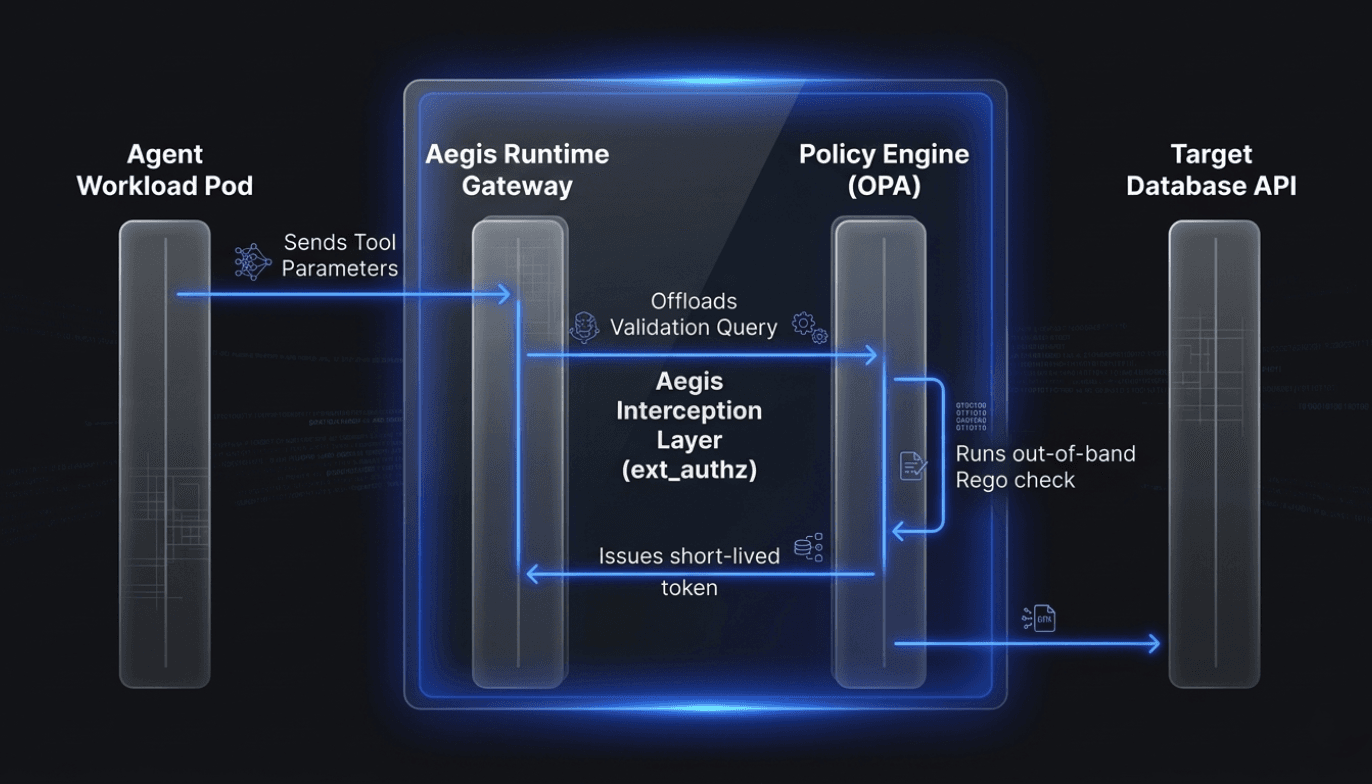
To mitigate this exposure, best practice is shifting toward an in-path architecture that evaluates permission boundaries at request time, rather than onboarding time. This aligns directly with the NIST AI Risk Management Framework (AI RMF) and the CSA MAESTRO framework, forcing organizations to build runtime controls across four specific vectors:
- Just-in-Time (JIT) Credential Provisioning: Access keys are generated dynamically for a discrete sub-task, then automatically torn down the millisecond the execution finishes.
- Short-Lived Token TTLs: Eliminating permanent standing keys hidden in scripts or setup pipelines, drastically shortening the abuse window for intercepted secrets.
- Cryptographic Workload Attestation: Utilizing platform frameworks like SPIFFE/SPIRE and OIDC to verify exactly what the active container image is at the kernel layer, rather than trusting whatever text is passed inside the prompt.
- In-Path Policy Enforcement: Checking payload characteristics, parameter thresholds, and semantic intent at the exact moment of tool execution.
Common Variations and Edge Cases: Visible but Unmanaged
Organizations attempting to balance security with developer velocity frequently stumble into two complex governance edge cases that expose the limitations of traditional, single-point IT risk management frameworks.
The "Visible but Unmanaged" Asset
The agent appears clearly inside an asset discovery dashboard, yet no named human owner is cataloged within the configuration database, and no decommissioning or retirement path has been engineered. When this agent experiences model drift, encounters an error loop, or starts executing unapproved database writes, the control chain fragments because there is no explicit accountability matrix to handle the containment.
The "Governed but Invisible" Asset
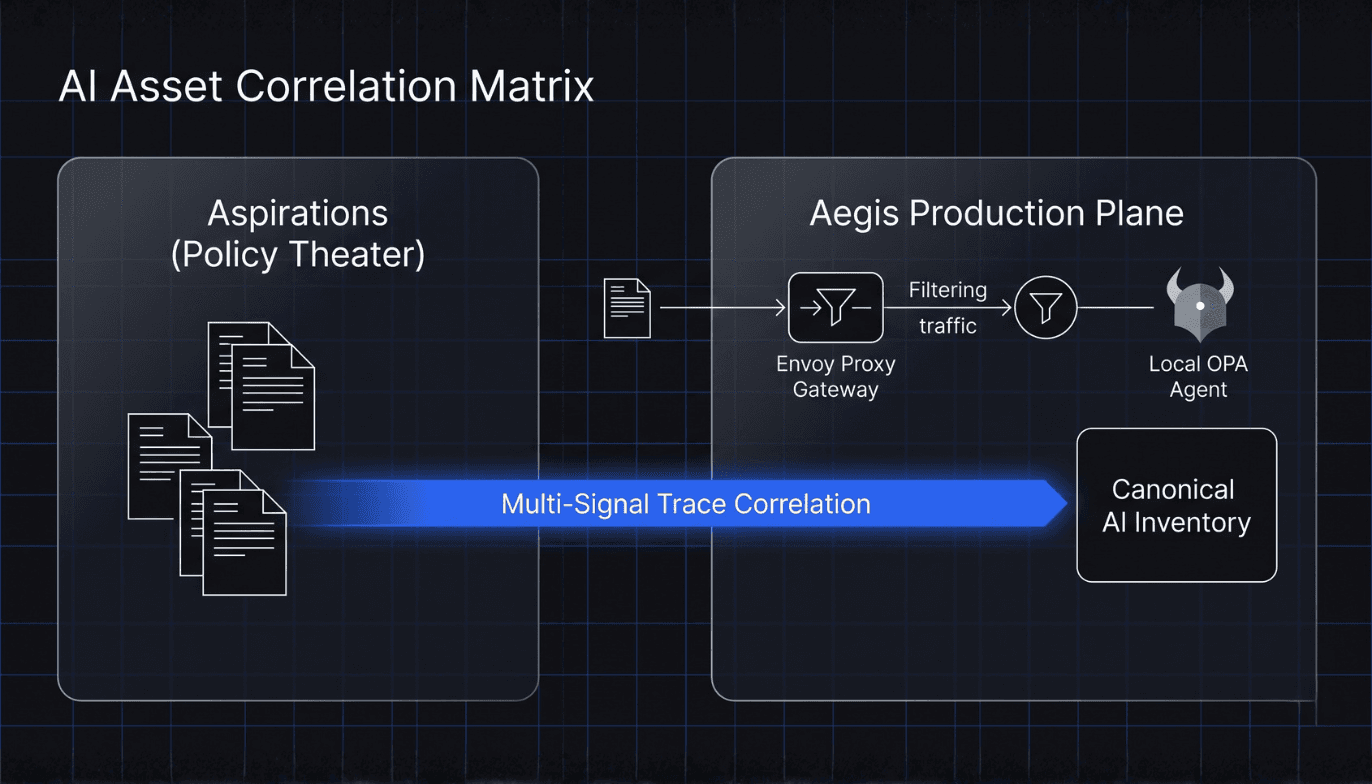
An enterprise compliance committee formally reviews and approves an AI use case on paper, yet the engineering team lacks the telemetry infrastructure to audit which internal data layers the model actually accessed, which tools it chained, or where its outputs were transmitted. Research reveals that only 52% of companies can track and audit the data payloads their AI agents interact with, showing why visibility and governance are entirely non-interoperable. A system can be authorized in a policy document and still be completely uncontrollable in a live multi-cloud cluster.
The Core Pillars of an Effective AI Security Governance Framework
Building an operational framework that scales across the entire AI lifecycle (design, development, deployment, and post-deployment) requires balancing agility with deterministic infrastructure controls. The framework relies on four core pillars working in harmony:
- Pillar 1: Responsible AI Deployment: Establishes the core ethical guidelines, semantic evaluation parameters, and bias-mitigation rules that must shape model fine-tuning and retrieval context.
- Pillar 2: Compliance and Regulation: Encodes external regulatory frameworks (such as the EU AI Act, GDPR, and CCPA) directly into runtime code, turning compliance from a static post-hoc reporting exercise into an automated launch check.
- Pillar 3: Risk Management: Deploys continuous, out-of-band monitoring tools to detect model drift, syntax injection, and behavioral anomalies at the operating system kernel level before data leaves the environment.
- Pillar 4: Oversight and Accountability: Defines explicit, named human ownership across all programmatic assets, ensuring that no agent operates without a clear decommissioning timeline and an automated kill switch path.
Before You Buy an AI Governance Tool: The Enterprise Checklist
To prevent your organization from falling into the "policy theater" trap, execute this mandatory operational verification checklist before onboarding any enterprise AI governance vendor:
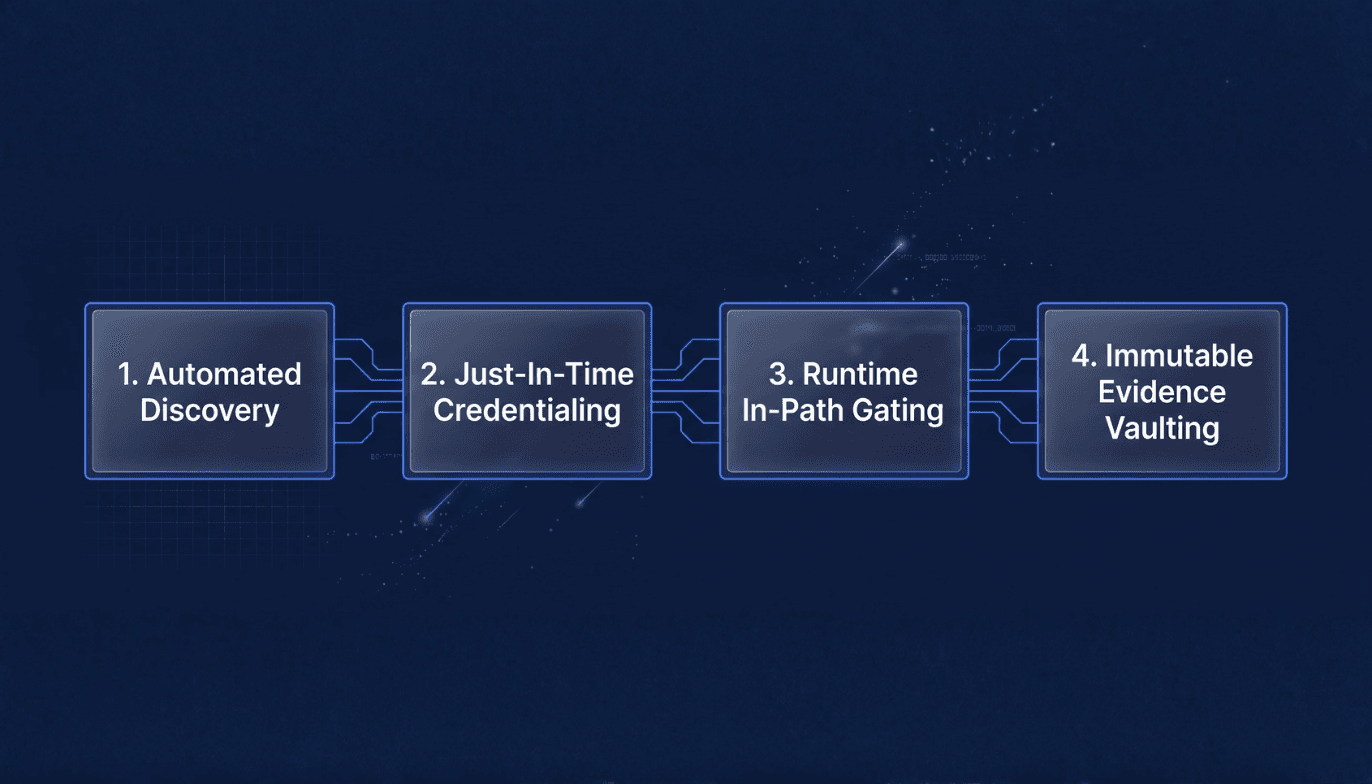
- [ ] Automated Agent Discovery: Can the tool programmatically discover unmanaged, shadow AI tools, browser extensions, and embedded model features running across your network without relying on manual entry lists?
- [ ] Trace-Native Observability: Does the platform log complete execution traces (mapping the full sequence of inputs, retrievals, tool modifications, and policy fires) or does it merely record flat, uncontextualized text alerts?
- [ ] In-Path Execution Gating: Are the guardrails observational (logging a violation after data has left the perimeter) or deterministic (intercepting and blocking a malicious API payload before side effects occur)?
- [ ] Workload Identity Binding: Does the tool support kernel-level workload attestation (SPIFFE/OIDC) to bind permissions to real-time intent, or does it depend on legacy, vulnerable static API keys?
- [ ] Multi-Agent Delegation Control: Can the platform track and govern delegation chains, ensuring a parent agent cannot delegate an action that violates its approved budget envelope or data scope?
- [ ] Immutable Evidence Store: Does it write audit snapshots directly to write-once-read-many (WORM) object storage to guarantee cryptographically secure compliance reports for external regulators?
The Agentic SOC: Regaining Control at Machine Speed
The underlying reality of enterprise AI chaos is that human attention cannot function as a scalable control plane. When an autonomous agent can exploit a context injection vulnerability, manipulate its own tool-use logic, and exfiltrate records across cloud tenants in under two minutes, waiting for a human compliance committee or a manual SOC review queue is an operational failure.
The only architecturally sound defense against an autonomous ecosystem moving at machine velocity is the implementation of an Agentic SOC: an engineering infrastructure where specialized AI monitoring agents continuously govern operational AI agents.
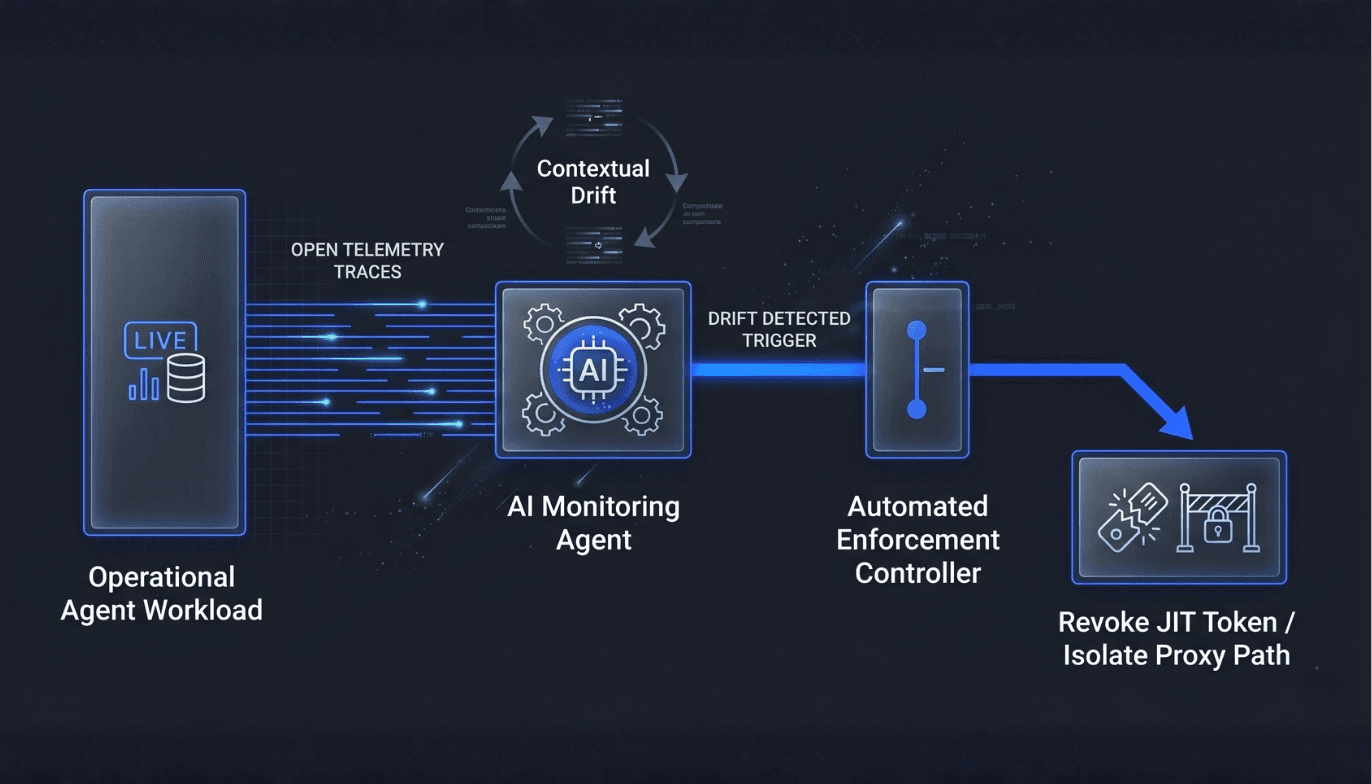
Operating directly inside the active data path, AI monitoring agents continuously analyze the streaming telemetry traces of your running systems. They construct real-time behavioral profiles and apply localized reinforcement learning to detect anomalous intent.
The moment an operational agent's trajectory strays from its authorized baseline boundary, the monitoring engine steps completely outside human manual latencies—instantly revoking the target workload's JIT token at the identity layer and dropping its network packets at the Envoy proxy edge.
The human operators move away from chasing individual alerts, stepping up to serve as systemic commanders who configure risk tiers and dictate baseline rules, while the machine-speed monitoring layer handles the massive transactional volume that human oversight cannot sustain.
Conclusion: Inventory is the Only Path to Trust
Enterprise AI governance fails when it exists in isolation, completely disconnected from the live systems running inside the business. When something goes wrong, everyone points at the written policy document as if it were self-operating. But an AI policy without an underlying runtime inventory is simply theater.
The durable enterprise AI platforms will not be the ones that attempt to build rigid approval mazes on paper, but those that establish automated, real-time workload visibility as the absolute foundation of their risk architecture. By following the precise operational sequence—Visibility $\rightarrow$ Confidence $\rightarrow$ Inventory $\rightarrow$ Governance—organizations can eliminate unmanaged agent sprawl, enforce fine-grained intent boundaries, and scale automation with complete architectural trust. Stop buying controls for assets you cannot see; secure the execution layer, and the governance will follow.
Frequently Asked Questions (FAQ)
Q1: Why is visibility considered the baseline requirement before establishing AI governance?
A: Visibility answers whether an asset exists, where it runs, and what data systems it touches. You cannot write a scalable, enforceable policy or assign human accountability for autonomous agents, shadow pipelines, or unvetted tools that your security architecture hasn't found.
Q2: What is the main operational difference between visibility and governance?
A: Visibility is an asset discovery and observation function. Governance is an active infrastructure control function—it defines who owns the operational outcome, enforces policy boundaries at request time, and manages the lifecycle and decommissioning state of the workload.
Q3: Why does traditional Role-Based Access Control (RBAC) fail in an agentic ecosystem?
A: Traditional RBAC assigns long-lived, standing permissions to user roles. AI agents operate stochastically, chaining tools and modifying execution trajectories dynamically based on real-time prompt text. If an agent holds a permanent administrative role, a single prompt injection can hijack its reasoning loop and turn it into a high-speed vector for data exfiltration.
Q4: How does intent-based authorization protect legacy systems linked to AI agents?
A: Legacy systems are often incapable of revoking tokens cleanly or evaluating non-deterministic behavior because standing secrets are embedded directly inside their scripts. Intent-based authorization routes transactions through a runtime gateway proxy that evaluates payload parameters at request time, blocking anomalous interactions before they can hit the backend database.
Q5: What is an "unmanaged visible agent" and why is it dangerous?
A: An unmanaged visible agent appears inside an asset inventory tool, but lacks an assigned human owner and has no documented lifecycle retirement path. If that agent experiences model drift, encounters an infinite loop, or suffers an infrastructure compromise, the control chain fragments faster than the visibility stack can reconcile it.
Q6: How do global frameworks like the EU AI Act change compliance obligations for AI workloads?
A: The EU AI Act and emerging regional regulations mandate that compliance be demonstrable and enforceable at runtime, rather than just documented during procurement. Organizations must maintain continuous post-deployment monitoring, automated decision logging, human-on-the-loop oversight, and live safeguards against unintended systemic behavior.
Q7: What does an "Evidence Event" capture inside an immutable storage locker?
A: An evidence event captures the full decision context of an infrastructure control action. Rather than logging raw, flat event telemetry, it records exactly why a transaction was allowed, modified, or blocked—binding the active policy version, model characteristics, user tokens, and observed environmental signals into a tamper-proof record for external auditors.
Q8: Can AI monitoring agents safely execute automated containment loops?
A: Yes. Because autonomous threats move at machine velocity, human review queues introduce dangerous latency. An Agentic SOC deploys specialized AI monitoring nodes that track operational agents out-of-band and instantly trigger automated containment runbooks—such as revoking ephemeral tokens and injecting dynamic network isolation rules—the moment risk thresholds are breached.