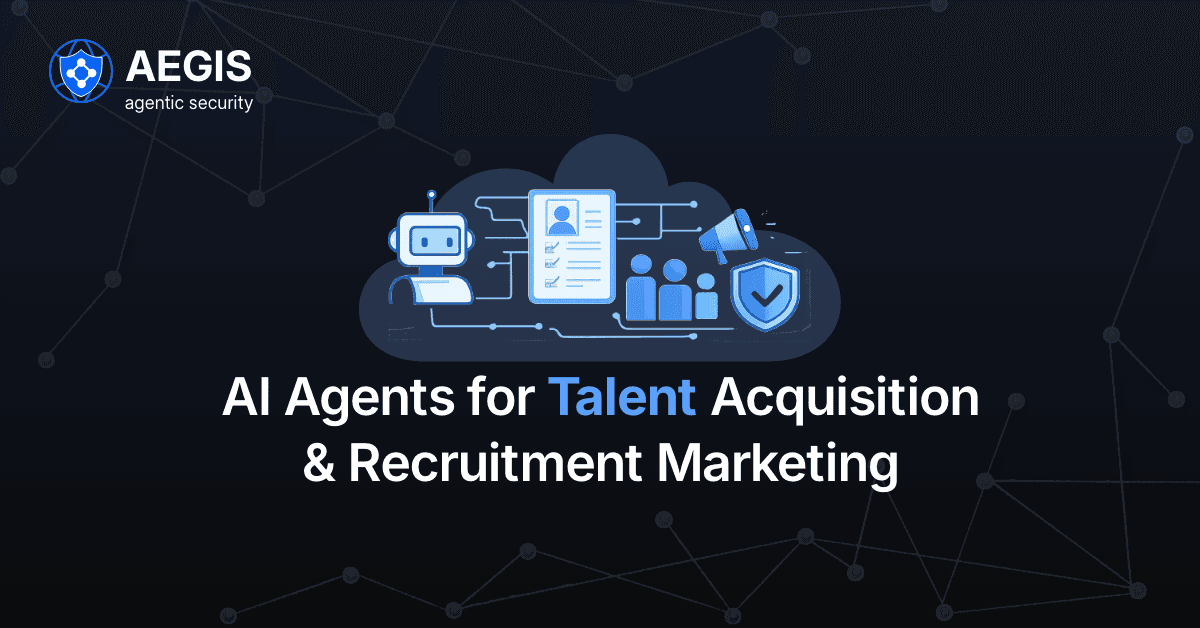
AI Agents for Talent Acquisition & Recruitment Marketing
Practical guide to securing multi-agent AI with Aegis: policy-as-code, runtime enforcement, approvals and telemetry.
Aegis: runtime security for agentic AI in operations and hiring
Agentic AI — autonomous or semi-autonomous agents that execute multi-step workflows — is moving fast from experiment to production. That velocity creates a new class of operational risks: privilege escalation between agents, silent data exfiltration, runaway costs, and audit gaps. This post explains practical controls for operator-grade agent deployments, demonstrates how Aegis (the Aegis Gateway) enforces them at runtime, and applies the controls to a concrete talent-acquisition automation example (sourcing → screening → scheduling → offers). Where possible, supporting data and enterprise guidance are cited.
Why runtime controls are now essential
Industry surveys show rapid interest but uneven maturity for agentic AI: Gartner projects 33% of enterprise apps will include agentic AI by 2028, up from near zero in 2024; many projects still fail without governance. Reuters summarised Gartner’s warning that over 40% of agentic AI projects could be scrapped by 2027 due to unclear value and costs. These findings underline the need for a security mesh that enforces guardrails when agents run at scale. (Gartner)
Key operational failure modes:
- Inter-agent coercion: a planner agent inducing a finance agent to exceed its payment limits.
- Parameter injection: unvalidated text becoming dangerous tool arguments (payments, shell commands).
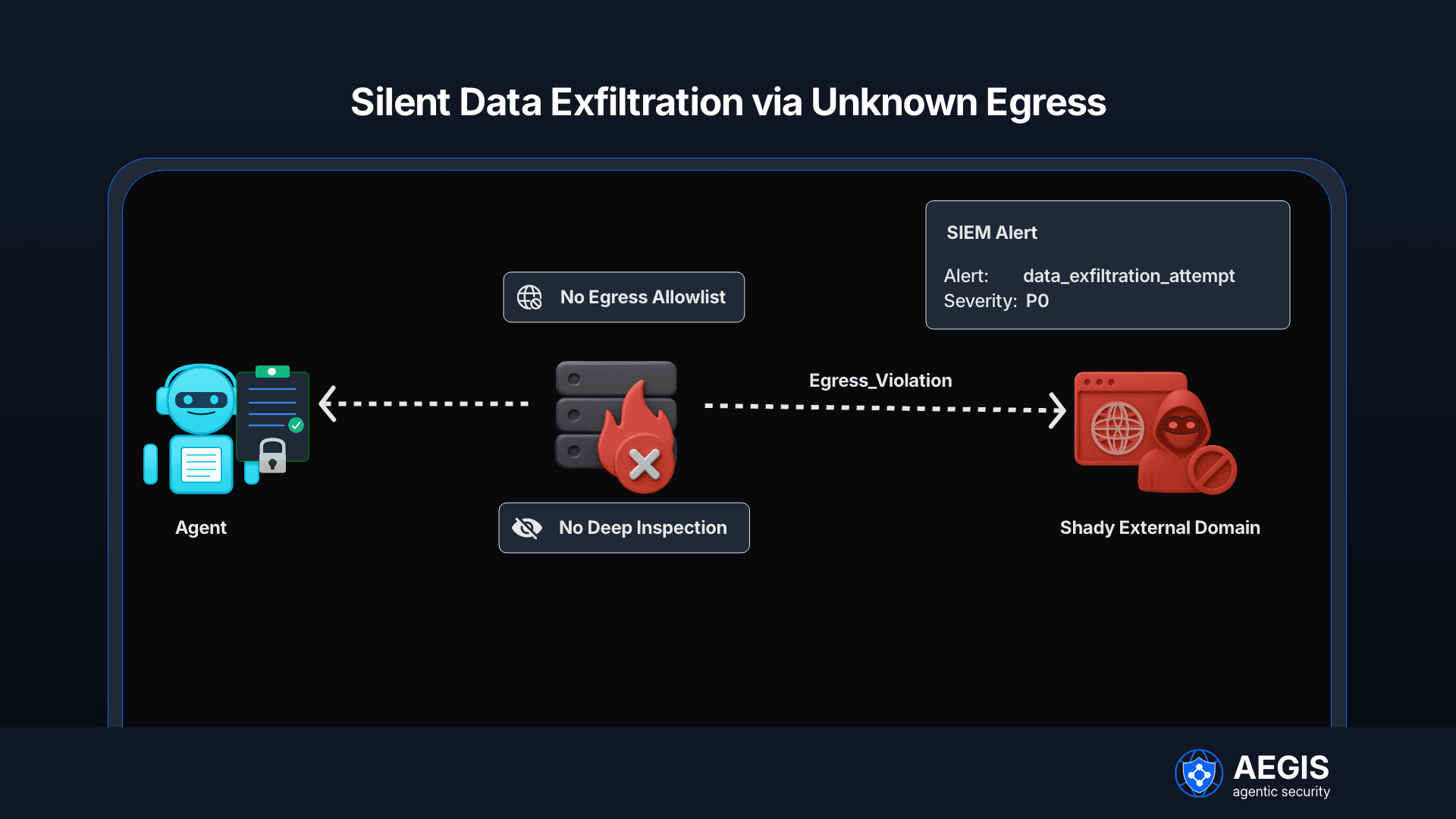
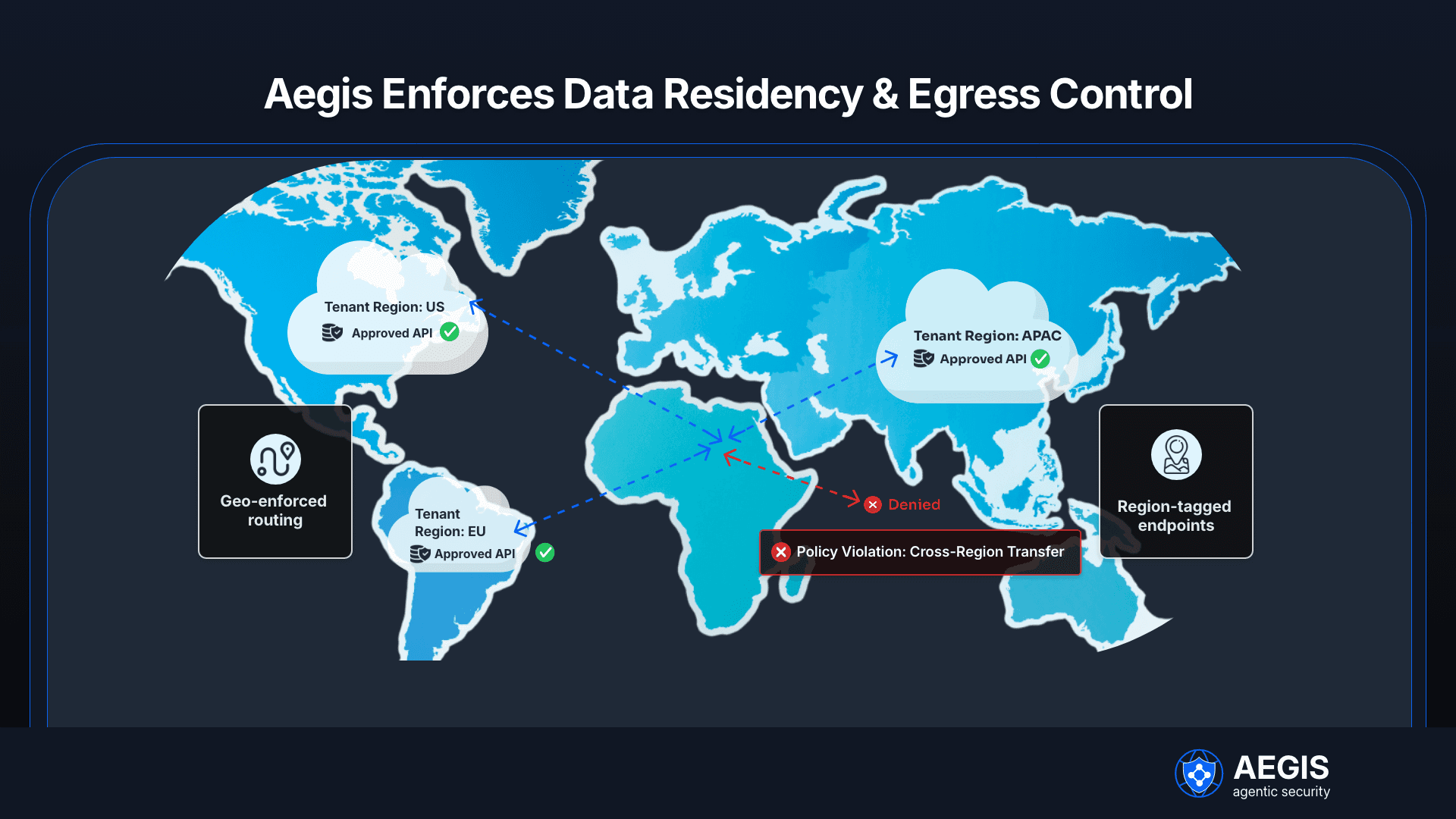
- Data exfiltration: agents sending candidate PII to unauthorized endpoints.
- Cost-runaway: auto-spawned agents calling expensive LLMs or third-party APIs without budgets.
Design practitioners should assume that IAM alone is insufficient — decisions must consider agent identity, parameters, call context, and approval gates at runtime.
Practical controls for agentic workflows
Core control patterns
- Agent identity & least privilege — issue unique short-lived tokens per agent, bind policies to agent IDs.
- Policy-as-code — express allowed tools, parameter conditions, thresholds, and approval rules in YAML/JSON compiled into fast evaluators.
- Runtime enforcement gateway — a proxy/sidecar that intercepts agent→tool calls, evaluates policy, and returns allow/deny/sanitize/approval_needed decisions.
- DLP & parameter sanitization — deterministic regex redaction for PII (emails, SSNs) and route blocking by domain.
- Observability & auditability — OpenTelemetry spans and signed logs for every decision, shipped to SIEM for SOC review.
Metrics and rollout practices
Start in shadow mode (observe would-block events) before enforcing. Track would-deny rates, false-reject counts, approval latency, and cost per agent. Pilot a single role family across two regions, measure time-to-offer, diversity mix and candidate drop-off, then expand. McKinsey and others recommend shadow rollouts to avoid governance surprises. (McKinsey & Company)
Use case: agentic talent acquisition with enforcement points
Recruiting pipelines are ideal for agentic automation: sourcing agents scrape approved pools; screening agents score resumes; scheduling agents coordinate interviews; offer agents draft letters. But candidate PII, fairness requirements, and offer approvals require policy controls. The example below shows enforcement points where Aegis applies rules.
Flow — job → sourcing agent → screening agent → interview agent → offer agent.
Enforcement points:
- Sourcing: allowlist sources, block bulk export of candidate PII.
- Screening: require anonymized shortlists (names redacted) and log fairness metrics.
- Interview scheduling: require consent capture and prevent calendar invites with full PII in titles.
- Offers: require human sign-off for salary/compensation decisions and attach audit trail.
Table 1 — Screening methods vs bias risk & mitigation
Method | Bias risk | Mitigation (policy examples) |
Keyword filters | High (overfitting to wording) | Enforce human review for rejects; record provenance; shadow testing |
ML classifier | Medium (training bias) | Require fairness score threshold; anonymized shortlist; periodic bias tests |
Hybrid (ML + rules) | Lower | Policy enforces audit trail & appeal path; DLP on PII |
Aegis Gateway: design and capabilities
Aegis is a runtime policy and observability fabric for multi-agent systems. It sits between orchestrators (LangChain/LangGraph/AgentKit) and tools, acting like “Istio + OPA for agents.” Key product attributes:
Identity & token model — short-lived JWTs minted per agent including organisation/tenant/agent claims and scope. Tokens are Ed25519-signed; the gateway validates and enforces scopes at call time.
Policy-as-code and compilation — administrators author YAML/JSON policies that express allowed tools, parameter conditions (ranges, regex), rate limits, budgets, and approval policies. Aegis compiles these into OPA bundles or embedded prepared queries for sub-20ms evaluation. Policies support modes: shadow, enforce, and dry-run.
Runtime enforcement — an Envoy sidecar or forward proxy funnels outbound calls through Aegis. Each call is evaluated (agent_id, tool, parameters, parent chain). Decisions can be:
- allow — pass through.
- deny — block with structured error.
- sanitize — redact or rewrite parameters (PII redaction).
- approval_needed — pause and send an interactive approval request to Slack/Teams; upon human approval a one-time override token allows retry.
Telemetry & audit — every decision yields an OpenTelemetry span including agent_id, policy_version, decision_reason, and estimated cost. Spans and signed logs are exportable to Grafana/Prometheus and SIEMs. Immutable policy versioning and signed manifests support tamper evidence in audits.
Developer ergonomics — SDKs and decorators simplify integration with LangChain/LangGraph and provide a secure_fetch replacement. CLI tools allow agent registration, policy push, dry-run simulation, and policy rollbacks. Shadow mode accelerates safe adoption by surfacing would-block events before enforcement.
Operational safeguards — per-agent budgets and RPS limits prevent cost runaways; egress allowlists block unknown destinations; per-field DLP removes PII before analytics or storage. Approval workflows can be tuned to thresholds to avoid overload while protecting high-risk actions.
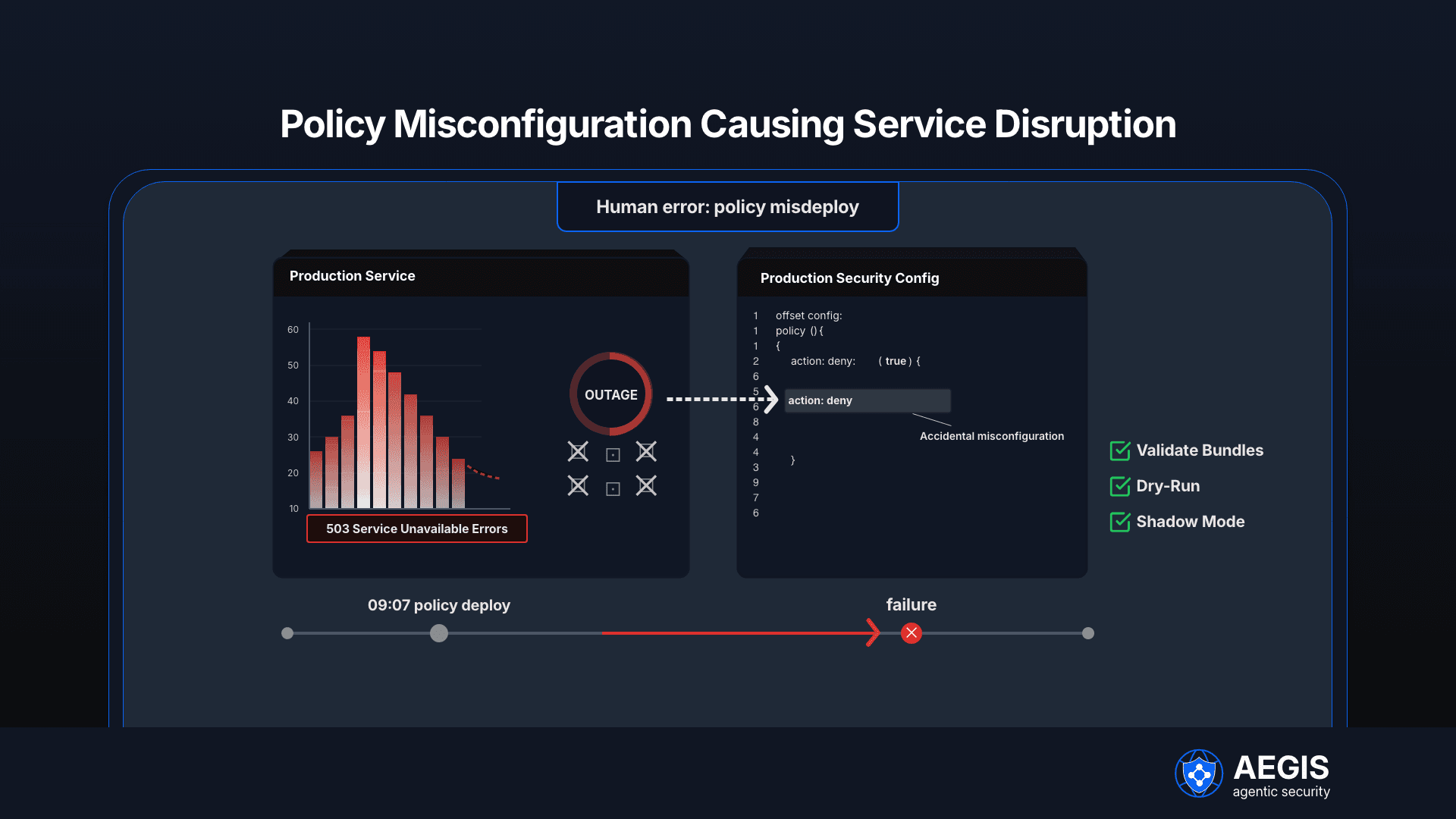
Table 2 — Aegis capability snapshot
Capability | Why it matters | Typical policy example |
Agent identity tokens | Attribution & least privilege | agent_id=screening-agent; allowed_tools: {ats-api:read} |
Parameter inspection | Prevent injection & exfiltration | deny if payload contains external_url |
Approval workflows | Human in the loop for high risk | approval_needed if amount > $5,000 |
Telemetry & signed logs | Audit & SOC readiness | trace includes policy_version, decision_reason |
Implementation checklist for a talent-acquisition pilot
- Select scope: one role family across two regions; integrate ATS + calendar + assessment platform connectors.
- Author policies: anonymized shortlist rule, PII redaction, approval_needed for offers > threshold.
- Deploy Aegis in shadow mode for 7–14 days; collect would-deny metrics and false-reject counts.
- Tune models & rules; set fairness score thresholds; add human review gates.
- Flip to enforce; monitor candidate experience metrics (drop-off, time-to-offer, diversity mix).
Governance, metrics and red teaming
Operational metrics to track:
- Would-deny rate (shadow mode)
- False-reject / appeal rate
- Time-to-offer and time-to-fill
- Diversity mix at shortlist and hire
- Cost per agent and P99 decision latency
Red teams should adversarially test prompt injection, parent_agent_id spoofing, and parameter coercion. Emit OpenTelemetry spans and signed audit logs for each test to validate observability. Use policy dry-run to simulate complex chains before production.
Practical constraints and edge cases
- Executive search and bespoke hiring workflows may require human-only paths; policies must support scoped bypasses (approval_needed + manual workflows).
- Policies must be versioned and tenant-scoped to avoid cross-tenant collisions.
- Approval workflows can become bottlenecks; aggregate low-risk approvals or use delegated approvers to scale.
Frequently Asked Questions
- What is Aegis?
Aegis is a runtime policy & observability gateway (policy-as-code + enforcement) for multi-agent AI, enforcing decisions at the agent→tool boundary with telemetry and approvals. - How does Aegis prevent agent privilege escalation?
By issuing scoped agent tokens, inspecting call parameters, enforcing per-agent tool lists and parameter conditions, and blocking/pausing calls that violate policy. - Can Aegis redact candidate PII automatically?
Yes — deterministic DLP rules can sanitize fields (email, phone, SSN) before outputs are persisted or forwarded. - What is shadow mode?
Shadow mode evaluates policies and logs would-deny events without blocking, enabling safe tuning before enforcement. - Which orchestrators are supported?
Aegis is orchestrator-agnostic and integrates via SDKs/middleware with LangChain/LangGraph/AgentKit patterns; it also works as an Envoy ext_authz proxy. - How do we measure fairness and bias?
Collect fairness scores for screening models, require thresholds for automated rejects, anonymize shortlists, and log appeals and false-reject rates for continuous tuning.
-1.png&w=3840&q=75)
Closing
Agentic automation can drive measurable operational gains — but only if runtime controls are in place. Aegis provides the policy-as-code, enforcement, approvals and telemetry enterprises need to run agents safely at scale.