
AI Agents for Research & Development: Literature Review and Synthesis
Enforce least-privilege, provenance, and auditability for multi-agent AI with Aegis Gateway.
Aegis: Runtime Security for Agentic AI
Introduction
Enterprises adopting agentic AI face a new class of runtime risk: autonomous agents executing multi-step workflows that touch payments, data stores, CI/CD pipelines, and external APIs. Aegis is designed as a runtime policy and observability fabric — a security mesh that enforces least-privilege, binds provenance to synthesized claims, and produces auditable traces for SOC and compliance teams. This article explains why runtime enforcement matters for R&D and production agent workflows, the technical design of Aegis, and operational recipes for deploying Aegis in research and development environments.
The problem: agents amplify both productivity and risk
Agentic systems dramatically reduce manual work — including literature reviews, extractive synthesis, and experiment ideation — but they also introduce new failure modes. In R&D, agents ingest corpora, extract candidate claims, synthesize narratives, and propose experiments. Without provenance and controls, synthesized claims can hallucinate, leak proprietary data, or misattribute sources, undermining reproducibility and compliance.
Recent enterprise research shows broad momentum and concern: 23% of organizations report they are scaling agentic AI systems, with another large cohort experimenting with agents. (McKinsey & Company) Security teams flag data privacy and governance as top blockers for adoption: multiple surveys in 2024–25 report that a majority of leaders cite AI data privacy and agent security as critical risks. (Cybersecurity Dive)
Why literature-review and R&D agents need runtime policy & provenance
Hallucination and provenance risks
LLMs still produce unsupported assertions and incorrect citations at nontrivial rates; medical and legal studies have documented reference accuracy problems when models generate citations without robust grounding. Provenance binding — attaching direct citations and retrieval evidence to each claim — is essential to avoid those errors. (JMIR)
Data leakage and egress threats
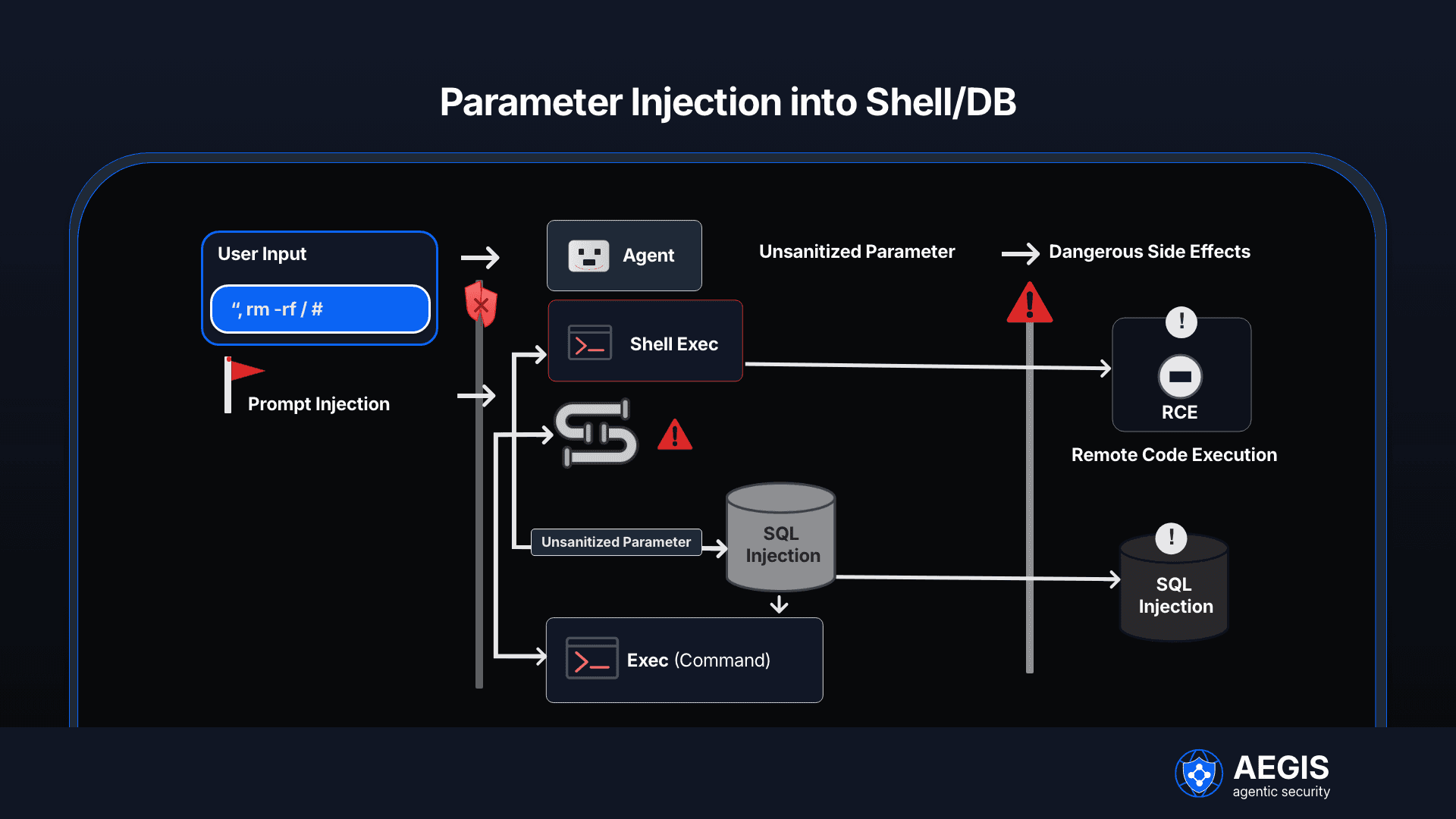
R&D agents frequently access proprietary corpora. A rogue or compromised agent can exfiltrate IP to public endpoints. Runtime egress control and per-agent allowlists are therefore mandatory for internal research projects. Shadow rollout and per-agent budgets reduce blast radius while tuning policies.
Aegis in the workflow: where it sits and what it enforces
Aegis sits as a gateway between orchestrators and tools (sidecar or forward proxy), enforcing policy at the agent↔tool boundary and emitting structured telemetry for every decision. Key primitives:
• Agent identity: short-lived JWTs with agent, tenant, and scope claims.
• Policy-as-code: YAML/JSON policies compiled into OPA bundles and hot-reloaded.
• Decisions: allow, deny, sanitize (redact), approval_needed.
• Telemetry: OpenTelemetry spans with decision reason, policy version, and cost estimates. (Internal design details and MVP spec available in binary design docs.)
Aegis technical design
Data plane: runtime enforcement and inspection
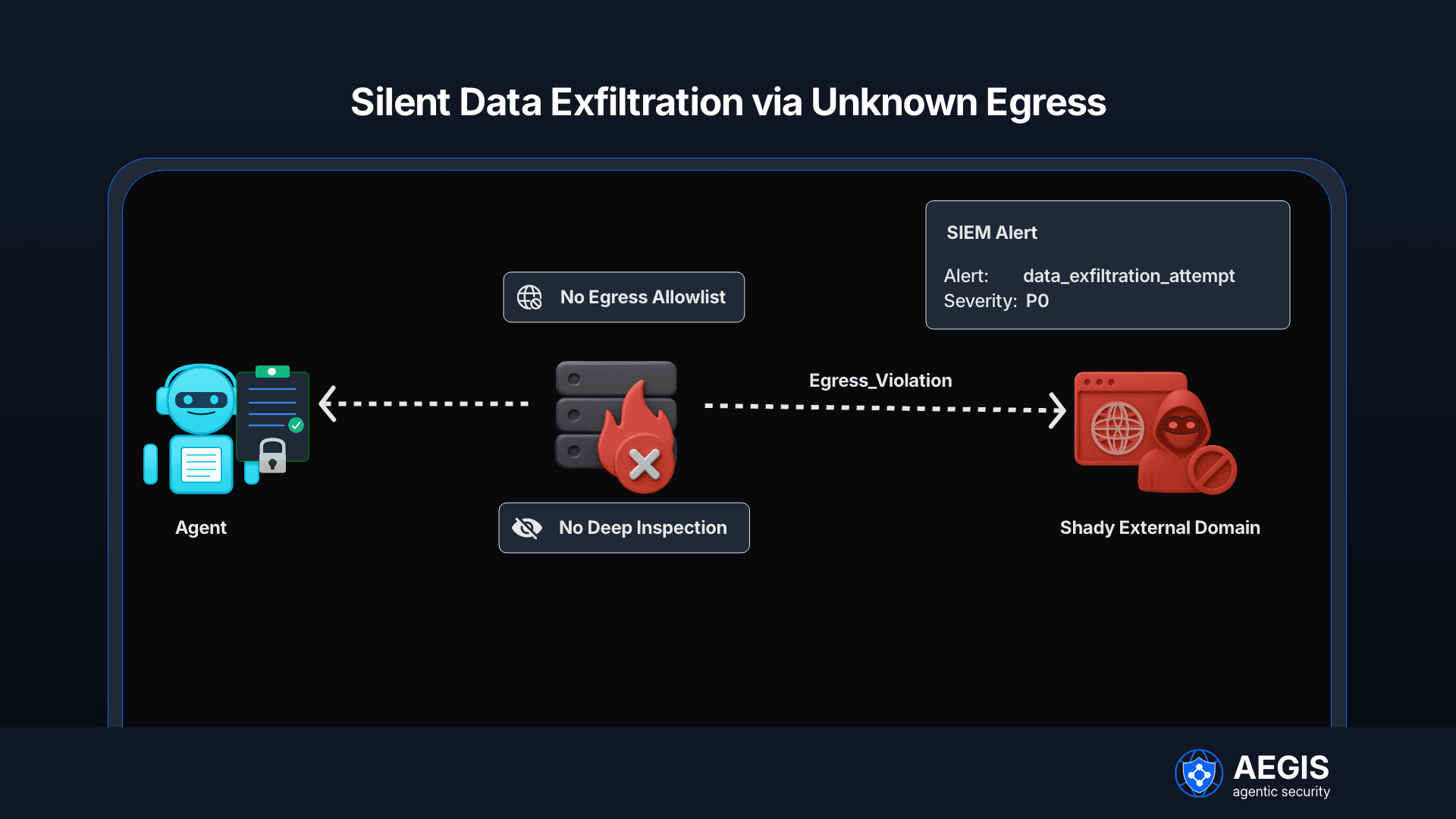
Aegis implements a lightweight proxy (Envoy ext_authz or SDK middleware) that intercepts outbound tool calls. Each request is evaluated by an external authorization service that consults the compiled OPA bundle. The service can return an attested allow decision (signed) or deny/sanitize response; for high-risk calls it returns approval_needed and triggers human workflow integration (Slack or Teams). Telemetry spans include agent_id, tool, decision, policy_version and latency.
Control plane: policy lifecycle and developer experience
Administrators author policies as YAML, validate with schemas, compile to OPA bundles, and publish. Policies support conditions (ranges, regexes), budgets, rate limits and override rules. Aegis provides dry-run (shadow) mode and simulation tools so teams can collect would-deny telemetry before enforcing policies, avoiding operational surprises.
Identity, egress, and DLP
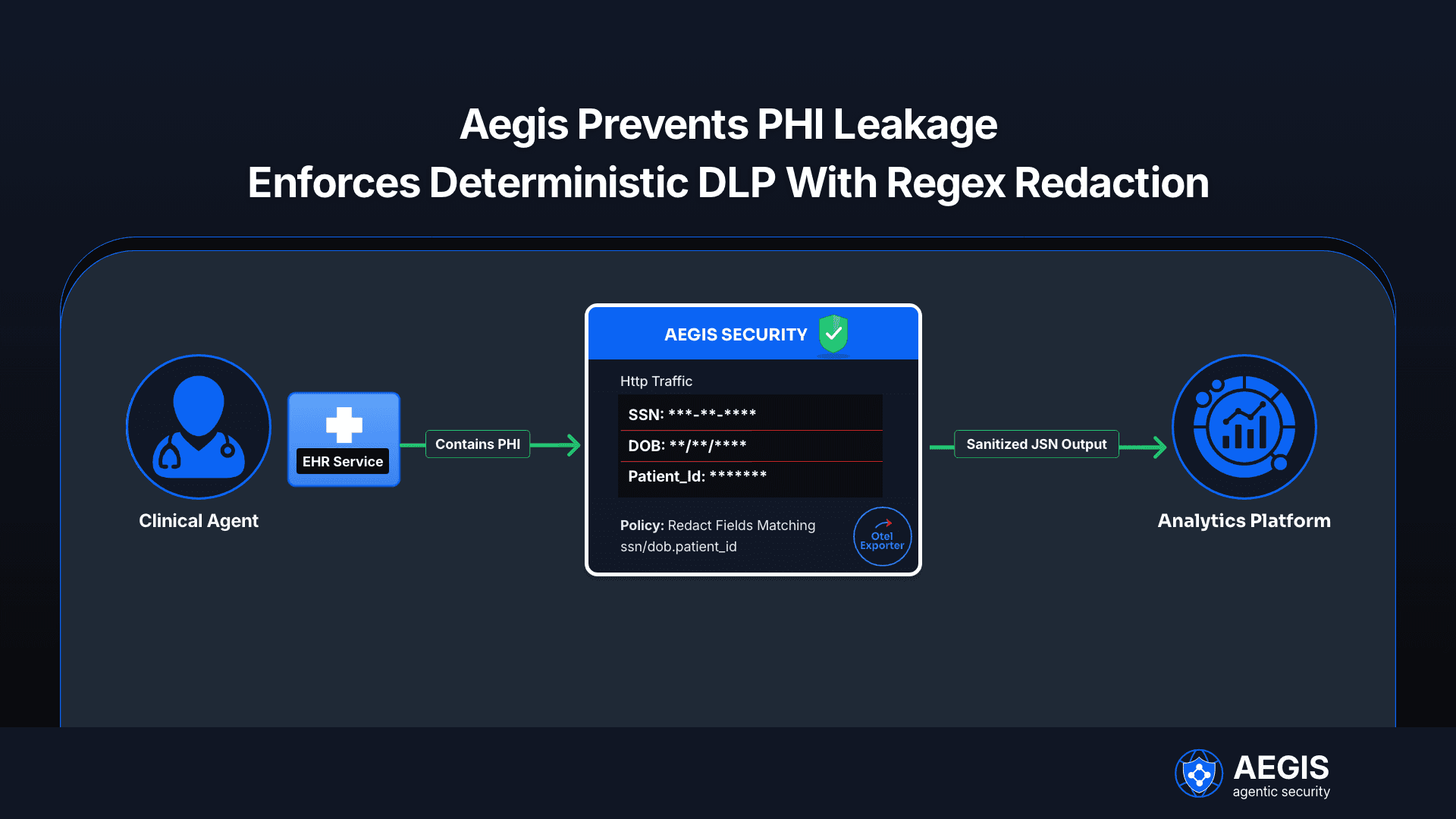
Aegis issues short-lived tokens and enforces outbound allowlists to approved domains. Deterministic DLP (regex redaction) sanitizes PII before calls reach external tools. For R&D corpus handling, provenance metadata (DOI resolution, snippet hashes, versioned corpora) is stored with every synthesized claim so that each assertion in a brief has retrievable evidence.
Table 1 — Comparison of retrieval methods (recall / precision example)
Method | Typical recall | Typical precision | Notes |
Keyword (lexical) | 0.55 | 0.70 | Fast, but misses paraphrases |
Semantic (embedding) | 0.78 | 0.68 | Better recall for paraphrases; may need reranking |
Hybrid (semantic + lexical) | 0.83 | 0.75 | Best balance for R&D SOTA scans |
Operational playbook: deploying Aegis for R&D agents
Start small, expand carefully
- Pilot with internal corpora and two connectors (e.g., internal search + LLM).
- Run policies in shadow for 7–14 days; tune regexes, budgets, and thresholds.
- Require at least two direct citations per extracted claim in synthesis agent outputs for pilot topics; block any synthesized claim lacking provenance.
Governance and human-in-the-loop
Require a human review checklist for hypotheses and high-impact experiment proposals from agents. Use Aegis approval flow to attach signed override tokens to approved actions. Store the exported dataset of snippet provenance and retrieval scores for reproducibility audits.
Table 2 — Sample policy snippets and enforcement outcomes
Policy intent | Example condition | Enforcement action |
High-value payments | amount > 5,000 | approval_needed (Slack) |
EHR reads | dest != internal-ehr.myorg | deny |
LLM budgets | daily_cost > $20 | deny / BudgetExceeded |
Synthesis claims | <2 source citations | deny (or mark low confidence) |
Measuring success: metrics that matter
Measure policy coverage, decision latency (target P99 ≤ 20 ms), fraction of claims with strong provenance, and reviewer time saved on synthesis briefs. Pilots often report 50–70% time savings on extraction and synthesis tasks when agents are used responsibly, but full human review remains necessary for interpretation. (anara.com)
Use cases and edge cases
• Research SOTA briefs: automated 2-page syntheses with inline citations and confidence scores — Aegis blocks any brief that lacks the required provenance attachments.
• Hypothesis generation: agents propose experiments and datasets; Aegis ensures no external data leak and enforces dataset consent constraints.
• Clinical reports: strict PHI handling, deterministic DLP, and policy attestations before exporting or sharing.
Integration and ecosystem links
Aegis integrates with common orchestrators via SDK middleware and proxy patterns, and provides dashboards for SOC, FinOps, and DevOps teams.
Frequently Asked Questions
- What is the minimum policy to start a pilot?
Start with agent registration, an egress allowlist, and two policies: per-agent budget and a deny for external domains not in allowlist. - How does Aegis prevent hallucinated citations?
Aegis requires provenance attachments (snippet IDs, retrieval scores, DOI) for each claim; synthesis without provenance is blocked or flagged low confidence. - Will policy evaluation add latency?
Target decision latency is P99 ≤ 20 ms using prepared OPA queries and caching; proxy overhead is designed to be minimal. - Can Aegis support multi-tenant MSSP deployments?
Yes — Aegis isolates bundles per tenant, regionally routes data, and emits tenant-scoped telemetry suitable for SOC reviews. - How do I prove provenance for audits?
Export the signed telemetry spans and the dataset of source snippets and retrieval scores; Aegis can optionally sign audit logs for tamper resistance. - What about approval overload?
Policies can set granular thresholds to reduce unnecessary approvals, and approval workflows can batch low-risk decisions.
Closing: practical next steps
For R&D teams building agentic pipelines, adopting a runtime enforcement fabric is not optional — it’s required to keep agent workflows auditable, reproducible, and safe. Start with internal corpora, deploy Aegis in shadow, require provenance attachments per claim, and iterate policies based on telemetry. The combination of policy-as-code, attested decisions, and provenance binding enables teams to shorten literature reviews and accelerate experiment cycles while maintaining compliance and auditability.
External references and further reading: McKinsey "State of AI" (2025) on agent scaling and enterprise adoption, and studies on citation accuracy in LLMs. (McKinsey & Company)