
AI Agent vs. Python Script: Tell Them Apart & Secure the Risk
Policy dashboards fail when applied to stochastic agents. Discover the structural differences between linear scripts and autonomous non-human actors.
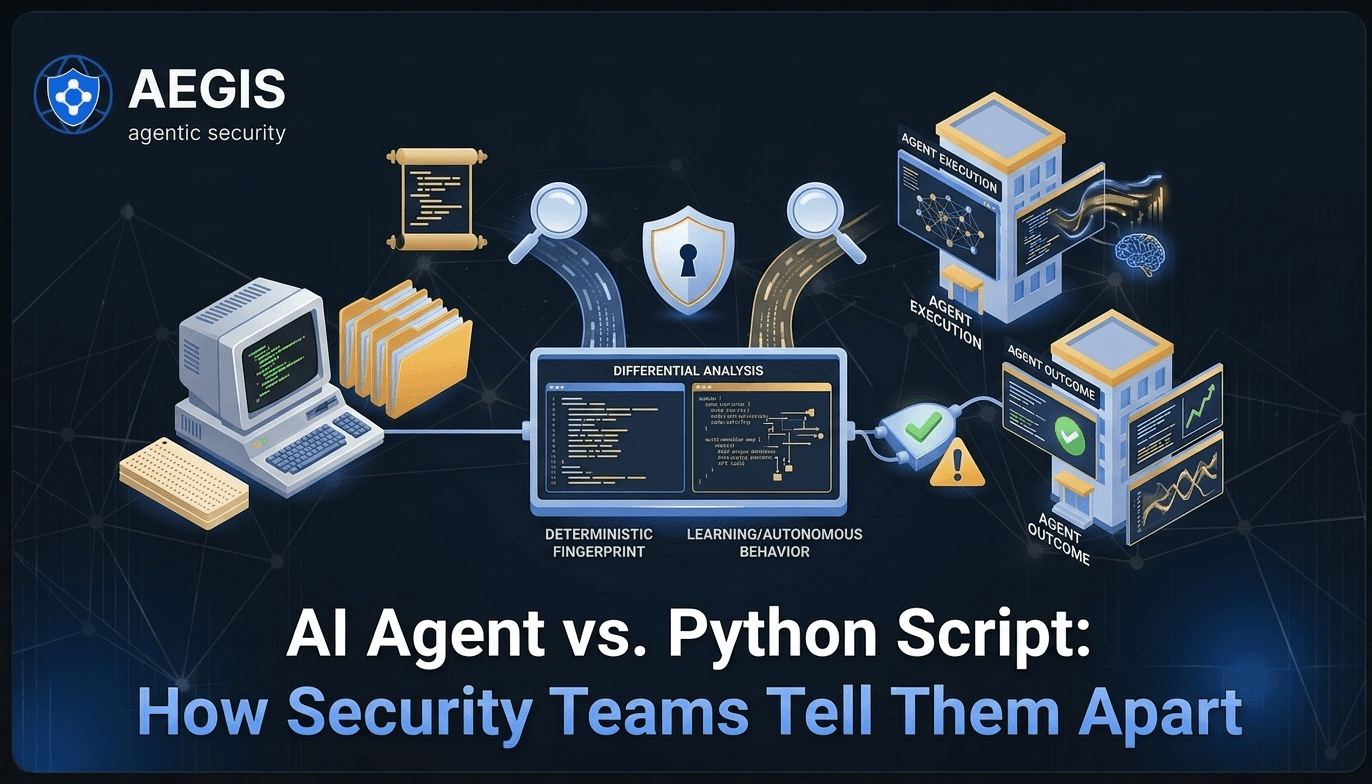
AI Agent vs. Python Script: How Security Teams Tell Them Apart (And Why Getting It Wrong Is Costly)
Enterprise security operations are facing a quiet but catastrophic perimeter crisis. For decades, the non-human identity (NHI) stack was straightforward: platform engineering teams deployed deterministic automations—typically packaged as Cron jobs, CI/CD runners, or standalone Python scripts—to handle routine infrastructure maintenance, data replication, and API syncing. Security architectures evolved to protect these channels by assigning static service account roles and checking connections at onboarding time.
But a new category of digital worker has entered production networks: the autonomous AI Agent. Armed with LLM reasoning components, model context protocols (MCP), and tool-use capabilities, these systems do not follow fixed, predictable code paths. They process data stochastically, creating independent sub-goals and chaining dynamic API executions based on real-time text context and prompt mutations.
The core operational failure occurring inside modern enterprise networks is a failure of classification: Security teams are treating stochastic AI agents like traditional, linear Python scripts. Getting this distinction wrong is extraordinarily costly. When your security stack fails to distinguish a static automation script from an autonomous actor, it grants permanent, over-privileged access to an entity that can be hijacked via a single prompt injection. To secure modern cloud environments, security architectures must move away from "policy theater" and build runtime controls that actively separate deterministic code loops from goal-driven non-human actors.
Defining the Execution Boundary: Scripts vs. Agents
To construct a resilient defense architecture, enterprise platform engineers must map out the stark behavioral variations that separate traditional automation scripts from autonomous agent runtimes.
Traditional Python Scripts
A standard automation script is completely deterministic. It executes a pre-defined sequence of instructions written by a developer. If it encounters a data packet anomaly or an unexpected API response that wasn't explicitly encoded in its error-handling logic, the script crashes, throws an infrastructure error code, and alerts the monitoring dashboard. Its access parameters are highly predictable and easily restricted using traditional, static role-based access control (RBAC).
Autonomous AI Agents
An AI agent is a non-deterministic software runtime. Rather than following rigid line-by-line syntax, it leverages a foundation model to reason toward an abstract objective. It perceives its environment, evaluates outputs from preceding steps, and decides its next tool call dynamically based on runtime context.
Because an agent can generate its own structural pathways and interface with unvetted systems via Model Context Protocols, its final execution web cannot be mapped at onboarding time. This means its risk profile is significantly closer to a privileged workload than a standard service account session.
Why the Identification Failure Is Seasoned with Risk
When an organization confuses an active autonomous agent with a simple, fixed script, it introduces deep security vulnerabilities that traditional perimeter frameworks are blind to monitor.
Prompt Manipulation and the Identity Hijack
If an AI agent is granted broad, permanent administrative privileges under the assumption that it is just a routine data-syncing script, its blast radius becomes infinite. An adversary does not need to compromise local network keys or execute an exploit payload to hijack the channel.
By injecting malicious instructions into a public website or a customer database record, the attacker executes an Indirect Prompt Injection attack. The agent parses the compromised source, its inner reasoning loop is instantly overridden, and it leverages its valid, authenticated service account role to execute unauthorized data extractions or system mutations at machine velocity.
The Illusion of Posture Safety
Data exposure remains a highly volatile threat because AI systems process, infer, and repackage data in ways that bypass conventional file perimeters. Legacy Data Loss Prevention (DLP) and Secure Web Gateway (SWG) engines are engineered to look for structured, syntax-based data formats—Social Security numbers, credit card strings, or known file extension headers.
An agent hijacked via an instruction hijack transmits sensitive data as natural language conversations without structured formats. A user-centric DLP system sees generic, encrypted HTTPS streaming traffic routing to an approved cloud domain, completely missing the real-time data exfiltration loop.
Non-Deterministic Behavioral Drift
A Python script’s code remains static until a developer commits an explicit update to the repository. An agent’s behavior shifts continuously based on conversation state history, retrieved context, and the evolution of underlying provider models. This non-deterministic model drift can go completely undetected by standard security scans, accumulating minor inaccuracies silently until it crosses a critical threshold and triggers severe compliance violations or legal liabilities.
The Aegis Architecture: Moving to Action-Level Security
Remediating this classification gap requires an engineering framework that shifts focus from static perimeter verification to In-Path Action Security. Security teams must implement a Runtime AI Gateway pattern that intercepts every outbound tool call before any system state changes occur.
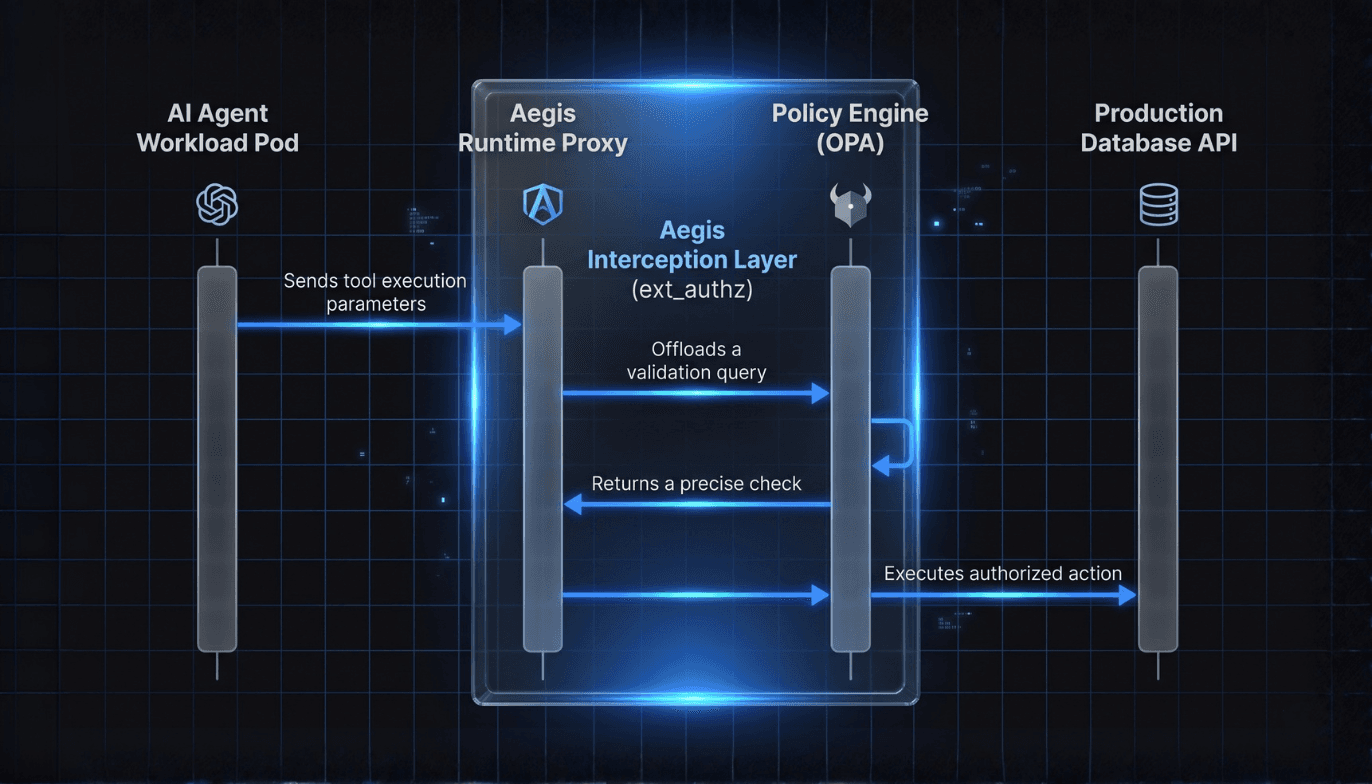
The Aegis runtime framework decouples the core reasoning engine (the LLM) from the infrastructure execution layer, applying three strict technical principles:
- Externalized Control Plane: Models cannot be trusted to self-regulate or parse their own safety constraints. Policies must execute within an independent, out-of-band proxy layer (such as an Envoy gateway configuration utilizing an external authorization filter primitive) that inspects inputs, outputs, and tool arguments out-of-band.
- Semantic Evaluation Over Regex Matching: Traditional pattern matching is blind to paraphrasing or context synthesis. The policy engine uses lightweight classifiers that reason over intent, topic, and data classification tags to catch inferred data leakage before it can leave the environment.
- Untrusted Output Filtering: Models can leak internal configuration tokens or combine separate data domains across permission boundaries even when inputs appear entirely clean. The proxy applies post-generation output filtering—including redaction, generalization, or response truncation—continuously at the network edge.
The Multi-Layered Safety Architecture
To scale autonomous workflows confidently without risking operational chaos, organizations must structure security into four automated operational layers across the system lifecycle:
- Layer 1: Threat Detection and Anomaly Scoring: The system continuously monitors network metadata, process instantiation paths, and tool call velocities to build a mathematical baseline of normal software behavior. Any out-of-place activity is instantly scored.
- Layer 2: Automation and Response (Agentic Triage): When an anomaly score crosses defined risk thresholds, automated runbooks execute instantly. Rather than waiting for manual intervention, the platform automatically isolates affected container nodes or rotates compromised identities.
- Layer 3: In-Path Runtime Protections: Deploys dedicated content filters directly within the active streaming pipeline to check payloads, evaluate data sensitivity tags, and neutralize injection vectors before application logic can process the input.
- Layer 4: Regular Audits and Drift Tracking: Tracks model drift and behavior decay using structural metrics, executing scheduled revalidation fire drills and adversarial red-teaming to ensure runtime boundaries remain hardened over time.
Implementing the 3As Governance Control Framework
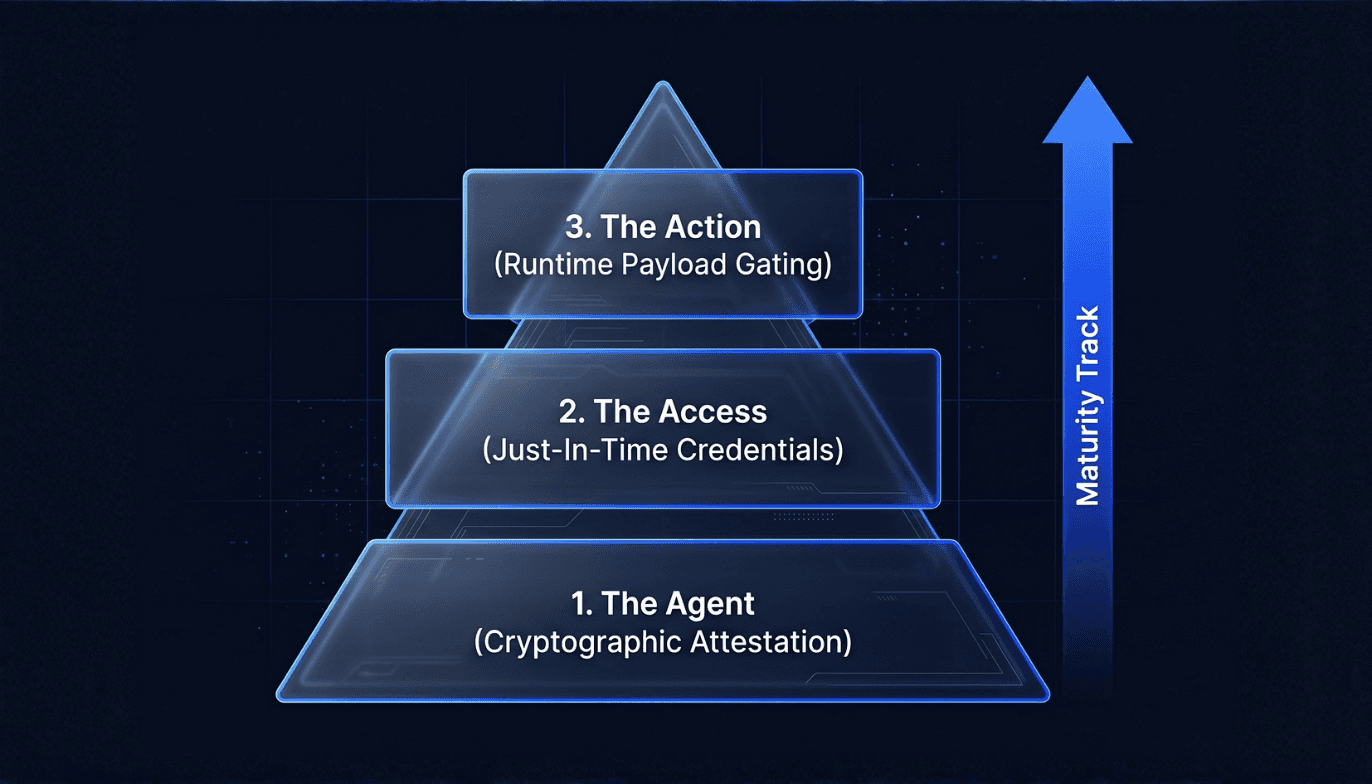
To safely manage a distributed non-human workforce, enterprise security leadership must implement an institutional governance framework structured around the three core engineering variables of the 3As Framework.
- Variable 1: The Agent (Cryptographic Attestation): Every running asset must be cataloged inside a centralized registry and mapped explicitly to a named human owner who retains legal accountability for its state mutations. Runtimes are attested at the kernel layer using standards like SPIFFE/SPIRE or OpenID Connect (OIDC) identity exchange rather than relying on unvetted service account entries.
- Variable 2: The Access (Just-In-Time Credentials): Eliminate permanent, standing "God-Mode" API keys across your architecture. Implement Intent-Based Access Control, utilizing secure identity vaults to generate fine-grained, short-lived tokens that expire automatically the millisecond a discrete execution sub-task completes.
- Variable 3: The Action (Runtime Payload Gating): The policy engine checks the semantic meaning, arguments, and parameters of individual tool calls out-of-band against declarative policy-as-code bundles (such as Rego definitions via Open Policy Agent), blocking or truncating the packet at the gateway edge if a rule is breached.
The Agentic SOC: Defending at Machine Velocity
The structural latency inherent in a traditional Security Operations Center framework represents a critical failure vector when defending against compromised machine identities. In a classic tier-1 analyst environment, a telemetry alert is ingested, aggregated into a centralized data lake, prioritized by a SIEM engine, and dropped into an analyst's manual triage queue—introducing an inherent operational latency measured in hours.
When an autonomous agentic system encounters a prompt injection or model drift error, it can loop across microservices, exfiltrate sensitive files, manipulate cloud identities, and delete its own local configuration logs in under ninety seconds.
Machine-Speed Isolation
Waiting for a human response team to open an investigation ticket is an operational failure; it merely serves as an after-the-fact report documenting a completed disaster. The only architecturally coherent defense against a threat moving at machine velocity is the deployment of an Agentic SOC: a security operational model where specialized AI monitoring agents continuously govern operational AI agents.
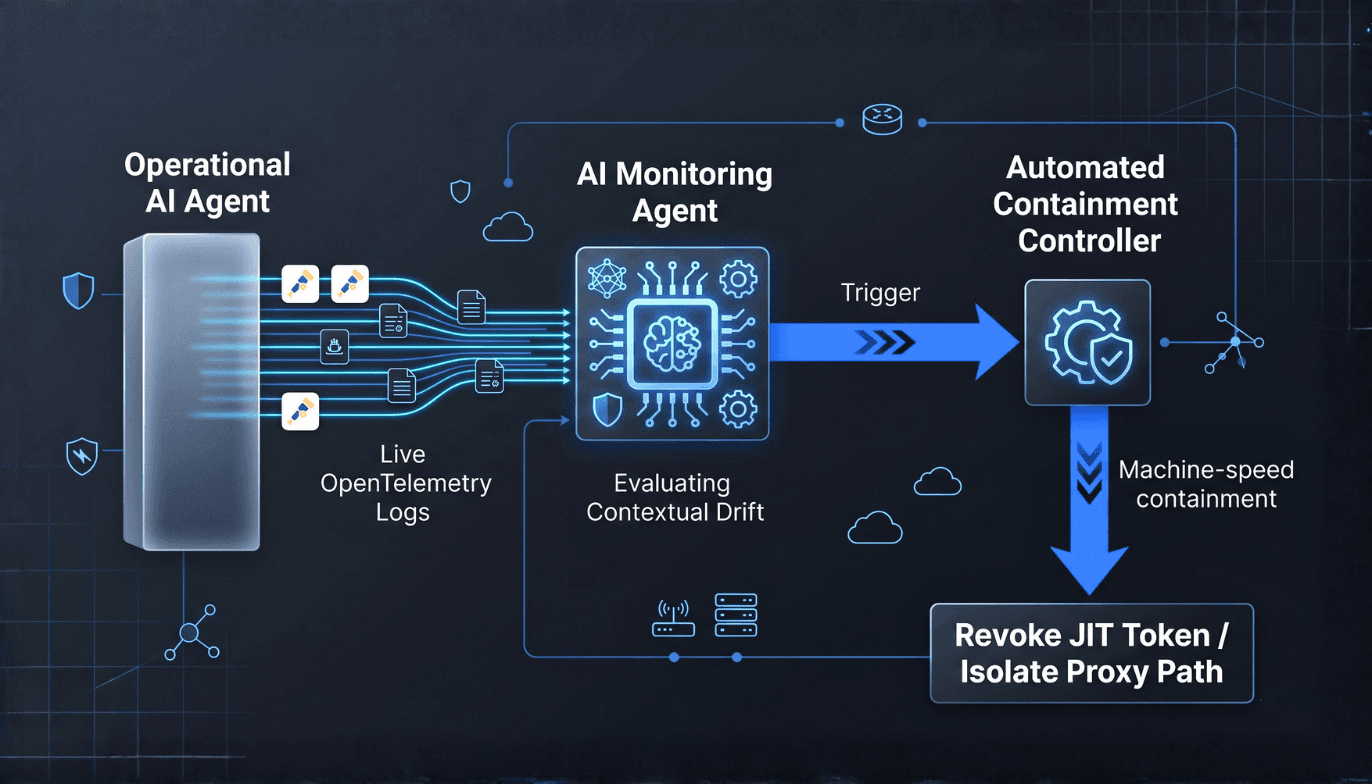
In this architecture, autonomous monitoring agents run out-of-band alongside primary enterprise workflows, consuming thin execution traces via continuous OpenTelemetry loops. These specialized nodes apply localized reinforcement learning to construct real-time profiles of normal software intent.
The exact millisecond an operational agent's call trajectory drifts outside its authorized baseline parameters, the monitoring layer steps completely outside human manual latencies: it signals the identity layer to instantly revoke the target workload's short-lived JWT token, modifies proxy gateway settings to isolate the network path at the transport edge, and packages the complete trace record for forensic analysis.
Human security operators move away from chasing individual event logs, stepping up to serve as systemic commanders who configure risk tolerances and dictate baseline rules, while the automated runtime architecture handles the massive transaction volume that human oversight cannot sustain.
Standards, Frameworks, and Regulatory Compliance Alignment
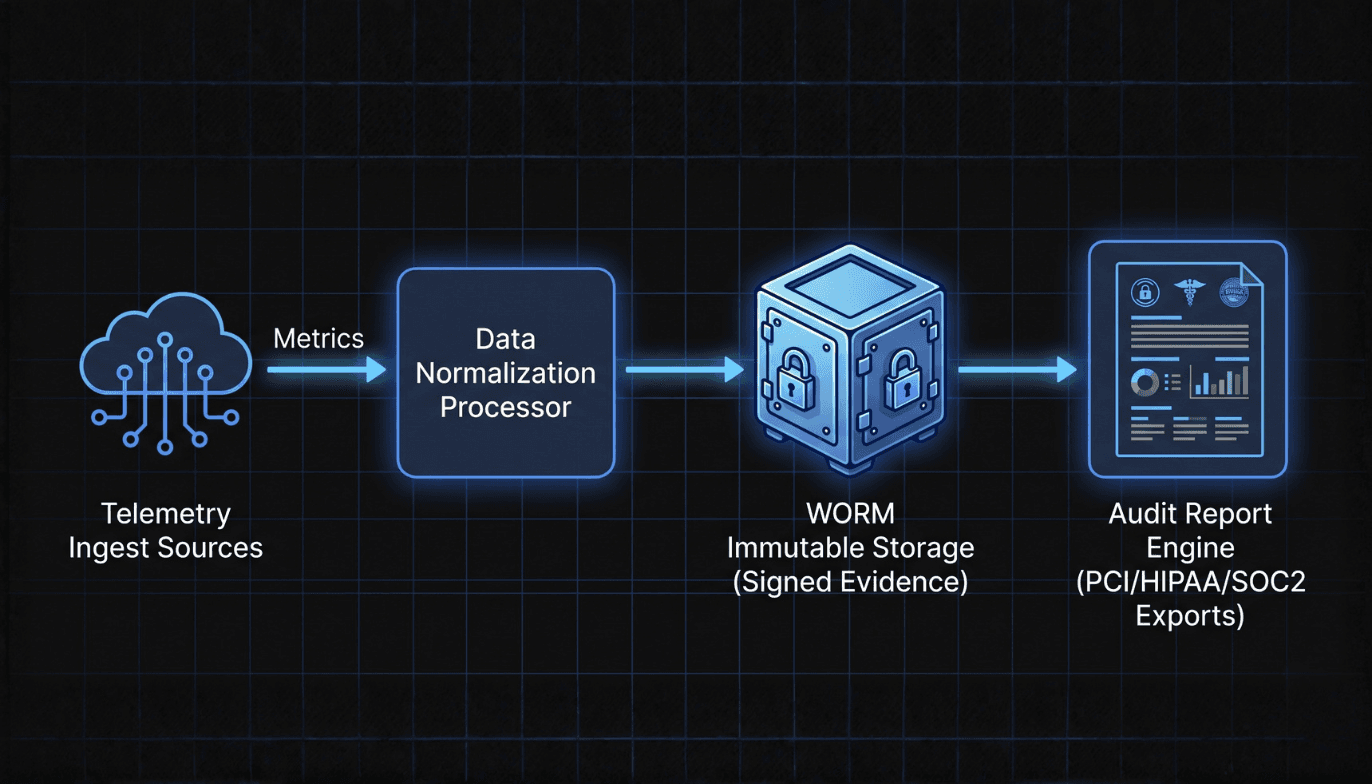
To move past the limitations of policy theater and ensure verifiable audit readiness, organizations must map their real-time controls directly to global compliance and safety standards.
Global Framework Intersections
Governance Benchmark | Core Obligation | Real-Time Enforcement Control Implementation |
NIST AI RMF (GOVERN) | Establishing clear human tracking boundaries and absolute organizational accountability for AI behavior. | Continuous mapping of every operational agent runtime footprint to a named human owner within the core CMDB. |
OWASP Agentic AI Top 10 | Mitigating prompt injection, tool privilege abuse, and malicious parameter manipulation. | Real-time payload filtering and context-aware validation at the gateway edge before execution. |
CSA MAESTRO Framework | Enforcing granular lifecycle monitoring and secure data domain separation across multi-cloud networks. | Utilizing short-lived token exchange protocols to provision ephemeral, task-scoped credentials via identity vaults. |
EU AI Act Core Mandates | Demonstrable post-deployment monitoring, system logging, and active human-on-the-loop oversight. | Implementing in-path runtime gateways that evaluate proposed transactions before side effects can hit production systems. |
Conclusion: Turning Policy into Infrastructure
Enterprise operations frequently lose control of artificial intelligence because their policies exist strictly on paper, disconnected from the actual systems running inside the business. A written principle cannot govern a non-deterministic model that acts, adapts, and scales at machine speed. Treating an autonomous AI agent like a simple, fixed Python script creates massive structural vulnerabilities that single-signal tools cannot catch.
Securing the agentic workforce is not an administrative challenge—it is an infrastructure control challenge. By decoupling global policy-as-code management from underlying application logic, implementing automated real-time interception via runtime gateways, and anchoring response speeds with an Agentic SOC architecture, organizations can confidently mitigate risk while accelerating innovation. Replace policy theater with deterministic controls, protect the action layer, and ensure your autonomous workforce remains a managed enterprise asset.
Frequently Asked Questions (FAQ)
Q1: Why can't traditional user-centric IAM tools regulate autonomous AI agents?
A: Traditional IAM tools authenticate a known user or a highly deterministic script, evaluate a static role, and issue a long-lived session token. AI agents operate stochastically, chaining tools and generating parallel execution paths dynamically based on real-time text context. If an agent holds a permanent administrative role, a single prompt injection can hijack its reasoning loop and turn it into a high-speed vector for data exfiltration.
Q2: What is the risk of relying on system prompts or vendor assurances for security?
A: System prompts and vendor certifications are "soft controls" that reside inside the model's environment and can be easily bypassed via prompt injection, adversarial context manipulation, or model drift. Real security requires "hard controls" implemented in an external infrastructure layer completely independent of the model's logic.
Q3: How does a Runtime AI Gateway impact core system latency?
A: When implementing a high-performance proxy layer (such as Envoy) alongside localized Open Policy Agent (OPA) sidecar engines, the infrastructure latency overhead is typically sub-millisecond. Because typical enterprise agentic workflows already incur large LLM inference wait times ranging from 500ms to 2 seconds, this sub-millisecond gateway tax is mathematically negligible and represents a necessary trade-off for real-time protection.
Q4: What is the difference between a "Human-in-the-Loop" and a "Human-on-the-Loop" model?
A: A human-in-the-loop model forces an operator to manually review and sign off on every discrete output or action before it executes, which completely eliminates the velocity gains of automation at machine scale. A human-on-the-loop model elevates the operator to a supervisory role, leveraging automated tools to monitor macro behavior patterns and system anomalies in real time, allowing for rapid intervention only when a policy boundary is breached.
Q5: What is the benefit of deploying security policies in "Shadow Mode"?
A: Shadow mode allows security architecture teams to test new Policy-as-Code configurations in a non-blocking "dry-run" state. The runtime gateway intercepts live agent workflows, evaluates the proposed payloads against the OPA definitions, and logs whether an action would have been blocked without actually dropping the network packet. This allows platform teams to eliminate false positives and fine-tune rules without breaking live production systems.
Q6: What does an "Evidence Event" capture inside an immutable storage locker?
A: An evidence event captures the full decision context of an infrastructure control action. Rather than logging raw, flat event telemetry, it records exactly why a transaction was allowed, modified, or blocked—binding the active policy version, model characteristics, user tokens, and observed environmental signals into a tamper-proof record for external auditors.
Q7: How do automated remediation playbooks handle an active runtime threat?
A: When a behavioral anomaly exceeds risk thresholds, the system fires automated runbooks that reduce risk while preserving system usability. This includes dynamically redacting PII from output streams, restricting an agent's tool execution scope, or immediately revoking an asset's short-lived JWT token to isolate the node.
Q8: Why must testing be conducted continuously under attorney-client privilege?
A: In the absence of a unified federal oversight framework, organizations are responsible for designing their own testing criteria. Conducting continuous bias audits and performance re-validations under attorney-client privilege allows legal and technical teams to diagnose and fix emergent system errors without immediately exposing the firm to regulatory penalties or litigation risk.