
AI Agent Sprawl: How Enterprises Get Control Back
Autonomous agents are multiplying faster than enterprise governance. Discover the technical drivers behind AI agent sprawl and how to implement runtime control blocks.
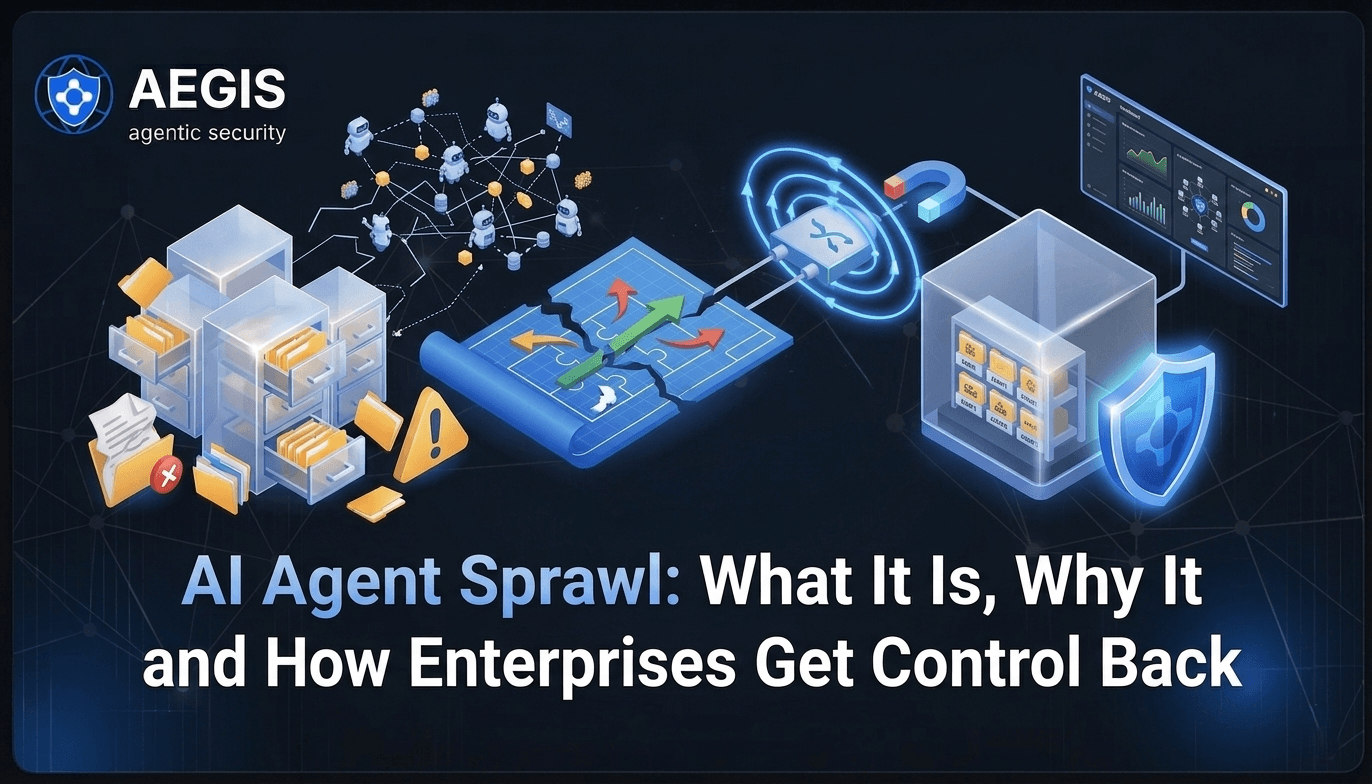
AI Agent Sprawl: What It Is, Why It Happens, and How Enterprises Get Control Back
The CISO Lifeline: Your engineering and business units added three new AI agents to the corporate network last week. Do you know exactly which data fields they can access, what downstream tools they are authorized to chain, and who retains legal accountability if their reasoning loop encounters a prompt injection attack?
Enterprise technology leaders have navigated this macro structural pattern before. SaaS sprawl granted business teams localized execution speed but created shadow IT perimeters, major access risks, and massive vendor integration complexity. API sprawl improved service reusability but introduced millions of unmanaged, unauthenticated endpoints. Cloud sprawl offered developers immediate compute flexibility, then forced enterprises to execute multi-million dollar optimization passes to rebuild core discipline around identity boundaries, cost control, regulatory compliance, and telemetry observability.
AI agent sprawl represents the next, most complex iteration of this structural cycle.
The fundamental crisis is that agents are not merely software applications, static APIs, or isolated virtual infrastructures. They are autonomous software actors. They possess the capacity to perceive, reason, manipulate tools, extract data from disparate databases, and trigger complex multi-step workflows over extended time horizons without human intervention.
A traditional SaaS application stores and processes data; an API exposes a discrete capability; a cloud container runs infrastructure. An AI agent can coordinate all three at machine velocity.
The primary challenge facing the modern enterprise is clear: the democratization of low-code and no-code agent frameworks means that the ability to build and deploy agents is spreading exponentially faster than the architectural operating models required to govern them.
The Technical Drivers: How Agent Proliferation Occurs
AI agent sprawl refers to the uncontrolled proliferation of unsanctioned, unmanaged, or siloed AI agents across an enterprise environment. This structural phenomenon rarely occurs out of malicious intent; rather, it happens because capability developers are silently embedding autonomous features directly into the SaaS applications and software packages teams already use.
The AI Agent Proliferation Timeline:
With low-code developer platforms like Microsoft Copilot Studio and Salesforce Agentforce democratizing development, an engineer or business unit analyst can connect a frontier large language model (LLM) to a corporate data source, expose a handful of tool APIs, and launch an active agentic workflow in a matter of days.
The early operational results appear highly compelling: customer support nodes summarizing escalation queues, sales systems constructing real-time account briefs, and infrastructure monitors executing automated ticket triage.
However, because these systems are deployed in total isolation, they form a highly fragmented ecosystem of redundant software blocks with zero shared context, unmapped data pipelines, and no unified mechanism for resolving conflicts when outputs overlap.
Why Agent Sprawl Breaks Traditional Security Controls
Traditional software security relies on deterministic assumptions: code paths are fixed, access rules are bounded by static parameters, and application deployment is governed by centralized release check gates. Agentic architectures completely break these primitives. They operate stochastically, meaning their execution vectors are probabilistic and heavily context-dependent.
The Multilayered Behavioral Attack Surface
An enterprise AI agent is not an isolated model file; it is a highly integrated, shifting pipeline composed of foundation model routing, prompt templates, system instructions, retrieval-augmented generation (RAG) connections, downstream API integrations, Model Context Protocol (MCP) servers, short-term memory caches, and federated user privileges.
Because these layers interact dynamically at runtime, system failures are rarely limited to traditional code bugs or infrastructure downtime. An agent can perform an insecure or non-compliant operation because:
- The model experienced semantic hallucination.
- The prompt context was manipulated via indirect injection.
- The tool schema was formatted ambiguously.
- The agent held excessive, inherited ambient privileges across internal networks.
Traditional identity and access management (IAM) models assume a clear human subject performing a bounded, predictable action. If an agent inherits a broad corporate service account role, it can chain tool calls to execute massive, irreversible data mutations or system-wide configuration overwrites at machine speed before a human-in-the-loop gate can react.
Core Architectural Dimensions of the Control Gap
To regain control of a sprawling agent network, security leadership must look past high-level policy guidelines and address four specific runtime risk surfaces.
The Canonical Inventory Failure
The first immediate symptom of agent proliferation is total inventory breakdown. Most organizations operate with no single source of truth detailing how many agents are active on their network, who retains human ownership over their actions, which underlying foundation models they call, what datasets they read, or what specific corporate APIs they are authorized to invoke. Research indicates that only 18% of enterprises maintain a current, validated inventory of their active AI assets. Without an automated discovery mechanism, governance remains entirely theoretical.
The Tool-Access Risk Horizon
An agent that purely generates text carries minor business exposure. The moment an agent connects to an execution capability—allowing it to update an internal CRM ledger, alter cloud infrastructure tags, write production code, or dispatch outbound messages—it effectively functions as part of the enterprise control surface.
While open connectivity architectures like the Model Context Protocol (MCP) make it remarkably easy to link models to developer tools, they introduce deep security gaps around registration, discoverability, enforced authorization, and auditable accounting. Every single tool interface exposed to a model must be managed as a critical, permissioned access gate.
The Runaway Cost Curve
Unlike simple chatbot turnarounds that map linearly to a single request-response token count, an autonomous agentic workflow uses multi-turn reasoning loops. One high-level user objective can trigger a cascading loop of internal planning steps, recursive data fetches, tool selections, and automated retries.
This non-deterministic loop structure means agent economics can scale exponentially without warning. If an agent encounters a logic exception or an ambiguous tool response, it can generate hundreds of recursive LLM inferences within minutes, creating an immediate cost blowout. Token-level tracking is fundamentally obsolete; enterprises must measure unit economics per completed outcome or resolved workflow.
Non-Deterministic Observability vs. Verification
Traditional application monitoring tells security operations teams if a system is available, latency-bounded, or saturated. It cannot tell you why an autonomous machine-learning engine took an unexpected or dangerous action.
Because agent operations are probabilistic, a system can remain completely available, execute fast, complete its task successfully, and still profoundly violate corporate data handling compliance. Observability must evolve into behavioral accountability—tracing every prompt version, model routing decision, context insertion, and gateway filter applied to every single transaction.
The Aegis Blueprint: Implementing Executable Governance
Remediating agent sprawl demands that governance move from an passive administrative spreadsheet to an active, executable runtime infrastructure layer. Security leaders must decouple model reasoning from network execution by deploying a unified, trace-native AgenticOps control plane.
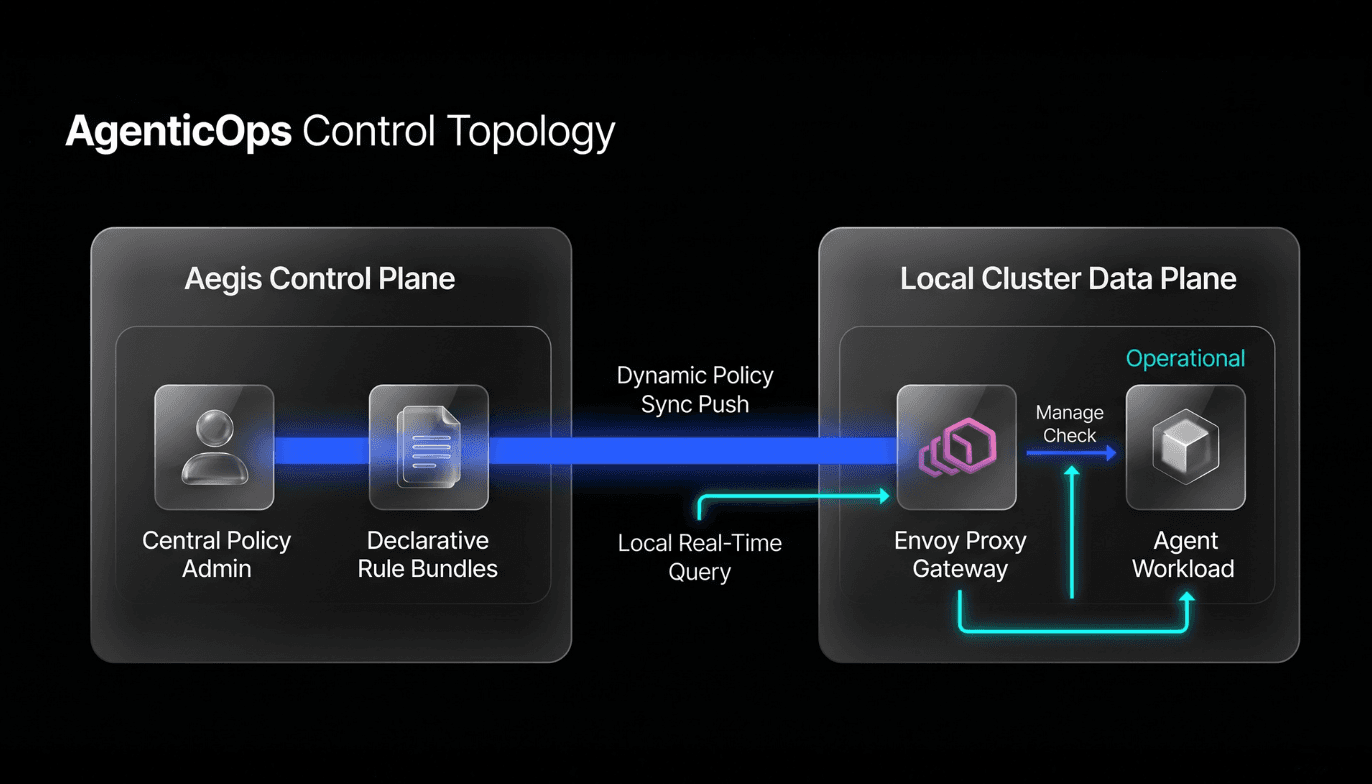
This architecture translates high-level corporate risk intent into deterministic, infrastructure-enforced constraints in real time:
Governance Intent | Automated Runtime Infrastructure Control |
Prevent Sensitive Data Exposure | Real-time content classification layers that automatically redact, sanitize, or restrict context blocks out-of-band. |
Control Runaway Architecture Cost | Runtime enforcement engines that apply rigid budget caps, execution quotas, and transaction looping thresholds. |
Govern Loose Tool/MCP Access | In-path proxies that explicitly evaluate, allow, scope, or deny discrete API calls based on context. |
Maintain System Reliability | Automated circuit breakers that gracefully degrade capabilities, force failovers, or halt anomalous loops. |
Ensure Auditor Traceability | Centralized OpenTelemetry streams that log every model call, system argument, and policy rationale to immutable storage. |
The 5-Stage Agent Sprawl Containment Roadmap
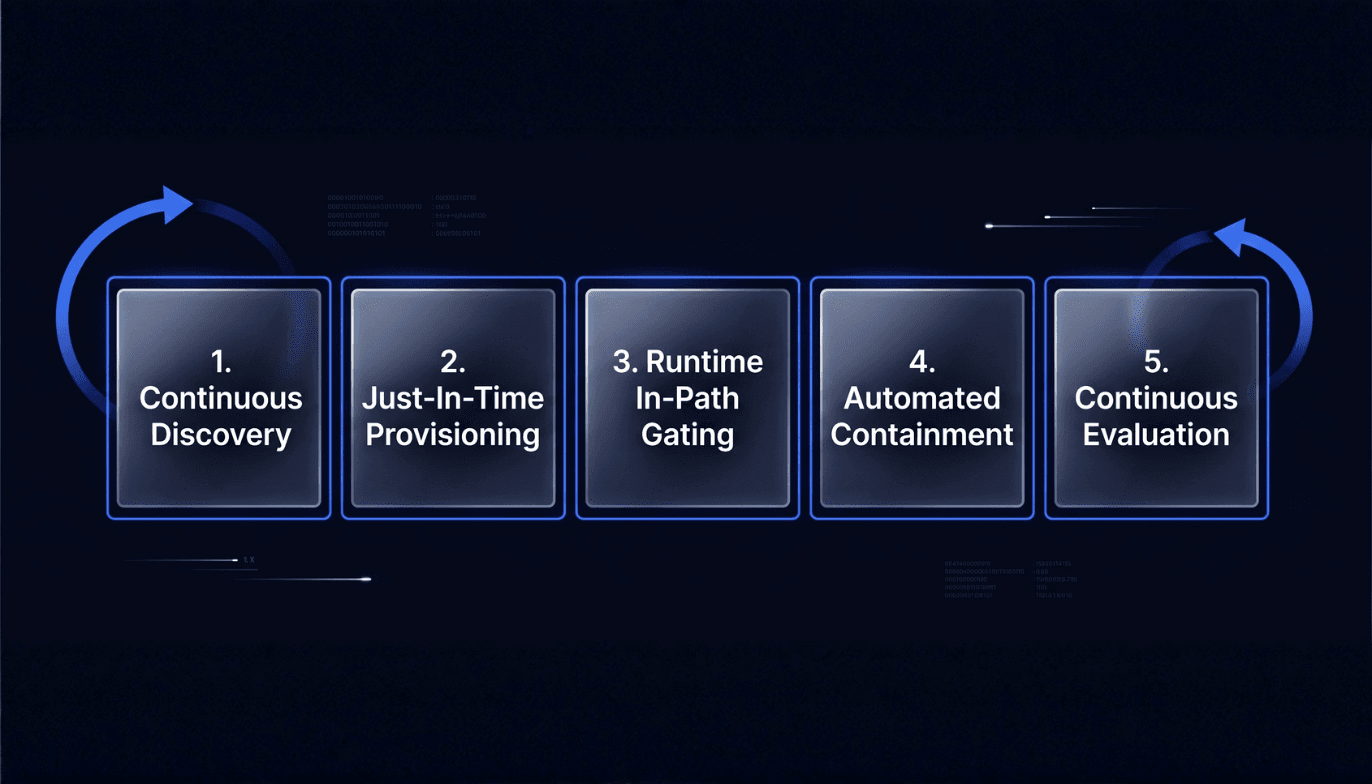
To safely regain command of an expanding autonomous software fleet, enterprises must replace manual approval boards with a continuous, programmatic control loop.
- Stage 1: Continuous Automated Discovery: The framework executes continuous background scanning across API gateways, network logs, and multi-cloud environments to discover untracked agents and map out a comprehensive canonical inventory of assets, dependencies, and business owners.
- Stage 2: Just-In-Time (JIT) Credential Provisioning: The platform eliminates permanent standing credentials for machine identities. It implements Intent-Based Access Control, utilizing secure identity vaults to generate fine-grained, short-lived tokens that expire automatically the millisecond a specific sub-task completes.
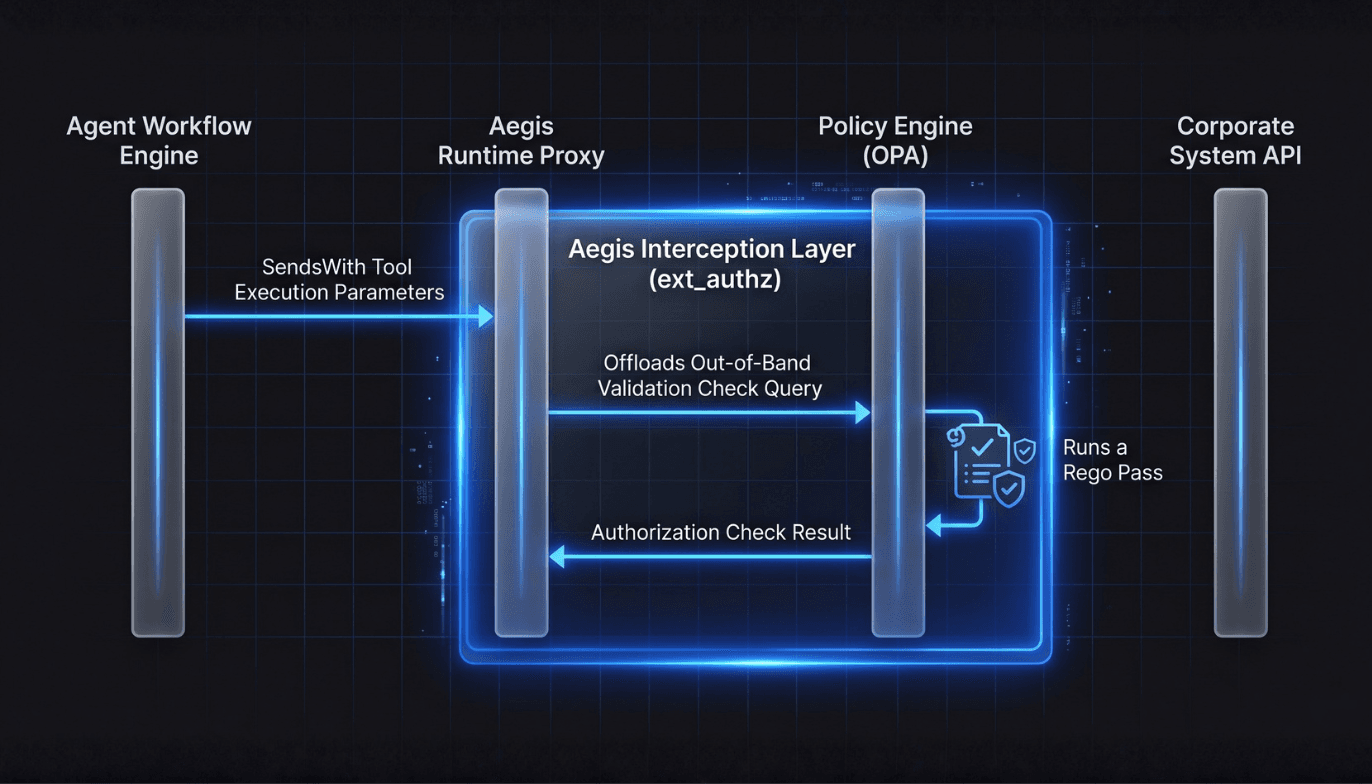
- Stage 3: Runtime In-Path Interception: An independent gateway proxy (like an Envoy network configuration running an ext_authz filter) processes prompts, retrieved contexts, and proposed actions out-of-band, validating data attributes before payloads hit production targets.
- Stage 4: Progressive Autonomy & Kill Switches: Leadership assigns explicit autonomy tiers to agents based on business impact and blast radius. Low-risk tracking nodes can execute quickly; high-risk transactional tools require tiered infrastructure circuit breakers that let security teams freeze entire agent networks simultaneously if an exploit manifests.
- Stage 5: Continuous Evaluation Loops: Ad-hoc manual code reviews cannot scale alongside hundreds of shifting probabilistic models. The architecture implements automated continuous evaluation, converting production traces into regression datasets to systematically test for groundedness, policy compliance, and safety.
The Architecturally Sound Response
The only viable defense against a threat moving at machine speed is the deployment of an Agentic SOC: a security operational model where specialized AI monitoring agents continuously govern, audit, and contain operational AI agents.
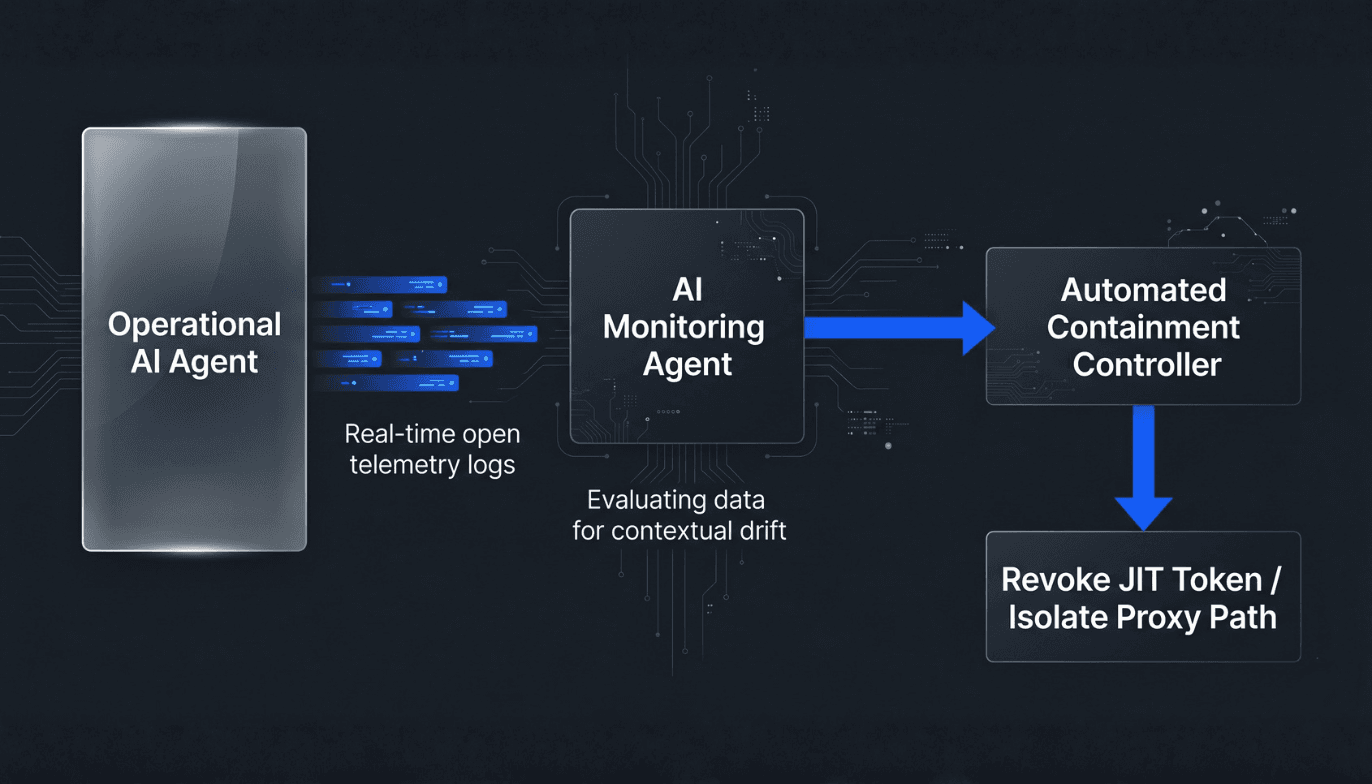
In this architecture, automated monitoring agents run natively within the data plane, consuming thin execution traces via OpenTelemetry loops. These specialized nodes apply localized reinforcement learning to construct real-time profiles of normal software intent.
The exact millisecond an operational agent's call trajectory drifts outside its authorized baseline parameters, the monitoring layer steps completely outside human latency bounds: it signals the identity layer to instantly revoke the target's short-lived JWT token, modifies proxy gateway settings to isolate the network path, and packages the complete trace record for forensic analysis.
Human security operators move away from chasing individual event logs, stepping up to serve as systemic commanders who set risk tolerances and configure baseline policies, while the automated runtime architecture handles the massive transaction volume that human oversight cannot sustain.
Conclusion: Autonomy Requires Control
Enterprise technology platforms are entering a defining transition. The integration of autonomous agents across core systems represents an exceptional capability jump, but in a regulated corporate environment, autonomy without visibility and command is a path to systemic failure.
Agent proliferation cannot be solved by forcing engineering teams to fill out more compliance forms or by attempting to execute blanket domain blocking at the network edge. These restrictive measures simply drive adoption underground, accelerating shadow AI risk.
The organizations that achieve true operational maturity will not be the ones that launch the highest gross number of unmanaged models, but those that establish an executable AgenticOps control plane from day one. By decoupling policy management from application layers, enforcing cryptographic identity attestation at request time, and deploying an automated Agentic SOC, leaders can transform AI from a fragmented liability into a governed enterprise asset. Build your risk architecture for autonomous execution, protect the action layer, and make your automated workforce safely scalable at global scale.