AI Agent Hackathons: Lessons from Rapid Prototyping
Make hackathon prototypes deployable: runtime policy, shadow mode telemetry, per-agent identity, budgets, and audit trails.
Aegis: Policy-First Security for Agent Hackathons
Introduction
Hackathons are where fast ideas meet early product-market fit. For agentic AI this is especially true: teams spin up multi-step agents that chain tools, call payments, read EHRs or push code. But speed creates risk — prototypes often become production seeds without the governance that regulated environments need. In this article we explain common failure modes, outline a policy-first approach for hackathons (shadow mode + metrics), and show how Aegis — a runtime policy and observability gateway — fits into the loop to make winners safe and deployable. The article draws on market context from industry studies and Aegissecurity product briefs. (McKinsey & Company)
Hackathon failure modes
Common security gotchas
Hackathons often optimize for UX and demo velocity, which leaves multiple technical gaps that become security debt:
• Prototype = privileged identity. Teams wire targets directly; there’s no short-lived agent token or per-agent identity, so credentials leak or are reused.
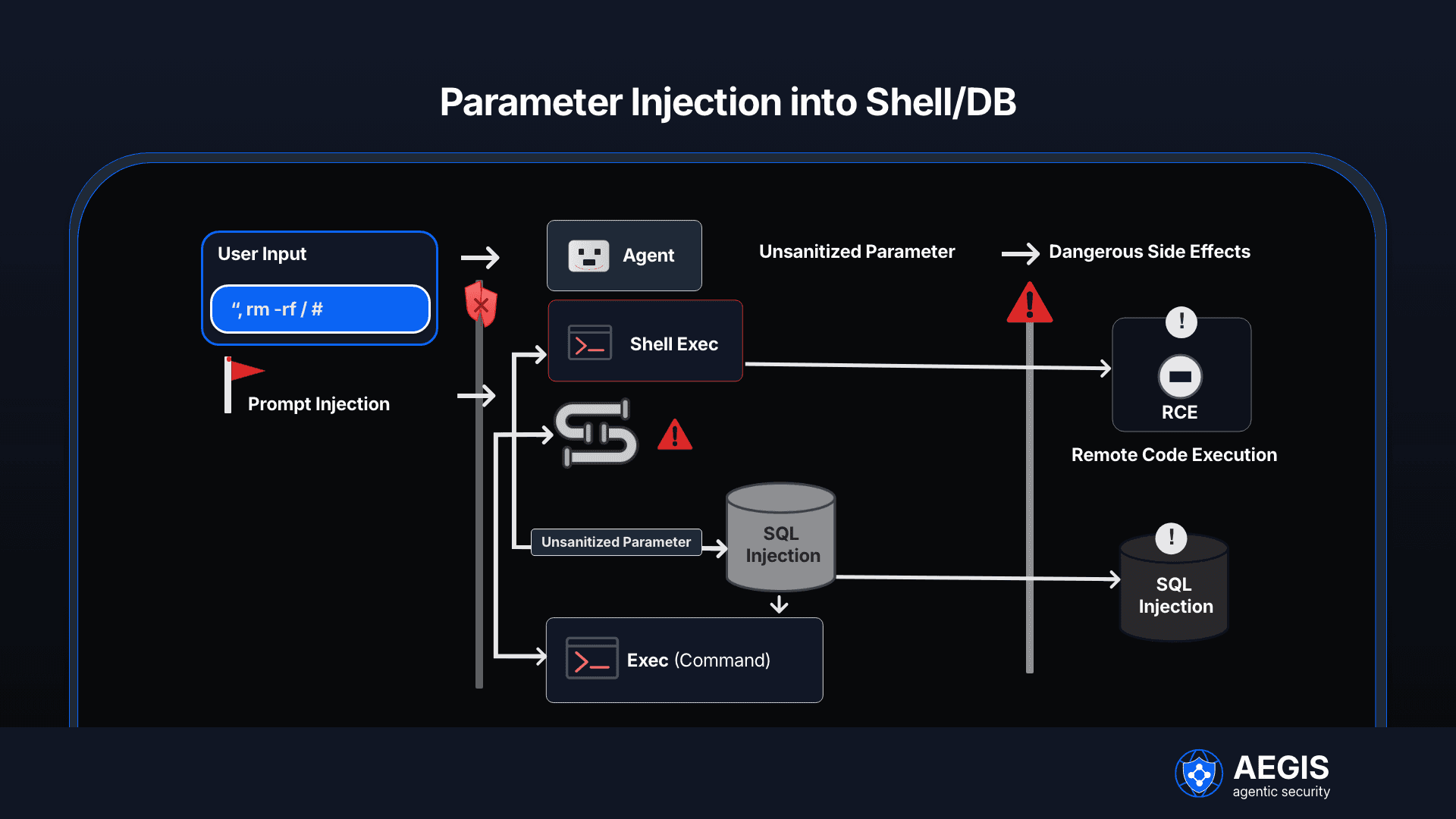
• Parameter injection. Unvalidated user or prompt data flows into tool parameters (amounts, file paths, SQL), enabling dangerous actions.
• Uncontrolled egress. Agents call arbitrary domains or upload data to third-party endpoints.
• Runaway cost. Auto-spawned agents hit billed APIs (LLMs, external services) and explode budgets.
• No audit trail. Demos have no tamper-resistant spans or approvals, so compliance teams cannot reconstruct decisions.
.png&w=3840&q=75)
Table 1 — Typical hackathon failure modes and immediate impact
Failure mode | Manifestation in demos | Immediate risk |
Missing identity & tokens | Hardcoded keys, reused service accounts | Credential leakage, lateral movement |
Parameter injection | Unvalidated payment amounts / file paths | Fraud, data exposure |
No egress control | Calls to unknown domains | Data exfiltration |
No budgets | Unbounded LLM or API calls | Cost spikes |
No audit/approval | No signed traces or approvals | Non-compliance risk |
Policy-first hackathons
Shadow mode and metrics
Policy-first hackathons bake guardrails into prototypes so the winners are deployable, not dangerous. The key practices:
• Policy templates: Provide prebuilt, opinionated templates for common connectors (payments, egress, file access, CI/CD). Teams toggle these in shadow mode during the event.
• Default shadow mode: Policies default to dry-run (“would-block”) for an event window. Telemetry captures would-deny events so teams can iterate without blocking demos.
• Short-lived tokens & per-agent budgets: Each team receives ephemeral agent tokens and a budget cap to avoid runaway spend.
• Measure conversion: Track would-block → enforced conversion rate, top rules that trigger, and false positives to tune rules. Use OpenTelemetry for spans and dashboards.
Table 2 — Shadow rollout metrics
Metric | Why it matters | Target (example) |
Would-block events/day | Surface risky behaviour in prototypes | ≤ 1% of calls after tuning |
Conversion rate (would-block → enforced) | Measures readiness for enforcement | ≥ 70% after shadow week |
Avg policy decision latency (P99) | Impacts UX for agents | ≤ 20 ms. (McKinsey & Company) |
Budget exhaustion events | Detect frequent cost overruns | 0–2 per team during event |
Industry context: agentic AI is moving fast. Large surveys and industry briefings show many organizations are experimenting and some already scaling agentic systems, but governance remains a bottleneck — Gartner predicts over 40% of agentic AI projects will be canceled by 2027 without improved governance. (Gartner)
Aegis in the loop
What Aegis is
Aegis is a runtime policy, enforcement and observability gateway that enforces least-privilege between agents and tools, issues short-lived agent tokens, captures signed audit spans, and supports shadow mode for hackathons.
Aegis technical fit and architecture
Aegis sits between the orchestrator (LangChain, LangGraph or custom orchestrators) and downstream tools as a proxy/sidecar and decision service. Key capabilities:
• Agent identity & tokens — short-lived JWTs identify org, tenant, and agent; tokens encode scopes and expiry.
• Policy-as-code & OPA bundles — YAML/JSON policies compile to OPA bundles for fast evaluation; hot-reloadable bundles reduce operational friction.
• Runtime enforcement modes — allow / deny / sanitize / approval_needed and shadow (dry-run) mode used during hackathons.
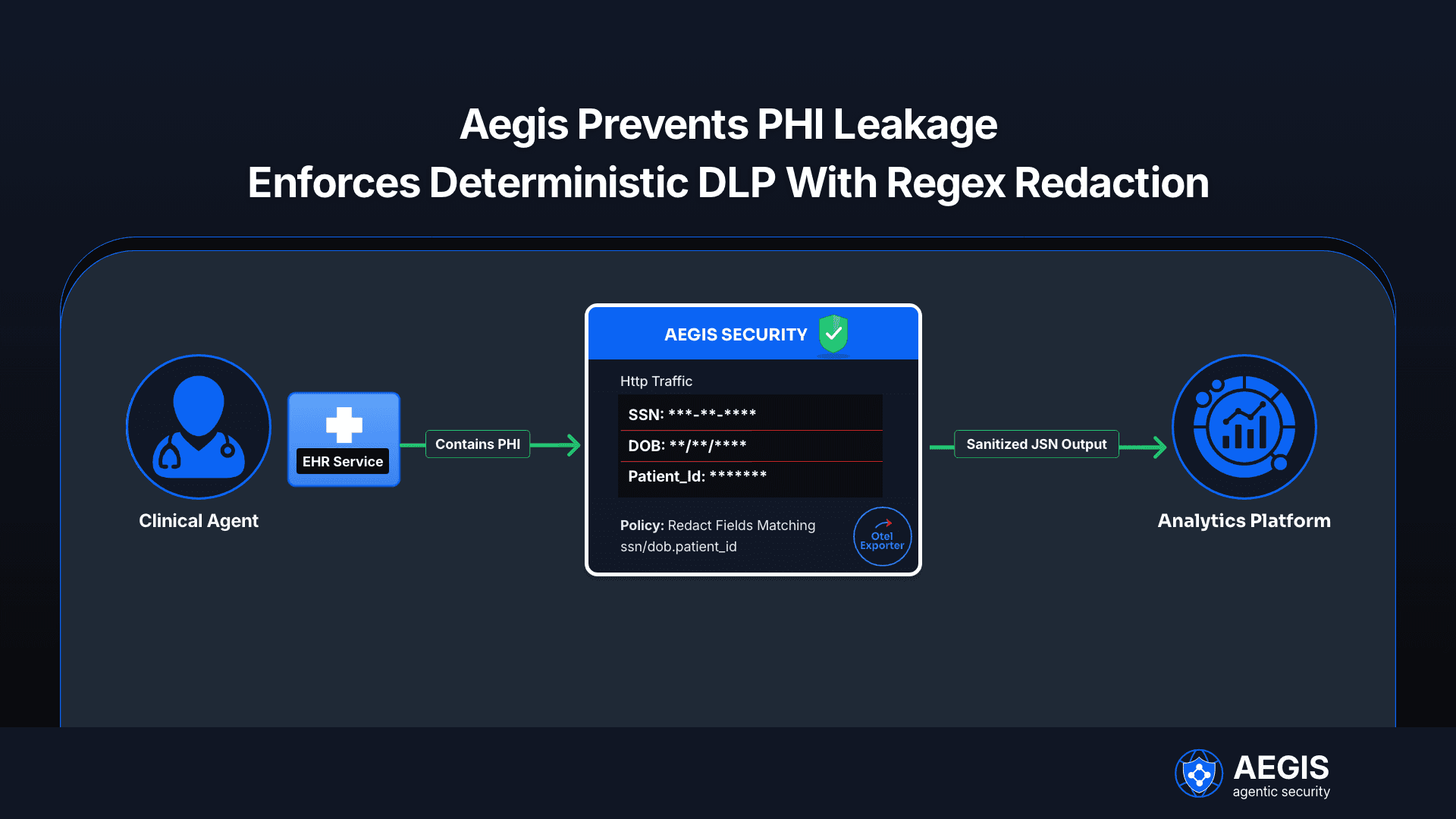
• Parameter inspection — tool-call payloads are inspected; conditions validate fields (amount ranges, regex on account IDs, file path whitelists).
• Telemetry & audit — OpenTelemetry spans include agent_id, tool, decision, policy_version and approval_id; spans can be signed to provide tamper-evidence for SOC/Compliance.
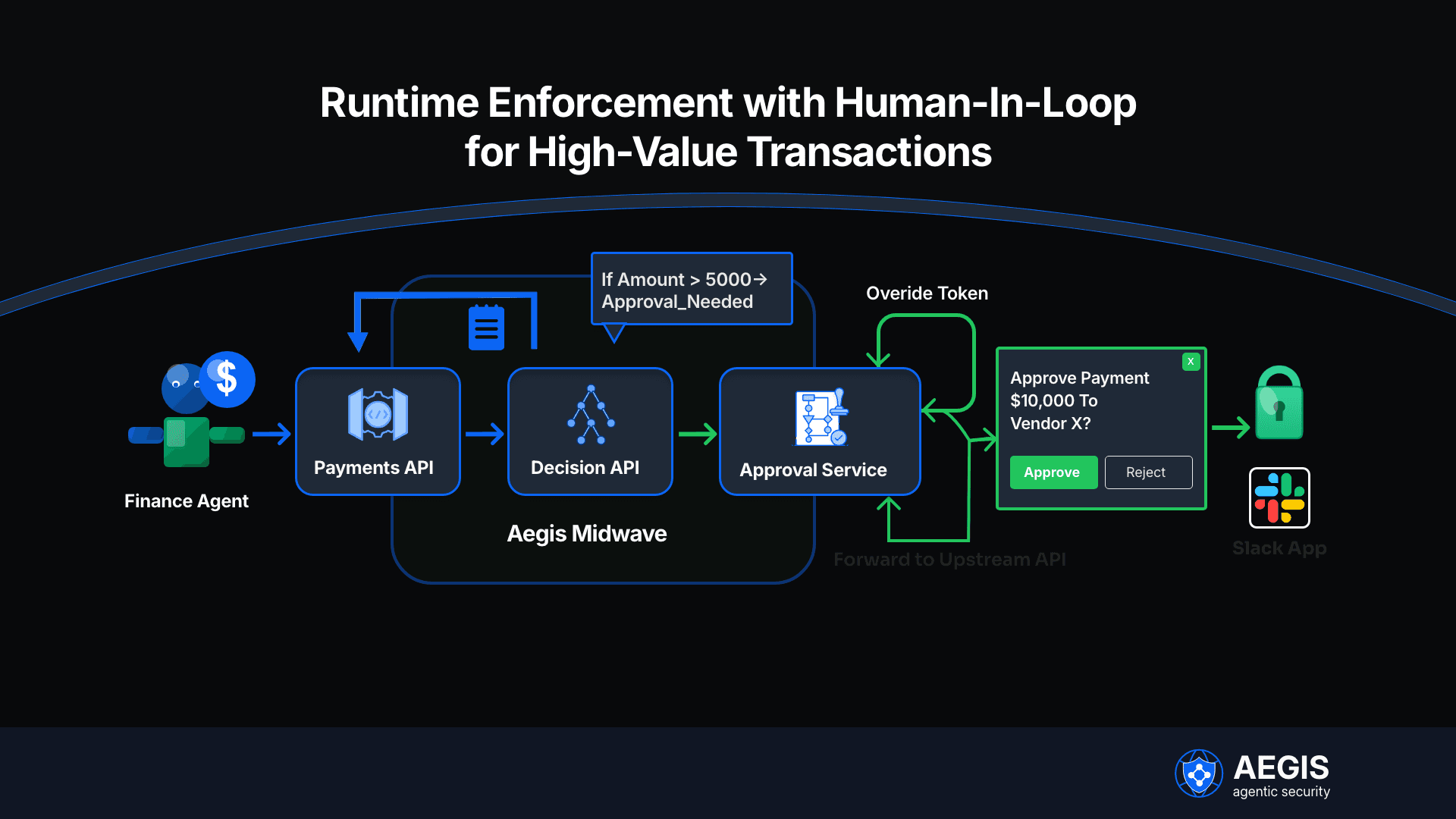
Example: payments demo (payments demo flow)
- Team builds a “procure agent” during hackathon.
- Aegis runs finance policies in shadow mode; would-deny events are logged for any payment attempts > $5,000.
- Team tunes rules, flips the policy to enforce; the same prototype continues to run, now production-ready with approvals wired for > $5,000.
Why Aegis matters for MSSPs and regulated industries
Aegis addresses three operational constraints that enterprise security teams demand: predictable enforcement latency (P99 < ~20 ms), strong auditability for compliance, and developer-friendly DX (policy templates, CLI dry-run). Its model aligns with typical enterprise drivers: risk management, compliance, cost control and operational velocity.
Post-hackathon hardening
Rollout checklist (prioritized)
Below is a condensed, prioritized checklist to move winners from prototype → pilot:
- Apply pre-hackathon policy templates (payments, CI/CD, EHR).
- Keep default shadow mode for a 7-day tuning window.
- Issue short-lived agent tokens per team; enable per-agent budgets.
- Run the policy dry-run CLI; review top would-block events and false positives.
- Integrate approval flow (Slack/Teams) and attach signed approval spans to records.
- Run legal/compliance signoff using the post-event audit report (policy hits, would-blocks).
Playbook: Hackathon → Shadow week → Enforced pilot. This simple timeboxed approach reduces friction while surfacing the security work needed to run agents safely in production.
Operational examples and playbook items (operational snippets)
• OPA rule example: Validate payment amount ≤ policy.max_amount; return approval_needed if amount in (max_amount, escalation_threshold).
• Telemetry hook: Emit OTel span with decision_reason and estimated_cost for FinOps dashboards.
• Egress allowlist: Block all outbound domains not on tenant allowlist; log would-block events in shadow mode.
FAQ
- How does shadow mode differ from blocking?
Shadow mode logs would-block events without interrupting calls, enabling teams to tune policies using real traffic before enforcement. - Can Aegis integrate with LangChain/LangGraph?
Yes — SDK middleware and secure_fetch replacement simplify integration; a policy dry-run CLI helps devs iterate locally. - What about latency?
Aegis targets P99 decision latency ≤ 20 ms using prepared OPA queries and in-memory caches. - How are approvals handled?
High-risk actions return approval_needed; Aegis sends an interactive message to Slack/Teams and issues a one-time override token after approval. - Which industries benefit most?
Finance, healthcare, SaaS, manufacturing and MSSPs — any org needing audit trails, budgets, and runtime control for autonomous agents.
Closing: practical next steps for hackathon organisers
- Ship policy templates and enable default shadow mode for teams.
- Issue short-lived tokens and per-agent budgets.
- Collect OTel spans and run a short shadow week; convert the most common would-blocks to enforced rules.
Adopting a policy-first approach and a runtime guardrail like Aegis lets organisations keep hackathon velocity while eliminating the security debt that turns prototype features into risky production mistakes. For platform and product teams running agent hackathons, converting a few procedural steps into automation (templates, tokens, shadow telemetry and approval hooks) dramatically reduces downstream work and improves the deployability of winning prototypes. Industry research underscores the urgency: organisations experimenting with agentic AI must match speed with governance to avoid project cancellations and costly missteps. (McKinsey & Company)