Agents for Marketing Campaign Planning and Execution
Runtime policy & observability for secure multi-agent workflows: enforce budgets, redact PII, require approvals, and trace every action.
Aegis: Runtime security for agentic marketing and enterprise workflows
Marketing teams are moving from single-action automation to multi-step, multi-agent campaign execution: segmentation agents, creative agents, scheduling agents and performance agents. Those multi-agent workflows unlock speed, but they introduce new risks — uncontrolled ad spend, PII leakage in copy, accidental posts to unapproved channels, and missing audit trails. This post explains the operational problem, outlines an agent flow with governance controls, shows how to measure ROI, and describes Aegis — Aegissecurity runtime policy and observability gateway — as a practical solution for enterprises and MSSPs
The problem: multi-agent marketing is fast — and fragile
Marketing campaigns are multi-step by design: audience segmentation → creative generation → channel scheduling → budget allocation → iterative optimization. Each step can be executed by an autonomous agent. Orchestrators coordinate them, but orchestration errors and lax runtime controls create three practical failure modes:
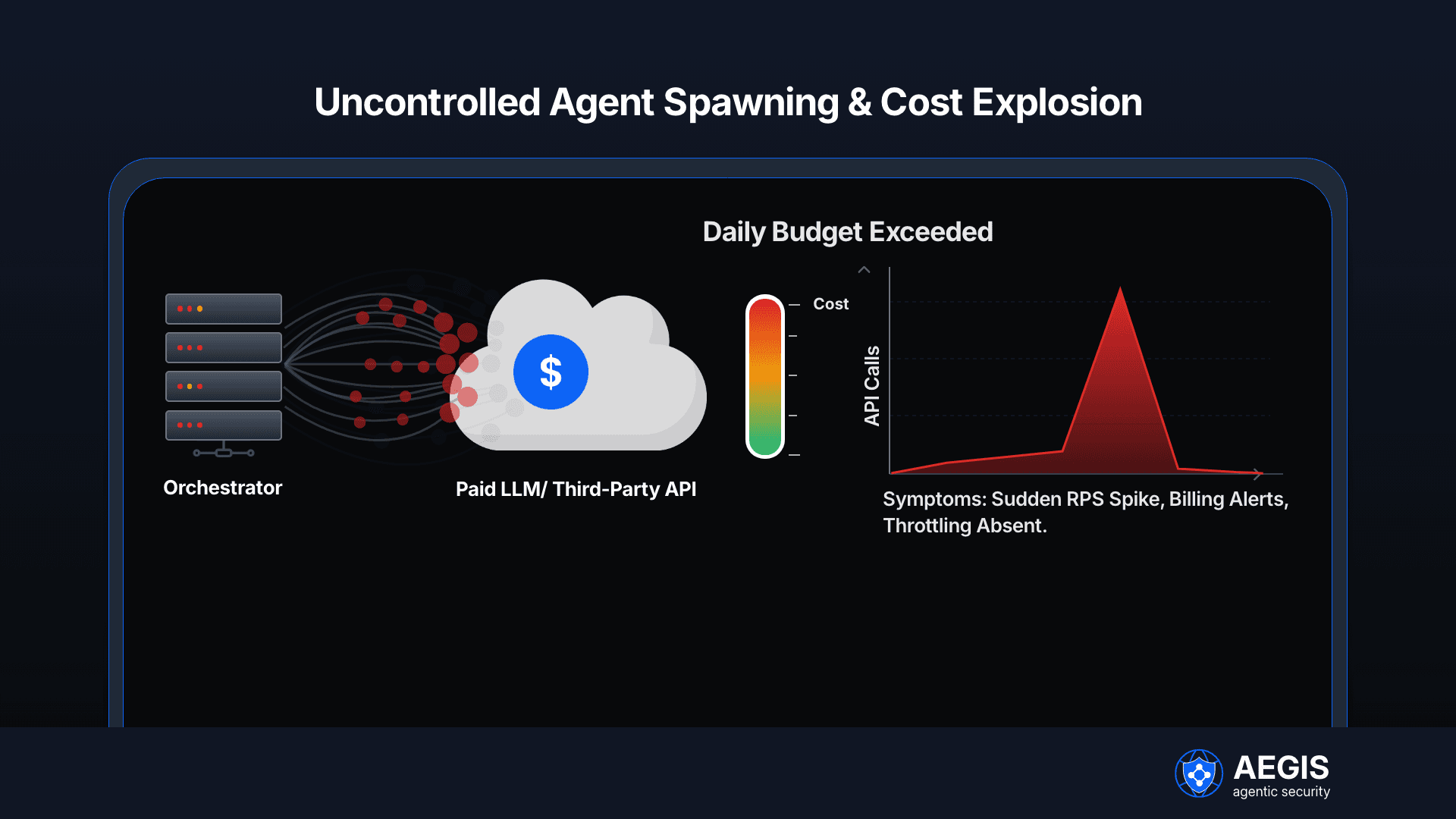
- Cost runaway — an LLM or outbound API is called repeatedly or with expensive parameters; per-agent budgets are missing so spend explodes. Industry observers warn of rising cost and project churn for immature agentic projects. (Reuters)
- PII & brand risk — ad copy or social posts include customer PII or regulated language; no deterministic DLP or approval gate exists to sanitize or block publishing.
- Lack of auditability / compliance — regulators and SOC teams need traceable, tamper-resistant logs for each agent action (who, what, why, policy version). Without traces, audits fail.
Surveys show many enterprises are experimenting with agentic AI but cite security and compliance as top adoption blockers; 23% report scaling agentic systems, with many more experimenting — a clear signal that governance must scale with adoption. (McKinsey & Company)
.png&w=3840&q=75)
Agent flow: where policies must act
A reliable runtime control model must intercept agent→tool calls and make decisions based on identity, context and policy. A practical flow:
- Agent identity & token — each agent gets a short-lived signed token containing org, tenant, agent_id and scopes.
- Call inspection — gateway inspects destination tool, path, and critical parameters (amounts, channels, files).
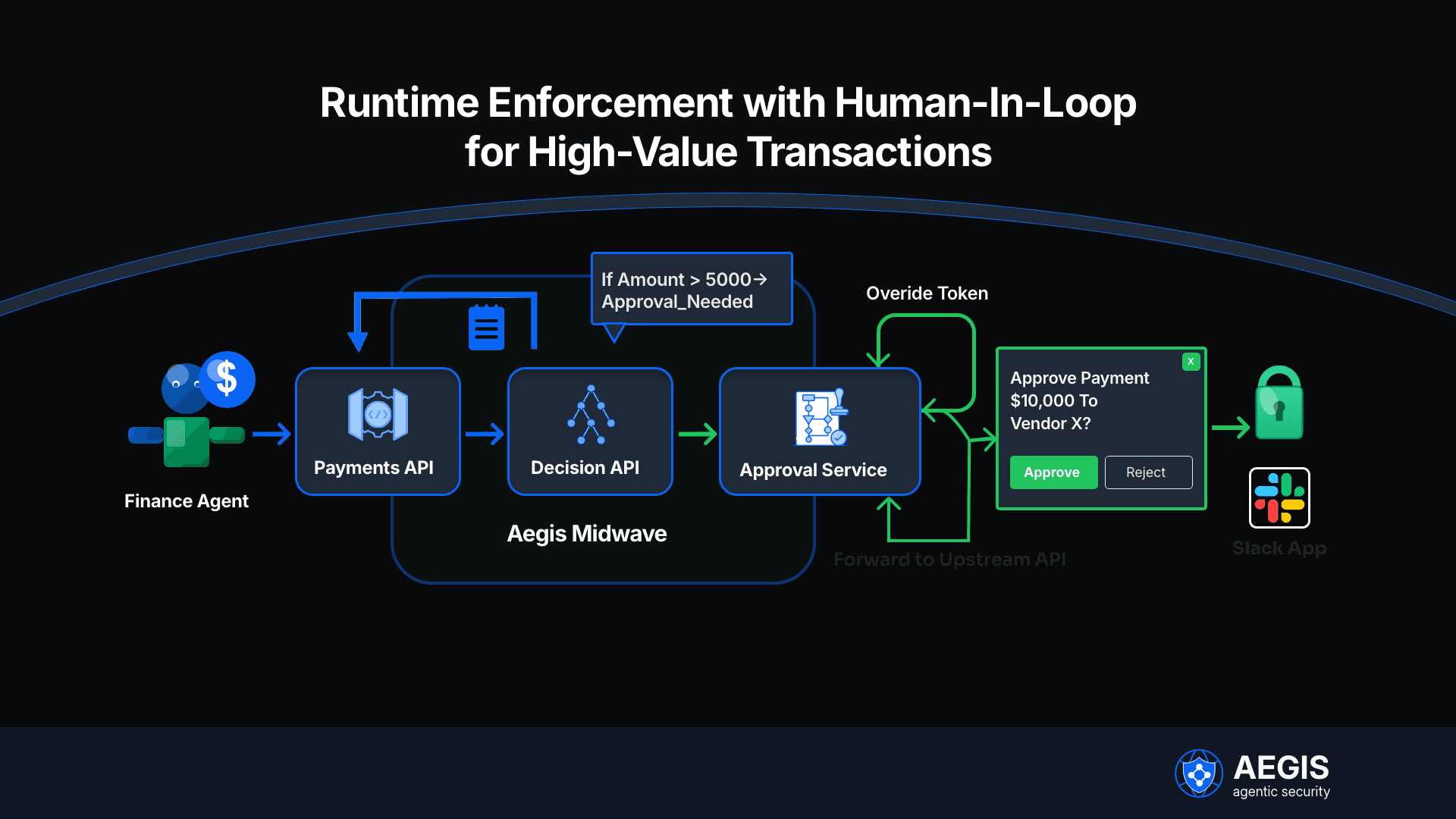
- Policy evaluation — policy engine (policy-as-code) evaluates allow / deny / sanitize / approval_needed.
- Decision & action — gateway enforces: block, redact, or pause for human approval; logs decision with OpenTelemetry spans.
- Telemetry & audit — structured logs and signed spans are shipped to SIEM / FinOps dashboards.
Governance: policies you can operationalize
Policies must be declarative, composable, and versioned. Practical policy primitives:
- Allowlists / Denylists for egress (approved posting domains, approved ad platforms).
- Per-agent budgets & rate limits (daily LLM spend, RPS caps).
- Parameter constraints (payment max_amount, regex for account IDs or channel names).
- Sanitization rules (regex-based PII redaction on ad copy before post).
- Approval workflows (approval_needed, integration with Slack/MS Teams for human override tokens).
Aegis as a solution
Aegis is a runtime policy & observability gateway specifically built for multi-agent AI architectures. It acts as “Istio + OPA for agents”: a lightweight enforcement layer between orchestrators (AgentKit, LangGraph, etc.) and tools/connectors. The product approach covers identity, enforcement, telemetry, and developer experience.
Runtime enforcement and policy-as-code
- Data plane (sidecar / forward proxy) inspects requests and calls an external authz service. Decisions are allow, deny, sanitize, or approval_needed. The gateway can re-originate requests to perform deep parameter inspection.
- Policy engine compiles YAML/JSON policies into OPA bundles and supports hot reload. Policies include conditions (ranges, regex), budgets, rate limits and human approval rules.
- Token service issues short-lived JWTs (Ed25519 signatures) that include agent & tenant claims — enabling least-privilege identity per agent.
Observability, FinOps & audit
Aegis emits OpenTelemetry spans for every decision (agent_id, tool, decision, policy_version, estimated_cost). Dashboards aggregate per-agent spend, blocked events, and egress violations so Security and FinOps teams get a single pane of truth. This is critical because many agentic projects fail due to unclear cost/benefit fallouts. (Reuters)
Controls for marketing examples
- Creative agent produces social copy → Aegis runs deterministic DLP, redacts PII, and returns approval_needed for regulated sectors until legal_agent signs off.
- Scheduling agent wants to post to a new channel → Aegis enforces channel allowlist and requires approval_needed if connector not pre-registered.
- Performance agent triggers budget-intensive A/B tests → Aegis enforces per-campaign budget ceilings and blocks calls that would exceed them.
Example policies and operational outcome
Policy Example | Enforcement Action | Operational Benefit |
finance-agent: max_amount = 5000 | Block + PolicyViolation | Prevents unauthorized high-value transfers. |
support-agent: slack_channels = [#support] + business_hours | Sanitize PII + Allow only in hours | Reduces PII leakage and brand risk. |
llm-agent: daily_budget = $20, rps = 5 | BudgetExceeded → Deny | Stops runaway third-party LLM costs; FinOps visibility. |
Measurement & ROI: what to track
Measurement must tie security actions to business outcomes. Key metrics:
- Blocked policy violations / month — indicates rule coverage and tuning needs.
- Policy enforcement latency (P99) — aim ≤ 20 ms to avoid UX regressions.
- Cost avoided (est.) — e.g., prevented $X of spend by blocking would-be API calls.
- Approval turnaround time — treating approval overload as a signal to refine thresholds.
Suggested KPI targets for pilot
KPI | Suggested target (pilot) |
P99 policy decision latency | ≤ 20 ms. |
Policy coverage (critical connectors) | ≥ 80% |
FinOps prevents (monthly) | visible $X avoided (custom) |
Approval false positives | < 5% (after 2 weeks shadow tuning) |
Operational checklist — how to adopt safely
- Inventory connectors — map every channel (ad networks, social platforms, billing APIs). Tag each connector with risk level.
- Start in shadow mode — run policies in observation to collect would-block metrics for 7–14 days. Tune regexes, budgets and thresholds.
- Define approval SLAs & routing — route high-risk approvals to legal/finance; define SLA for approvals; implement override token with one-time use.
- Integrate telemetry with SIEM & FinOps — export signed spans and structured logs for audit and billing reconciliation.
- Automate policy CI/CD — store policy YAML in repo, run schema validation and a dry-run before deploy.
Use cases — targeted vertical benefits
- FinTech — prevent unauthorized transfers (per-agent ceilings, approval_needed for high value).
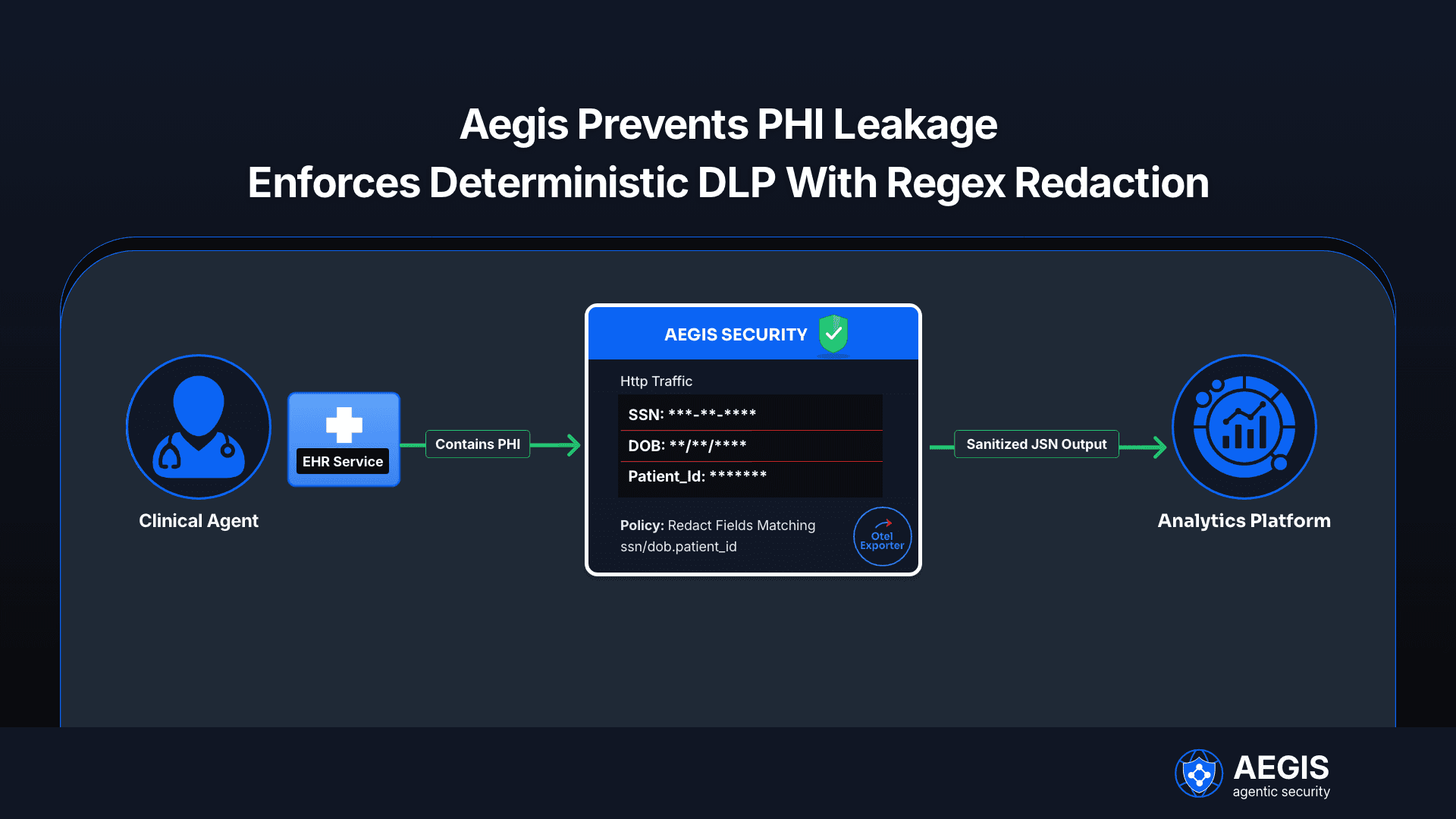
- Healthcare — enforce PHI redaction for EHR calls; block off-region egress.
- SaaS & MSSP — multi-tenant policy isolation, signed audit trails for SOC reviews.
Practical integration notes
Aegis is built to be orchestrator-agnostic with SDKs and middleware for common frameworks. The typical integration pattern is lightweight: deploy the Envoy sidecar or call the decision API in middleware, issue short-lived tokens, and run policies in shadow mode before enforcement. The MVP targets < 4–5 week pilot readiness with a small set of connectors and Grafana dashboards.
Frequently Asked Questions
Q1: Can Aegis enforce field-level redaction for ad copy?
A1: Yes — deterministic DLP rules (regex) run during policy evaluation and can return sanitize with redacted payload.
Q2: How does approval flow scale?
A2: Policies include thresholds to reduce approvals. Approval requests are routed to Slack/Teams and produce a one-time override token after human sign-off. Use rate limits and budgets to reduce noise.
Q3: Will runtime checks harm latency?
A3: Properly tuned OPA prepared queries and in-memory caches keep P99 decision latency ≤ 20 ms. Target P99 and run shadow mode to measure.
Q4: What telemetry is available for FinOps?
A4: OpenTelemetry spans include estimated cost per call, agent_id and tool — dashboards can show per-agent spend and prevented spend.
Q5: How do I onboard marketing agents safely?
A5: Inventory connectors, start policies in shadow mode for 7–14 days, tune DLP/approvals, then flip to enforcement. Map channels and require approval_needed for new channel posts.
Closing and practical next steps
Agentic marketing delivers speed and scale, but it must be paired with runtime governance. Aegis provides a focused enforcement fabric — identity, policy-as-code, deterministic DLP, human approvals, and full telemetry — so security, compliance and FinOps teams can manage agentic workflows without slowing marketing velocity. For pilots, start with high-risk connectors (payments, publishing channels, EHR), run policies in shadow mode, and iterate until enforcement targets are stable.
External references and further reading: McKinsey / State of AI 2025 (agentic adoption stats). (McKinsey & Company) Gartner coverage of agentic project risk and project churn. (Reuters) SailPoint/TechRadar findings on security concerns with agents. (TechRadar) Capgemini research on trust and agent adoption. (Capgemini)