
Agents for DevOps: Automated CI/CD and Deployment Orchestration
Enforce runtime policies, approvals and observability for agentic CI/CD; prevent costly automation outages and supply-chain exposures.
Aegis: Secure agentic CI/CD and deployment orchestration
Modern DevOps pipelines increasingly delegate build, test, promotion and deploy steps to software agents and orchestration frameworks. That velocity brings measurable benefits — and measurable risk. This article defines the problem, describes a clear agent flow (policy → decision → enforcement → telemetry), and explains how Aegis — a runtime policy and observability gateway — prevents uncontrolled automation, enforces least privilege, and produces audit-grade traces that SOC and FinOps teams can rely on. Sections are practical and operational: policy templates, integration checklist, two diagrams, and two tables with comparative and statistical context.
The problem: uncontrolled agent actions in CI/CD
Agentic automation expands attack and failure surfaces in CI/CD:
- Agents that trigger production deploys or change infra can cause outages if they run without runtime checks.
- Parameter injection (malformed image tags, unverified container digests) may let a compromised agent promote unsafe images.
- Unrestricted egress (arbitrary SSH/tunnel endpoints) creates exfiltration vectors and supply-chain risk.
Industry evidence shows rapid agent adoption while security readiness lags: analysts predict a material increase in agentic AI usage across enterprise apps by 2028, and surveys highlight security as a top barrier to AI adoption. (Gartner)
Operationally, the “old way” (human-approved CI/CD with manual gates) is slow but predictable. The “new way” (agents handling full pipelines) is fast but demands stricter runtime policy controls — especially for production actions. Aegis addresses this gap by placing policy and enforcement at the agent↔tool boundary. (Product brief and use-case templates available in internal docs.)
Agent flow: decision, enforcement, telemetry
1. What happens when an agent requests a deploy
- Agent calls the orchestrator (LangChain/LangGraph/AgentKit) to build, test or deploy.
- Orchestrator issues an outbound request that routes through Aegis (sidecar or forward proxy).
- Aegis extracts agent identity (short-lived JWT / API key) and evaluates the policy (allow | deny | sanitize | approval_needed).
- If approval_needed, Aegis pauses the call, posts an interactive request to human approvers (Slack/Teams), then issues a one-time override token on approval.
- Aegis emits OpenTelemetry spans and structured logs for the decision and the full call chain for SOC/FinOps correlation. (OpenTelemetry)
2. Policy evaluation criteria (examples)
- allowed_environments: restrict deploys to staging unless approval present.
- allowed_images / image_digest checks: block mismatched digests.
- parameter validation: reject unexpected SSH endpoints or base64 payloads.
- budgets & rate limits: throttle cluster scale operations to prevent runaway costs.
Policy templates for deploys
Minimal production deploy policy (YAML pseudo)
agent: deploy-manager
actions:
- name: deploy
allowed_environments: ["staging"]
approval_needed: env == "production"
allowed_images:
- digest: "sha256:...approved..."
max_replicas: 50
This pattern enforces environment scoping, image digest verification, and an approval gate for production. Aegis compiles and serves policies as OPA bundles for low-latency evaluation.
Why OpenTelemetry matters here
Instrumenting every decision as an OTel span lets security, SRE and FinOps teams link a failed deploy, a blocked attempt, or a costly API call back to the originating agent and policy version. OpenTelemetry adoption and active development continue to accelerate; integrating OTel into the gateway ensures traces are consumable by existing backends. (Grafana Labs)
Aegis as a solution
Aegis is designed specifically to close runtime governance gaps introduced by agentic CI/CD. It is a lightweight policy and observability fabric that sits between agents and tools, operating as a forward proxy / sidecar plus decision service. Key capabilities:
- Identity & least privilege: short-lived JWTs and agent registration; policies scoped to agent IDs and tool names.
- Policy-as-code: YAML/JSON policies compiled to OPA bundles; hot-reloadable and versioned; dry-run (shadow) mode for tuning before enforcement.
- Runtime enforcement: allow / deny / sanitize / approval_needed decisions returned synchronously with standardized error payloads to prevent ambiguous failures.
- Egress & tool controls: allowlists for domains (prevent arbitrary SSH/tunnel destinations), parameter inspection and deterministic DLP for PII/PHI redaction.
- Cost & rate governance: per-agent budgets and RPS limits to prevent runaway spend (e.g., scaling loops or abusive LLM calls).
- Observability & audit: structured logs and OTel spans per decision, plus dashboarding for blocked events, top offenders and budget consumption.
Aegis deliberately mirrors service-mesh patterns (Envoy ext_authz + external authorizer) but is tuned for agent semantics: it inspects call parameters, enforces parameter-level conditions (e.g., max_amount for payments, allowed_image_digests for deploys), and integrates approvals workflows to avoid unnecessary human fatigue.
Comparative table of Aegis Agentic Security vs legacy controls
Capability | Legacy CI/CD & IAM | Aegis Gateway |
Parameter inspection | No | Yes (policy conditions, DLP) |
Per-agent budgets | No | Yes |
Human approval on high risk | Manual, ad hoc | Built-in approval_needed workflow |
Image digest enforcement | Manual scripts | Policy-enforced at runtime |
Traceability (per action) | Partial | Full OTel spans + signed logs |
Shadow/dry-run | Limited | Native shadow mode |
Operational checklist: integration & rollout
- Deploy Aegis sidecar next to CD runners or configure forward proxy for orchestration layer.
- Register agents and issue short-lived tokens.
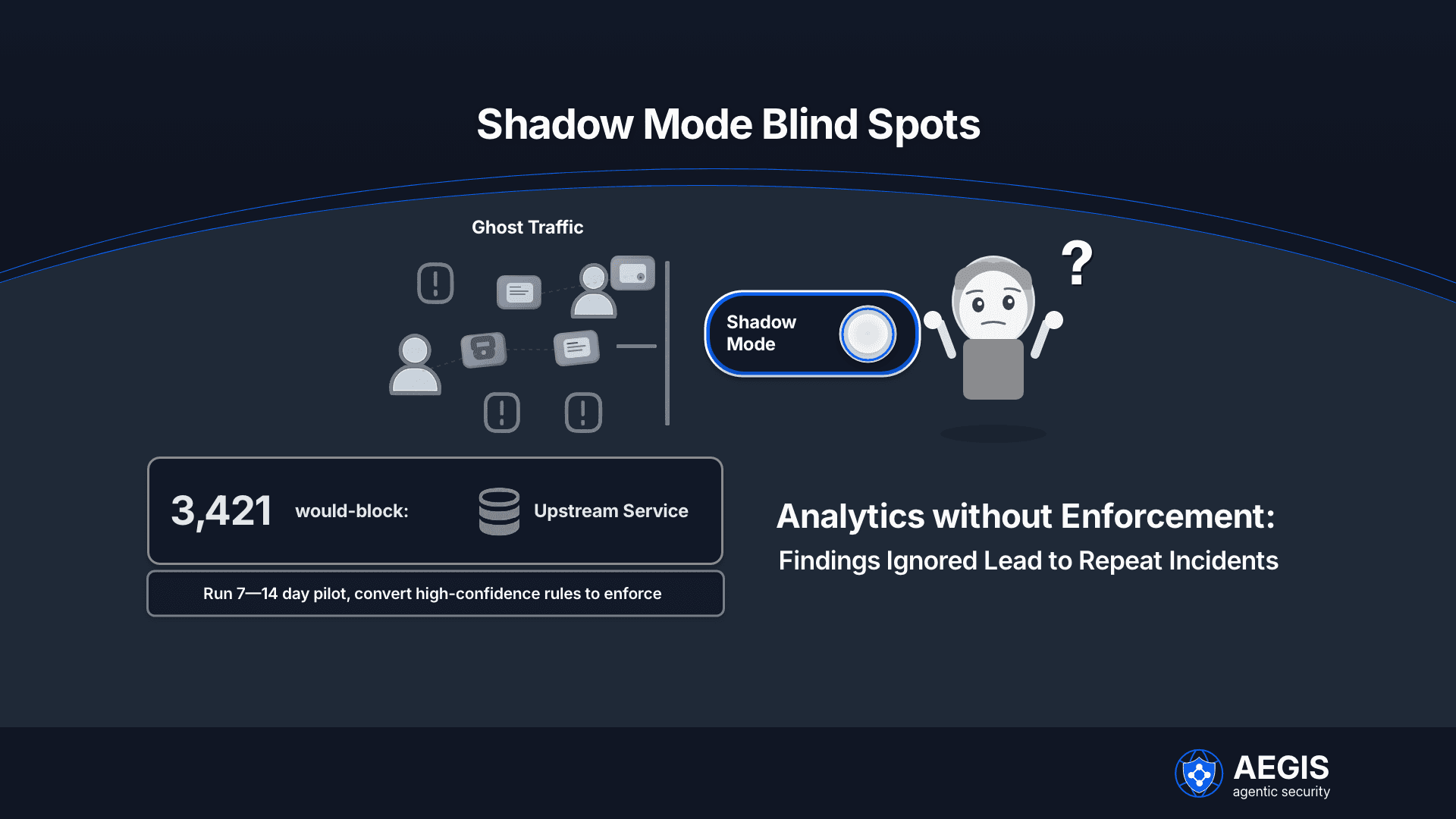
- Start in shadow mode for 7 days; collect would-block metrics and tune regexes and thresholds.
- Define key policies: staging allowlist, production approval_needed, allowed_images, egress allowlist.
- Add dashboards (blocked ratio, budget burn rate, top offending agents).
- Move to enforce mode and iterate.
Risk & guardrails (sample metrics)
Risk | Guardrail (Aegis policy) | Failure mode prevented |
Unverified image promoted to prod | required image_digest in allowed_images | compromised or unsigned images |
Agent triggers unlimited scale | daily budget + rate limit | runaway cloud spend / autoscale storms |
Agent uses arbitrary SSH endpoint | egress allowlist + proxy | exfiltration / supply-chain tunnel |
Payment automation abuse | max_amount + approval_needed | unauthorized transfers |
Practical notes and examples
- Example: An agent requests cluster scale to 200 replicas. Policy max_replicas:50 and daily_budget prevents the action; Aegis returns a clear PolicyViolation with reason and emits a span with policy_version and decision_reason.
- Example: An agent attempts to deploy an image whose digest is not in the allowed list. Aegis blocks and signals an approval_needed workflow if configured for manual override, avoiding an automatic rollback or outage.
- Use shadow mode to collect “would-block” telemetry and calibrate regex and numeric thresholds before moving to enforcement.
Frequently Asked Questions
Q1: Can Aegis block a deploy already in progress?
A1: Aegis blocks outbound calls from agents to deployment APIs. If a deploy request is already underway and bypasses the proxy, Aegis cannot retroactively stop it; ensure the orchestrator routes tool calls via the Aegis sidecar/proxy.
Q2: How do approvals scale?
A2: Policies can set thresholds and approval granularity (per-agent, per-action). Integrations with Slack/Teams and override tokens make approvals human-actionable; rate limits and budgets reduce noisy approvals.
Q3: What telemetry is emitted?
A3: OpenTelemetry spans per decision (agent_id, tool, decision, policy_version, latency) plus structured logs that can be forwarded to SIEMs. (OpenTelemetry)
Q4: What about performance impact?
A4: The architecture targets low-latency decisions (P99 10–20 ms) using OPA prepared queries, in-memory caches and optional WASM compilation. Design choices reduce proxy overhead.
Q5: How to start?
A5: Deploy the Aegis sidecar in shadow mode, register a small set of agents (e.g., CI runners), and publish a minimal staging policy (allowed_environments). Tune from would-block telemetry, then enable enforcement.
Q6: Does Aegis integrate with existing orchestrators?
A6: Yes — drop-in middleware and SDKs target LangChain/LangGraph and common orchestrators; non-HTTP tools are supported via decorators and middleware.
Closing (practical next steps)
Agentic CI/CD brings speed — and responsibility. Enforcing runtime policies, validating images and parameters, gating production actions with approvers, and producing traceable telemetry are essential to avoid outages, fraud and cost explosions. Aegis implements those controls where they matter most: at the agent↔tool boundary, with policies as code, OTel observability, and pragmatic developer tooling. For implementation guidance and industry use cases, see Aegissecurity industry and solution pages above.