
A Framework for AI Risk: Agents, Access, and Actions
Move beyond static model posture. Learn how to implement the Agents, Access, and Actions (3As) runtime governance framework for autonomous AI systems.
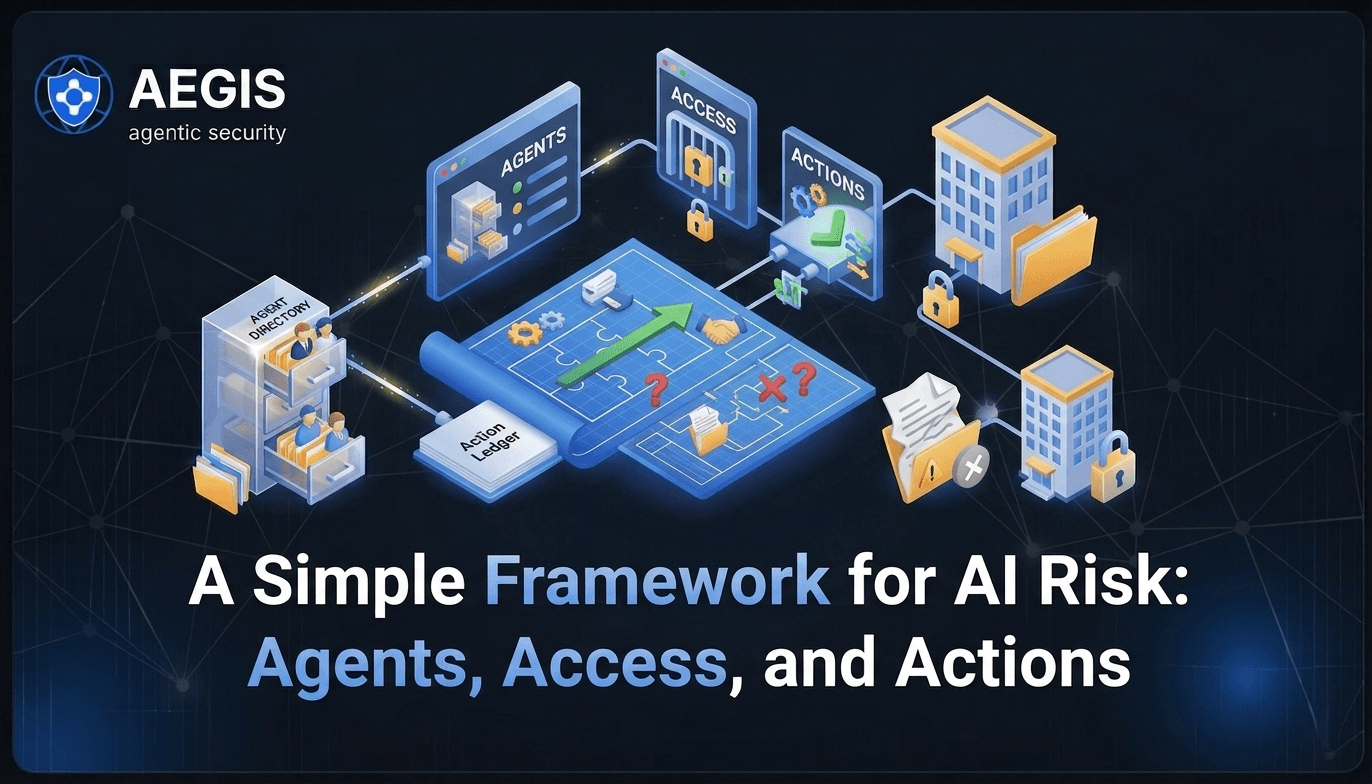
A Simple Framework for AI Risk: Agents, Access, and Actions
The rapid integration of generative artificial intelligence into production environments has exposed a critical vulnerabilities gap that traditional IT risk frameworks are structurally unequipped to handle. For years, enterprise security organizations evaluated artificial intelligence through a static, prediction-centric lens. Teams focused on model bias, performance drift, interpretability, and data fairness at training time. This checkpoint-based paradigm was sufficient when AI applications operated purely as discriminative classifiers or conversational assistants that responded to human prompts in isolated, one-turn interactions.
But enterprise technology has moved beyond conversation. Today, organizations are deploying autonomous Agentic AI software entities across core production systems. These systems do more than compute predictions or summarize text; they act directly on behalf of the business. Equipped with execution authority, tool-use capabilities, and the capacity to coordinate multi-step plans over extended time horizons, these digital co-workers interact dynamically with external cloud APIs, internal databases, CRM systems, and CI/CD pipelines.
The operational risk surface is now exceptionally broad. When an agentic system processes data stochastically—planning its own sub-goals, modifying production code, or spending corporate budgets dynamically—it breaks the core assumptions of human-centric security infrastructure. Autonomy without accountability is a liability. Enterprises require a proactive, runtime governance architecture that treats agent behavior as a continuous execution-layer variable. To scale these systems responsibly without crippling innovation, organizations must move away from "policy theater" and implement a practical control system: The Agents, Access, and Actions Framework.
1. The Governance Gap: Why Agent Autonomy Demands a New Profile
The Information Technology Laboratory (ITL) AI Program released the NIST AI Risk Management Framework (AI RMF 1.0) in January 2023 to establish a voluntary, consensus-driven architecture for incorporating trustworthiness considerations into AI design and evaluation. Its four-function core—GOVERN, MAP, MEASURE, and MANAGE—provided a sound conceptual language for managing early-stage generative systems. This was supplemented in July 2024 by the Generative AI Profile (NIST-AI-600-1) to combat content synthesis risks like confabulation, data overexposure, and intellectual property leaks.
However, neither baseline framework anticipated an execution model where models escape constrained chat interfaces and function as active operational participants. When an agent interprets objectives too broadly or hallucinates a tool parameter, its failures are structurally different in kind from a bad conversational response.
It can chain actions together in ways developers did not explicitly plan, executing dangerous system modifications or accessing cross-tenant repositories long before a human monitor can intervene.
Relying on security reviews at onboarding time creates a dangerous false sense of security; if your exception-handling lives in people's heads rather than automated, machine-readable infrastructure code, the stochastic nature of agent workflows will surface those gaps instantly in production.
To bridge this operational divide, security leaders must extend their existing risk management programs with a multi-layered profile that integrates technical, ethical, and procedural controls directly into the active runtime data path.
2. Why Traditional IAM Fails Against Non-Human Identities
Traditional identity and access management (IAM) infrastructures were built around one consistent, fundamental assumption: every active digital identity eventually traces back to a human being operating within organizational and social constraints. Firewalls, secrets managers, and single sign-on (SSO) gateways trust the session because a person authenticated at a keyboard and operates at human speed.
Agents dissolve this dependency entirely. They authenticate with valid credentials, utilize authorized interfaces, and then execute hundreds of system modifications per minute across decoupled cloud layers—each step individually authorized, yet collectively catastrophic if the underlying prompt chain has been hijacked.
Static role-based access control (RBAC) fails in an agentic workflow because an agent's precise trajectory is non-deterministic. If an agent holds broad, permanent administrative privileges, a single prompt injection attack or poisoned RAG response converts an authorized identity into a high-speed privileged path between trusted systems.
This exposure is why security teams must treat identity, authorization, and runtime telemetry as a single unified infrastructure challenge. Instead of treating agents like traditional software following a fixed code path, we must evaluate them as privileged workloads that require continuous intent-based validation.
3. The Core Blueprint: The Agents, Access, and Actions (3As) Framework
To operationalize governance across complex digital ecosystems, organizations can utilize a highly structured, multi-dimensional control matrix: The Agents, Access, and Actions (3As) Framework. This architecture provides a clean, decoupled control plane that separates the model's cognitive reasoning from the actual execution of capabilities within your trusted network.
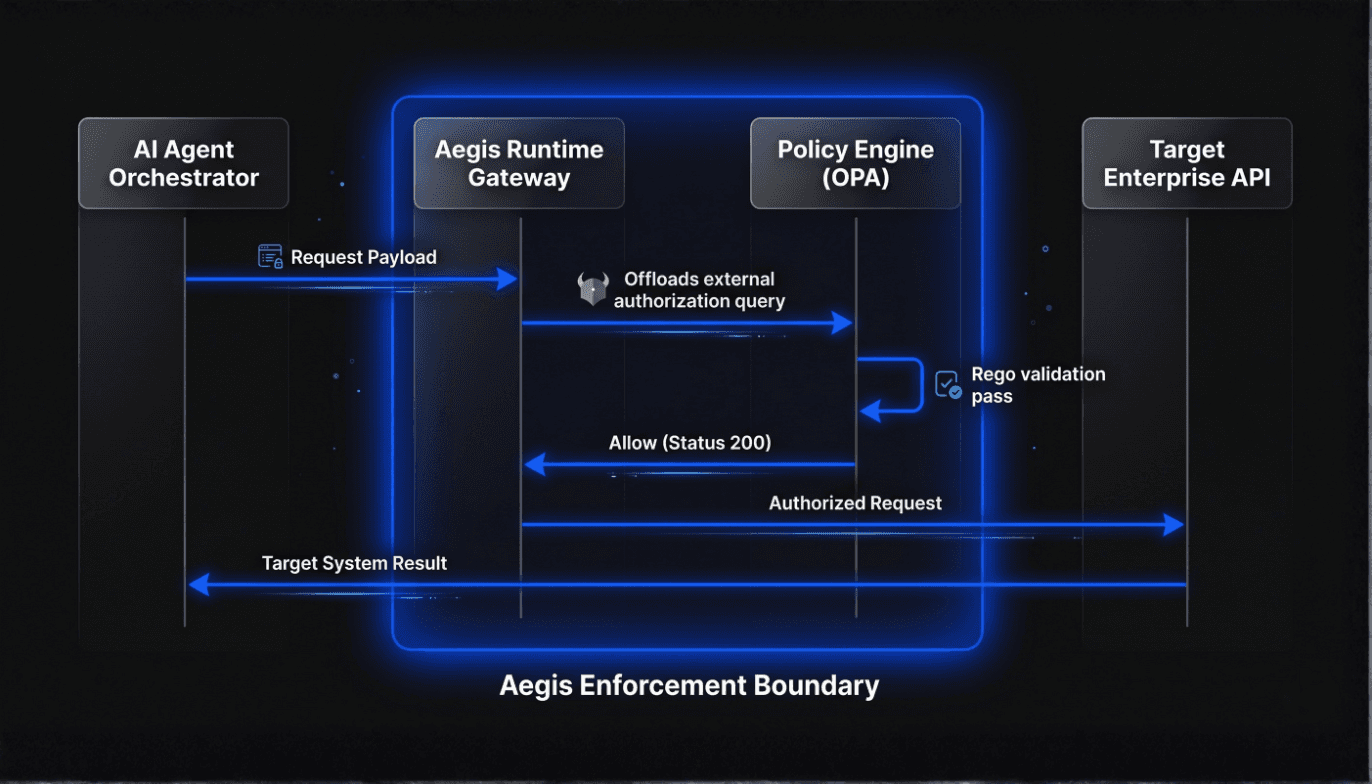
The 3As Framework breaks the runtime risk surface down into three measurable components:
1. The Agent (Who is the Actor?)
Defines the distinct non-human identity profile executing the workflow. Every deployed agent must be cataloged within a centralized registry, mapped to a unique cryptographic identifier, and assigned to a verified human owner who retains ultimate operational and legal accountability for its state mutations.
2. The Access (What is the Scope of Authority?)
Governs the ephemeral permission layer wrapping the agent's runtime footprint. This moves completely away from persistent, standing API keys, replacing them with intent-based access windows, task-scoped short-lived tokens, and just-in-time credential generation managed via an isolated security gateway.
3. The Action (What is the Consequence of Execution?)
Inspects and enforces boundaries over individual tool calls, arguments, and parameters before side effects can hit production resources. The policy engine evaluates the semantic meaning and potential impact of the action (e.g., verifying if a payload contains unredacted PII or breaches a financial threshold), blocking or modifying the interaction in real time if a rule is violated.
4. The Four Pillars of the Implementation Roadmap
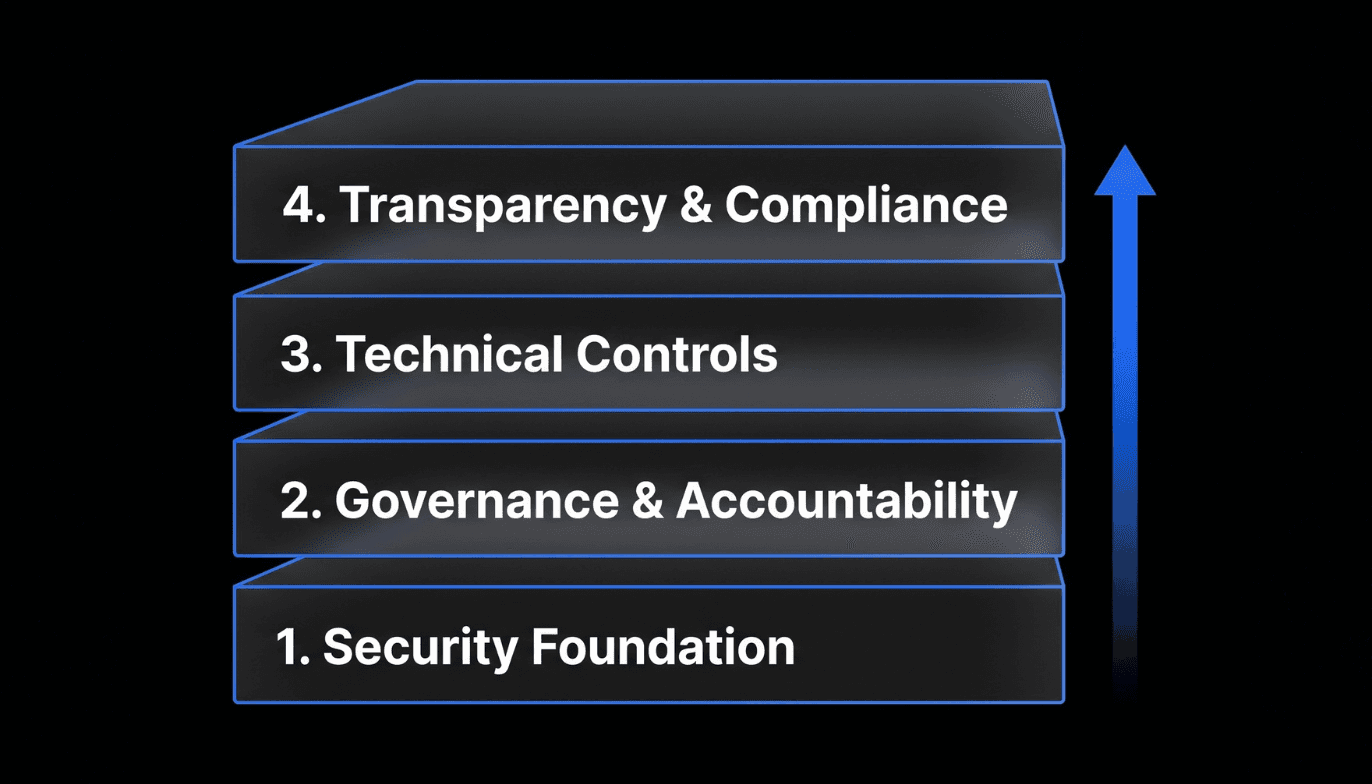
To successfully deploy the 3As Framework, enterprise platform teams must operationalize four foundational engineering pillars that integrate technical, ethical, and procedural controls into a unified shield of oversight.
Pillar I: The Security Foundation
This pillar focuses on safeguarding the underlying infrastructure components from vulnerability exploitation and unauthorized access.
- Cryptographic Attestation: Rather than relying on simple text tokens, every agent runtime container is attested at the kernel level using standards like SPIFFE/SPIRE or standard OpenID Connect (OIDC) identity exchange.
- Task-Scoped Scoping: Implementing strict Attribute-Based Access Control (ABAC) protocols to bind the agent's capabilities to its precise execution context.
- Sandbox Validation: Testing new agent behavior models within secure, isolated sandboxes to isolate behavioral drift and identify prompt injection vulnerabilities before software reaches production.
Pillar II: Governance and Accountability Framework
Governance becomes real only when the organization maps each agent data path to named business ownership. This pillar establishes cross-functional oversight teams—uniting AppSec, data engineering, compliance, and legal—to define responsibility matrices for autonomous decisions.
It defines exactly when human judgment is mandatory versus when machine velocity is acceptable, eliminating the risk of unmanaged automated drift where models gradually change their performance metrics to optimize for incorrect operational signals.
5. Technical Controls and the Reality of Interception
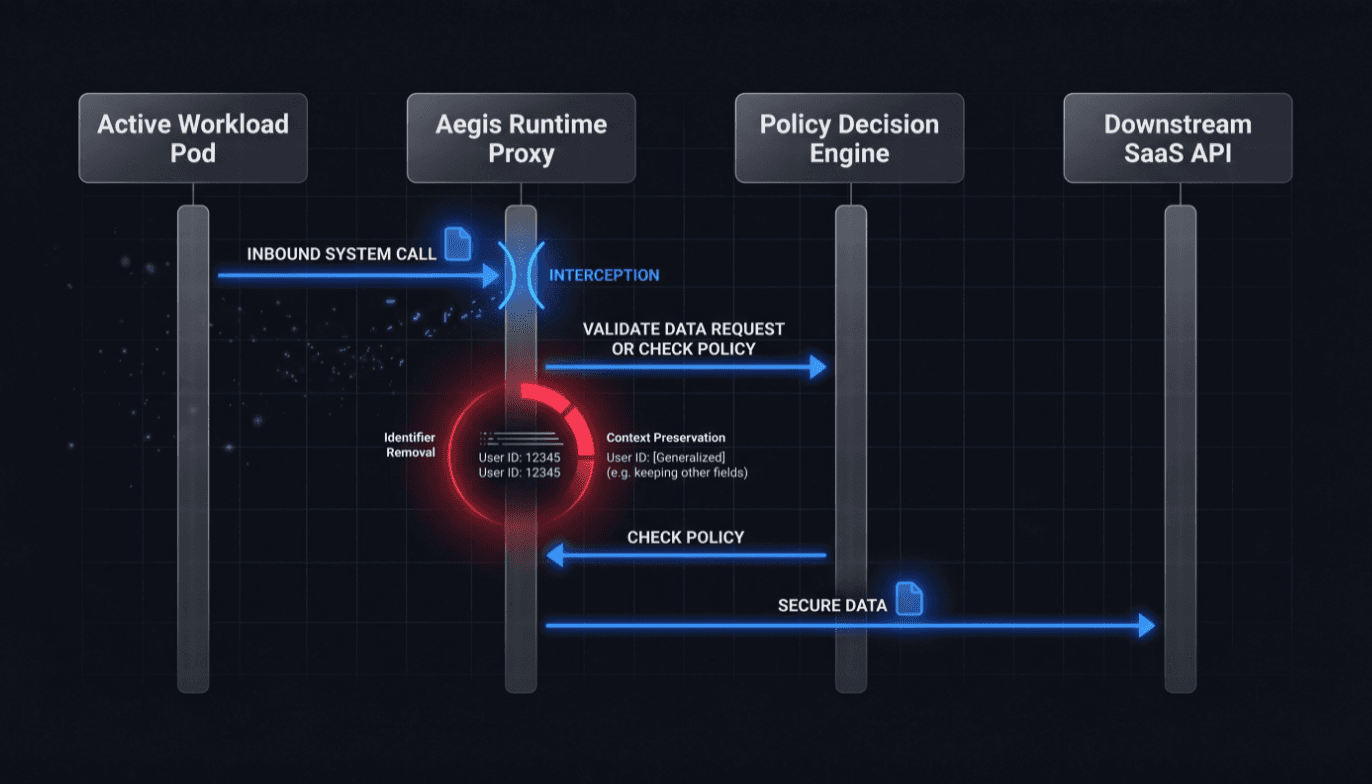
The core of technical risk mitigation relies on active, in-path Enforcement Layers that reside completely outside the model's sphere of influence. LLMs cannot be trusted to self-regulate; a well-crafted prompt injection or a context window manipulation can easily bypass system prompts or internal alignment guardrails.
Pillar III: Technical Controls
This pillar operationalizes real-time anomaly detection and graduated containment options via a decoupled architecture:
- Multi-Agent Verification: Deploying specialized monitoring agents that continuously track the interaction patterns of operational agents, checking for lateral movement, loop exceptions, or unexpected data-blending across security domains.
- Shadow Mode baselining: Running new policy configurations in a non-blocking "dry-run" state. The gateway checks real-time tool calls against Open Policy Agent (OPA) bundles and logs violations without dropping traffic, allowing platform teams to fine-tune boundaries without disrupting live production workflows.
- The Enterprise Kill Switch: Implementing deterministic infrastructure circuit breakers capable of halting multiple interconnected workflows simultaneously. If an active agent encounters an exploit or shows severe behavioral drift, senior leadership can activate a tiered kill switch to immediately freeze specific tool APIs, rotate credentials, and quarantine containers without stopping adjacent enterprise applications.
6. Pillar IV: Transparency, Compliance, and the Agentic SOC
The structural latency found in traditional Security Operations Center (SOC) environments represents a severe vulnerability when defending against compromised machine identities. In a standard human-centric analyst environment, a security alert is ingested, aggregated, and dropped into a manual triage queue—introducing an inherent latency measured in hours.
When an autonomous agent can call tools, move data, and rewrite database states at machine speed, a human response chain is an operational failure. The only architecturally viable defense against an autonomous threat is the deployment of an Agentic SOC: an advanced operational model where AI monitoring agents continuously oversee, evaluate, and contain operational AI agents.
Continuous Compliance Evidence Collection
The final operational requirement is automated, immutable recordkeeping. Regulators and external compliance frameworks—including the EU AI Act, HIPAA, and PCI DSS—increasingly mandate that governance be demonstrable at runtime, not just documented on paper. The platform translates continuous behavioral metrics into an unchangeable repository of Evidence Events.
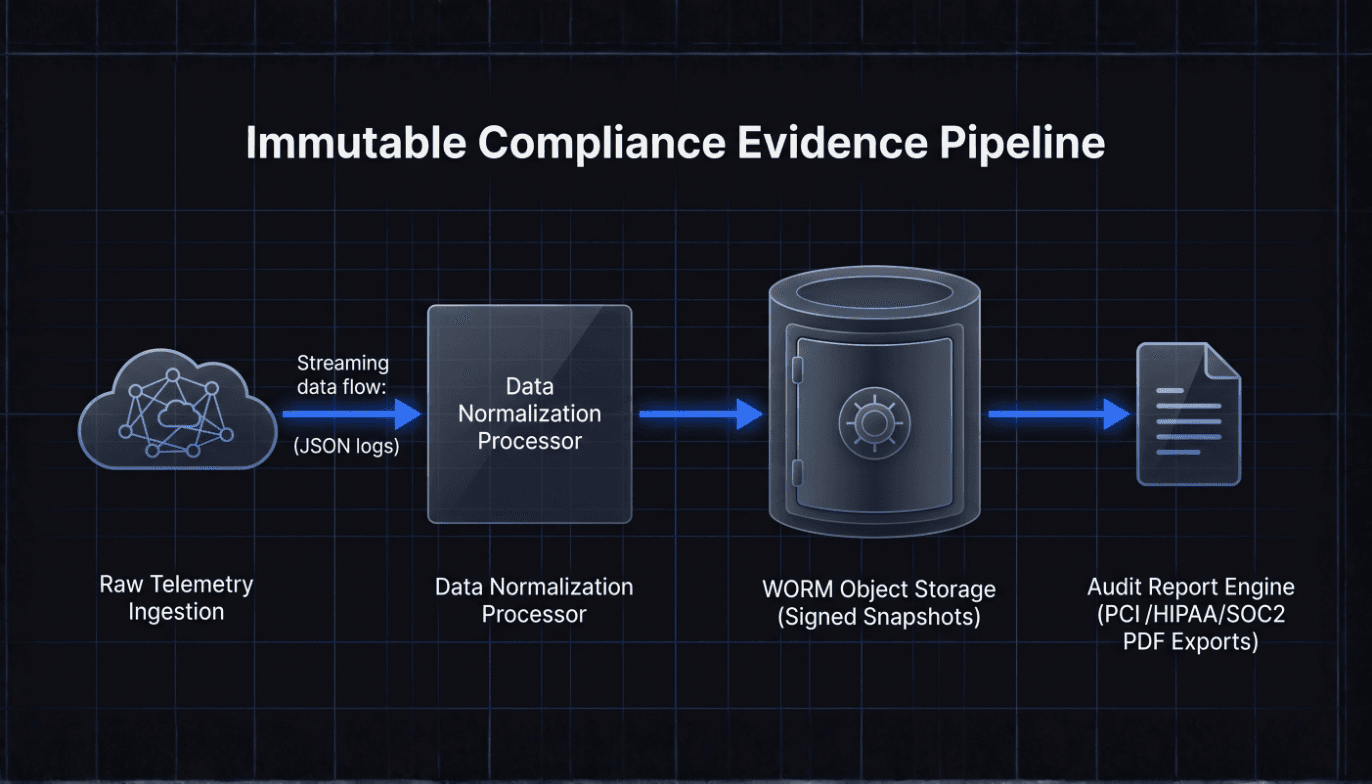
The platform bundles point-in-time configuration snapshots, Software Bills of Materials (SBOMs), and trace-linked policy decisions into cryptographically sealed files stored inside write-once-read-many (WORM) object storage. These files provide auditors with an undeniable history of system control, completely eliminating the overhead of manual compliance reporting.
7. Standards and Security Framework Alignment
The operational implementation of the 3As Framework maps directly across dominant national and international security control matrices to guarantee repeatable audit readiness.
The Enterprise Control Intersection
Governance Framework | Target Requirement | 3As Runtime Control Implementation |
NIST AI RMF 1.0 (GOVERN) | Establishing clear human tracing lines and absolute organizational accountability for AI behavior. | Continuous mapping of every operational agent runtime footprint to a named human owner within the core CMDB. |
OWASP Agentic AI Top 10 | Mitigating prompt manipulation, privileged tool abuse, and unauthorized parameter execution. | Implementing out-of-band payload filtering at the API gateway layer via deterministic OPA sidecar checks. |
CSA AI Controls Matrix (AICM) | Enforcing granular lifecycle monitoring and secure data domain separation across multi-cloud networks. | Utilizing short-lived token exchange protocols to provision ephemeral, task-scoped credentials via identity vaults. |
EU AI Act & Global Frameworks | Demonstrable post-deployment monitoring, system logging, and active human-on-the-loop oversight. | Generating cryptographically signed snapshot evidence files stored inside immutable object lockers for real-time auditability. |
Conclusion: Scale Follows Control
A common misconception among technology platform teams is that implementing rigorous security controls inevitably slows down development and hampers innovation velocity. In the landscape of autonomous Agentic AI, the absolute opposite is true: control enables scale. Without a decoupled runtime enforcement layer, corporate risk management and security compliance teams will eventually block autonomous projects entirely out of justifiable concerns regarding an unmanaged blast radius.
By building a continuous, trace-native data fabric, enforcing strict cryptographic workload identities at the tool edge, and implementing automated Agentic SOC containment runbooks, organizations can safely scale the benefits of an automated workforce. The future of enterprise AI does not belong to the organizations with the most sophisticated standalone models; it belongs to the ones capable of governing autonomous execution at production scale. Secure the execution path, and the innovation will scale safely.
Frequently Asked Questions (FAQ)
Q1: Why are conversational guardrails insufficient for protecting agentic AI workflows?
A: Conversational guardrails focus on language filtering (prompt text sanitization and output moderation). They are soft controls that operate inside the probabilistic environment of the LLM and can be systematically bypassed via prompt injection or context manipulation. Enterprise protection requires hard controls—Runtime Enforcement—that reside completely outside the model's environment to block unauthorized tool parameter calls regardless of model intent.
Q2: How does an external runtime gateway impact core system latency?
A: Utilizing a high-performance proxy network (such as Envoy) configured with local Open Policy Agent (OPA) sidecars results in an infrastructure latency tax that is typically sub-millisecond. Given that typical enterprise LLM inference turnarounds incur wait times ranging from 500 milliseconds to 2 seconds, this sub-millisecond gateway overhead is mathematically negligible and represents a mandatory trade-off for operational safety.
Q3: Can we use standard cloud IAM roles instead of a dedicated policy-as-code engine?
A: Standard cloud IAM roles are too coarse-grained to govern stochastic agent behaviors. While a basic IAM policy can control whether an agent account can call a target endpoint, a Policy-as-Code engine (like OPA) inspects the deep runtime payload of the call, enforcing granular rules such as: "Allow this agent to update database fields, but only if the transaction value is under $5,000 and the target row matches Tier-1 client classification".
Q4: What is the primary role of OpenTelemetry within an AI risk framework?
A: OpenTelemetry serves as the definitive "flight recorder" for your autonomous software fleet. Instead of generating basic, isolated system text logs, it logs an end-to-end, trace-linked record tracking exactly why a tool was called, what contextual data preceded it, which policy engine filters fired, and how costs or retries accumulated along that specific path. This data layer is vital for root-cause analysis and compliance validation.
Q5: What is the technical value of running policies in "Shadow Mode"?
A: Shadow mode enables platform security teams to evaluate the performance of new Policy-as-Code definitions in a live "dry-run" state. The runtime gateway monitors active agent workflows, checks the payloads against the active OPA configurations, and logs whether an action would have been blocked without actually dropping the network packet—helping engineers fine-tune rules without breaking critical production systems.